A French Word to Live By
How to Conjugate Élever in French
/el.ve/
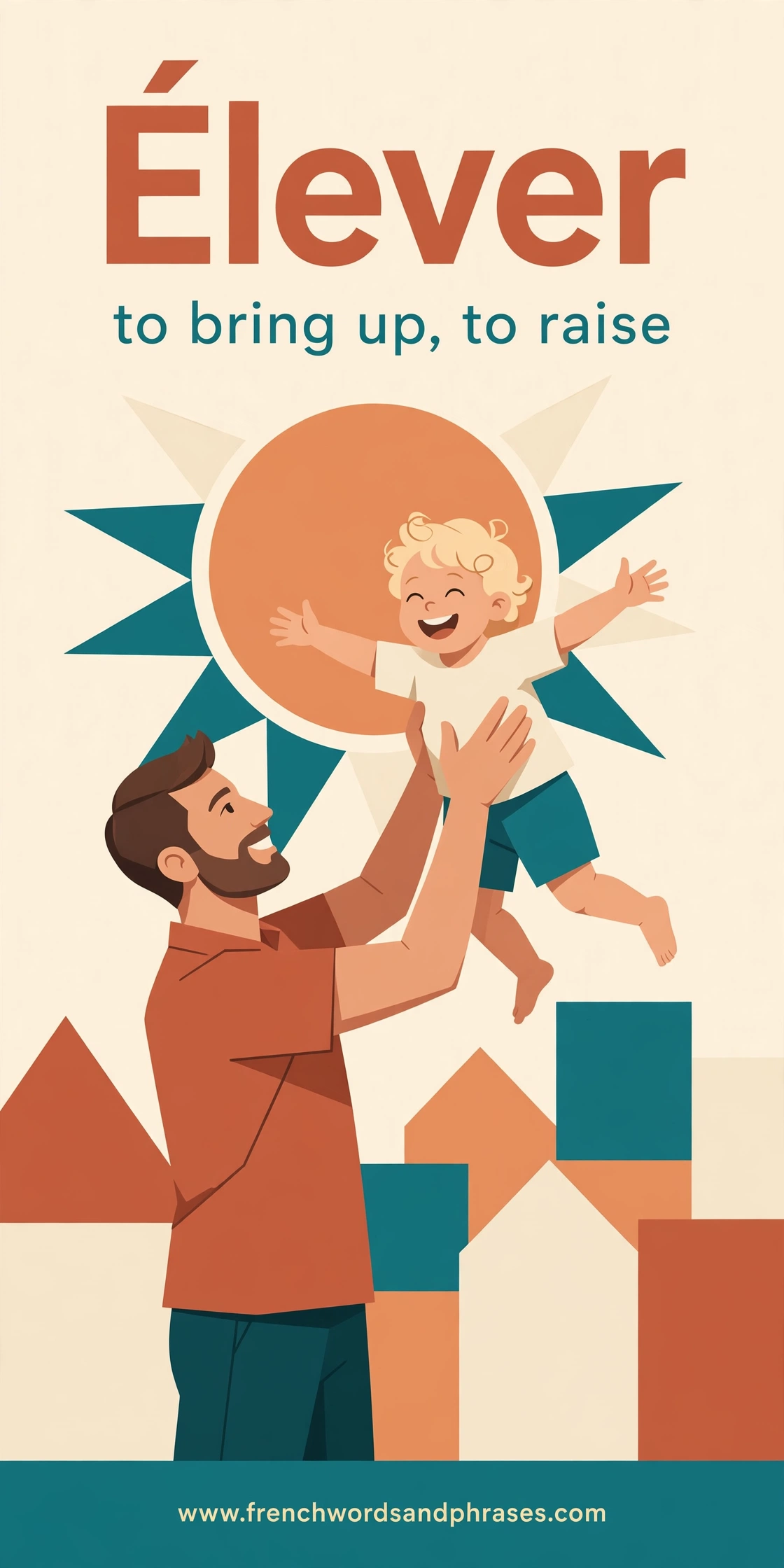
Élever means to bring up, to raise — to rear children and animals, and to lift anything from a voice to a wall toward the sky.
A mother raising three children on a farm, a shepherd raising lambs in the hills, a mason raising a wall stone by stone — élever is the verb of patient upward work: whatever grows, climbs or is lifted under someone’s care, on l’élève.
In this guide, you’ll learn how to conjugate élever in all the major French tenses and moods. Explore complete conjugation tables, French examples, English translations, and practice quizzes.
Understanding the French Verb Élever
Élever is a regular French verb belonging to the first group of verbs, those ending in-er.
It means to bring up, to raise. It is the standard verb for bringing up children — être élevé par ses grands-parents, to be brought up by one’s grandparents — and for rearing livestock, from poulets to chevaux. Beyond the farmyard it raises voices, walls, prices in older usage and people to rank: élever quelqu’un au rang de, to raise someone to the rank of. Its participle gives the everyday compliment bien élevé, well brought up, and its opposite, mal élevé.
Verb classification: First group (-er)
Auxiliary verb: Avoir
Past participle: élevé
Present participle: élevant
English equivalents: To bring up, to raise, to rear; élever des enfants — to bring up children; élever des poulets — to raise chickens; élever la voix — to raise one’s voice; élever un mur — to raise a wall; bien élevé — well brought up.
One important detail: élever changes its accent with its rhythm. Wherever the next syllable is mute, the é of the stem opens to è: j’élève, tu élèves, il élève, ils élèvent, and all through the future and conditional: j’élèverai, j’élèverais. Wherever the ending is sounded, the é stays: nous élevons, vous élevez, j’élevais, en élevant, and in the infinitive and participle themselves: élever, élevé. The subjunctive splits along the same line: que j’élève, but que nous élevions. One verb, three great territories: children (élever des enfants), animals (élever des chèvres) and anything lifted (élever la voix, élever un mur).
Experience the Word
Élever is the verb of slow raising — years of feeding, teaching and lifting, all pointed upward.
Imagine a widow on a small farm a century ago. Five children, a dozen hens, three goats — everything in the yard is being élevé by the same pair of hands. The children learn their letters at her table, the hens learn her step, and by harvest the whole farm stands taller than she found it.
She has built nothing in a day. She has raised — élevé — a family and a farm, one season at a time.
How to Conjugate Élever: Complete French Conjugation Guide
Let’s explore every major conjugation of élever, beginning with the indicative mood.
How to Conjugate Élever in the Indicative Mood
The indicative mood is used to express facts, observations, actions, and events.
How to Conjugate Élever in the Present Tense (Présent)
Used for actions happening now, habitual actions, and general truths.
| Subject | Conjugation |
|---|---|
| je | élève |
| tu | élèves |
| il / elle | élève |
| nous | élevons |
| vous | élevez |
| ils / elles | élèvent |
Example
Elle élève seule ses trois enfants.
She is bringing up her three children on her own.
Quick Quiz 1
Complete the sentence:
Nous ______ des abeilles au fond du jardin.
Reveal the answer
élevons
Nous élevons des abeilles au fond du jardin.
We keep bees at the bottom of the garden.
How to Conjugate Élever in the Passé Composé
Used for completed actions in the past. Élever takes the auxiliary verb avoir.
| Subject | Conjugation |
|---|---|
| j’ | ai élevé |
| tu | as élevé |
| il / elle | a élevé |
| nous | avons élevé |
| vous | avez élevé |
| ils / elles | ont élevé |
Example
Mes grands-parents ont élevé huit enfants à la ferme.
My grandparents brought up eight children on the farm.
How to Conjugate Élever in the Imparfait (Imperfect Tense)
Used for habitual past actions, descriptions, and ongoing situations in the past.
| Subject | Conjugation |
|---|---|
| je | élevais |
| tu | élevais |
| il / elle | élevait |
| nous | élevions |
| vous | éleviez |
| ils / elles | élevaient |
Example
Autrefois, on élevait des poulets dans chaque cour.
In the old days, people used to raise chickens in every yard.
Quick Quiz 2
Choose the correct form:
She brought up her children alone.
Elle ______ ses enfants seule. (a élevé / est élevée)
Reveal the answer
a élevé
Elle a élevé ses enfants seule.
Élever takes avoir; est élevée would be the reflexive se élever.
How to Conjugate Élever in the Plus-que-parfait
Used to describe an action that had already been completed before another past event.
| Subject | Conjugation |
|---|---|
| j’ | avais élevé |
| tu | avais élevé |
| il / elle | avait élevé |
| nous | avions élevé |
| vous | aviez élevé |
| ils / elles | avaient élevé |
Example
Il avait élevé ses neveux comme ses propres fils.
He had brought up his nephews like his own sons.
How to Conjugate Élever in the Passé Simple
Primarily used in formal writing, literature, and historical narratives. It is rarely used in everyday conversation.
| Subject | Conjugation |
|---|---|
| je | élevai |
| tu | élevas |
| il / elle | éleva |
| nous | élevâmes |
| vous | élevâtes |
| ils / elles | élevèrent |
Example
La veuve éleva ses enfants avec un courage admirable.
The widow brought up her children with admirable courage.
How to Conjugate Élever in the Passé Antérieur
A literary tense used to express an action completed immediately before another past action, generally in the passé simple.
| Subject | Conjugation |
|---|---|
| j’ | eus élevé |
| tu | eus élevé |
| il / elle | eut élevé |
| nous | eûmes élevé |
| vous | eûtes élevé |
| ils / elles | eurent élevé |
Example
Quand elle eut élevé ses cinq enfants, elle reprit ses études.
When she had brought up her five children, she took up her studies again.
How to Conjugate Élever in the Future Tense (Futur Simple)
Used to describe actions that will take place in the future.
| Subject | Conjugation |
|---|---|
| je | élèverai |
| tu | élèveras |
| il / elle | élèvera |
| nous | élèverons |
| vous | élèverez |
| ils / elles | élèveront |
Example
J’élèverai mes enfants à la campagne.
I will bring up my children in the countryside.
How to Conjugate Élever in the Futur Antérieur (Future Perfect)
Used for an action that will have been completed before a particular point in the future.
| Subject | Conjugation |
|---|---|
| j’ | aurai élevé |
| tu | auras élevé |
| il / elle | aura élevé |
| nous | aurons élevé |
| vous | aurez élevé |
| ils / elles | auront élevé |
Example
À vingt ans, elle aura élevé trois enfants et deux neveux.
By the age of twenty, she will have brought up three children and two nephews.
How to Conjugate Élever in the Near Future (Futur Proche)
Used to describe something that is going to happen soon. Formed with aller + infinitive.
| Subject | Conjugation |
|---|---|
| je | vais élever |
| tu | vas élever |
| il / elle | va élever |
| nous | allons élever |
| vous | allez élever |
| ils / elles | vont élever |
Example
Nous allons élever des abeilles au fond du jardin.
We are going to keep bees at the bottom of the garden.
How to Conjugate Élever in the Conditional Mood
The conditional mood expresses what would happen under certain circumstances. It is also frequently used to make polite requests or express wishes.
How to Conjugate Élever in the Present Conditional
| Subject | Conjugation |
|---|---|
| je | élèverais |
| tu | élèverais |
| il / elle | élèverait |
| nous | élèverions |
| vous | élèveriez |
| ils / elles | élèveraient |
Example
J’élèverais la voix si l’on m’interrompait encore.
I would raise my voice if I were interrupted again.
How to Conjugate Élever in the Past Conditional
| Subject | Conjugation |
|---|---|
| j’ | aurais élevé |
| tu | aurais élevé |
| il / elle | aurait élevé |
| nous | aurions élevé |
| vous | auriez élevé |
| ils / elles | auraient élevé |
Example
Elle aurait élevé des chevaux si elle avait eu des terres.
She would have raised horses if she had had land.
Élever in the Literary Past Conditional Form
This less common literary form uses the imperfect subjunctive of avoir.
| Subject | Conjugation |
|---|---|
| j’ | eusse élevé |
| tu | eusses élevé |
| il / elle | eût élevé |
| nous | eussions élevé |
| vous | eussiez élevé |
| ils / elles | eussent élevé |
Example
Il eût élevé ses fils dans la crainte de Dieu, selon l’usage du temps.
He would have brought up his sons in the fear of God, as was the custom of the time.
How to Conjugate Élever in the Subjunctive Mood
The subjunctive is used to express wishes, emotions, doubts, necessity, and uncertainty. It frequently follows expressions such as il faut que (it is necessary that) or bien que (although).
How to Conjugate Élever in the Present Subjunctive
| Subject | Conjugation |
|---|---|
| que je | élève |
| que tu | élèves |
| qu’il / qu’elle | élève |
| que nous | élevions |
| que vous | éleviez |
| qu’ils / qu’elles | élèvent |
Example
Il faut que tu élèves les enfants avec patience.
You must bring up the children with patience.
Quick Quiz 3
Complete the sentence using the subjunctive:
Il faut que vous ______ les enfants avec patience.
Reveal the answer
éleviez
Il faut que vous éleviez les enfants avec patience.
You must bring up the children with patience.
How to Conjugate Élever in the Imperfect Subjunctive
A literary tense, rarely encountered in modern spoken French.
| Subject | Conjugation |
|---|---|
| que je | élevasse |
| que tu | élevasses |
| qu’il / qu’elle | élevât |
| que nous | élevassions |
| que vous | élevassiez |
| qu’ils / qu’elles | élevassent |
Example
On souhaitait qu’elle élevât ses enfants loin de la ville.
People hoped she would bring up her children far from the city.
How to Conjugate Élever in the Pluperfect Subjunctive
A literary construction used to express an action completed before another past action.
| Subject | Conjugation |
|---|---|
| que j’ | eusse élevé |
| que tu | eusses élevé |
| qu’il / qu’elle | eût élevé |
| que nous | eussions élevé |
| que vous | eussiez élevé |
| qu’ils / qu’elles | eussent élevé |
Example
On disait qu’il eût élevé une famille nombreuse avec presque rien.
People said he had brought up a large family with almost nothing.
How to Conjugate Élever in the Past Subjunctive
| Subject | Conjugation |
|---|---|
| que j’ | aie élevé |
| que tu | aies élevé |
| qu’il / qu’elle | ait élevé |
| que nous | ayons élevé |
| que vous | ayez élevé |
| qu’ils / qu’elles | aient élevé |
Example
Je suis fier qu’elle ait élevé ses enfants si bien.
I am proud that she brought up her children so well.
How to Conjugate Élever in the Imperative
The imperative is used to give commands, instructions, invitations, or suggestions. Subject pronouns are omitted.
How to Conjugate Élever in the Present Imperative
| Person | Conjugation |
|---|---|
| (tu) | élève |
| (nous) | élevons |
| (vous) | élevez |
Example
Élève la voix, on ne t’entend pas au fond !
Raise your voice, they cannot hear you at the back!
Quick Quiz 4
How would you say Raise your voice (tu form)?
Reveal the answer
Élève la voix !
French Participles of Élever
Participles are verb forms that can be used in compound tenses and other grammatical constructions.
Present Participle of Élever
élevant
En élevant des chèvres, il a appris la patience.
By raising goats, he learned patience.
Past Participle of Élever
élevé
Élevés à la ferme, les enfants savaient tout faire.
Brought up on the farm, the children knew how to do everything.
Élever in Everyday French: Real-Life Examples
Now that you know the conjugations, let’s see how élever appears in everyday French.
Example 1 — Present
Elle élève seule ses trois enfants.
She is bringing up her three children on her own.
Example 2 — Passé composé
Ils ont élevé huit enfants à la ferme.
They brought up eight children on the farm.
Example 3 — Imparfait
On élevait des poulets dans chaque cour.
People used to raise chickens in every yard.
Example 4 — Future
J’élèverai mes enfants à la campagne.
I will bring up my children in the countryside.
Example 5 — Conditional
Elle élèverait des chevaux avec plus de terres.
She would raise horses with more land.
Example 6 — Imperative
Élève la voix, on ne t’entend pas !
Raise your voice, they cannot hear you!
Beyond Translation: The Meaning of Élever
English splits this verb’s world in three — bring up for children, rear or raise for animals, raise for walls and voices — but French élever holds them all in one word, from the Latin elevare, to lift up.
Its deepest sense is care that lifts.
That is why its participle became the measure of manners: bien élevé is not just well raised but well lifted — a child carried upward by the adults around him, until he can stand at their height.
How to Remember the French Verb Élever
Remember it this way: Élever is about one pair of hands raising children, hens and goats — everything on the farm, upward.
- The accent breathes: j’élève with è before a mute syllable, nous élevons with é before a sounded one — and j’élèverai in the future.
- Three territories, one verb: élever des enfants, élever des poulets, élever la voix.
- Its participle judges manners: bien élevé, well brought up; mal élevé, badly brought up.
The key idea is one pair of hands raising children, hens and goats — everything on the farm, upward.
Test Your Knowledge of Élever
Let’s see how much you’ve learned. Try answering these questions before revealing the answers.
Question 1
Why does j’élève have a grave accent but nous élevons an acute one?
Reveal the answer
The stem opens before a mute syllable — é becomes è in j’élève and j’élèverai, and stays é where the ending is sounded: nous élevons.
Question 2
How do you say She is bringing up her three children on her own in French?
Reveal the answer
Elle élève seule ses trois enfants.
Question 3
Translate: My grandparents brought up eight children on the farm.
Reveal the answer
Mes grands-parents ont élevé huit enfants à la ferme.
Question 4
What is the past participle of élever?
Reveal the answer
Élevé — as in bien élevé, well brought up.
Question 5
Complete the sentence:
Il faut que tu ______ les enfants avec patience.
Reveal the answer
élèves
Il faut que tu élèves les enfants avec patience.
You must bring up the children with patience.
Your Final Challenge
Can You Use It?
How would you say this in French?
She brought up five children, two nephews and a whole village of birds, without ever raising her voice.
Reveal the answer
Elle a élevé cinq enfants, deux neveux et tout un village d’oiseaux, sans jamais élever la voix.
She brought up five children, two nephews and a whole village of birds, without ever raising her voice.
A little French. A little curiosity. A richer everyday life.
LEARN FRENCH ONE WORD AT A TIME