A French Word to Live By
How to Conjugate Électrolyser in French
/e.lɛk.tʁɔ.li.ze/
Électrolyser means to electrolyze — to split a substance apart by passing an electric current through it.
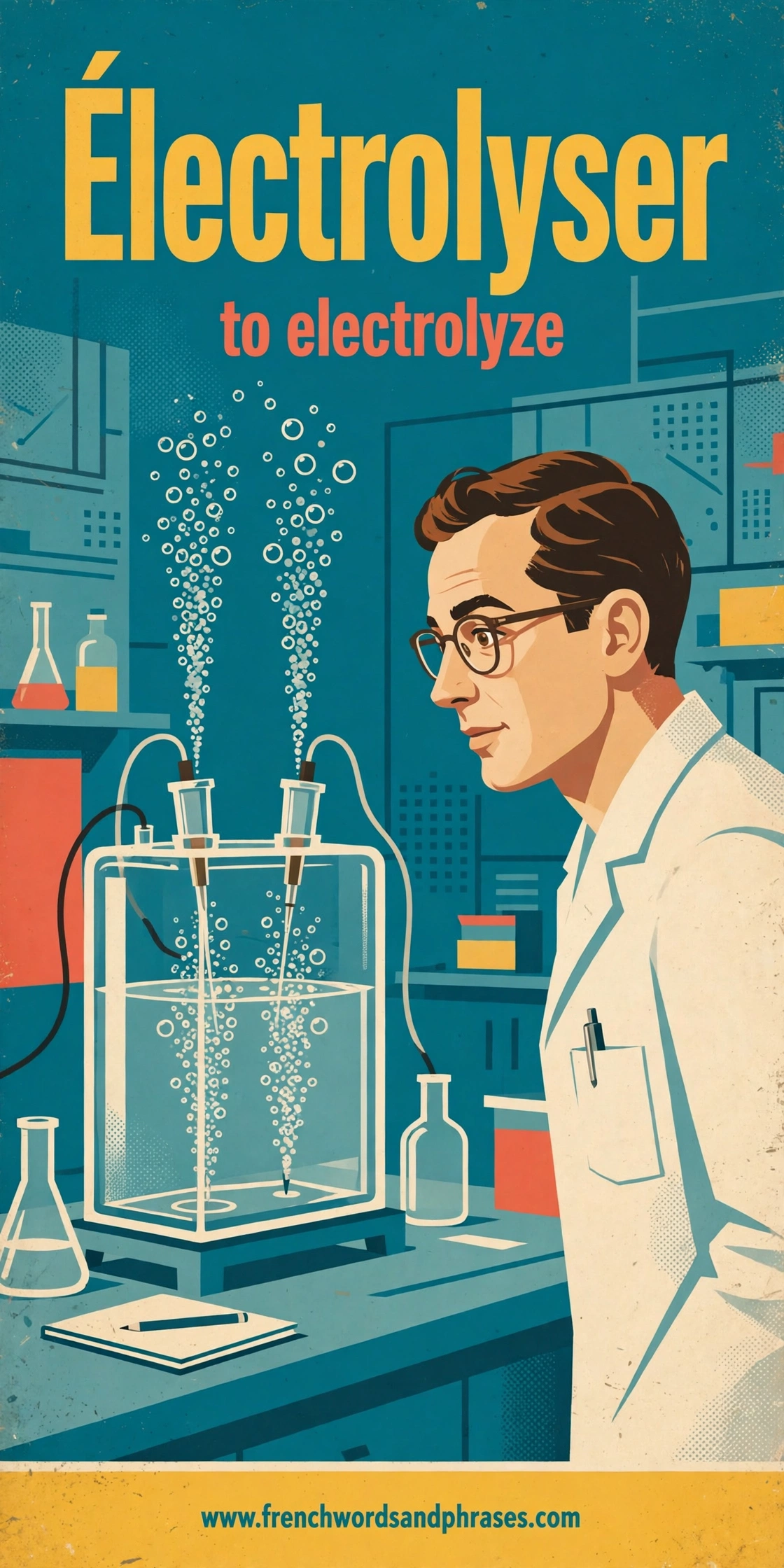
A school laboratory with two electrodes bubbling in a jar of water, a factory bath where metal coats metal — électrolyser is the chemist’s verb: electricity used as a pair of scissors, cutting compounds into their elements.
In this guide, you’ll learn how to conjugate électrolyser in all the major French tenses and moods. Explore complete conjugation tables, French examples, English translations, and practice quizzes.
Understanding the French Verb Électrolyser
Électrolyser is a regular French verb belonging to the first group of verbs, those ending in-er.
It means to electrolyze. It is commonly used in chemistry lessons — splitting water into hydrogen and oxygen is the classic school experiment — and in industry, for refining metals and for electroplating, where a current lays one metal over another. It belongs to the laboratory and the factory; nobody électrolyse anything in a kitchen.
Verb classification: First group (-er)
Auxiliary verb: Avoir
Past participle: électrolysé
Present participle: électrolysant
English equivalents: To electrolyze; électrolyser l’eau — to electrolyze water; électrolyser une solution — to electrolyze a solution; l’électrolyse de l’eau — the electrolysis of water; un bain électrolysé — an electrolyzed bath.
One important detail: électrolyser is a technical verb with a Greek heart — électro- plus -lyser, to loosen, the same root as in analyse. The spelling is fixed and the verb perfectly regular: j’électrolyse, nous électrolysons, ils électrolysent. Its natural partners are the substances of the laboratory and the factory: électrolyser l’eau, électrolyser une solution, électrolyser la saumure — and the noun l’électrolyse is the form you will meet most often outside the laboratory.
Experience the Word
Électrolyser is the verb of electricity as scissors — a current that unmakes what nature had joined.
Imagine a chemistry lesson. Two wires dip into a jar of water, the battery is connected, and slowly — bubble by bubble — the water gives up its secret: hydrogen at one pole, oxygen at the other. Le professeur électrolyse l’eau, and a substance everyone thought was one thing turns out to be two gases holding hands.
Nothing has been heated, hit or dissolved. The water has been electrolyzed — undone by a current, element by element.
How to Conjugate Électrolyser: Complete French Conjugation Guide
Let’s explore every major conjugation of électrolyser, beginning with the indicative mood.
How to Conjugate Électrolyser in the Indicative Mood
The indicative mood is used to express facts, observations, actions, and events.
How to Conjugate Électrolyser in the Present Tense (Présent)
Used for actions happening now, habitual actions, and general truths.
| Subject | Conjugation |
|---|---|
| je | électrolyse |
| tu | électrolyses |
| il / elle | électrolyse |
| nous | électrolysons |
| vous | électrolysez |
| ils / elles | électrolysent |
Example
En classe, nous électrolysons de l’eau pour obtenir de l’hydrogène.
In class, we electrolyze water to obtain hydrogen.
Quick Quiz 1
Complete the sentence:
Nous ______ la solution depuis une heure.
Reveal the answer
électrolysons
Nous électrolysons la solution depuis une heure.
We have been electrolyzing the solution for an hour.
How to Conjugate Électrolyser in the Passé Composé
Used for completed actions in the past. Électrolyser takes the auxiliary verb avoir.
| Subject | Conjugation |
|---|---|
| j’ | ai électrolysé |
| tu | as électrolysé |
| il / elle | a électrolysé |
| nous | avons électrolysé |
| vous | avez électrolysé |
| ils / elles | ont électrolysé |
Example
Le technicien a électrolysé la solution pendant une heure.
The technician electrolyzed the solution for an hour.
How to Conjugate Électrolyser in the Imparfait (Imperfect Tense)
Used for habitual past actions, descriptions, and ongoing situations in the past.
| Subject | Conjugation |
|---|---|
| je | électrolysais |
| tu | électrolysais |
| il / elle | électrolysait |
| nous | électrolysions |
| vous | électrolysiez |
| ils / elles | électrolysaient |
Example
Autrefois, on électrolysait la saumure pour fabriquer de la soude.
In the past, brine was electrolyzed to make soda.
Quick Quiz 2
Choose the correct form:
The chemist electrolyzed the water.
Le chimiste ______ l’eau. (a électrolysé / est électrolysé)
Reveal the answer
a électrolysé
Le chimiste a électrolysé l’eau.
Électrolyser takes avoir.
How to Conjugate Électrolyser in the Plus-que-parfait
Used to describe an action that had already been completed before another past event.
| Subject | Conjugation |
|---|---|
| j’ | avais électrolysé |
| tu | avais électrolysé |
| il / elle | avait électrolysé |
| nous | avions électrolysé |
| vous | aviez électrolysé |
| ils / elles | avaient électrolysé |
Example
Elle avait électrolysé l’échantillon avant l’analyse.
She had electrolyzed the sample before the analysis.
How to Conjugate Électrolyser in the Passé Simple
Primarily used in formal writing, literature, and historical narratives. It is rarely used in everyday conversation.
| Subject | Conjugation |
|---|---|
| je | électrolysai |
| tu | électrolysas |
| il / elle | électrolysa |
| nous | électrolysâmes |
| vous | électrolysâtes |
| ils / elles | électrolysèrent |
Example
Le chimiste électrolysa l’eau devant ses élèves ébahis.
The chemist electrolyzed the water in front of his astonished pupils.
How to Conjugate Électrolyser in the Passé Antérieur
A literary tense used to express an action completed immediately before another past action, generally in the passé simple.
| Subject | Conjugation |
|---|---|
| j’ | eus électrolysé |
| tu | eus électrolysé |
| il / elle | eut électrolysé |
| nous | eûmes électrolysé |
| vous | eûtes électrolysé |
| ils / elles | eurent électrolysé |
Example
Quand il eut électrolysé la solution, les bulles cessèrent.
When he had electrolyzed the solution, the bubbles stopped.
How to Conjugate Électrolyser in the Future Tense (Futur Simple)
Used to describe actions that will take place in the future.
| Subject | Conjugation |
|---|---|
| je | électrolyserai |
| tu | électrolyseras |
| il / elle | électrolysera |
| nous | électrolyserons |
| vous | électrolyserez |
| ils / elles | électrolyseront |
Example
Demain, vous électrolyserez ce bain de cuivre.
Tomorrow, you will electrolyze this copper bath.
How to Conjugate Électrolyser in the Futur Antérieur (Future Perfect)
Used for an action that will have been completed before a particular point in the future.
| Subject | Conjugation |
|---|---|
| j’ | aurai électrolysé |
| tu | auras électrolysé |
| il / elle | aura électrolysé |
| nous | aurons électrolysé |
| vous | aurez électrolysé |
| ils / elles | auront électrolysé |
Example
À la fin de l’expérience, nous aurons électrolysé deux litres d’eau.
By the end of the experiment, we will have electrolyzed two litres of water.
How to Conjugate Électrolyser in the Near Future (Futur Proche)
Used to describe something that is going to happen soon. Formed with aller + infinitive.
| Subject | Conjugation |
|---|---|
| je | vais électrolyser |
| tu | vas électrolyser |
| il / elle | va électrolyser |
| nous | allons électrolyser |
| vous | allez électrolyser |
| ils / elles | vont électrolyser |
Example
Le professeur va électrolyser de l’eau sous vos yeux.
The teacher is going to electrolyze water before your eyes.
How to Conjugate Électrolyser in the Conditional Mood
The conditional mood expresses what would happen under certain circumstances. It is also frequently used to make polite requests or express wishes.
How to Conjugate Électrolyser in the Present Conditional
| Subject | Conjugation |
|---|---|
| je | électrolyserais |
| tu | électrolyserais |
| il / elle | électrolyserait |
| nous | électrolyserions |
| vous | électrolyseriez |
| ils / elles | électrolyseraient |
Example
Avec un courant plus fort, on électrolyserait l’eau plus vite.
With a stronger current, the water would be electrolyzed faster.
How to Conjugate Électrolyser in the Past Conditional
| Subject | Conjugation |
|---|---|
| j’ | aurais électrolysé |
| tu | aurais électrolysé |
| il / elle | aurait électrolysé |
| nous | aurions électrolysé |
| vous | auriez électrolysé |
| ils / elles | auraient électrolysé |
Example
Ils auraient électrolysé le métal sans cette panne.
They would have electrolyzed the metal if it had not been for the breakdown.
Électrolyser in the Literary Past Conditional Form
This less common literary form uses the imperfect subjunctive of avoir.
| Subject | Conjugation |
|---|---|
| j’ | eusse électrolysé |
| tu | eusses électrolysé |
| il / elle | eût électrolysé |
| nous | eussions électrolysé |
| vous | eussiez électrolysé |
| ils / elles | eussent électrolysé |
Example
Le courant eût électrolysé la solution en quelques minutes.
The current would have electrolyzed the solution within a few minutes.
How to Conjugate Électrolyser in the Subjunctive Mood
The subjunctive is used to express wishes, emotions, doubts, necessity, and uncertainty. It frequently follows expressions such as il faut que (it is necessary that) or bien que (although).
How to Conjugate Électrolyser in the Present Subjunctive
| Subject | Conjugation |
|---|---|
| que je | électrolyse |
| que tu | électrolyses |
| qu’il / qu’elle | électrolyse |
| que nous | électrolysions |
| que vous | électrolysiez |
| qu’ils / qu’elles | électrolysent |
Example
Il faut que tu électrolyses l’eau lentement.
You must electrolyze the water slowly.
Quick Quiz 3
Complete the sentence using the subjunctive:
Il faut que vous ______ le mélange vous-mêmes.
Reveal the answer
électrolysiez
Il faut que vous électrolysiez le mélange vous-mêmes.
You must electrolyze the mixture yourselves.
How to Conjugate Électrolyser in the Imperfect Subjunctive
A literary tense, rarely encountered in modern spoken French.
| Subject | Conjugation |
|---|---|
| que je | électrolysasse |
| que tu | électrolysasses |
| qu’il / qu’elle | électrolysât |
| que nous | électrolysassions |
| que vous | électrolysassiez |
| qu’ils / qu’elles | électrolysassent |
Example
Le professeur voulait que nous électrolysassions le mélange nous-mêmes.
The teacher wanted us to electrolyze the mixture ourselves.
How to Conjugate Électrolyser in the Pluperfect Subjunctive
A literary construction used to express an action completed before another past action.
| Subject | Conjugation |
|---|---|
| que j’ | eusse électrolysé |
| que tu | eusses électrolysé |
| qu’il / qu’elle | eût électrolysé |
| que nous | eussions électrolysé |
| que vous | eussiez électrolysé |
| qu’ils / qu’elles | eussent électrolysé |
Example
On expliquait que Faraday eût électrolysé ses solutions avec des piles rudimentaires.
It was explained that Faraday had electrolyzed his solutions with rudimentary batteries.
How to Conjugate Électrolyser in the Past Subjunctive
| Subject | Conjugation |
|---|---|
| que j’ | aie électrolysé |
| que tu | aies électrolysé |
| qu’il / qu’elle | ait électrolysé |
| que nous | ayons électrolysé |
| que vous | ayez électrolysé |
| qu’ils / qu’elles | aient électrolysé |
Example
Je suis content que l’élève ait électrolysé l’eau sans renverser le bac.
I am glad the pupil electrolyzed the water without knocking over the tank.
How to Conjugate Électrolyser in the Imperative
The imperative is used to give commands, instructions, invitations, or suggestions. Subject pronouns are omitted.
How to Conjugate Électrolyser in the Present Imperative
| Person | Conjugation |
|---|---|
| (tu) | électrolyse |
| (nous) | électrolysons |
| (vous) | électrolysez |
Example
Électrolysez la solution et notez les gaz dégagés !
Electrolyze the solution and note the gases given off!
Quick Quiz 4
How would you say Electrolyze the water (tu form)?
Reveal the answer
Électrolyse l’eau !
French Participles of Électrolyser
Participles are verb forms that can be used in compound tenses and other grammatical constructions.
Present Participle of Électrolyser
électrolysant
En électrolysant l’eau, on obtient de l’hydrogène et de l’oxygène.
By electrolyzing water, you obtain hydrogen and oxygen.
Past Participle of Électrolyser
électrolysé
Électrolysée pendant une heure, la solution a changé de couleur.
Electrolyzed for an hour, the solution changed colour.
Électrolyser in Everyday French: Real-Life Examples
Now that you know the conjugations, let’s see how électrolyser appears in everyday French.
Example 1 — Present
Nous électrolysons de l’eau en classe.
We electrolyze water in class.
Example 2 — Passé composé
Le technicien a électrolysé la solution.
The technician electrolyzed the solution.
Example 3 — Imparfait
On électrolysait la saumure autrefois.
Brine was electrolyzed in the old days.
Example 4 — Future
Vous électrolyserez ce bain de cuivre.
You will electrolyze this copper bath.
Example 5 — Conditional
On électrolyserait l’eau plus vite avec un courant plus fort.
The water would be electrolyzed faster with a stronger current.
Example 6 — Imperative
Électrolysez lentement et observez les bulles !
Electrolyze slowly and watch the bubbles!
Beyond Translation: The Meaning of Électrolyser
The word carries its inventor’s world inside it: Michael Faraday coined electrolysis in the 1830s, from the Greek lysis, a loosening — and French électrolyser is that same loosening turned into a verb.
It is the opposite of cooking.
Cooking joins flavours together; électrolyser takes a compound apart — water into gases, brine into soda and chlorine, an ore into pure metal — patiently, bubble by bubble, with nothing but a current for a tool.
How to Remember the French Verb Électrolyser
Remember it this way: Électrolyser is about two wires in a jar of water — bubbles rising, water coming undone.
- Electricity as scissors: électrolyser splits a substance into its elements — water into hydrogen and oxygen.
- Its home is the laboratory and the factory: électrolyser l’eau, une solution, la saumure.
- Regular -er: j’électrolyse, nous électrolysons, past participle électrolysé; the noun is l’électrolyse.
The key idea is two wires in a jar of water — bubbles rising, water coming undone.
Test Your Knowledge of Électrolyser
Let’s see how much you’ve learned. Try answering these questions before revealing the answers.
Question 1
What happens when you électrolyse water?
Reveal the answer
It splits into hydrogen and oxygen — the current unmakes the compound, element by element.
Question 2
How do you say In class, we electrolyze water in French?
Reveal the answer
En classe, nous électrolysons de l’eau.
Question 3
Translate: The technician electrolyzed the solution for an hour.
Reveal the answer
Le technicien a électrolysé la solution pendant une heure.
Question 4
What is the past participle of électrolyser?
Reveal the answer
Électrolysé.
Question 5
Complete the sentence:
Il faut que tu ______ l’eau lentement.
Reveal the answer
électrolyses
Il faut que tu électrolyses l’eau lentement.
You must electrolyze the water slowly.
Your Final Challenge
Can You Use It?
How would you say this in French?
Water is electrolyzed in silence, and two invisible gases tell what the world is made of.
Reveal the answer
On électrolyse l’eau en silence, et deux gaz invisibles racontent de quoi le monde est fait.
Water is electrolyzed in silence, and two invisible gases tell what the world is made of.
A little French. A little curiosity. A richer everyday life.
LEARN FRENCH ONE WORD AT A TIME