A French Word to Live By
How to Conjugate Égrapper in French
/e.ɡʁa.pe/
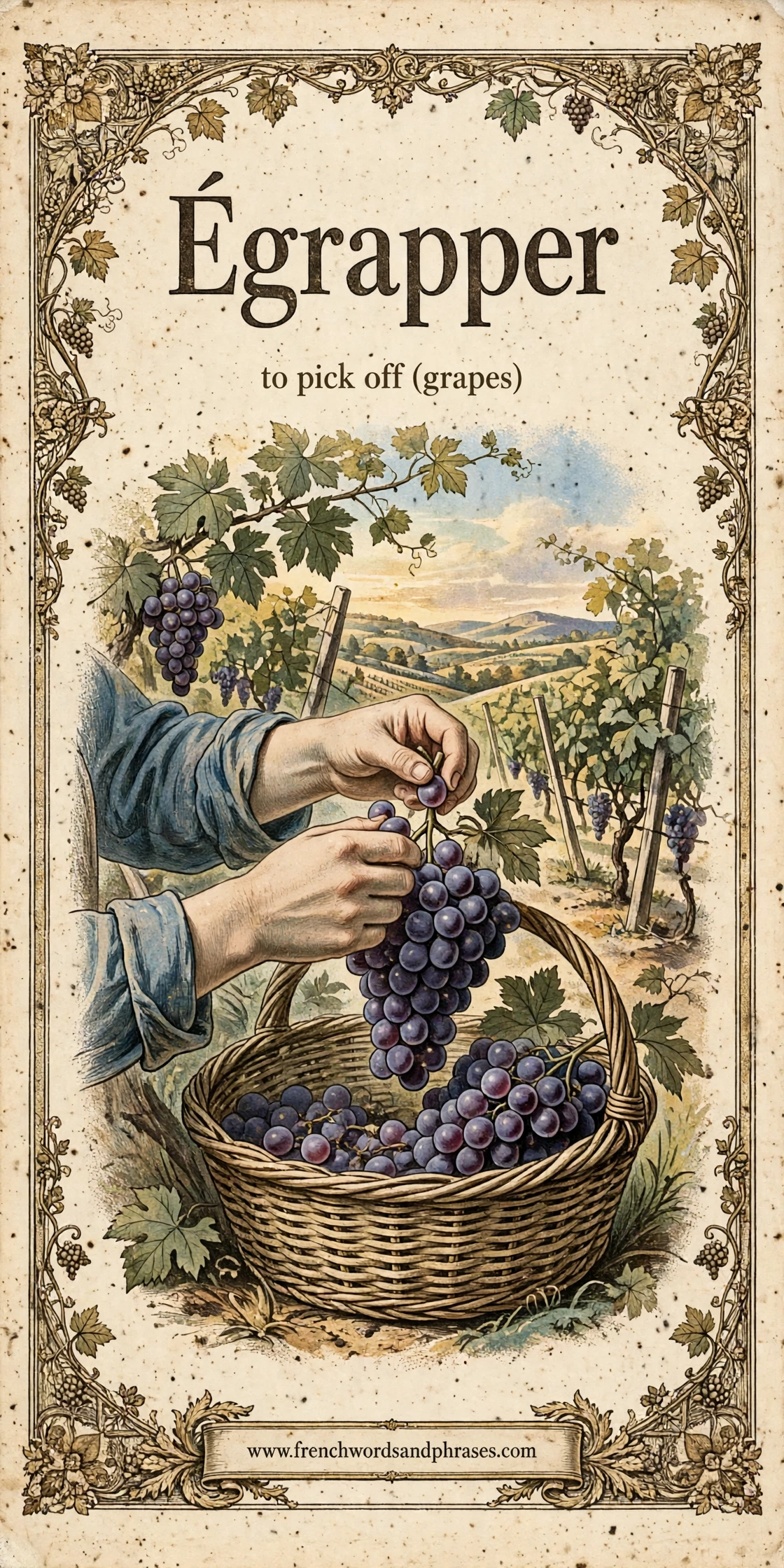
Égrapper means to pick off (grapes) — to strip the berries from their stalk, the first sorting of the harvest.
It is harvest time in a vineyard. Before the grapes can be pressed, the berries must come off the woody stalk that carried them all summer — and that separation, done by hand for centuries and by machine today, is égrapper: the verb of the vendange at its most patient.
In this guide, you’ll learn how to conjugate égrapper in all the major French tenses and moods. Explore complete conjugation tables, French examples, English translations, and practice quizzes.
Understanding the French Verb Égrapper
Égrapper is a regular French verb belonging to the first group of verbs, those ending in-er.
It means to pick off (grapes). It is used at the harvest and in the winery: bunches arriving from the vines are égrappées, the berries sorted, and only then crushed. Outside wine country the verb is rare, but at the vendange it is said a hundred times a day.
Verb classification: First group (-er)
Auxiliary verb: Avoir
Past participle: égrappé
Present participle: égrappant
English equivalents: To pick off the grapes, to destem; égrapper le raisin — to destem the grapes; l’égrappage — destemming; un égrappoir — a destemmer; la grappe — the bunch; la rafle — the grape stalk.
One important detail: égrapper belongs to the vineyard’s own vocabulary, and it is built on une grappe, a bunch of grapes. Its object is precise: you égrapper le raisin or les grappes, separating berry from rafle, the stalk — because stalks make wine bitter. Winemakers today also say érafler for the machine’s work; égrapper keeps the older, by-hand flavour of the harvest. The double p is constant: j’égrappe, nous égrappons, with two p’s in every form.
Experience the Word
Égrapper is the verb of the harvest table — bunches on one side, a growing mound of loose berries on the other, and the bare stalks thrown aside.
Imagine a small vineyard in September, before machines. The family sits around a long table in the shade, baskets of bunches in front of them, and the berries fall under their fingers — ploc, ploc, ploc — into the vat. On égrappe en chantant, the children steal the sweetest berries, and by evening the whole harvest stands stalk-free and ready for the press.
The bunches arrived whole from the vines. They leave the table picked clean — égrappés, berry by berry.
How to Conjugate Égrapper: Complete French Conjugation Guide
Let’s explore every major conjugation of égrapper, beginning with the indicative mood.
How to Conjugate Égrapper in the Indicative Mood
The indicative mood is used to express facts, observations, actions, and events.
How to Conjugate Égrapper in the Present Tense (Présent)
Used for actions happening now, habitual actions, and general truths.
| Subject | Conjugation |
|---|---|
| je | égrappe |
| tu | égrappes |
| il / elle | égrappe |
| nous | égrappons |
| vous | égrappez |
| ils / elles | égrappent |
Example
Les vendangeurs égrappent le raisin à la main.
The harvesters destem the grapes by hand.
Quick Quiz 1
Complete the sentence:
Nous ______ le raisin à la main.
Reveal the answer
égrappons
Nous égrappons le raisin à la main.
We destem the grapes by hand.
How to Conjugate Égrapper in the Passé Composé
Used for completed actions in the past. Égrapper takes the auxiliary verb avoir.
| Subject | Conjugation |
|---|---|
| j’ | ai égrappé |
| tu | as égrappé |
| il / elle | a égrappé |
| nous | avons égrappé |
| vous | avez égrappé |
| ils / elles | ont égrappé |
Example
Nous avons égrappé toute la récolte avant le soir.
We destemmed the whole harvest before evening.
How to Conjugate Égrapper in the Imparfait (Imperfect Tense)
Used for habitual past actions, descriptions, and ongoing situations in the past.
| Subject | Conjugation |
|---|---|
| je | égrappais |
| tu | égrappais |
| il / elle | égrappait |
| nous | égrappions |
| vous | égrappiez |
| ils / elles | égrappaient |
Example
Autrefois, on égrappait les grappes sur des claies en bois.
In the old days, people destemmed the bunches on wooden racks.
Quick Quiz 2
Choose the correct form:
We destemmed the whole harvest.
Nous ______ toute la récolte. (avons égrappé / sommes égrappés)
Reveal the answer
avons égrappé
Nous avons égrappé toute la récolte.
Égrapper takes avoir.
How to Conjugate Égrapper in the Plus-que-parfait
Used to describe an action that had already been completed before another past event.
| Subject | Conjugation |
|---|---|
| j’ | avais égrappé |
| tu | avais égrappé |
| il / elle | avait égrappé |
| nous | avions égrappé |
| vous | aviez égrappé |
| ils / elles | avaient égrappé |
Example
Il avait égrappé les plus belles grappes pour le vin doux.
He had destemmed the finest bunches for the sweet wine.
How to Conjugate Égrapper in the Passé Simple
Primarily used in formal writing, literature, and historical narratives. It is rarely used in everyday conversation.
| Subject | Conjugation |
|---|---|
| je | égrappai |
| tu | égrappas |
| il / elle | égrappa |
| nous | égrappâmes |
| vous | égrappâtes |
| ils / elles | égrappèrent |
Example
La famille égrappa le raisin sous la treille.
The family picked the grapes off their stalks under the vine arbour.
How to Conjugate Égrapper in the Passé Antérieur
A literary tense used to express an action completed immediately before another past action, generally in the passé simple.
| Subject | Conjugation |
|---|---|
| j’ | eus égrappé |
| tu | eus égrappé |
| il / elle | eut égrappé |
| nous | eûmes égrappé |
| vous | eûtes égrappé |
| ils / elles | eurent égrappé |
Example
Quand ils eurent égrappé la récolte, le pressoir se mit en route.
When they had destemmed the harvest, the press started up.
How to Conjugate Égrapper in the Future Tense (Futur Simple)
Used to describe actions that will take place in the future.
| Subject | Conjugation |
|---|---|
| je | égrapperai |
| tu | égrapperas |
| il / elle | égrappera |
| nous | égrapperons |
| vous | égrapperez |
| ils / elles | égrapperont |
Example
Cette année, la machine égrappera les raisins en une journée.
This year, the machine will destem the grapes in a single day.
How to Conjugate Égrapper in the Futur Antérieur (Future Perfect)
Used for an action that will have been completed before a particular point in the future.
| Subject | Conjugation |
|---|---|
| j’ | aurai égrappé |
| tu | auras égrappé |
| il / elle | aura égrappé |
| nous | aurons égrappé |
| vous | aurez égrappé |
| ils / elles | auront égrappé |
Example
À la tombée de la nuit, nous aurons égrappé toutes les vignes basses.
By nightfall, we will have destemmed all the low vines.
How to Conjugate Égrapper in the Near Future (Futur Proche)
Used to describe something that is going to happen soon. Formed with aller + infinitive.
| Subject | Conjugation |
|---|---|
| je | vais égrapper |
| tu | vas égrapper |
| il / elle | va égrapper |
| nous | allons égrapper |
| vous | allez égrapper |
| ils / elles | vont égrapper |
Example
Viens, on va égrapper les grappes ramassées ce matin.
Come, we are going to destem the bunches picked this morning.
How to Conjugate Égrapper in the Conditional Mood
The conditional mood expresses what would happen under certain circumstances. It is also frequently used to make polite requests or express wishes.
How to Conjugate Égrapper in the Present Conditional
| Subject | Conjugation |
|---|---|
| je | égrapperais |
| tu | égrapperais |
| il / elle | égrapperait |
| nous | égrapperions |
| vous | égrapperiez |
| ils / elles | égrapperaient |
Example
À la main, nous égrapperions plus doucement les baies fragiles.
By hand, we would destem the fragile berries more gently.
How to Conjugate Égrapper in the Past Conditional
| Subject | Conjugation |
|---|---|
| j’ | aurais égrappé |
| tu | aurais égrappé |
| il / elle | aurait égrappé |
| nous | aurions égrappé |
| vous | auriez égrappé |
| ils / elles | auraient égrappé |
Example
Elle aurait égrappé le raisin si la machine était tombée en panne.
She would have destemmed the grapes if the machine had broken down.
Égrapper in the Literary Past Conditional Form
This less common literary form uses the imperfect subjunctive of avoir.
| Subject | Conjugation |
|---|---|
| j’ | eusse égrappé |
| tu | eusses égrappé |
| il / elle | eût égrappé |
| nous | eussions égrappé |
| vous | eussiez égrappé |
| ils / elles | eussent égrappé |
Example
Il eût égrappé les grappes lui-même, comme son père.
He would have destemmed the bunches himself, like his father.
How to Conjugate Égrapper in the Subjunctive Mood
The subjunctive is used to express wishes, emotions, doubts, necessity, and uncertainty. It frequently follows expressions such as il faut que (it is necessary that) or bien que (although).
How to Conjugate Égrapper in the Present Subjunctive
| Subject | Conjugation |
|---|---|
| que je | égrappe |
| que tu | égrappes |
| qu’il / qu’elle | égrappe |
| que nous | égrappions |
| que vous | égrappiez |
| qu’ils / qu’elles | égrappent |
Example
Il faut que tu égrappes ce raisin avant demain.
You must destem these grapes before tomorrow.
Quick Quiz 3
Complete the sentence using the subjunctive:
Il faut que tu ______ ce raisin.
Reveal the answer
égrappes
Il faut que tu égrappes ce raisin.
You must destem these grapes.
How to Conjugate Égrapper in the Imperfect Subjunctive
A literary tense, rarely encountered in modern spoken French.
| Subject | Conjugation |
|---|---|
| que je | égrappasse |
| que tu | égrappasses |
| qu’il / qu’elle | égrappât |
| que nous | égrappassions |
| que vous | égrappassiez |
| qu’ils / qu’elles | égrappassent |
Example
Le vigneron voulait que l’on égrappât tout avant la pluie.
The winegrower wanted everything destemmed before the rain.
How to Conjugate Égrapper in the Pluperfect Subjunctive
A literary construction used to express an action completed before another past action.
| Subject | Conjugation |
|---|---|
| que j’ | eusse égrappé |
| que tu | eusses égrappé |
| qu’il / qu’elle | eût égrappé |
| que nous | eussions égrappé |
| que vous | eussiez égrappé |
| qu’ils / qu’elles | eussent égrappé |
Example
On racontait que son grand-père eût égrappé des tonnes de raisin.
They said his grandfather had destemmed tons of grapes.
How to Conjugate Égrapper in the Past Subjunctive
| Subject | Conjugation |
|---|---|
| que j’ | aie égrappé |
| que tu | aies égrappé |
| qu’il / qu’elle | ait égrappé |
| que nous | ayons égrappé |
| que vous | ayez égrappé |
| qu’ils / qu’elles | aient égrappé |
Example
Je suis content que vous ayez égrappé la récolte à temps.
I am glad you destemmed the harvest in time.
How to Conjugate Égrapper in the Imperative
The imperative is used to give commands, instructions, invitations, or suggestions. Subject pronouns are omitted.
How to Conjugate Égrapper in the Present Imperative
| Person | Conjugation |
|---|---|
| (tu) | égrappe |
| (nous) | égrappons |
| (vous) | égrappez |
Example
Égrappe ces grappes pendant que je prépare les cuves.
Destem these bunches while I prepare the vats.
Quick Quiz 4
How would you say Destem the grapes (tu form)?
Reveal the answer
Égrappe le raisin !
French Participles of Égrapper
Participles are verb forms that can be used in compound tenses and other grammatical constructions.
Present Participle of Égrapper
égrappant
En égrappant le raisin, elle triait les baies abîmées.
While destemming the grapes, she sorted out the damaged berries.
Past Participle of Égrapper
égrappé
Égrappé dès la récolte, le raisin donne un vin plus doux.
Destemmed straight at harvest, the grapes give a smoother wine.
Égrapper in Everyday French: Real-Life Examples
Now that you know the conjugations, let’s see how égrapper appears in everyday French.
Example 1 — Present
Les vendangeurs égrappent le raisin.
The harvesters destem the grapes.
Example 2 — Passé composé
Nous avons égrappé toute la récolte.
We destemmed the whole harvest.
Example 3 — Imparfait
On égrappait les grappes à la main.
People used to destem the bunches by hand.
Example 4 — Future
La machine égrappera les raisins demain.
The machine will destem the grapes tomorrow.
Example 5 — Conditional
À la main, nous égrapperions plus doucement.
By hand, we would destem more gently.
Example 6 — Imperative
Égrappez les grappes, vite !
Destem the bunches, quickly!
Beyond Translation: The Meaning of Égrapper
The verb is a portrait of its parent word: une grappe is a bunch, a cluster — of grapes, but also of people in a doorway (en grappe) and of fruit on a stem.
Égrapper is the bunch undone.
It exists because the stalk, the rafle, is the enemy of fine wine: left in the press it gives bitterness and green flavours. So the harvest’s first act of quality is an act of separation — berry kept, stalk discarded, sweetness saved.
How to Remember the French Verb Égrapper
Remember it this way: Égrapper is about the harvest table — bunches in, loose berries out, stalks aside.
- Built on une grappe, a bunch: égrapper undoes the bunch, berry by berry.
- Its object is grapes and its reason is wine — stalks out, or the wine turns bitter.
- Regular -er with a double p everywhere: j’égrappe, nous égrappons, past participle égrappé.
The key idea is the harvest table — bunches in, loose berries out, stalks aside.
Test Your Knowledge of Égrapper
Let’s see how much you’ve learned. Try answering these questions before revealing the answers.
Question 1
Which auxiliary does égrapper use?
Reveal the answer
Avoir — nous avons égrappé toute la récolte.
Question 2
How do you say The harvesters destem the grapes in French?
Reveal the answer
Les vendangeurs égrappent le raisin.
Question 3
Translate: We destemmed the whole harvest.
Reveal the answer
Nous avons égrappé toute la récolte.
Question 4
What is the past participle of égrapper?
Reveal the answer
Égrappé.
Question 5
Complete the sentence:
Il faut que tu ______ ce raisin avant demain.
Reveal the answer
égrappes
Il faut que tu égrappes ce raisin avant demain.
You must destem these grapes before tomorrow.
Your Final Challenge
Can You Use It?
How would you say this in French?
He destems the last bunch at dusk, and the harvest is done.
Reveal the answer
Il égrappe la dernière grappe à la tombée du jour, et la vendange est finie.
He destems the last bunch at dusk, and the harvest is done.
A little French. A little curiosity. A richer everyday life.
LEARN FRENCH ONE WORD AT A TIME