A French Word to Live By
How to Conjugate Effeuiller in French
/e.fœ.je/
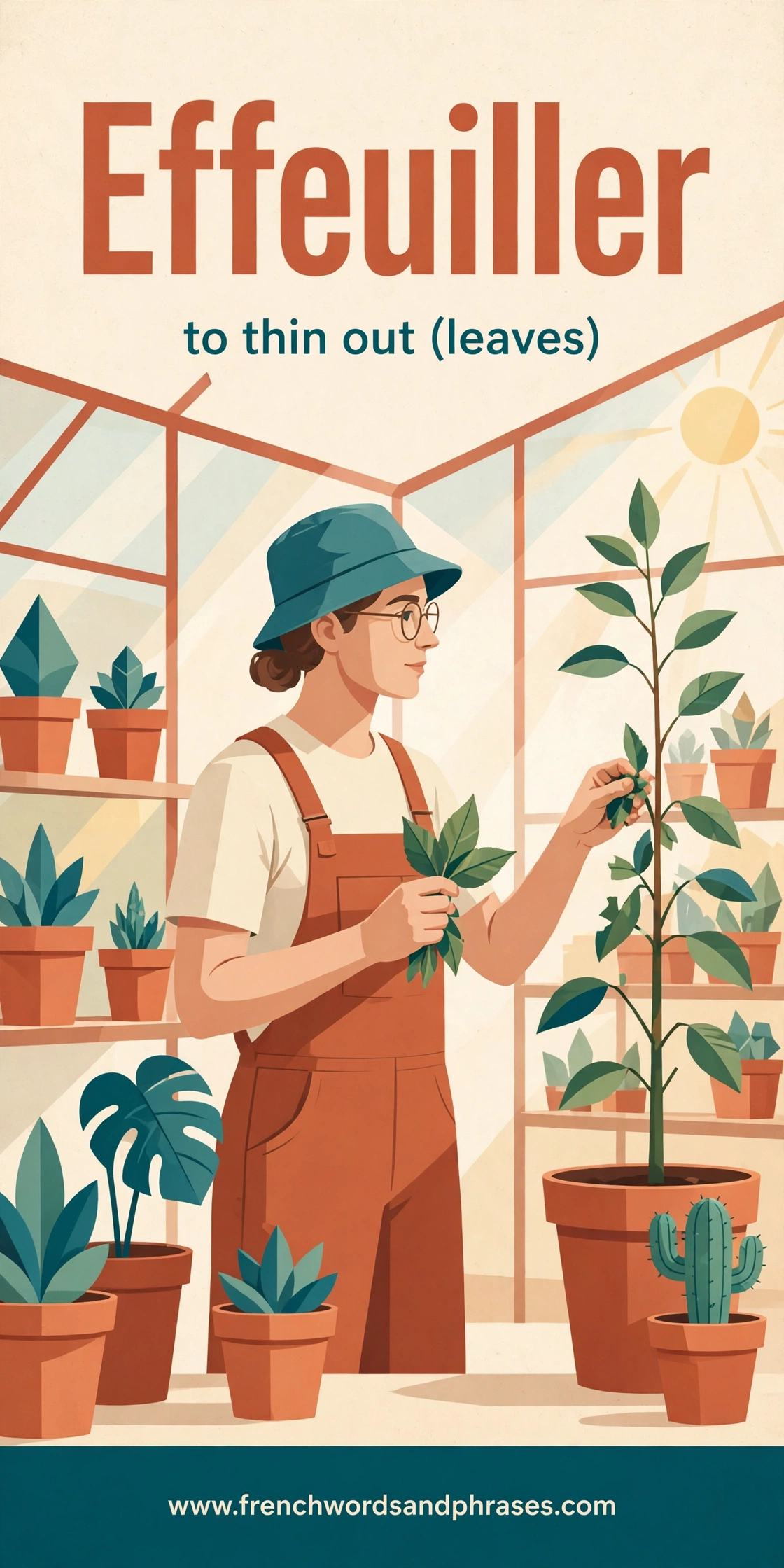
Effeuiller means to thin out the leaves — to strip a plant of part of its foliage so the fruit beneath can breathe and ripen.
A vine-grower walking his rows in June, tearing away the leaves that shade the young grapes; a gardener opening a tomato plant to the sun — effeuiller is the deliberate thinning of foliage, leaf by leaf, for the good of what hides underneath.
In this guide, you’ll learn how to conjugate effeuiller in all the major French tenses and moods. Explore complete conjugation tables, French examples, English translations, and practice quizzes.
Understanding the French Verb Effeuiller
Effeuiller is a regular French verb belonging to the first group of verbs, those ending in-er.
It means to thin out (leaves). It is commonly used in viticulture and gardening: effeuiller la vigne in early summer is a standard, skilled job in French vineyards, done by hand row by row, and gardeners effeuillent roses and tomatoes for the same reason — fewer leaves, healthier fruit.
Verb classification: First group (-er)
Auxiliary verb: Avoir
Past participle: effeuillé
Present participle: effeuillant
English equivalents: To thin out the leaves of, to defoliate (by hand); effeuiller la vigne — to thin out the vine’s leaves; effeuiller un rosier — to strip some leaves from a rose bush; effeuiller les tomates — to thin out the tomato plants; l’effeuillage — leaf thinning, leaf removal.
One important detail: effeuiller is an ordinary -er verb with the -ill- of feuille (a leaf) running through every form: j’effeuille, nous effeuillons, ils effeuillent. It is a grower’s word, not a destroyer’s — you effeuille a vine or a rose to let light and air reach the fruit or the flowers, removing only the leaves that smother them. Strip a plant bare and French would rather say défeuiller or défolier; effeuiller is the measured, careful version.
Experience the Word
Effeuiller is the verb of the gardener’s judgement — knowing which leaves feed the plant and which ones smother the fruit.
Imagine a Bordeaux vineyard at the end of June. Before sunrise the workers are already in the rows, hands moving fast: a tug, a tear, and the shaded bunches appear, green and hard, blinking in the new light — ils effeuillent.
Nothing is cut away for cruelty. The leaves are thinned — effeuillées — so the grapes can ripen.
How to Conjugate Effeuiller: Complete French Conjugation Guide
Let’s explore every major conjugation of effeuiller, beginning with the indicative mood.
How to Conjugate Effeuiller in the Indicative Mood
The indicative mood is used to express facts, observations, actions, and events.
How to Conjugate Effeuiller in the Present Tense (Présent)
Used for actions happening now, habitual actions, and general truths.
| Subject | Conjugation |
|---|---|
| je | effeuille |
| tu | effeuilles |
| il / elle | effeuille |
| nous | effeuillons |
| vous | effeuillez |
| ils / elles | effeuillent |
Example
Le vigneron effeuille ses vignes au début de l’été.
The vine-grower thins out his vines’ leaves at the start of summer.
Quick Quiz 1
Complete the sentence:
Nous ______ les tomates avant la pluie.
Reveal the answer
effeuillons
Nous effeuillons les tomates avant la pluie.
We are thinning out the tomato plants before the rain.
How to Conjugate Effeuiller in the Passé Composé
Used for completed actions in the past. Effeuiller takes the auxiliary verb avoir.
| Subject | Conjugation |
|---|---|
| j’ | ai effeuillé |
| tu | as effeuillé |
| il / elle | a effeuillé |
| nous | avons effeuillé |
| vous | avez effeuillé |
| ils / elles | ont effeuillé |
Example
Nous avons effeuillé les rosiers ce matin.
We thinned out the rose bushes this morning.
How to Conjugate Effeuiller in the Imparfait (Imperfect Tense)
Used for habitual past actions, descriptions, and ongoing situations in the past.
| Subject | Conjugation |
|---|---|
| je | effeuillais |
| tu | effeuillais |
| il / elle | effeuillait |
| nous | effeuillions |
| vous | effeuilliez |
| ils / elles | effeuillaient |
Example
Chaque année, elle effeuillait les tomates en juillet.
Every year, she used to thin out the tomato plants in July.
Quick Quiz 2
Choose the correct form:
We thinned the rose bushes this morning.
Nous ______ les rosiers ce matin. (avons effeuillé / sommes effeuillés)
Reveal the answer
avons effeuillé
Nous avons effeuillé les rosiers ce matin.
Effeuiller takes avoir.
How to Conjugate Effeuiller in the Plus-que-parfait
Used to describe an action that had already been completed before another past event.
| Subject | Conjugation |
|---|---|
| j’ | avais effeuillé |
| tu | avais effeuillé |
| il / elle | avait effeuillé |
| nous | avions effeuillé |
| vous | aviez effeuillé |
| ils / elles | avaient effeuillé |
Example
Ils avaient effeuillé la parcelle avant la canicule.
They had thinned out the plot’s leaves before the heatwave.
How to Conjugate Effeuiller in the Passé Simple
Primarily used in formal writing, literature, and historical narratives. It is rarely used in everyday conversation.
| Subject | Conjugation |
|---|---|
| je | effeuillai |
| tu | effeuillas |
| il / elle | effeuilla |
| nous | effeuillâmes |
| vous | effeuillâtes |
| ils / elles | effeuillèrent |
Example
Le jardinier effeuilla le rosier en quelques minutes.
The gardener thinned the rose bush in a few minutes.
How to Conjugate Effeuiller in the Passé Antérieur
A literary tense used to express an action completed immediately before another past action, generally in the passé simple.
| Subject | Conjugation |
|---|---|
| j’ | eus effeuillé |
| tu | eus effeuillé |
| il / elle | eut effeuillé |
| nous | eûmes effeuillé |
| vous | eûtes effeuillé |
| ils / elles | eurent effeuillé |
Example
Quand il eut effeuillé la rangée, le soleil atteignit les grappes.
When he had thinned the row, the sun reached the bunches.
How to Conjugate Effeuiller in the Future Tense (Futur Simple)
Used to describe actions that will take place in the future.
| Subject | Conjugation |
|---|---|
| je | effeuillerai |
| tu | effeuilleras |
| il / elle | effeuillera |
| nous | effeuillerons |
| vous | effeuillerez |
| ils / elles | effeuilleront |
Example
Demain, nous effeuillerons le côté est de la vigne.
Tomorrow, we will thin out the east side of the vineyard.
How to Conjugate Effeuiller in the Futur Antérieur (Future Perfect)
Used for an action that will have been completed before a particular point in the future.
| Subject | Conjugation |
|---|---|
| j’ | aurai effeuillé |
| tu | auras effeuillé |
| il / elle | aura effeuillé |
| nous | aurons effeuillé |
| vous | aurez effeuillé |
| ils / elles | auront effeuillé |
Example
À midi, ils auront effeuillé trois rangées entières.
By noon, they will have thinned three whole rows.
How to Conjugate Effeuiller in the Near Future (Futur Proche)
Used to describe something that is going to happen soon. Formed with aller + infinitive.
| Subject | Conjugation |
|---|---|
| je | vais effeuiller |
| tu | vas effeuiller |
| il / elle | va effeuiller |
| nous | allons effeuiller |
| vous | allez effeuiller |
| ils / elles | vont effeuiller |
Example
Je vais effeuiller ces tomates avant la pluie.
I am going to thin out these tomato plants before the rain.
How to Conjugate Effeuiller in the Conditional Mood
The conditional mood expresses what would happen under certain circumstances. It is also frequently used to make polite requests or express wishes.
How to Conjugate Effeuiller in the Present Conditional
| Subject | Conjugation |
|---|---|
| je | effeuillerais |
| tu | effeuillerais |
| il / elle | effeuillerait |
| nous | effeuillerions |
| vous | effeuilleriez |
| ils / elles | effeuilleraient |
Example
Avec plus de bras, on effeuillerait toute la parcelle.
With more hands, we would thin out the whole plot.
How to Conjugate Effeuiller in the Past Conditional
| Subject | Conjugation |
|---|---|
| j’ | aurais effeuillé |
| tu | aurais effeuillé |
| il / elle | aurait effeuillé |
| nous | aurions effeuillé |
| vous | auriez effeuillé |
| ils / elles | auraient effeuillé |
Example
Elle aurait effeuillé plus tôt sans la pluie de juin.
She would have thinned the leaves earlier without the June rain.
Effeuiller in the Literary Past Conditional Form
This less common literary form uses the imperfect subjunctive of avoir.
| Subject | Conjugation |
|---|---|
| j’ | eusse effeuillé |
| tu | eusses effeuillé |
| il / elle | eût effeuillé |
| nous | eussions effeuillé |
| vous | eussiez effeuillé |
| ils / elles | eussent effeuillé |
Example
Le vigneron eût effeuillé ses ceps sans cette chaleur soudaine.
The vine-grower would have thinned his vines without that sudden heat.
How to Conjugate Effeuiller in the Subjunctive Mood
The subjunctive is used to express wishes, emotions, doubts, necessity, and uncertainty. It frequently follows expressions such as il faut que (it is necessary that) or bien que (although).
How to Conjugate Effeuiller in the Present Subjunctive
| Subject | Conjugation |
|---|---|
| que je | effeuille |
| que tu | effeuilles |
| qu’il / qu’elle | effeuille |
| que nous | effeuillions |
| que vous | effeuilliez |
| qu’ils / qu’elles | effeuillent |
Example
Il faut que tu effeuilles les rosiers avant la floraison.
You must thin out the rose bushes before they flower.
Quick Quiz 3
Complete the sentence using the subjunctive:
Il faut que vous ______ la vigne côté soleil.
Reveal the answer
effeuilliez
Il faut que vous effeuilliez la vigne côté soleil.
You must thin the vine on the sunny side.
How to Conjugate Effeuiller in the Imperfect Subjunctive
A literary tense, rarely encountered in modern spoken French.
| Subject | Conjugation |
|---|---|
| que je | effeuillasse |
| que tu | effeuillasses |
| qu’il / qu’elle | effeuillât |
| que nous | effeuillassions |
| que vous | effeuillassiez |
| qu’ils / qu’elles | effeuillassent |
Example
Je voulais qu’il effeuillât la vigne côté soleil.
I wanted him to thin the vine on the sunny side.
How to Conjugate Effeuiller in the Pluperfect Subjunctive
A literary construction used to express an action completed before another past action.
| Subject | Conjugation |
|---|---|
| que j’ | eusse effeuillé |
| que tu | eusses effeuillé |
| qu’il / qu’elle | eût effeuillé |
| que nous | eussions effeuillé |
| que vous | eussiez effeuillé |
| qu’ils / qu’elles | eussent effeuillé |
Example
On disait qu’ils eussent effeuillé trop tard cette année-là.
People said they had thinned the leaves too late that year.
How to Conjugate Effeuiller in the Past Subjunctive
| Subject | Conjugation |
|---|---|
| que j’ | aie effeuillé |
| que tu | aies effeuillé |
| qu’il / qu’elle | ait effeuillé |
| que nous | ayons effeuillé |
| que vous | ayez effeuillé |
| qu’ils / qu’elles | aient effeuillé |
Example
Je suis content que vous ayez effeuillé les tomates.
I am glad you thinned out the tomato plants.
How to Conjugate Effeuiller in the Imperative
The imperative is used to give commands, instructions, invitations, or suggestions. Subject pronouns are omitted.
How to Conjugate Effeuiller in the Present Imperative
| Person | Conjugation |
|---|---|
| (tu) | effeuille |
| (nous) | effeuillons |
| (vous) | effeuillez |
Example
Effeuille les rosiers, mais laisse les jeunes pousses !
Thin out the rose bushes, but leave the young shoots!
Quick Quiz 4
How would you say Thin out the rose bushes (tu form)?
Reveal the answer
Effeuille les rosiers !
French Participles of Effeuiller
Participles are verb forms that can be used in compound tenses and other grammatical constructions.
Present Participle of Effeuiller
effeuillant
En effeuillant la vigne, on découvre parfois un nid.
While thinning the vine’s leaves, you sometimes find a nest.
Past Participle of Effeuiller
effeuillé
Effeuillée au bon moment, la vigne donne de meilleurs raisins.
Thinned at the right moment, the vine gives better grapes.
Effeuiller in Everyday French: Real-Life Examples
Now that you know the conjugations, let’s see how effeuiller appears in everyday French.
Example 1 — Present
Le vigneron effeuille ses vignes en juin.
The vine-grower thins his vines in June.
Example 2 — Passé composé
Nous avons effeuillé les tomates ce matin.
We thinned out the tomatoes this morning.
Example 3 — Imparfait
Elle effeuillait les rosiers chaque été.
She used to thin the rose bushes every summer.
Example 4 — Future
Demain, ils effeuilleront la parcelle est.
Tomorrow, they will thin out the eastern plot.
Example 5 — Conditional
On effeuillerait plus vite avec de l’aide.
We would thin faster with some help.
Example 6 — Imperative
Effeuillez côté soleil seulement !
Thin only on the sunny side!
Beyond Translation: The Meaning of Effeuiller
The word wears its anatomy openly: ef- (off, out) plus feuille, a leaf — to leaf-out, to un-leaf.
Its noun, l’effeuillage, is a date in the vineyard calendar.
In Bordeaux and Burgundy the effeuillage is skilled summer work, timed to the week: too early and the grapes scorch, too late and they ripen in the shade.
How to Remember the French Verb Effeuiller
Remember it this way: Effeuiller is about hands in the vineyard rows, tearing leaves away so the grapes can see the sun.
- Feuille is inside it: to effeuiller is to take leaves OFF a plant — carefully, and only some of them.
- A grower’s verb: effeuiller la vigne, les rosiers, les tomates — always for light and air.
- Regular -er: j’effeuille, nous effeuillons, past participle effeuillé.
The key idea is hands in the vineyard rows, tearing leaves away so the grapes can see the sun.
Test Your Knowledge of Effeuiller
Let’s see how much you’ve learned. Try answering these questions before revealing the answers.
Question 1
Why do growers effeuiller a vine?
Reveal the answer
To let light and air reach the grapes — thinning the leaves so the fruit ripens instead of rotting in the shade.
Question 2
How do you say We thinned out the tomatoes this morning in French?
Reveal the answer
Nous avons effeuillé les tomates ce matin.
Question 3
Translate: The vine-grower thins out his vines in June.
Reveal the answer
Le vigneron effeuille ses vignes en juin.
Question 4
What is the past participle of effeuiller?
Reveal the answer
Effeuillé.
Question 5
Complete the sentence:
Il faut que tu ______ les rosiers avant la floraison.
Reveal the answer
effeuilles
Il faut que tu effeuilles les rosiers avant la floraison.
You must thin out the rose bushes before they flower.
Your Final Challenge
Can You Use It?
How would you say this in French?
In June, the vine’s leaves are thinned, and the hidden bunches finally discover the sun.
Reveal the answer
En juin, on effeuille la vigne, et les grappes cachées découvrent enfin le soleil.
In June, the vine’s leaves are thinned, and the hidden bunches finally discover the sun.
A little French. A little curiosity. A richer everyday life.
LEARN FRENCH ONE WORD AT A TIME