A French Word to Live By
Translate Âge to English
/aʒ/
L’âge means the age.
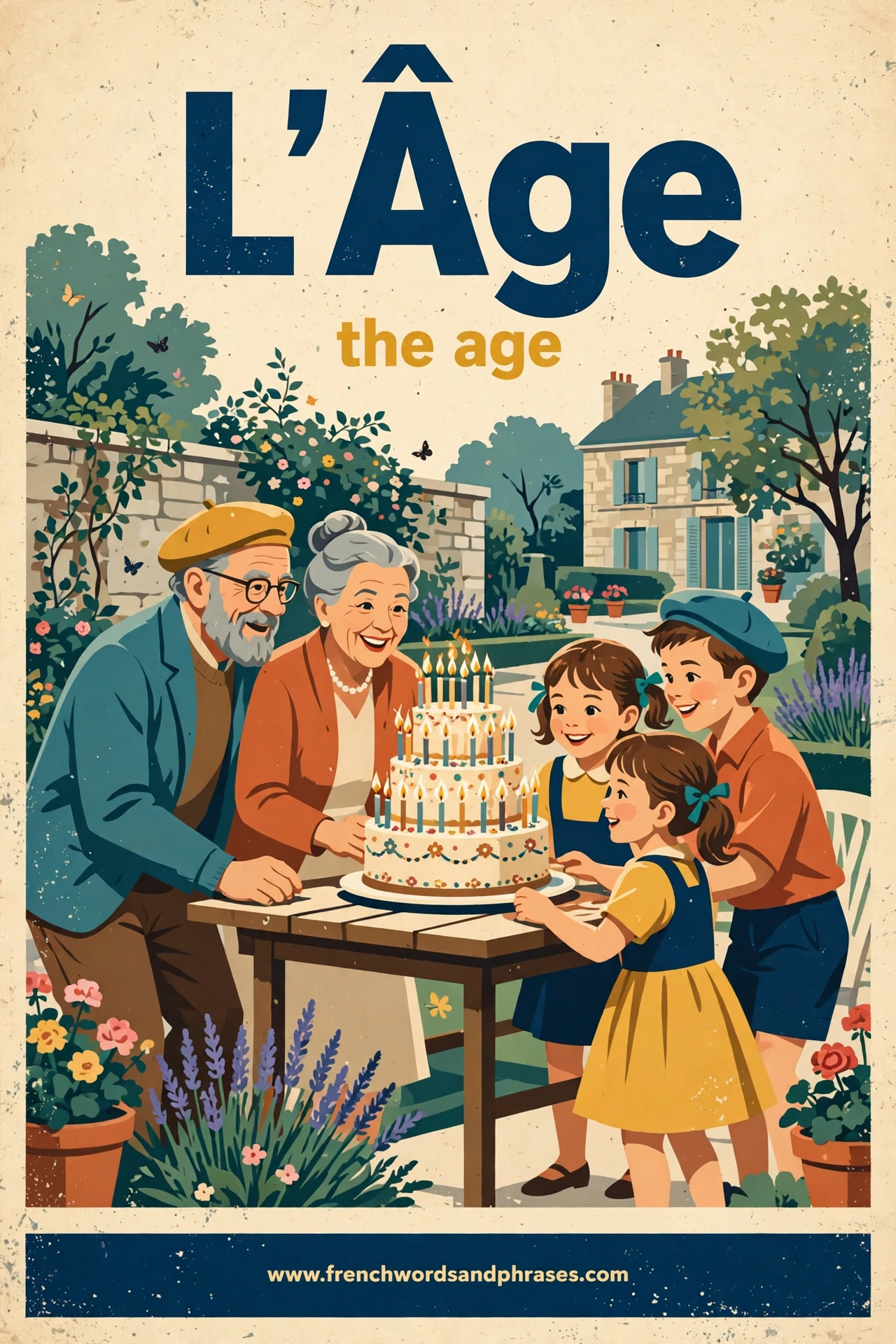
A birthday cake, a forest of candles, and the same teasing question as every year: « Tu as quel âge, maintenant ? » Behind the laughter sits the word itself — l’âge, the number of years a life has gathered.
In this guide, you’ll learn what âge means in English, how to use it with its articles, how to form its plural, and how it appears in everyday French. Explore French examples, English translations, and practice quizzes.
Understanding the French Noun Âge
Âge is a masculine French noun, learned with its article: l’âge, un âge. Because it begins with a vowel, le shrinks to l’ — you never say « le âge ». The circumflex on the â is part of the word’s identity and never disappears, singular or plural.
It means the age — how old a person, an animal or a thing is. You ask it with quel âge ? (how old?), you state it with avoir: « J’ai trente ans » — literally « I have thirty years ». Âge also measures eras and stages: l’âge de raison (the age of reason), le troisième âge (old age, retirement age), and le Moyen Âge (the Middle Ages).
Gender: Masculine
Definite article: l’ — l’âge (the age), because the word begins with a vowel
Indefinite article: un — un âge (an age)
Plural: les âges — the circumflex stays: des âges
Asking the age: Quel âge as-tu ? — How old are you?
English equivalents: The age; a person’s age; an era, an epoch.
One important usage detail: French counts age with avoir, never with être. « J’ai vingt ans » — I have twenty years. The word ans does the counting, and âge appears in the question and in set phrases: à l’âge de cinq ans (at the age of five), à ton âge (at your age).
Experience the Word
Âge is more than a number. In France it politely stays unasked among adults, yet it decides everything quietly — the price of a train ticket, the right to vote, the moment a child moves up a class at school.
Imagine a grandmother blowing out eighty candles while three generations argue, laughing, about whether she looks a day over sixty: l’âge becomes a family story, not a figure.
You have not just counted years. You have measured a life — vécu, gathered year by year.
How to Use Âge in French: Complete Guide
Let’s explore how âge works in French, beginning with its articles — and watch the little circumflex ride along in every form.
Âge with the Definite Article (L’, Les)
Âge begins with a vowel, so le becomes l’ in the singular; the plural is les, as usual.
| Form | French |
|---|---|
| Singular | l’âge |
| Plural | les âges |
Example
L’âge de la maison se voit à ses pierres.
The age of the house shows in its stones.
Âge with the Indefinite Article (Un, Des)
Used for an age in general — un âge, an age among all the ages of life.
| Form | French |
|---|---|
| Singular | un âge |
| Plural | des âges |
Example
Il y a un âge pour tout, dit ma grand-mère.
There is an age for everything, says my grandmother.
Âge with Quantities and Stages (Tous les âges, Un certain âge…)
Âge names stages and spans of life, so French pairs it with words of range and degree rather than taking « some » of it.
| Quantity | French |
|---|---|
| at every age | à tout âge |
| people of all ages | des gens de tous âges |
| a certain age | un certain âge |
| an advanced age | un âge avancé |
| a young age | un jeune âge |
Example
On peut apprendre le français à tout âge.
You can learn French at any age.
Quick Quiz 1
Complete the sentence:
______ âge a votre fille ? (How old is your daughter?)
Reveal the answer
Quel
Quel âge a votre fille ?
French asks « what age has your daughter? » — âge is masculine, so the question word is quel.
The Plural of Âge
Âge adds an -s in the plural and keeps its circumflex — les âges, the ages of man, the ages of history.
| Number | French |
|---|---|
| Singular | l’âge |
| Plural | les âges |
Example
Les âges de la vie ont chacun leurs joies.
Each of the ages of life has its own joys.
Âge with Possessive Adjectives (Mon, Ton, Son…)
Âge is masculine and begins with a vowel, so « my age » is mon âge — never ma âge.
| Owner | French |
|---|---|
| my | mon âge |
| your (tu) | ton âge |
| his / her | son âge |
| our | notre âge |
| your (vous) | votre âge |
| their | leur âge |
Example
À mon âge, on ne court plus après le bus.
At my age, you don’t run after the bus any more.
Quick Quiz 2
Complete the sentence:
À ______ âge, je jouais encore dans la cour. (my)
Reveal the answer
mon
À mon âge, je jouais encore dans la cour.
At my age, I still played in the yard — âge is masculine, and mon also avoids the clash of two vowels.
Âge with Demonstrative Adjectives (Cet, Ces)
Used to point: cet âge — ce becomes cet before the vowel of âge.
| Form | French |
|---|---|
| Singular | cet âge |
| Plural | ces âges |
Example
À cet âge, les enfants posent mille questions.
At that age, children ask a thousand questions.
Âge with Adjectives
Adjectives agree with âge, masculine: un âge avancé, un âge tendre.
| Adjective | With Âge |
|---|---|
| avancé (advanced) | un âge avancé |
| tendre (tender, early) | un âge tendre |
| adulte (adult) | l’âge adulte |
| certain (a certain) | un certain âge |
| grand (great, advanced) | un grand âge |
Example
Elle lit encore sans lunettes, à un âge avancé.
She still reads without glasses, at an advanced age.
Quick Quiz 3
How do you say « the Middle Ages » in French?
Reveal the answer
Le Moyen Âge
Le Moyen Âge dure environ mille ans.
The Middle Ages last about a thousand years — the same âge, stretched to the scale of history.
Everyday Expressions with Âge
Birthdays and life stages — the âge phrases of daily life.
| Expression | In English |
|---|---|
| avoir l’âge de | to be old enough to, to be the age of |
| à l’âge de dix ans | at the age of ten |
| l’âge de raison | the age of reason (about seven) |
| le troisième âge | old age, the retirement years |
| être d’un certain âge | to be of a certain age (no longer young) |
| l’âge adulte | adulthood |
Example
Mon fils a enfin l’âge de prendre le train seul.
My son is finally old enough to take the train alone.
Words from the Same Family as Âge
Years, eras and growing old — the words that travel with âge.
| French | In English |
|---|---|
| âgé | old, elderly (adjective) |
| un an | a year |
| le Moyen Âge | the Middle Ages |
| moyenâgeux | medieval |
| le vieillissement | ageing |
| intemporel | timeless, ageless |
Example
Un homme âgé traverse la place lentement.
An elderly man crosses the square slowly.
Quick Quiz 4
Translate: She is forty years old.
Reveal the answer
Elle a quarante ans.
French « has » its years with avoir — the âge is asked with quel âge, but the answer counts in ans.
Âge in Everyday French: Real-Life Examples
Now that you know the word, let’s see how âge appears in everyday French.
Example 1 — The birthday question
Quel âge a ton petit frère ? Il a sept ans.
How old is your little brother? He is seven.
Example 2 — At the ticket office
À votre âge, le billet est à moitié prix.
At your age, the ticket is half price.
Example 3 — A proud grandmother
À mon âge, je danse encore à tous les mariages.
At my age, I still dance at every wedding.
Example 4 — Talking about a house
On ne connaît pas l’âge exact de cette ferme.
We don’t know the exact age of this farmhouse.
Example 5 — Childhood memories
À l’âge de six ans, j’ai appris à nager.
At the age of six, I learned to swim.
Example 6 — A new stage
Le troisième âge commence souvent par un voyage.
The retirement years often begin with a trip.
Beyond Translation: The Meaning of Âge
Âge carries a small fossil in its spelling: the circumflex on the â remembers a lost letter — old French wrote aage, from Latin aetas, the same root as English « eternal » by a longer road. French keeps the hat as a souvenir.
To say âge is to hold a whole life in one short word.
It stretches from a baby’s first months to the thousand years of the Moyen Âge, from the âge de raison of a seven-year-old to the troisième âge of the retired — one syllable for every scale of time a person can live.
How to Remember the French Noun Âge
Remember it this way: Âge is the age — masculine, vowel-first, so it hides behind l’ and mon, and it wears its little hat in every form.
- You ask it — Quel âge as-tu ?, with quel, because âge is masculine.
- You answer it — J’ai trente ans, with avoir and ans doing the counting.
- You point at it — à mon âge, à cet âge, never ma or ce before the vowel.
The key idea is l’âge, un âge, les âges — the hat never comes off.
Test Your Knowledge of Âge
Let’s see how much you’ve learned. Try answering these questions before revealing the answers.
Question 1
Is âge masculine or feminine?
Reveal the answer
Masculine — l’âge, un âge, mon âge.
Question 2
How do you ask someone their age in French?
Reveal the answer
Quel âge as-tu ? (or Quel âge avez-vous ?) — literally, what age have you?
Question 3
Translate: He is twenty years old.
Reveal the answer
Il a vingt ans.
Question 4
What is le troisième âge?
Reveal the answer
Old age — the retirement years, the third stage of life.
Question 5
Complete the sentence:
______ âge, les jumeaux commencent l’école. (At this age)
Reveal the answer
À cet
À cet âge, les jumeaux commencent l’école.
Ce becomes cet before the vowel of âge.
Your Final Challenge
Can You Use It?
How would you say this in French?
“At my age, we still dance at weddings.”
Reveal the answer
À mon âge, on danse encore aux mariages.
At my age, we still dance at weddings.
A little French. A little curiosity. A richer everyday life.
LEARN FRENCH ONE WORD AT A TIME