A French Word to Live By
Translate Ongle to English
/ɔ̃ɡl/
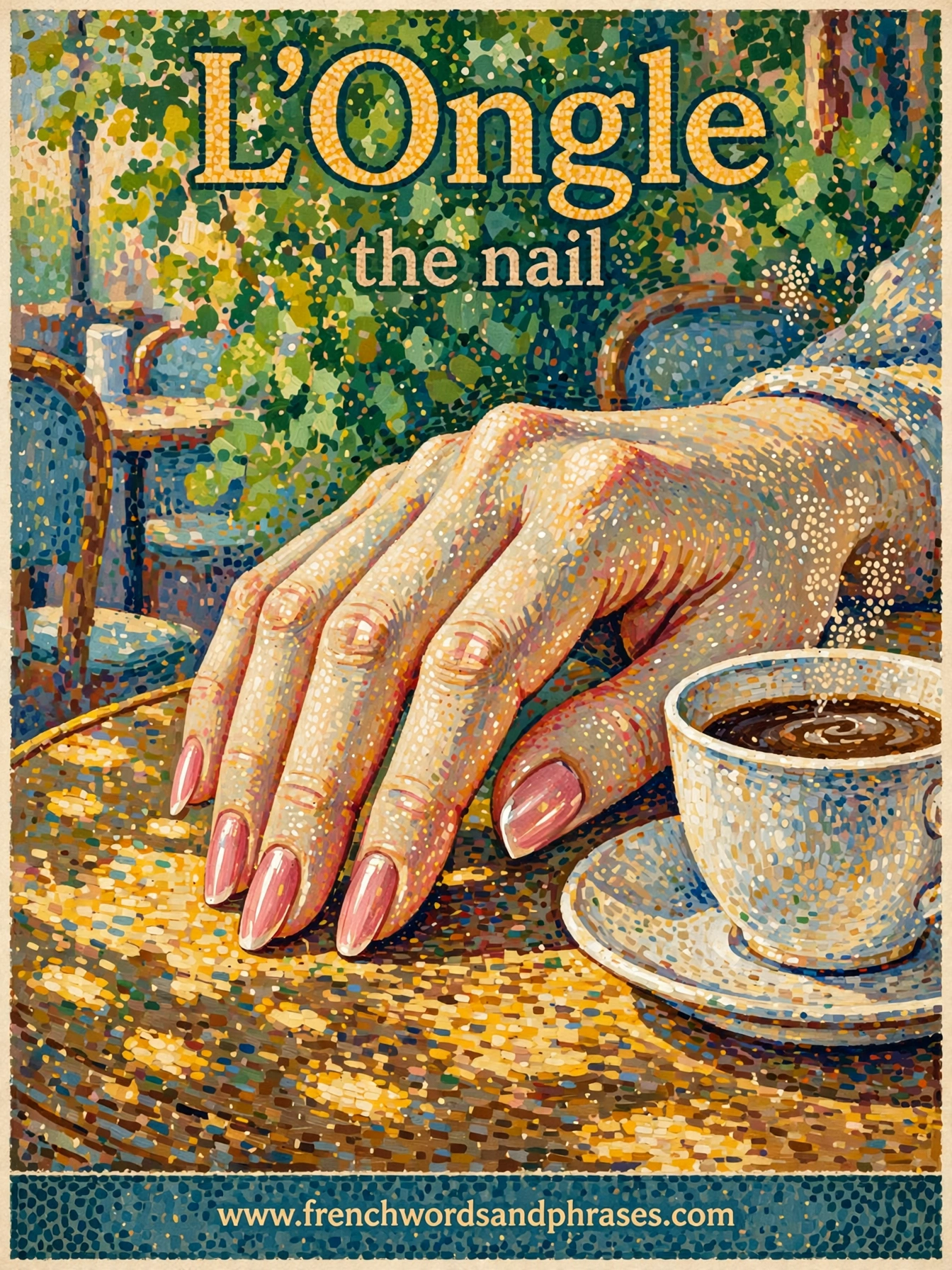
L’ongle means the nail.
At the kitchen table, a teenager is painting her nails a deep red, one careful stroke at a time, blowing gently on each ongle before starting the next.
In this guide, you’ll learn what ongle means in English, how to use it with its articles, how to form its plural, and how it appears in everyday French. Explore French examples, English translations, and practice quizzes.
Understanding the French Noun Ongle
Ongle is a masculine French noun. It begins with a vowel, so the article shrinks: l’ongle, never « le ongle ». With the indefinite article nothing changes: un ongle. It names the hard plate at the tip of each finger and toe.
It means the nail — the hard, translucent plate that protects the tip of every doigt and orteil. You cut them (se couper les ongles), file them (se limer les ongles), paint them with du vernis à ongles (nail varnish), and bite them (se ronger les ongles) when you are nervous.
Gender: Masculine
Definite article: l’ — l’ongle (the nail), because ongle begins with a vowel
Indefinite article: un — un ongle (a nail)
Plural: les ongles
Where: At the tip of every doigt and every orteil
English equivalents: The nail — fingernail or toenail, French uses one word for both.
One important usage detail: English separates fingernails and toenails, but French does not — les ongles des pieds and les ongles des mains if you must specify. And at the butcher’s, beware: l’onglet is a prized cut of beef, the hanger steak — a cousin word, not a little nail.
Experience the Word
Ongle is the body’s tiny shield. It protects the fingertip, helps you pick up a coin, scratch an itch and peel an orange — work no other part of you can do.
Imagine the manicure ritual: the file, the careful polish, ten small crescents of colour — or the bad habit, the bitten nail of the student before an exam.
You have not just groomed yourself. You have looked after the smallest armour you own.
How to Use Ongle in French: Complete Guide
Let’s explore how ongle works in French, beginning with its articles — and watch le become l’ before its vowel.
Ongle with the Definite Article (L’, Les)
Ongle begins with a vowel, so le shrinks to l’ — l’ongle, the nail everyone is talking about.
| Form | French |
|---|---|
| Masculine singular | l’ongle |
| Plural | les ongles |
Example
L’ongle cassé de son pouce la gêne pour écrire.
The broken nail on her thumb bothers her when she writes.
Ongle with the Indefinite Article (Un, Des)
Used for a nail in general — un ongle, one nail among ten.
| Form | French |
|---|---|
| Masculine singular | un ongle |
| Plural | des ongles |
Example
Il s’est cassé un ongle en ouvrant la porte.
He broke a nail opening the door.
Ongle with Quantities and Care
Nails are counted, cut and measured — the quantities of the manicure table.
| Quantity | French |
|---|---|
| one nail | un ongle |
| ten nails | dix ongles |
| all her nails | tous ses ongles |
| short nails | des ongles courts |
| a bottle of nail varnish | un flacon de vernis à ongles |
Example
Elle a dix ongles peints en rouge vif.
She has ten nails painted bright red.
Quick Quiz 1
Complete the sentence:
______ ongle de mon pouce est cassé. (The)
Reveal the answer
L’
L’ongle de mon pouce est cassé.
The nail on my thumb is broken — l’, because ongle begins with a vowel.
The Plural of Ongle
Ongle adds an -s in the plural — les ongles, hands and feet together.
| Number | French |
|---|---|
| Singular | l’ongle |
| Plural | les ongles |
Example
Les ongles poussent plus vite en été.
Nails grow faster in summer.
Ongle with Possessive Adjectives (Mon, Ton, Son…)
A vowel-start bonus: ongle takes mon, ton, son — the smooth forms, for every owner.
| Owner | French |
|---|---|
| my | mon ongle |
| your (tu) | ton ongle |
| his / her | son ongle |
| our | notre ongle |
| your (vous) | votre ongle |
| their | leur ongle |
Example
Elle regarde son ongle cassé avec dépit.
She looks at her broken nail in dismay.
Quick Quiz 2
Complete the sentence:
Il se ronge ______ ongles avant chaque examen. (his)
Reveal the answer
les
Il se ronge les ongles avant chaque examen.
He bites his nails before every exam — French uses les with body parts after a reflexive verb.
Ongle with Demonstrative Adjectives (Cet, Ces)
Used to point: cet ongle — cet, not ce, because ongle begins with a vowel.
| Form | French |
|---|---|
| Masculine singular | cet ongle |
| Plural | ces ongles |
Example
Cet ongle est trop long, il faut le couper.
This nail is too long, it needs cutting.
Ongle with Adjectives
Adjectives agree with ongle: long, court, verni — all in masculine forms.
| Adjective | With Ongle |
|---|---|
| long (long) | un ongle long |
| court (short) | un ongle court |
| cassé (broken) | un ongle cassé |
| verni (painted) | un ongle verni |
| propre (clean) | un ongle propre |
Example
Elle préfère les ongles courts et propres pour travailler.
She prefers short, clean nails for work.
Quick Quiz 3
How do you say « this nail » in French?
Reveal the answer
Cet ongle
Cet ongle me fait mal depuis hier.
This nail has been hurting me since yesterday — cet, because ongle starts with a vowel.
Everyday Expressions with Ongle
Nerves, elegance and thoroughness — the ongle phrases of daily life.
| Expression | In English |
|---|---|
| se ronger les ongles | to bite one’s nails |
| se faire les ongles | to do one’s nails |
| se couper les ongles | to cut one’s nails |
| jusqu’au bout des ongles | through and through, to the fingertips |
| avoir de la saleté sous les ongles | to have dirt under one’s nails |
| le vernis à ongles | nail varnish, nail polish |
Example
C’est une artiste jusqu’au bout des ongles.
She is an artist through and through, to her fingertips.
Words from the Same Family as Ongle
Files, varnish and a famous steak — the words that travel with ongle.
| French | In English |
|---|---|
| le vernis à ongles | nail varnish |
| la lime à ongles | the nail file |
| le coupe-ongles | the nail clippers |
| l’onglet | the hanger steak (at the butcher’s) |
| la manucure | the manicure |
Example
Elle cherche sa lime à ongles dans son sac.
She is looking for her nail file in her bag.
Quick Quiz 4
What does « se ronger les ongles » mean?
Reveal the answer
To bite one’s nails — the classic sign of nerves or impatience.
Il se ronge les ongles en attendant les résultats.
He is biting his nails while waiting for the results.
Ongle in Everyday French: Real-Life Examples
Now that you know the word, let’s see how ongle appears in everyday French.
Example 1 — Manicure time
Elle se fait les ongles avec un vernis rouge.
She is doing her nails with red varnish.
Example 2 — A bad habit
Mon fils se ronge les ongles quand il est stressé.
My son bites his nails when he is stressed.
Example 3 — Grooming
Il se coupe les ongles tous les dimanches.
He cuts his nails every Sunday.
Example 4 — A small accident
Elle s’est cassé un ongle en jardinant.
She broke a nail while gardening.
Example 5 — At the salon
La manucure lime les ongles de la cliente.
The manicurist files the client’s nails.
Example 6 — Through and through
C’est un musicien jusqu’au bout des ongles.
He is a musician through and through.
Beyond Translation: The Meaning of Ongle
Ongle comes from the Latin ungula, a little claw or hoof — a reminder that our nails are the polite descendants of claws. French keeps the animal echo in the expression jusqu’au bout des ongles, « to the very tips of the nails », for someone who is something through and through. And the word has a delicious double life at the butcher’s: l’onglet, the hanger steak, was named for its nail-like shape against the diaphragm.
To say ongle is to name the tiny claw we turned into jewellery.
It evokes the salon and the nail file, the bitten nail of exam week, and ten small mirrors of how we look after ourselves.
How to Remember the French Noun Ongle
Remember it this way: Ongle is the nail — masculine, and because it starts with a vowel the article hugs it: l’ongle, cet ongle, mon ongle.
- You see the vowel — l’ongle, never « le ongle ».
- You picture the habit — se ronger les ongles, biting your nails.
- You remember both ends — one word for fingernails et toenails.
The key idea is l’ongle — the article shrinks before the vowel.
Test Your Knowledge of Ongle
Let’s see how much you’ve learned. Try answering these questions before revealing the answers.
Question 1
Is ongle masculine or feminine?
Reveal the answer
Masculine — l’ongle, un ongle.
Question 2
Why do we say l’ongle and not le ongle?
Reveal the answer
Because ongle begins with a vowel — le shrinks to l’ before a vowel sound.
Question 3
Translate: She is doing her nails.
Reveal the answer
Elle se fait les ongles.
Question 4
What is le vernis à ongles?
Reveal the answer
Nail varnish — the polish you paint on les ongles.
Question 5
Complete the sentence:
______ ongle est cassé. (This)
Reveal the answer
Cet
Cet ongle est cassé.
This nail is broken — cet, because ongle begins with a vowel.
Your Final Challenge
Can You Use It?
How would you say this in French?
“She paints her nails red.”
Reveal the answer
Elle se peint les ongles en rouge.
She paints her nails red.
A little French. A little curiosity. A richer everyday life.
LEARN FRENCH ONE WORD AT A TIME