A French Word to Live By
Translate Doigt to English
/dwa/
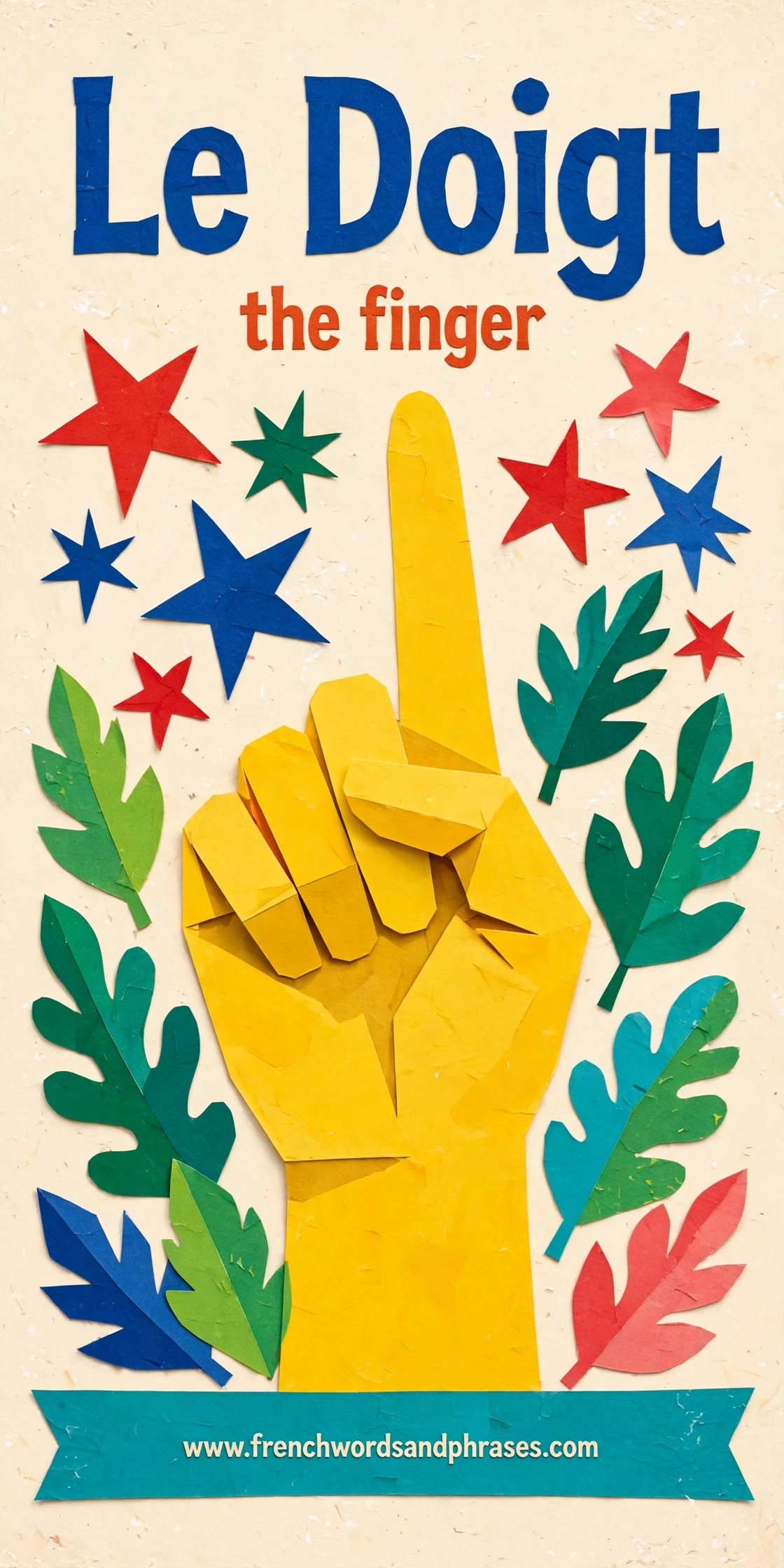
Le doigt means the finger.
The little girl counts the days before her birthday the way children have always counted: one by one, on her fingers — « un, deux, trois… » Each number lives at the tip of a doigt.
In this guide, you’ll learn what doigt means in English, how to use it with its articles, how to form its plural, and how it appears in everyday French. Explore French examples, English translations, and practice quizzes.
Understanding the French Noun Doigt
Doigt is a masculine French noun, learned with its article: le doigt, un doigt. It names the fingers of the hand — French keeps toes for another word, les orteils, so a doigt is always a finger.
It means the finger — one of the five digits of the hand, the one you point with, count with and touch the world with. Each hand has five: le pouce (the thumb) and four doigts. You wear une bague (a ring) on a doigt, you play the piano with all ten, and a baby discovers the world by putting every doigt in its mouth.
Gender: Masculine
Definite article: le — le doigt (the finger)
Indefinite article: un — un doigt (a finger)
Plural: les doigts
Sound note: The final -gt is silent — doigt sounds like « dwa »
English equivalents: The finger. (A toe is un orteil, not a doigt.)
One important usage detail: English uses « finger » as a measure, and French does too — un doigt de whisky is a finger of whisky, about two centimetres in the glass. And do not point: in France, montrer quelqu’un du doigt is as rude as it sounds.
Experience the Word
Doigt is the body’s smallest tool. Before we had buttons, screens or pens, we had ten doigts — to count, to point, to test the wind, to feel whether the soup is too hot.
Imagine a pianist before a concert, flexing each doigt in turn, or a grandmother teaching a child to count to ten on the fingers of one small hand.
You have not just touched something. You have explored the world — au bout des doigts, at your fingertips.
How to Use Doigt in French: Complete Guide
Let’s explore how doigt works in French, beginning with its articles — then count, point and play with all ten.
Doigt with the Definite Article (Le, Les)
Used for a specific finger — the one that hurts, the one with the ring.
| Form | French |
|---|---|
| Masculine singular | le doigt |
| Plural | les doigts |
Example
Le doigt blessé de l’enfant est bandé.
The child’s injured finger is bandaged.
Doigt with the Indefinite Article (Un, Des)
Used for a finger in general — un doigt, any finger at all.
| Form | French |
|---|---|
| Masculine singular | un doigt |
| Plural | des doigts |
Example
Il lève un doigt pour poser une question.
He raises a finger to ask a question.
Doigt with Quantities and Counting
Fingers are made for counting — French counts them, measures with them and offers drinks by them.
| Quantity | French |
|---|---|
| one finger | un doigt |
| five fingers | cinq doigts |
| the ten fingers | les dix doigts |
| a finger of whisky | un doigt de whisky |
| on the fingers of one hand | sur les doigts d’une main |
Example
On peut compter ses amis fidèles sur les doigts d’une main.
You can count his faithful friends on the fingers of one hand.
Quick Quiz 1
Complete the sentence:
Elle porte une bague au ______. (finger)
Reveal the answer
doigt
Elle porte une bague au doigt.
She wears a ring on her finger — au doigt, because doigt is masculine.
The Plural of Doigt
Doigt adds an -s in the plural — les doigts, all ten of them.
| Number | French |
|---|---|
| Singular | le doigt |
| Plural | les doigts |
Example
Les doigts du pianiste volent sur les touches.
The pianist’s fingers fly over the keys.
Doigt with Possessive Adjectives (Mon, Ton, Son…)
Possessives agree with the noun: doigt is masculine, so it takes mon, ton, son.
| Owner | French |
|---|---|
| my | mon doigt |
| your (tu) | ton doigt |
| his / her | son doigt |
| our | notre doigt |
| your (vous) | votre doigt |
| their | leur doigt |
Example
Il a coupé son doigt en ouvrant la boîte.
He cut his finger opening the tin.
Quick Quiz 2
Complete the sentence:
______ doigts sont gelés, je ne sens plus rien ! (My)
Reveal the answer
Mes
Mes doigts sont gelés, je ne sens plus rien !
My fingers are frozen, I can’t feel anything any more!
Doigt with Demonstrative Adjectives (Ce, Ces)
Used to point — with a finger, naturally: ce doigt, ces doigts.
| Form | French |
|---|---|
| Masculine singular | ce doigt |
| Plural | ces doigts |
Example
Regarde ce doigt, il est tout gonflé.
Look at this finger, it’s all swollen.
Doigt with Adjectives
Adjectives agree with doigt: long, fin, blessé — all masculine forms here.
| Adjective | With Doigt |
|---|---|
| long (long) | un doigt long |
| fin (slender) | un doigt fin |
| blessé (injured) | un doigt blessé |
| cassé (broken) | un doigt cassé |
| agile (nimble) | un doigt agile |
Example
Le guitariste a des doigts longs et agiles.
The guitarist has long, nimble fingers.
Quick Quiz 3
How do you say « a broken finger » in French?
Reveal the answer
Un doigt cassé
Il est arrivé aux urgences avec un doigt cassé.
He arrived at A&E with a broken finger.
Everyday Expressions with Doigt
Regrets, near misses and perfect knowledge — French fingers are full of expressions.
| Expression | In English |
|---|---|
| se mordre les doigts | to regret something bitterly |
| à deux doigts de | within a hair of, on the verge of |
| montrer du doigt | to point at, to single out |
| savoir sur le bout des doigts | to know by heart, at one’s fingertips |
| obéir au doigt et à l’œil | to obey instantly, without question |
| se lécher les doigts | to lick one’s fingers (it was delicious) |
Example
Elle connaît son texte sur le bout des doigts.
She knows her lines by heart, at her fingertips.
Words from the Same Family as Doigt
Tact, fingerprints and toe-talk — the words that travel with doigt.
| French | In English |
|---|---|
| le doigté | tact; fingering (in music) |
| l’empreinte digitale | the fingerprint |
| digital | digital; relating to the fingers |
| le doigt de pied | the toe (everyday wording) |
| le pouce | the thumb |
Example
La police relève les empreintes digitales sur la porte.
The police take the fingerprints on the door.
Quick Quiz 4
What does « savoir quelque chose sur le bout des doigts » mean?
Reveal the answer
To know it by heart, at your fingertips — to know it perfectly, down to the last detail.
Il sait la ville sur le bout des doigts.
He knows the city like the back of his hand.
Doigt in Everyday French: Real-Life Examples
Now that you know the word, let’s see how doigt appears in everyday French.
Example 1 — Counting
La fillette compte les bonbons sur ses doigts.
The little girl counts the sweets on her fingers.
Example 2 — At the doctor’s
Le médecin examine le doigt blessé de l’enfant.
The doctor examines the child’s injured finger.
Example 3 — A warning
Ne mets pas tes doigts dans la prise électrique !
Don’t put your fingers in the electrical socket!
Example 4 — At the piano
Le pianiste échauffe ses doigts avant le concert.
The pianist warms up his fingers before the concert.
Example 5 — A near miss
Le train est passé à deux doigts de l’accident.
The train came within a hair of an accident.
Example 6 — Good manners
On ne montre pas les gens du doigt, c’est impoli.
You don’t point at people, it’s rude.
Beyond Translation: The Meaning of Doigt
Doigt carries an old spelling mystery: it comes from the Latin digitus, and medieval scribes, proud of their Latin, slipped a silent g back into the word — which is why French writes doigt but says simply « dwa ». The fingers also measure French history: un doigt of wine in a glass, and a whole system of counting that children still learn before any calculator.
To say doigt is to name the first tool every human being ever owns.
It evokes the child counting birthdays, the pianist’s flying hands, the ring slipped onto a finger — small word, endless work.
How to Remember the French Noun Doigt
Remember it this way: Doigt is the finger — masculine, and spelled with a silent -gt that you write but never say: le doigt, said « dwa ».
- You count — les doigts are for counting, from your very first maths lesson.
- You point — montrer du doigt, but only in the expression, never at people.
- You remember the toes — fingers are doigts, toes are orteils.
The key idea is le doigt — fingers for the hands, orteils for the toes.
Test Your Knowledge of Doigt
Let’s see how much you’ve learned. Try answering these questions before revealing the answers.
Question 1
Is doigt masculine or feminine?
Reveal the answer
Masculine — le doigt, un doigt.
Question 2
How do you say « the fingers » in French?
Reveal the answer
Les doigts — doigt adds an -s in the plural.
Question 3
Translate: He cut his finger.
Reveal the answer
Il s’est coupé le doigt. (With body parts, French uses the definite article: le doigt.)
Question 4
What is un doigt de whisky?
Reveal the answer
A finger of whisky — a measure of about two centimetres poured in the glass.
Question 5
Complete the sentence:
Elle connaît la leçon sur le bout des ______.
Reveal the answer
doigts
Elle connaît la leçon sur le bout des doigts.
She knows the lesson by heart, at her fingertips.
Your Final Challenge
Can You Use It?
How would you say this in French?
“The child counts on his fingers.”
Reveal the answer
L’enfant compte sur ses doigts.
The child counts on his fingers.
A little French. A little curiosity. A richer everyday life.
LEARN FRENCH ONE WORD AT A TIME