A French Word to Live By
How to Conjugate Remettre in French
/ʁə.mɛtʁ/
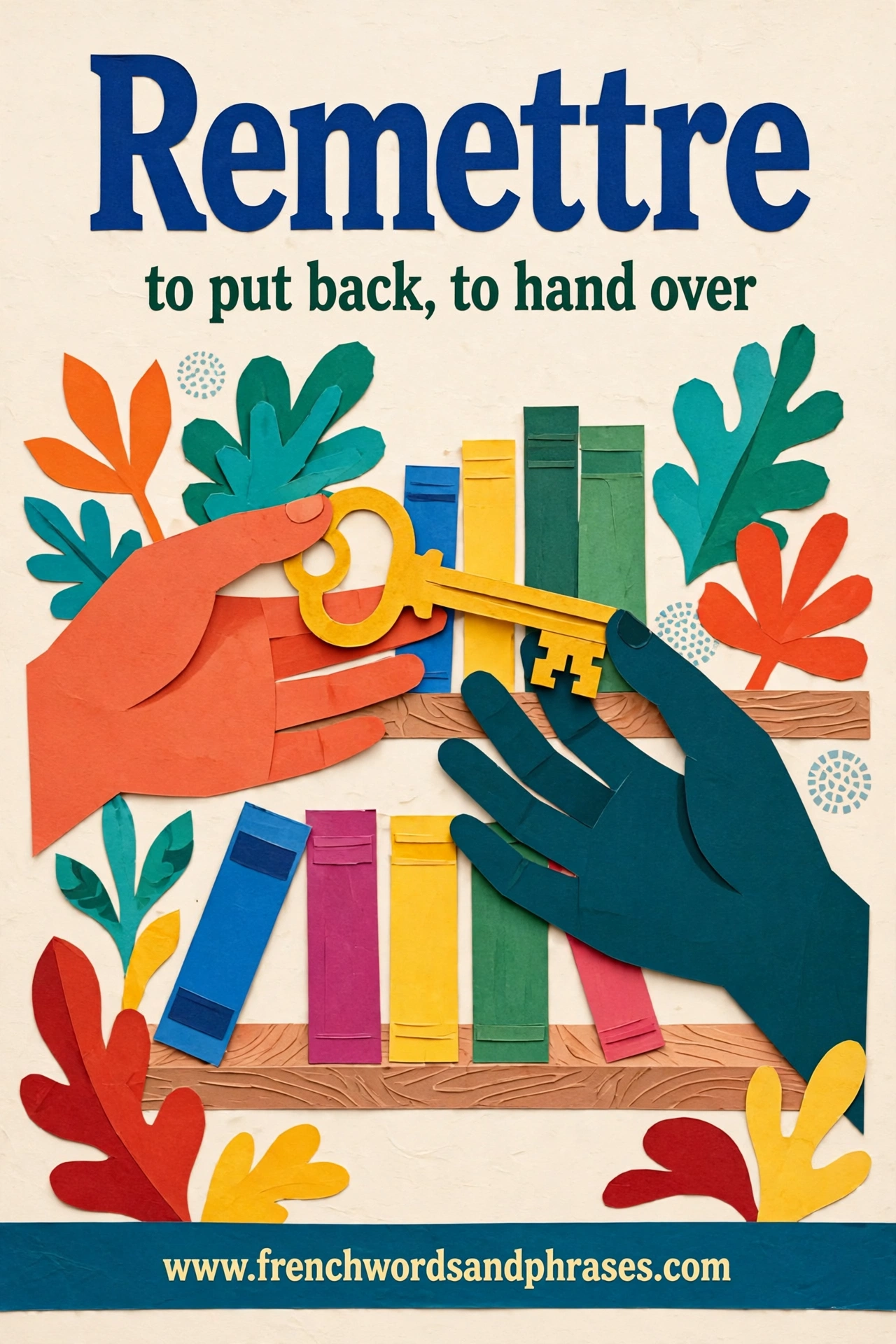
Remettre means to put back, to hand over — to return a thing to its place, or into someone’s hands: a book to its shelf, the keys to their owner, a prize to its winner.
A librarian sliding a book back into its exact place on the shelf, a champion receiving the trophy from the mayor’s hands, a tenant returning the keys on the last day of the lease — remettre is the verb of the return into place or into hands: nothing is created, everything is put back where it belongs.
In this guide, you’ll learn how to conjugate remettre in all the major French tenses and moods. Explore complete conjugation tables, French examples, English translations, and practice quizzes.
Understanding the French Verb Remettre
Remettre is an irregular French verb ending in -re, conjugated exactly like mettre.
It means to put back, to hand over. Few verbs carry so many errands: remettre un devoir (hand in homework), remettre une lettre (deliver a letter), remettre de l’ordre (tidy up, restore order), remettre ça (do it again — familiar). And remettre à demain, putting things off until tomorrow, is the polite French name for procrastination itself.
Verb classification: Irregular (-mettre)
Auxiliary verb: Avoir
Past participle: remis
Present participle: remettant
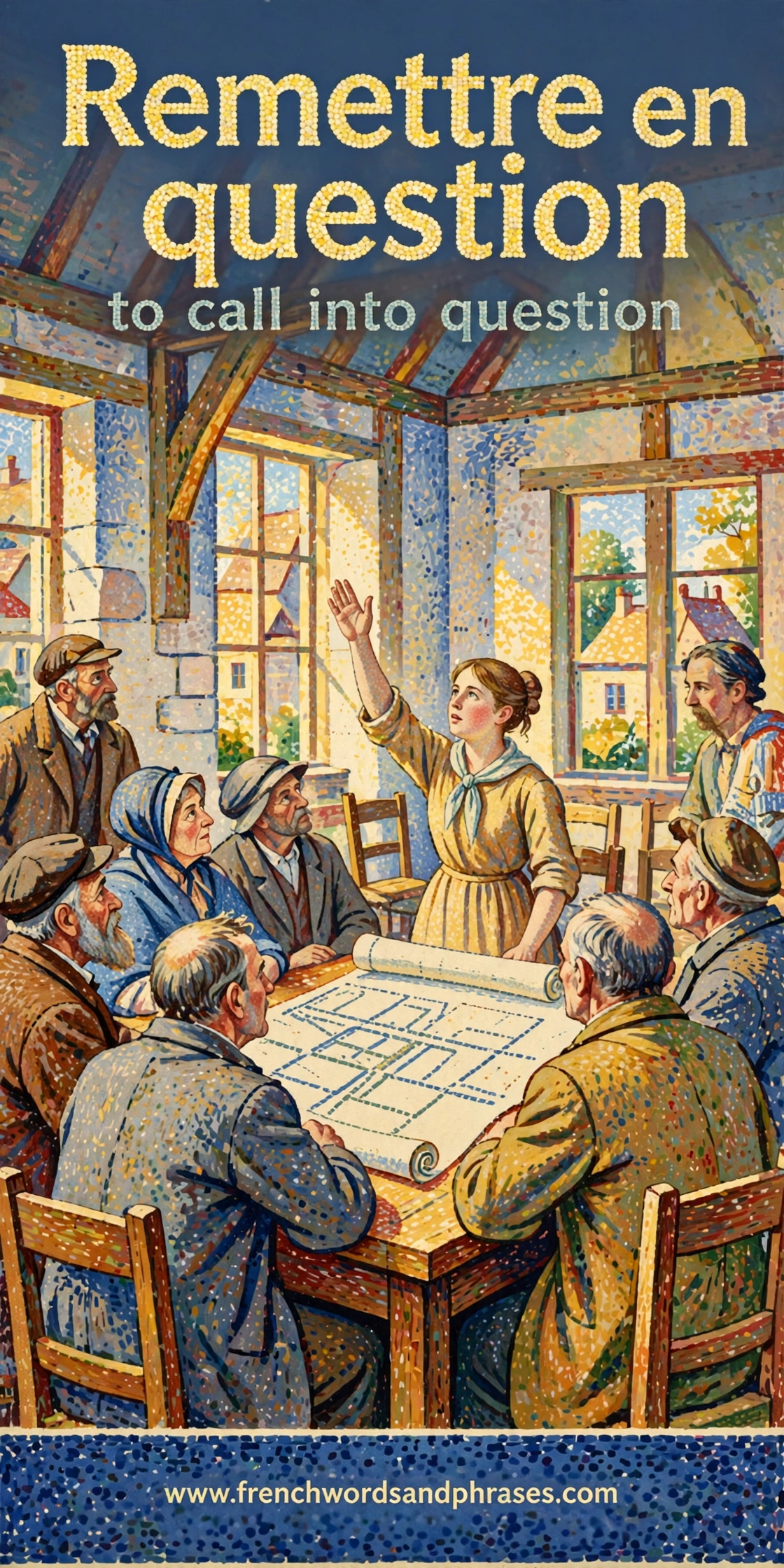
English equivalents: To put back, to hand over, to deliver, to postpone; remettre un livre à sa place — to put a book back in its place; remettre les clés — to hand over the keys; remettre un prix — to present a prize; remettre une réunion à demain — to postpone a meeting until tomorrow; remettre en question — to call into question.
One important detail: remettre follows mettre letter for letter — one t in the singular, two in the plural: je remets, tu remets, il remet, but nous remettons, vous remettez, ils remettent. The past participle is remis — never remetté. Watch also its two everyday traps: remettre + a date means to postpone (remettre la réunion à lundi), and the reflexive se remettre is a different world — to recover: elle se remet de sa grippe.
Experience the Word
Remettre is the verb of things going home — back to the shelf, back to the owner, back into the right hands.
Imagine the last evening of a village fête. The mayor climbs the two steps of the bandstand with the great silver cup, and the whole square watches as he remet le prix to the winning pétanque team — the cup passes from his hands to theirs, and for a moment the transfer itself is the ceremony.
The cup has simply changed hands. It has been handed over — remis — and that small journey is the whole celebration.
How to Conjugate Remettre: Complete French Conjugation Guide
Let’s explore every major conjugation of remettre, beginning with the indicative mood.
How to Conjugate Remettre in the Indicative Mood
The indicative mood is used to express facts, observations, actions, and events.
How to Conjugate Remettre in the Present Tense (Présent)
Used for actions happening now, habitual actions, and general truths.
| Subject | Conjugation |
|---|---|
| je | remets |
| tu | remets |
| il / elle | remet |
| nous | remettons |
| vous | remettez |
| ils / elles | remettent |
Example
Elle remet toujours les livres à leur place.
She always puts the books back in their place.
Quick Quiz 1
Complete the sentence:
Nous ______ les clés au concierge.
Reveal the answer
remettons
Nous remettons les clés au concierge.
We are handing the keys to the caretaker.
How to Conjugate Remettre in the Passé Composé
Used for completed actions in the past. Remettre takes the auxiliary verb avoir.
| Subject | Conjugation |
|---|---|
| j’ | ai remis |
| tu | as remis |
| il / elle | a remis |
| nous | avons remis |
| vous | avez remis |
| ils / elles | ont remis |
Example
Le maire a remis le prix aux gagnants.
The mayor presented the prize to the winners.
How to Conjugate Remettre in the Imparfait (Imperfect Tense)
Used for habitual past actions, descriptions, and ongoing situations in the past.
| Subject | Conjugation |
|---|---|
| je | remettais |
| tu | remettais |
| il / elle | remettait |
| nous | remettions |
| vous | remettiez |
| ils / elles | remettaient |
Example
Autrefois, le facteur remettait les lettres en main propre.
In the old days, the postman used to deliver letters into people’s own hands.
Quick Quiz 2
Choose the correct form:
She handed over the keys.
Elle ______ les clés. (a remis / est remise)
Reveal the answer
a remis
Elle a remis les clés.
Remettre takes avoir.
How to Conjugate Remettre in the Plus-que-parfait
Used to describe an action that had already been completed before another past event.
| Subject | Conjugation |
|---|---|
| j’ | avais remis |
| tu | avais remis |
| il / elle | avait remis |
| nous | avions remis |
| vous | aviez remis |
| ils / elles | avaient remis |
Example
Nous avions remis les clés au concierge avant de partir.
We had handed the keys to the caretaker before leaving.
How to Conjugate Remettre in the Passé Simple
Primarily used in formal writing, literature, and historical narratives. It is rarely used in everyday conversation.
| Subject | Conjugation |
|---|---|
| je | remis |
| tu | remis |
| il / elle | remit |
| nous | remîmes |
| vous | remîtes |
| ils / elles | remirent |
Example
Le messager remit la lettre au roi en silence.
The messenger handed the letter to the king in silence.
How to Conjugate Remettre in the Passé Antérieur
A literary tense used to express an action completed immediately before another past action, generally in the passé simple.
| Subject | Conjugation |
|---|---|
| j’ | eus remis |
| tu | eus remis |
| il / elle | eut remis |
| nous | eûmes remis |
| vous | eûtes remis |
| ils / elles | eurent remis |
Example
Dès qu’il eut remis le document, il quitta le bureau.
As soon as he had handed over the document, he left the office.
How to Conjugate Remettre in the Future Tense (Futur Simple)
Used to describe actions that will take place in the future.
| Subject | Conjugation |
|---|---|
| je | remettrai |
| tu | remettras |
| il / elle | remettra |
| nous | remettrons |
| vous | remettrez |
| ils / elles | remettront |
Example
Demain, je remettrai le rapport à la directrice.
Tomorrow, I will hand the report to the director.
How to Conjugate Remettre in the Futur Antérieur (Future Perfect)
Used for an action that will have been completed before a particular point in the future.
| Subject | Conjugation |
|---|---|
| j’ | aurai remis |
| tu | auras remis |
| il / elle | aura remis |
| nous | aurons remis |
| vous | aurez remis |
| ils / elles | auront remis |
Example
À midi, les élèves auront remis leur devoir.
By noon, the pupils will have handed in their homework.
How to Conjugate Remettre in the Near Future (Futur Proche)
Used to describe something that is going to happen soon. Formed with aller + infinitive.
| Subject | Conjugation |
|---|---|
| je | vais remettre |
| tu | vas remettre |
| il / elle | va remettre |
| nous | allons remettre |
| vous | allez remettre |
| ils / elles | vont remettre |
Example
Tu vas remettre la réunion à demain, encore ?
Are you going to postpone the meeting until tomorrow, again?
How to Conjugate Remettre in the Conditional Mood
The conditional mood expresses what would happen under certain circumstances. It is also frequently used to make polite requests or express wishes.
How to Conjugate Remettre in the Present Conditional
| Subject | Conjugation |
|---|---|
| je | remettrais |
| tu | remettrais |
| il / elle | remettrait |
| nous | remettrions |
| vous | remettriez |
| ils / elles | remettraient |
Example
Je remettrais volontiers ce dossier entre vos mains.
I would gladly place this file in your hands.
How to Conjugate Remettre in the Past Conditional
| Subject | Conjugation |
|---|---|
| j’ | aurais remis |
| tu | aurais remis |
| il / elle | aurait remis |
| nous | aurions remis |
| vous | auriez remis |
| ils / elles | auraient remis |
Example
Ils auraient remis les clés plus tôt sans la tempête.
They would have handed over the keys sooner without the storm.
Remettre in the Literary Past Conditional Form
This less common literary form uses the imperfect subjunctive of avoir.
| Subject | Conjugation |
|---|---|
| j’ | eusse remis |
| tu | eusses remis |
| il / elle | eût remis |
| nous | eussions remis |
| vous | eussiez remis |
| ils / elles | eussent remis |
Example
Le roi eût remis la couronne à son fils sans la guerre.
The king would have handed the crown to his son without the war.
How to Conjugate Remettre in the Subjunctive Mood
The subjunctive is used to express wishes, emotions, doubts, necessity, and uncertainty. It frequently follows expressions such as il faut que (it is necessary that) or bien que (although).
How to Conjugate Remettre in the Present Subjunctive
| Subject | Conjugation |
|---|---|
| que je | remette |
| que tu | remettes |
| qu’il / qu’elle | remette |
| que nous | remettions |
| que vous | remettiez |
| qu’ils / qu’elles | remettent |
Example
Il faut que tu remettes ton devoir avant vendredi.
You must hand in your homework before Friday.
Quick Quiz 3
Complete the sentence using the subjunctive:
Il faut que vous ______ le rapport avant midi.
Reveal the answer
remettiez
Il faut que vous remettiez le rapport avant midi.
You must hand in the report before noon.
How to Conjugate Remettre in the Imperfect Subjunctive
A literary tense, rarely encountered in modern spoken French.
| Subject | Conjugation |
|---|---|
| que je | remisse |
| que tu | remisses |
| qu’il / qu’elle | remît |
| que nous | remissions |
| que vous | remissiez |
| qu’ils / qu’elles | remissent |
Example
Je ne pensais pas qu’il remît la réunion une deuxième fois.
I did not think he would postpone the meeting a second time.
How to Conjugate Remettre in the Pluperfect Subjunctive
A literary construction used to express an action completed before another past action.
| Subject | Conjugation |
|---|---|
| que j’ | eusse remis |
| que tu | eusses remis |
| qu’il / qu’elle | eût remis |
| que nous | eussions remis |
| que vous | eussiez remis |
| qu’ils / qu’elles | eussent remis |
Example
On racontait que le trésorier eût remis l’argent en secret.
People said the treasurer had handed over the money in secret.
How to Conjugate Remettre in the Past Subjunctive
| Subject | Conjugation |
|---|---|
| que j’ | aie remis |
| que tu | aies remis |
| qu’il / qu’elle | ait remis |
| que nous | ayons remis |
| que vous | ayez remis |
| qu’ils / qu’elles | aient remis |
Example
Je suis content que vous ayez remis les clés.
I am glad you handed over the keys.
How to Conjugate Remettre in the Imperative
The imperative is used to give commands, instructions, invitations, or suggestions. Subject pronouns are omitted.
How to Conjugate Remettre in the Present Imperative
| Person | Conjugation |
|---|---|
| (tu) | remets |
| (nous) | remettons |
| (vous) | remettez |
Example
Remettez ce livre à sa place, s’il vous plaît !
Put this book back in its place, please!
Quick Quiz 4
How would you say Put this book back (tu form)?
Reveal the answer
Remets ce livre à sa place !
French Participles of Remettre
Participles are verb forms that can be used in compound tenses and other grammatical constructions.
Present Participle of Remettre
remettant
En remettant le prix, le maire a félicité toute l’équipe.
As he presented the prize, the mayor congratulated the whole team.
Past Participle of Remettre
remis
Remis en main propre, le document ne pouvait plus se perdre.
Handed over in person, the document could no longer get lost.
Remettre in Everyday French: Real-Life Examples
Now that you know the conjugations, let’s see how remettre appears in everyday French.
Example 1 — Present
Elle remet les livres à leur place.
She puts the books back in their place.
Example 2 — Passé composé
Le maire a remis le prix aux gagnants.
The mayor presented the prize to the winners.
Example 3 — Imparfait
Le facteur remettait les lettres en main propre.
The postman used to deliver letters into people’s own hands.
Example 4 — Future
Je remettrai le rapport demain.
I will hand in the report tomorrow.
Example 5 — Conditional
Je remettrais ce dossier entre vos mains.
I would place this file in your hands.
Example 6 — Imperative
Remets ton devoir avant vendredi !
Hand in your homework before Friday!
Beyond Translation: The Meaning of Remettre
Remettre is mettre (to put) with the prefix re-: to put again, to put back — Latin remittere, to send back, the root of English remit and remittance.
Every sense is a journey back.
The book goes back to the shelf, the keys go back to the owner, the meeting goes back to a later date — and in remettre en question, even a certainty is sent back, to be examined all over again.
How to Remember the French Verb Remettre
Remember it this way: Remettre is about the silver cup passing from the mayor’s hands to the winners.
- Mettre’s exact shape: one t in je remets / il remet, two in nous remettons / ils remettent; past participle remis.
- Remettre + a date = to postpone: remettre la réunion à demain — and se remettre (de) is to recover from an illness.
- Its ceremonies: remettre un prix (present a prize), remettre les clés (hand over the keys), remettre un devoir (hand in homework).
The key idea is the silver cup passing from the mayor’s hands to the winners.
Test Your Knowledge of Remettre
Let’s see how much you’ve learned. Try answering these questions before revealing the answers.
Question 1
Why does je remets have one t but nous remettons two?
Reveal the answer
The mettre pattern — the singular keeps one t (je remets, il remet), the plural doubles it (nous remettons, ils remettent).
Question 2
How do you say The mayor presented the prize in French?
Reveal the answer
Le maire a remis le prix.
Question 3
Translate: She always puts the books back in their place.
Reveal the answer
Elle remet toujours les livres à leur place.
Question 4
What is the past participle of remettre?
Reveal the answer
Remis — never remetté.
Question 5
Complete the sentence:
Il faut que tu ______ ton devoir avant vendredi.
Reveal the answer
remettes
Il faut que tu remettes ton devoir avant vendredi.
You must hand in your homework before Friday.
Your Final Challenge
Can You Use It?
How would you say this in French?
He puts the book back in its place, the keys back to their owner, and the prize to the winners — everything falls back into order.
Reveal the answer
Il remet le livre à sa place, les clés à leur propriétaire, et le prix aux gagnants — tout rentre dans l’ordre.
He puts the book back in its place, the keys back to their owner, and the prize to the winners — everything falls back into order.
A little French. A little curiosity. A richer everyday life.
LEARN FRENCH ONE WORD AT A TIME