A French Word to Live By
Translate Qui plus est to English
/ki ply ɛ/
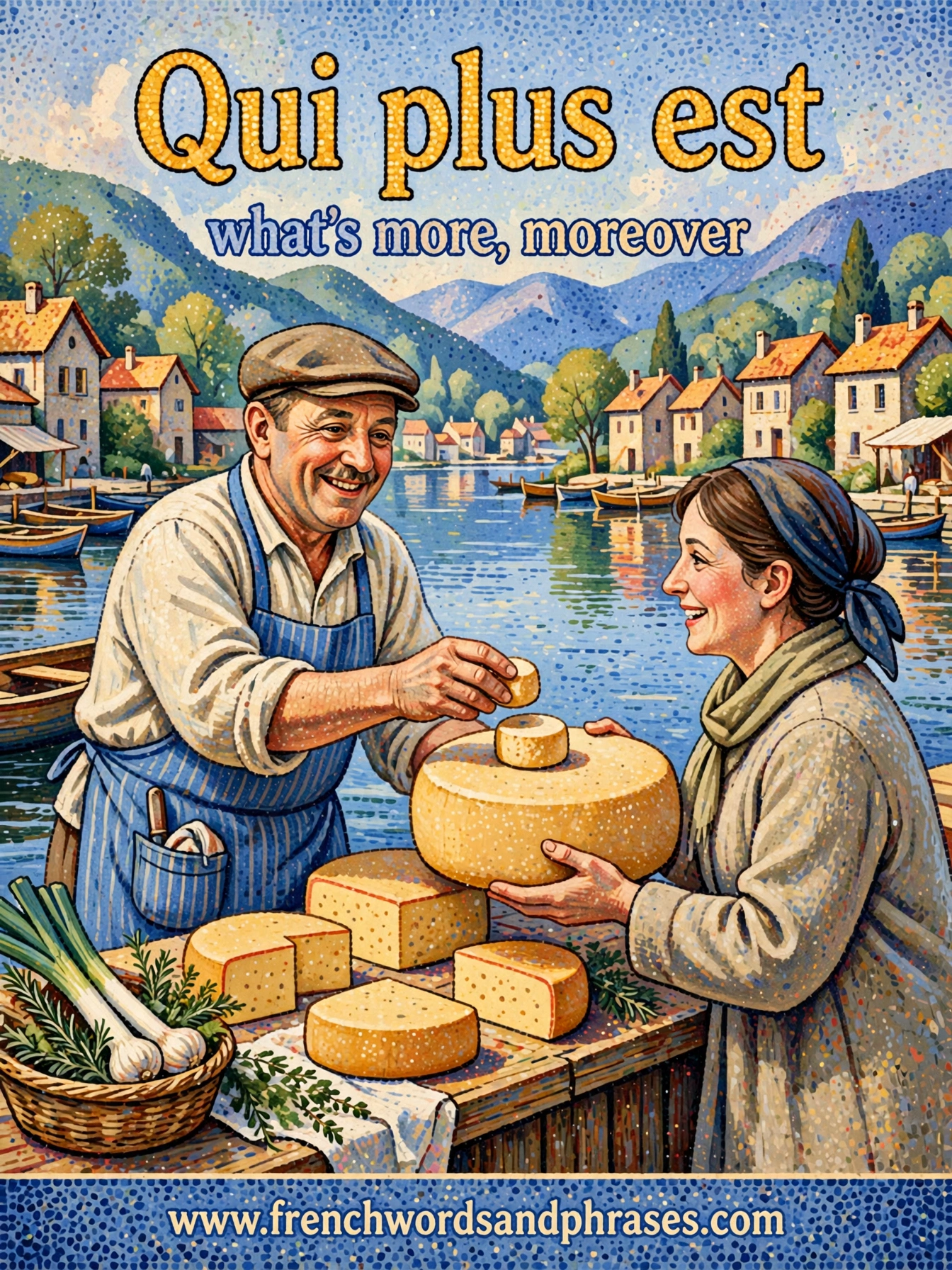
Qui plus est means what’s more, moreover — the phrase that adds one more argument to the pile.
A young lawyer is pleading for the little bakery threatened with closure, and she is saving her best for last. The rent was paid, she says. The neighbours have signed. « Et qui plus est, » she adds, pausing for the judges to look up, « c’est la plus ancienne boutique de la ville. » And what’s more, it is the oldest shop in the town. The pile of arguments has just received its crowning piece: qui plus est.
Let’s explore how qui plus est works in French, beginning with the whole phrase on one card.
Understanding the French Phrase Qui plus est
Qui plus est is a French fixed formula whose literal shape is old: qui (which), plus (more), est (is) — « which more is », the relative clause of classical rhetoric, worn smooth by centuries of use. It introduces an additional point, and not just any point: usually the one that strengthens, crowns or settles the argument being built.
It means what’s more, moreover, and furthermore. But its flavour is more precise than a plain addition: qui plus est signals that the speaker has kept something in reserve. The first arguments were good; this one is better, or more surprising, or the one that makes refusal awkward. It is the rhetorical equivalent of producing one last document from the folder.
Type: Fixed formula — adds a further, often clinching point
Answers the need: Strengthening a case with one more argument, saved for effect
Register: Polished — essays, speeches, careful writing; slightly ironic in chat
Strength: An escalator — each qui plus est raises the argument a floor
One important usage detail: qui plus est cannot open an argument — there must be a pile before it can crown one. It needs at least one point already on the table: Le loyer est bas, et qui plus est, le quartier est calme. Used first, it points at nothing. In relaxed speech its everyday twin is simply en plus; qui plus est in a café conversation usually arrives with a smile, half-serious, borrowing the robes of rhetoric for a small point.
Experience the Word
Qui plus est is the last document produced from the lawyer’s folder — the argument was complete, and yet here is one more.
Imagine a grandmother selling her grandson on a walk to the forest. It is not far, she says. The air is good. And then, with the timing of a born advocate: « Et qui plus est, les mûres sont mûres. » And what’s more, the blackberries are ripe. The case was already won; the blackberries merely sign the verdict.
That is the phrase’s whole pleasure: it adds — and the addition is the best part.
How to Use Qui plus est in French: Complete Guide
Let’s explore how qui plus est works in French, beginning with the whole phrase on one card.
Qui plus est at a Glance
The Whole Phrase on One Card
Real meaning, literal picture, register and secret — qui plus est in five lines.
| Point | Qui plus est |
|---|---|
| What it really means | what’s more, moreover, furthermore |
| Word for word | « which more is » — an old relative formula, worn smooth |
| Its job | adding a further point — often the clinching one |
| Register | polished writing and speech; half-ironic in chat |
| Its secret | the added point is usually the best one, saved for last |
Example
L’hôtel est central et, qui plus est, très calme.
The hotel is central and, what’s more, very quiet.
Word by Word: Building the Extra Point
Three small pieces from classical French — take them one by one.
| Word | Literal meaning | Its job in the phrase |
|---|---|---|
| qui | which | the old relative — it hooks the new point onto the old ones |
| plus | more | the addition itself — one more item on the pile |
| est | is | the little verb that holds the formula upright |
| et | and | its usual escort — et qui plus est opens the crowning point |
Example
Il est ponctuel, travailleur et, qui plus est, adorable avec les enfants.
He is punctual, hard-working and, what’s more, wonderful with children.
Quick Quiz 1
Can qui plus est open an argument, as the very first point?
Reveal the answer
No — it adds to a pile; at least one point must already be on the table.
La maison est grande et, qui plus est, elle a un jardin.
The house is big and, what’s more, it has a garden.
When You Say It: The Crowning Moments
Qui plus est appears at moments like these — wherever one more point will settle the matter.
| Moment | What the phrase does there |
|---|---|
| Pleading a case | produces the saved argument at the right second |
| In an essay | raises the discussion to its strongest point |
| Selling an idea | adds the feature nobody expected |
| In a debate | stacks the awkward fact on top of the good ones |
| Telling good news | saves the best detail for the end |
Example
Elle parle trois langues et, qui plus est, elle joue du piano.
She speaks three languages and, what’s more, she plays the piano.
Make It Yours: The Addition in Every Shape
The formula is fixed — its placement flexes: mid-sentence in commas, or heading its own clause.
| Form | French | In English |
|---|---|---|
| Heading a clause | Et qui plus est, … | And what’s more, … |
| In commas, mid-sentence | …, et, qui plus est, … | …, and, what’s more, … |
| After a pause | … Qui plus est, … | … What’s more, … — opening a new sentence |
| The doubling | qui plus est, et surtout… | what’s more, and above all… |
| The ironic use | Et qui plus est, il pleut. | And what’s more, it’s raining — said with a grin |
Example
Le train était en retard et, qui plus est, bondé.
The train was late and, what’s more, packed.
Quick Quiz 2
What is the everyday spoken twin of qui plus est?
Reveal the answer
En plus — the same addition without the classical robes.
C’est pas cher, en plus c’est joli.
It’s cheap, and what’s more it’s pretty.
Everyday Expressions: Building on the Pile
Qui plus est slots into these frames — each one ready to use as it stands.
| Frame | What it does |
|---|---|
| …et, qui plus est, c’est gratuit. | crowns the argument with the unbeatable detail |
| …qui plus est, à deux pas d’ici. | adds the location nobody knew |
| …et, qui plus est, elle le fait avec le sourire. | crowns a list of qualities with the manner |
| …qui plus est, personne ne le savait. | adds the secret — the pile becomes a revelation |
| …et, qui plus est, c’est toi qui l’as construit. | the personal clincher, saved for last |
Example
Le gâteau est beau et, qui plus est, c’est toi qui l’as fait.
The cake is beautiful and, what’s more, you made it yourself.
Close Cousins: The Other Ways to Add a Point
French adds points at several temperatures — qui plus est wears the classical robe; its cousins dress for the street or the market.
| Cousin | How it differs |
|---|---|
| en plus | what’s more — the everyday twin, no robes |
| de plus | moreover — the neutral written addition |
| en outre | furthermore — the formal, administrative addition |
| par-dessus le marché | into the bargain — the colourful clincher, often ironic |
| sans compter que | not to mention that — adds while pretending not to count it |
Example
Il a tout nettoyé et, par-dessus le marché, il a fait les courses.
He cleaned everything and, into the bargain, he did the shopping.
Quick Quiz 3
Which cousin adds a point « into the bargain », often with irony — en outre or par-dessus le marché?
Reveal the answer
Par-dessus le marché — literally « over the market », the colourful clincher. En outre is the formal furthermore.
Il a perdu ses clés et, par-dessus le marché, son train.
He lost his keys and, into the bargain, his train.
Qui plus est and Its Neighbours
The adding shelf in one view — from the classical formula to the market clincher.
| Phrase | Its flavour |
|---|---|
| qui plus est | what’s more — the classical crowning point |
| de plus | moreover — the neutral written addition |
| en outre | furthermore — the formal addition |
| en plus | what’s more — the spoken twin |
| par-dessus le marché | into the bargain — the colourful, ironic clincher |
| sans compter que | not to mention — the addition in disguise |
Example
Sans compter que le jardin donne sur la rivière, la maison a tout pour plaire.
Not to mention that the garden overlooks the river, the house has everything to please.
Watch Out: The Traps Around Qui plus est
The traps: opening with an addition, the wrong room, and a pile that never stops growing.
| Trap | Why it matters |
|---|---|
| Opening an argument with it | qui plus est adds — with nothing before it, it points at an empty table |
| Using it for every point | three qui plus est in one paragraph and the crowning effect is spent |
| Writing qui plus ai or qui plus es | the formula is fixed: qui + plus + est, the third person of être |
| Taking it deadly seriously in chat | among friends it usually arrives half-ironic — en plus is the sincere twin |
Example
Le village a une école, un marché et, qui plus est, une gare.
The village has a school, a market and, what’s more, a station.
Quick Quiz 4
True or false: qui plus est literally means « which more is ».
Reveal the answer
True — it is an old relative formula, worn smooth by centuries of arguments.
Il est gentil et, qui plus est, très drôle.
He is kind and, what’s more, very funny.
Qui plus est in Everyday French: Real-Life Examples
Now that you know the word, let’s see how qui plus est appears in everyday French.
Example 1 — Renting a flat
L’appartement est lumineux et, qui plus est, le loyer est raisonnable.
The flat is bright and, what’s more, the rent is reasonable.
Example 2 — Recommending a book
Le roman est court et, qui plus est, impossible à lâcher.
The novel is short and, what’s more, impossible to put down.
Example 3 — About a colleague
Elle est rapide, précise et, qui plus est, toujours de bonne humeur.
She is fast, precise and, what’s more, always in a good mood.
Example 4 — Choosing a hotel
L’hôtel est bon marché et, qui plus est, à deux minutes de la mer.
The hotel is cheap and, what’s more, two minutes from the sea.
Example 5 — Selling a car
Elle consomme peu et, qui plus est, elle vient d’être révisée.
It uses little fuel and, what’s more, it has just been serviced.
Example 6 — Good news
Nous avons gagné le concours et, qui plus est, le premier prix est un voyage.
We won the competition and, what’s more, the first prize is a trip.
Beyond Translation: The Meaning of Qui plus est
Qui plus est is a fossil that still works for a living. Its grammar belongs to the French of courts and sermons — a relative clause with its verb tucked inside, « which more is » — yet it survives because every arguer, in every century, needs the same move: one more point, produced at the right moment. English « what’s more » is its exact contemporary twin, just as worn and just as alive. Some formulas never retire; they just change their clothes.
How to Remember the French Phrase Qui plus est
Remember it this way: Qui plus est is about the lawyer’s folder — the case is closed, the folder is shut, and then one last document comes out.
- You picture the folder — qui plus est is never the first document; it is the one produced last.
- You hear the old grammar — qui, plus, est: « which more is », a fossil that still argues.
- You keep the twins sorted — en plus for the street, qui plus est for the podium.
The key idea is qui plus est means what’s more — the crowning point added to an argument.
Test Your Knowledge of Qui plus est
Let’s see how much you’ve learned. Try answering these questions before revealing the answers.
Question 1
What does qui plus est mean?
Reveal the answer
What’s more, moreover — it adds a further, often clinching point.
Question 2
What does the phrase literally say?
Reveal the answer
« Which more is » — an old relative formula: qui (which) + plus (more) + est (is).
Question 3
Can qui plus est be the first point of an argument?
Reveal the answer
No — it adds to a pile; at least one point must already be on the table.
Question 4
What is its everyday spoken twin?
Reveal the answer
En plus — the same addition in ordinary register.
Question 5
Which cousin means « into the bargain »?
Reveal the answer
Par-dessus le marché — the colourful, often ironic clincher.
Your Final Challenge
Can You Use It?
How would you say this in French?
“The hotel is cheap, and what’s more, it is two minutes from the sea.”
Reveal the answer
L’hôtel est bon marché et, qui plus est, il est à deux minutes de la mer.
The hotel is cheap, and what’s more, it is two minutes from the sea.
A little French. A little curiosity. A richer everyday life.
LEARN FRENCH ONE WORD AT A TIME