A French Word to Live By
Translate Avoir des difficultés à to English
/a.vwaʁ de di.fi.kyl.te a/
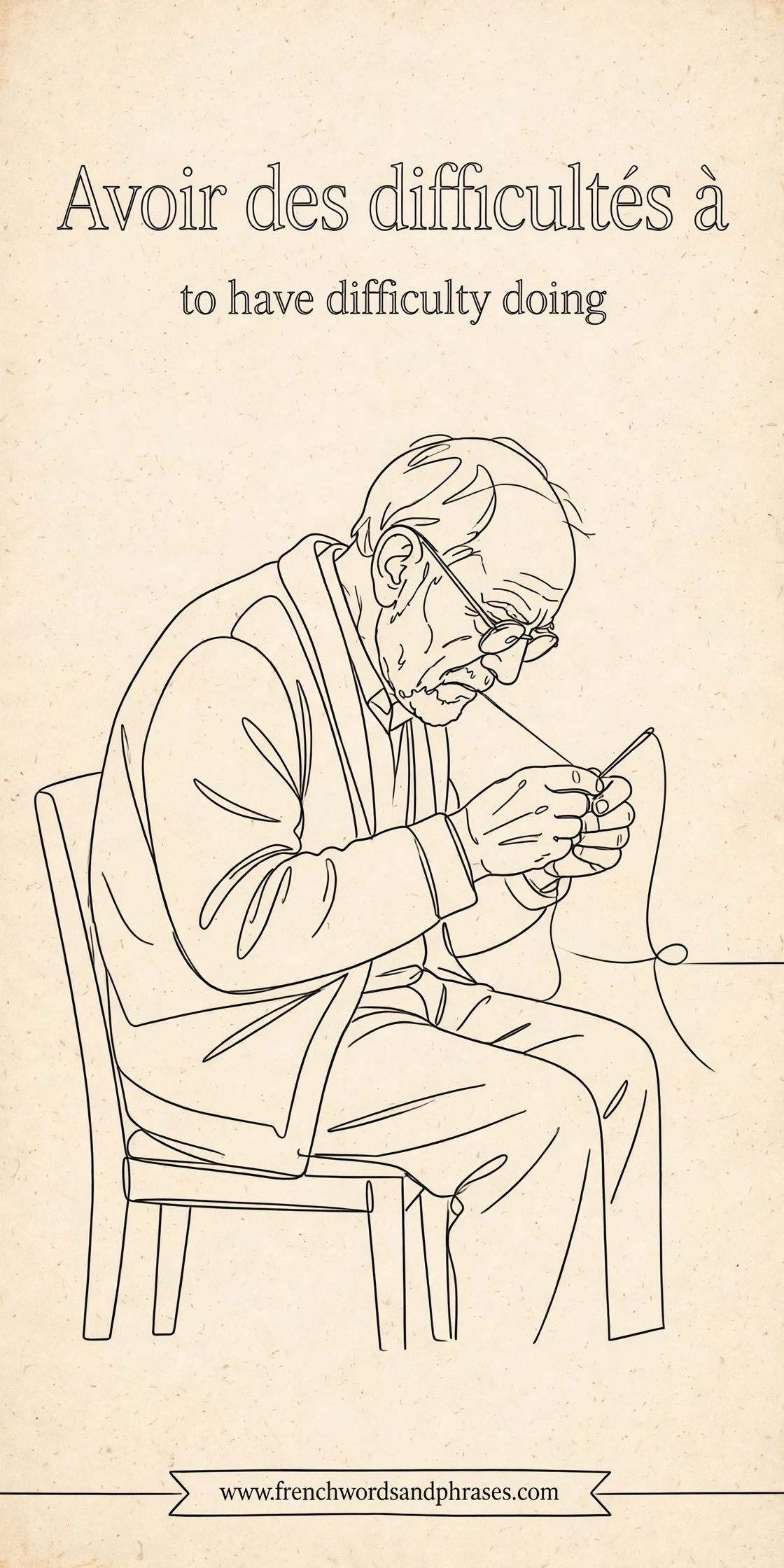
Avoir des difficultés à means to have difficulty doing — to find something hard to do.
Evening class, third row. The teacher asks everyone to read a paragraph aloud, and the man beside you whispers an apology before he begins: his reading is slow, the words arrive one by one. Afterwards he shrugs, half smiling: « J’ai des difficultés à lire en français, mais je continue. » Nobody laughs — half the room feels exactly the same.
Let’s explore how avoir des difficultés à works in French, beginning with the whole phrase on one card.
Understanding the French Phrase Avoir des difficultés à
Avoir des difficultés à is a French expression built from avoir (to have), des difficultés (difficulties, plural) and à followed by an infinitive. It is the honest, neutral way to say that doing something costs you real effort.
It means to have difficulty doing something — to find a task hard: reading, sleeping, walking, understanding. Nobody is describing a mountain: difficultés are the friction inside an ordinary action, the extra weight on a simple verb. The phrase is kind, because it names the struggle without blaming the person who struggles.
Type: Expression — effort (avoir + plural noun + à + infinitive)
Answers the need: Saying that doing something is genuinely hard for you
Register: Neutral — school, work, doctors and everyday honesty
Strength: Real but not dramatic — a true difficulty, not an impossibility
One important usage detail: à is always followed by the infinitive — avoir des difficultés à lire, à marcher, à dormir. The difficulties are plural with des in the standard phrase. The close everyday twin is avoir du mal à, which feels a touch more personal and spoken; avoir des difficultés à is the version for reports, teachers and doctors.
Experience the Word
Avoir des difficultés à is the phrase that turns shame into information — it says where the friction is, and friction can be worked on.
Imagine the swimming teacher watching a boy at the edge of the pool. He is not afraid of the water; he simply has des difficultés à coordonner les bras — his arms will not yet agree with each other. Naming it precisely is the first lesson: now everyone knows what to practise.
French pluralises the difficulty, and there is mercy in that. Not one great wall — several small stones, and stones can be moved one by one.
How to Use Avoir des difficultés à in French: Complete Guide
Let’s explore how avoir des difficultés à works in French, beginning with the whole phrase on one card.
Avoir des difficultés à at a Glance
The Whole Phrase on One Card
Real meaning, literal picture, English twin and register — avoir des difficultés à in five lines.
| Point | Avoir des difficultés à |
|---|---|
| What it really means | to have difficulty doing something — to find it hard |
| Word for word | to have difficulties at — several small stones on the path |
| English equivalent | to have difficulty doing / to struggle to do |
| Register | neutral — school, health, work and honest conversation |
| Use it for | learning, reading, walking, sleeping, understanding, remembering |
Example
Elle a des difficultés à monter les escaliers.
She has difficulty climbing the stairs.
Word by Word: Building the Friction
Three small pieces — take them one by one and the effort becomes visible.
| Word | Literal meaning | Its job in the phrase |
|---|---|---|
| avoir | to have | the verb that carries the phrase — it alone conjugates |
| des difficultés | difficulties | a feminine plural noun — the struggle comes as several stones, not one wall |
| à | at, to | the hinge before the infinitive that names the hard action |
Example
Il a des difficultés à se lever le matin.
He has difficulty getting up in the morning.
Quick Quiz 1
What follows à in avoir des difficultés à — an infinitive or a noun?
Reveal the answer
An infinitive — the hard action itself: à lire, à marcher, à dormir.
Nous avons des difficultés à comprendre son accent.
We have difficulty understanding his accent.
When You Say It: The Struggle Moments
Avoir des difficultés à fires at moments like these — wherever an ordinary action costs unusual effort.
| Situation | Example |
|---|---|
| At school | il a des difficultés à lire — he has difficulty reading |
| After an injury | elle a des difficultés à marcher — she has difficulty walking |
| Sleep | j’ai des difficultés à m’endormir — I have difficulty falling asleep |
| At work | nous avons des difficultés à recruter — we are having difficulty recruiting |
| Learning a language | ils ont des difficultés à prononcer ce mot — they have difficulty saying this word |
Example
Depuis son accident, il a des difficultés à conduire.
Since his accident, he has difficulty driving.
Make It Yours: The Struggle for Every Person
Avoir conjugates, difficultés stays plural, and à hands over to your own hard verb.
| Form | French | In English |
|---|---|---|
| I have difficulty | j’ai des difficultés à | I have difficulty doing |
| She had difficulty | elle avait des difficultés à | she had difficulty doing |
| We will have difficulty | nous aurons des difficultés à | we will have difficulty doing |
| Many difficulties | de grandes difficultés à | great difficulty doing |
| Fewer now | moins de difficultés à | less difficulty doing |
| Question | tu as des difficultés à respirer ? | are you having difficulty breathing? |
Example
Tu as des difficultés à respirer ? Assieds-toi.
Are you having difficulty breathing? Sit down.
Quick Quiz 2
Which twin is warmer and more spoken — avoir des difficultés à or avoir du mal à?
Reveal the answer
Avoir du mal à — it is the everyday, personal version. Avoir des difficultés à is the neutral one, at home in reports and classrooms.
J’ai du mal à me lever tôt, mais je vais y arriver.
I have trouble getting up early, but I’ll get there.
Everyday Expressions: Building on the Friction
Avoir des difficultés à slots into these everyday frames — each one ready to use as it stands.
| Frame | In English |
|---|---|
| avoir des difficultés à + infinitive | to have difficulty doing something |
| rencontrer des difficultés | to run into difficulties |
| sans difficulté | without difficulty, easily |
| en difficulté | in difficulty, in trouble |
| surmonter une difficulté | to overcome a difficulty |
Example
Le bateau en difficulté a été secouru à l’aube.
The boat in difficulty was rescued at dawn.
Close Cousins: The Other Ways to Struggle
French has a whole shelf of effort phrases — avoir des difficultés à is the honest report; its cousins suffer, sweat or give up sooner.
| Expression | The difference |
|---|---|
| avoir des difficultés à | to have difficulty doing — neutral, precise, report-like |
| avoir du mal à | to have trouble doing — the warm, everyday twin |
| peiner à | to labour to, to struggle to — literary in flavour |
| galérer | to struggle hard — informal, the word of real hardship and hassle |
| ne pas arriver à | to not manage to — the result is failure, not just friction |
Example
Il peine à finir ses phrases quand il est fatigué.
He struggles to finish his sentences when he is tired.
Quick Quiz 3
You tried three times and the door never opened. Avoir des difficultés à or ne pas arriver à?
Reveal the answer
Ne pas arriver à — the difficulty phrases describe friction; ne pas arriver à reports that it did not happen at all.
Je n’arrive pas à ouvrir cette fenêtre.
I can’t manage to open this window.
Avoir des difficultés à and Its Neighbours
The effort shelf around the phrase — from the first stone to the summit.
| French | In English |
|---|---|
| une difficulté | a difficulty |
| un effort | an effort |
| surmonter | to overcome |
| progresser | to make progress |
| un obstacle | an obstacle |
| réussir à | to manage to, to succeed in |
Example
À force d’efforts, elle a réussi à nager un kilomètre.
With steady effort, she managed to swim a kilometre.
Watch Out: The Traps Around Avoir des difficultés à
The traps: an English gerund that changes shape, a plural that matters, and a cousin that means money trouble.
| Trap | The truth |
|---|---|
| English ‘difficulty doing’ | after à, French uses the infinitive, never a French -ant form: difficultés à lire, not à lisant |
| plural by default | the standard phrase is plural — des difficultés; the singular une difficulté names one specific problem |
| des difficultés financières | with money, difficultés changes meaning: financial difficulties, money trouble — context decides |
| not impossible | avoir des difficultés à says hard, not impossible — for impossible, say impossible de or ne pas pouvoir |
Example
Elle a des difficultés à épargner, mais elle y arrive.
She has difficulty saving, but she manages it.
Quick Quiz 4
True or false: avoir des difficultés à means the thing cannot be done at all.
Reveal the answer
False — it means the thing is hard, with friction. The action usually still happens, slowly and with effort.
Il a des difficultés à marcher, mais il marche tous les jours.
He has difficulty walking, but he walks every day.
Avoir des difficultés à in Everyday French: Real-Life Examples
Now that you know the word, let’s see how avoir des difficultés à appears in everyday French.
Example 1 — At school
Mon fils a des difficultés à se concentrer en classe.
My son has difficulty concentrating in class.
Example 2 — After surgery
Elle a des difficultés à plier le genou.
She has difficulty bending her knee.
Example 3 — Sleep
J’ai des difficultés à dormir depuis quelques semaines.
I have had difficulty sleeping for a few weeks.
Example 4 — At work
L’entreprise a des difficultés à trouver du personnel.
The company is having difficulty finding staff.
Example 5 — Learning
Ils ont des difficultés à retenir les dates.
They have difficulty remembering the dates.
Example 6 — Honest answer
Oui, j’ai des difficultés à dire non.
Yes, I have difficulty saying no.
Beyond Translation: The Meaning of Avoir des difficultés à
English has difficulty — one solid block of a noun, singular and heavy. French scatters it into des difficultés, a plural: not a wall but a scatter of stones across the path, each one small enough to step over or move.
Avoir des difficultés à is pessimism refused — the struggle is real, and it comes in movable pieces.
Teachers and doctors love the phrase for exactly that reason: what is plural can be listed, and what can be listed can be treated.
How to Remember the French Phrase Avoir des difficultés à
Remember it this way: Avoir des difficultés à is a path with stones on it — hard walking, but every stone can be moved.
- You picture the stones — des difficultés is plural: not one wall, but several small obstacles.
- You finish with à + infinitive — à lire, à marcher, à dormir: the hard action is always a verb in its base form.
- You keep the twins apart — des difficultés for the report, du mal for the friend.
The key idea is avoir des difficultés à means to have difficulty doing — stones on the path, not a wall.
Test Your Knowledge of Avoir des difficultés à
Let’s see how much you’ve learned. Try answering these questions before revealing the answers.
Question 1
What does avoir des difficultés à mean?
Reveal the answer
To have difficulty doing something — to find an action genuinely hard.
Question 2
What follows à in the phrase?
Reveal the answer
An infinitive — à lire, à marcher, à dormir. Never a French -ant form.
Question 3
How do you say ‘she has difficulty climbing the stairs’?
Reveal the answer
Elle a des difficultés à monter les escaliers — avoir conjugates, difficultés stays plural.
Question 4
What is the warmer, more spoken twin of the phrase?
Reveal the answer
Avoir du mal à — same meaning, more personal; des difficultés is the neutral, report-style version.
Question 5
Complete the sentence:
Il a des ______ à se concentrer. (He has difficulty concentrating.)
Reveal the answer
difficultés
Il a des difficultés à se concentrer.
He has difficulty concentrating.
Your Final Challenge
Can You Use It?
How would you say this in French?
“She has difficulty climbing the stairs.”
Reveal the answer
Elle a des difficultés à monter les escaliers.
She has difficulty climbing the stairs.
A little French. A little curiosity. A richer everyday life.
LEARN FRENCH ONE WORD AT A TIME