A French Word to Live By
Translate Couteau to English
/ku.to/
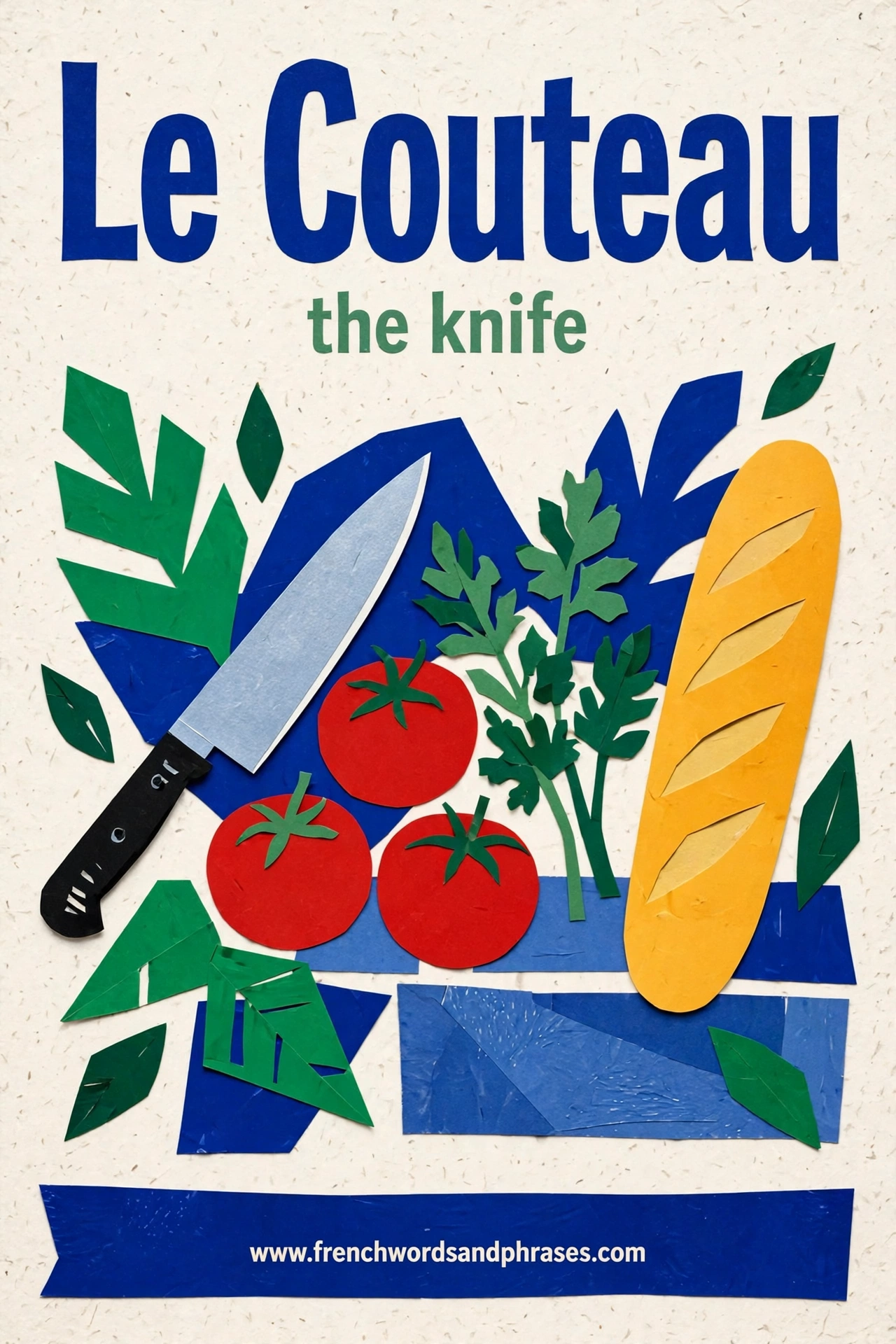
Le couteau means the knife.
Sunday lunch is roasting in the oven, the bread is still warm, and the grandfather reaches for the drawer with the ceremony of long habit: out comes le couteau, the good one, the one that has sliced a thousand roasts. In a French kitchen, the knife is never just a tool.
In this guide, you’ll learn what couteau means in English, how to use it with its articles, how to form its plural, and how it appears in everyday French. Explore French examples, English translations, and practice quizzes.
Understanding the French Noun Couteau
Couteau is a masculine French noun, learned with its article: le couteau, un couteau. Its plural follows the famous -eau rule: words ending in -eau take an -x, not an -s — les couteaux. Learn it here and you have gâteau, bateau and chapeau for free.
It means the knife — the blade on the table and in the kitchen: un couteau de cuisine (a kitchen knife), un couteau de poche (a pocket knife), un couteau à pain (a bread knife). France even gave the world a legendary pocket knife, l’Opinel, born in Savoie and carried by farmers, hikers and grandfathers for over a century. And in the language of idioms, the couteau is sharp in every sense — it appears in threats, quarrels and wounds that are not only physical.
Gender: Masculine
Definite article: le — le couteau (the knife)
Indefinite article: un — un couteau (a knife)
Plural: les couteaux — nouns in -eau take -x
Parts: la lame (the blade), le manche (the handle)
English equivalents: The knife.
One important usage detail: at a French table you will meet le couteau beside every plate, but the full place setting has its own name — les couverts, cutlery. And when two old friends fall out badly, French says they are à couteaux tirés — at daggers drawn, literally « with knives pulled out ».
Experience the Word
Couteau is more than cutlery. It is the oldest tool in the house — older than the fork, older than the plate — and in France it still carries a whiff of the countryside: the farmer’s Opinel, opened with two hands, used for bread, cheese, string and life’s small repairs.
Imagine the market at closing time: the cheese seller wraps your tomme, then wipes his couteau on his apron with the ease of a man who has done it ten thousand times.
You have not just picked up a blade. You have taken hold of the tool that built a thousand meals.
How to Use Couteau in French: Complete Guide
Let’s explore how couteau works in French, beginning with its articles — and watch for that -x in the plural.
Couteau with the Definite Article (Le, Les)
Used for the knife everyone knows — the one in the drawer, the one on the table.
| Form | French |
|---|---|
| Singular | le couteau |
| Plural | les couteaux |
Example
Le couteau est dans le tiroir de la cuisine.
The knife is in the kitchen drawer.
Couteau with the Indefinite Article (Un, Des)
Used for a knife in general — any knife that will do the job.
| Form | French |
|---|---|
| Singular | un couteau |
| Plural | des couteaux |
Example
Passe-moi un couteau pour couper le pain.
Pass me a knife to cut the bread.
Couteau in Sets and Quantities
Knives come in sets, pairs and drawers — the words French uses to count and gather them.
| Expression | In English |
|---|---|
| un jeu de couteaux | a set of knives |
| une paire de couteaux | a pair of knives |
| la pointe du couteau | the tip of the knife |
| un tiroir de couteaux | a drawer of knives |
| un couteau sur deux | one knife in two |
Example
Elle a acheté un jeu de couteaux japonais.
She bought a set of Japanese knives.
Quick Quiz 1
Complete the sentence:
Il coupe la viande avec ______ grand couteau.
Reveal the answer
un
Il coupe la viande avec un grand couteau.
He is cutting the meat with a big knife.
The Plural of Couteau
The -eau rule: couteau adds an -x, like gâteau and bateau — les couteaux.
| Number | French |
|---|---|
| Singular | le couteau |
| Plural | les couteaux |
Example
Les couteaux sont rangés dans le tiroir du haut.
The knives are kept in the top drawer.
Couteau with Possessive Adjectives (Mon, Ton, Son…)
Possessives agree with the noun: couteau is masculine, so it takes mon, ton, son.
| Owner | French |
|---|---|
| my | mon couteau |
| your (tu) | ton couteau |
| his / her | son couteau |
| our | notre couteau |
| your (vous) | votre couteau |
| their | leur couteau |
Example
Mon couteau de poche ne me quitte jamais en randonnée.
My pocket knife never leaves me when I go hiking.
Quick Quiz 2
Complete the sentence:
______ couteaux sont sur la table. (Their)
Reveal the answer
Leurs
Leurs couteaux sont sur la table.
Their knives are on the table — leur takes an -s before a plural noun.
Couteau with Demonstrative Adjectives (Ce, Ces)
Used to point at one knife among several — ce couteau-là, that one there.
| Form | French |
|---|---|
| Singular | ce couteau |
| Plural | ces couteaux |
Example
Ce couteau coupe comme un rasoir.
This knife cuts like a razor.
Couteau with Adjectives
Adjectives agree with couteau — a sharp knife, an old knife, a Swiss knife.
| Adjective | With Couteau |
|---|---|
| aiguisé (sharp) | un couteau aiguisé |
| vieux (old) | un vieux couteau |
| suisse (Swiss) | un couteau suisse |
| petit (small) | un petit couteau |
| long (long) | un long couteau |
Example
Il faut un couteau bien aiguisé pour ce rôti.
You need a really sharp knife for this roast.
Quick Quiz 3
Complete the sentence:
Les ______ sont dans le tiroir. (knives)
Reveal the answer
couteaux
Les couteaux sont dans le tiroir.
The knives are in the drawer — couteau takes an -x in the plural, never an -s.
Everyday Expressions with Couteau
Knives at the table and knives in the language — the expressions that give couteau its edge.
| Expression | In English |
|---|---|
| un couteau suisse | a Swiss army knife |
| à couteaux tirés | at daggers drawn, on very bad terms |
| remuer le couteau dans la plaie | to rub salt into the wound |
| mettre le couteau sous la gorge de quelqu’un | to hold a knife to someone’s throat, to force their hand |
| un couteau à beurre | a butter knife |
| être sur le fil du couteau | to be on a knife’s edge |
Example
Depuis leur dispute, les deux frères sont à couteaux tirés.
Since their argument, the two brothers have been at daggers drawn.
Words from the Same Family as Couteau
Blades, cutlers and cutting — the words that travel with couteau.
| French | In English |
|---|---|
| la coutellerie | the cutlery trade; a cutler’s shop |
| le coutelier | the cutler, the knife-maker |
| les couverts | cutlery, the place setting |
| la lame | the blade |
| aiguiser | to sharpen |
| couper | to cut |
Example
Thiers est la capitale française de la coutellerie.
Thiers is the French capital of cutlery-making.
Quick Quiz 4
What does être à couteaux tirés mean?
Reveal the answer
To be at daggers drawn — to be on very bad terms with someone.
Les voisins sont à couteaux tirés depuis des mois.
The neighbours have been at daggers drawn for months.
Couteau in Everyday French: Real-Life Examples
Now that you know the word, let’s see how couteau appears in everyday French.
Example 1 — In the kitchen
Passe-moi le couteau à pain, s’il te plaît.
Pass me the bread knife, please.
Example 2 — Setting the table
Mets les couteaux à droite des assiettes.
Put the knives to the right of the plates.
Example 3 — On a hike
Il ouvre son couteau suisse pour couper la corde.
He opens his Swiss army knife to cut the rope.
Example 4 — A warning
Attention, ce couteau coupe très bien !
Careful, that knife is very sharp!
Example 5 — A quarrel
Les deux associés sont à couteaux tirés.
The two business partners are at daggers drawn.
Example 6 — Shopping
Elle cherche un couteau de cuisine de bonne qualité.
She is looking for a good-quality kitchen knife.
Beyond Translation: The Meaning of Couteau
France is a country of knives with names and addresses: the Laguiole of Aubrac, with its little bee on the handle; the Opinel of Savoie, humble and perfect since 1890; the great cutlery town of Thiers, forging blades since the Middle Ages. A French couteau is inherited, sharpened, argued over — grandfathers test the edge with a thumb and pronounce judgement like wine critics.
To say couteau is to hold the oldest tool of the French table.
It evokes the farmhouse drawer and the market stall, the roast carved on Sunday, and the pocket knife that opens letters, trims string and slices apples at a picnic.
How to Remember the French Noun Couteau
Remember it this way: Couteau is the knife — masculine, le couteau — and its plural wears the elegant -x of all -eau words: les couteaux.
- You see -eau — couteau, gâteau, bateau — the plural takes -x.
- You quarrel badly — à couteaux tirés, knives drawn.
- You hike in France — un Opinel dans la poche, le couteau de tout le monde.
The key idea is le couteau, les couteaux — -eau words take -x.
Test Your Knowledge of Couteau
Let’s see how much you’ve learned. Try answering these questions before revealing the answers.
Question 1
Is couteau masculine or feminine?
Reveal the answer
Masculine — le couteau, un couteau.
Question 2
What is the plural of couteau?
Reveal the answer
Les couteaux — nouns ending in -eau take an -x in the plural.
Question 3
Translate: Pass me a knife, please.
Reveal the answer
Passe-moi un couteau, s’il te plaît.
Question 4
What is un couteau suisse?
Reveal the answer
A Swiss army knife — the famous multi-tool pocket knife.
Question 5
Complete the sentence:
Elle range ______ couteaux dans le tiroir.
Reveal the answer
les
Elle range les couteaux dans le tiroir.
She is putting the knives away in the drawer.
Your Final Challenge
Can You Use It?
How would you say this in French?
“The knives are in the top drawer.”
Reveal the answer
Les couteaux sont dans le tiroir du haut.
The knives are in the top drawer.
A little French. A little curiosity. A richer everyday life.
LEARN FRENCH ONE WORD AT A TIME