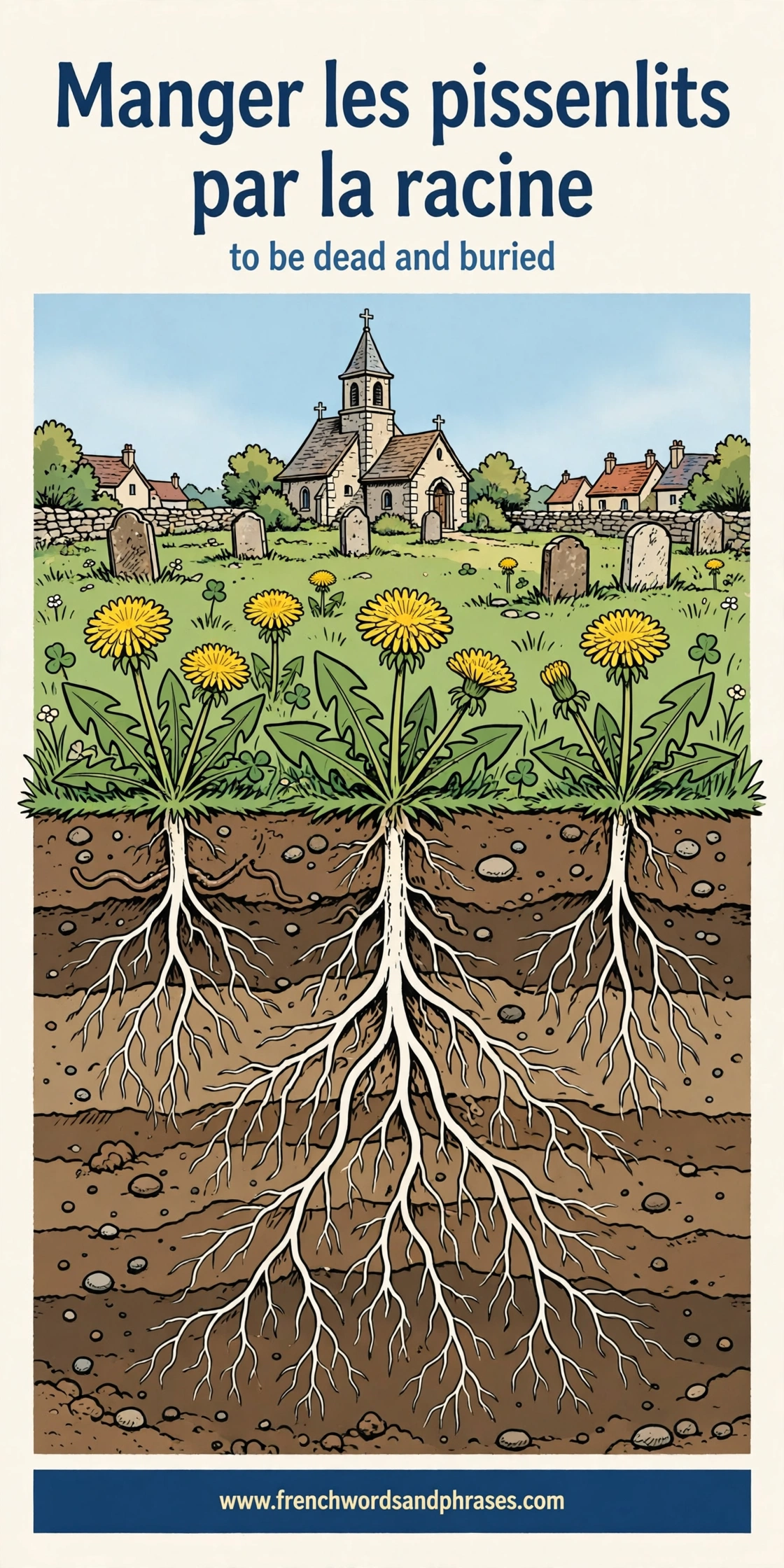
A French Word to Live By
Translate Manger les pissenlits par la racine to English
/mɑ̃.ʒe le pis.ɑ̃.li paʁ la ʁa.sin/
Manger les pissenlits par la racine means to be dead and buried — the French way of saying someone is pushing up daisies.
At the café, the talk turns to old Monsieur Fabre, who kept the bakery forty years ago and terrified every apprentice in the valley. Someone asks whether he is still alive, and the oldest man at the table shakes his head gently: « Lui ? Il mange les pissenlits par la racine depuis longtemps. » — he’s been eating dandelions by the root for a long time now.
Let’s explore how manger les pissenlits par la racine works in French, beginning with the whole phrase on one card.
Understanding the French Phrase Manger les pissenlits par la racine
Manger les pissenlits par la racine is a French idiomatic expression built from manger (to eat), les pissenlits (the dandelions) and par la racine (by the root). It is the humorous, earthy French way of saying someone is dead and buried — the exact counterpart of English ‘pushing up daisies’.
It means to be dead and buried. Nobody is dining: the picture is of a grave in a country churchyard, where dandelions grow over the sleeper — and the sleeper, lying beneath, is imagined eating them from underneath, root first. It is death told as a joke by people who buried their dead in flower-covered ground and were not afraid of the subject.
Type: Idiomatic expression — death, humorously (verb + noun + par-phrase)
Answers the need: Saying someone is long dead, with a wink instead of a shudder
Register: Informal, humorous — for distant deaths and old stories, never fresh grief
Strength: Definitive — dead and buried, usually for a long time
One important usage detail: the phrase almost always comes with a duration — depuis longtemps, depuis dix ans — because its home is the death discovered years later or recalled in an anecdote. The verb conjugates normally: il mange, ils mangeaient les pissenlits par la racine. Never use it of a recent bereavement: it is for ancestors, old villains of village stories, and tyrants of long ago.
Experience the Word
Manger les pissenlits par la racine is the churchyard joke of rural France — death answered with a flower and a shrug.
Imagine asking after the fearsome schoolmistress of your grandfather’s childhood, the one whose ruler ruled three generations. Your grandfather smiles into his soup. She has been eating dandelions by the root since before you were born — and somehow the sentence is affectionate, because the whole village is in that churchyard together, flowers and all.
French is famous for laughing at the grave’s edge. The dandelion is the humblest flower in France — and the one that outlives every gardener.
How to Use Manger les pissenlits par la racine in French: Complete Guide
Let’s explore how manger les pissenlits par la racine works in French, beginning with the whole phrase on one card.
Manger les pissenlits par la racine at a Glance
The Whole Phrase on One Card
Real meaning, literal picture, English twin and register — manger les pissenlits par la racine in five lines.
| Point | Manger les pissenlits par la racine |
|---|---|
| What it really means | to be dead and buried — usually for a long time |
| Word for word | to eat the dandelions by the root |
| English equivalent | to push up daisies / to be six feet under |
| Register | informal, humorous — old stories and distant deaths only |
| Use it for | ancestors, village legends, long-gone tyrants |
Example
Le vieux meunier mange les pissenlits par la racine depuis 1980.
The old miller has been pushing up daisies since 1980.
Word by Word: Building the Churchyard
Four small pieces — take them one by one and the grass closes over.
| Word | Literal meaning | Its job in the phrase |
|---|---|---|
| manger | to eat | the grim joke itself — the buried are imagined dining underground |
| les pissenlits | the dandelions | the flowers that grow on old graves — the humblest weed in France |
| par | by, through | the direction of the eating: from below, underground side first |
| la racine | the root | the end of the plant that touches the grave — you eat a dandelion from the top; the dead start at the root |
Example
Elle mange les pissenlits par la racine, comme tous les anciens du village.
She is pushing up daisies, like all the village elders.
Quick Quiz 1
Why par la racine — why does the eater start at the root?
Reveal the answer
Because he is underneath — buried below the flowers, he meets the root first. The whole joke is the viewpoint from under the grass.
D’en bas, on mange les pissenlits par la racine.
From below, you eat dandelions by the root.
When You Say It: The Long-Gone Moments
Manger les pissenlits par la racine fires at moments like these — someone asks after a person time has taken.
| Situation | Example |
|---|---|
| Asking after an old teacher | madame Roux ? elle mange les pissenlits par la racine depuis vingt ans — Madame Roux? she’s been gone twenty years |
| Village history | le fondateur de la foire mange les pissenlits par la racine depuis 1902 — the fair’s founder has been dead since 1902 |
| A family anecdote | ton arrière-grand-père mange les pissenlits par la racine, mais ses histoires vivent — your great-grandfather is gone, but his stories live |
| A feared figure, softened | le vieux directeur mange les pissenlits par la racine, on peut en rire maintenant — the old headmaster is long dead, we can laugh now |
| With a date | ils mangent les pissenlits par la racine depuis la guerre — they have been dead since the war |
Example
Tous les témoins de cette époque mangent les pissenlits par la racine.
All the witnesses of that era are long dead and buried.
Make It Yours: The Dandelions for Every Sleeper
Manger is a regular -er verb with a soft g before a and o — nous mangeons. The duration depuis does the time-keeping.
| Form | French | In English |
|---|---|---|
| He is long gone | il mange les pissenlits par la racine | he is pushing up daisies |
| Since when | il mange les pissenlits par la racine depuis dix ans | he has been dead for ten years |
| They are all gone | ils mangent les pissenlits par la racine | they are all dead and buried |
| In the past, discovered | il mangeait déjà les pissenlits par la racine | he was already long dead |
| The whole generation | toute sa génération mange les pissenlits par la racine | his whole generation is gone |
| Question | il mange les pissenlits par la racine depuis quand ? | how long has he been dead? |
Example
Le boulanger de mon enfance mange les pissenlits par la racine depuis 1995.
The baker of my childhood has been dead since 1995.
Quick Quiz 2
Your neighbour’s mother died last week. Can you say she mange les pissenlits par la racine?
Reveal the answer
No — the phrase is a joke for distant deaths and old stories. For fresh grief, say simply elle est décédée.
Pour un deuil récent, on dit : elle est décédée.
For a recent bereavement, you say: she has passed away.
Everyday Expressions: Building on the Dandelions
Manger les pissenlits par la racine slots into these everyday frames — each one ready to use as it stands.
| Frame | In English |
|---|---|
| manger les pissenlits par la racine | to be dead and buried, to push up daisies |
| manger les pissenlits par la racine depuis longtemps | to have been dead for a long time |
| aller manger les pissenlits par la racine | to go and join the dead — joking about the future |
| ils mangent tous les pissenlits par la racine | they are all dead and buried |
| bientôt, on mangera les pissenlits par la racine | soon we’ll all be pushing up daisies — gallows humour |
Example
Les fondateurs du club mangent tous les pissenlits par la racine.
The club’s founders are all dead and buried.
Close Cousins: The Other Ways to Be Gone
French has a whole shelf of death phrases — the pissenlits are the laughing ones; its cousins whisper, formalise or philosophise.
| Expression | The difference |
|---|---|
| manger les pissenlits par la racine | dead and buried — humorous, for distant deaths |
| être décédé | to have passed away — the neutral, respectful standard |
| casser sa pipe | to kick the bucket — humorous like the pissenlits, but about the moment of dying |
| passer l’arme à gauche | to die — an old soldier’s euphemism, dated and jocular |
| reposer au cimetière | to rest in the cemetery — gentle, descriptive, no joke |
Example
Il est décédé en 1970 ; depuis, il mange les pissenlits par la racine.
He passed away in 1970; he has been pushing up daisies ever since.
Quick Quiz 3
Which cousin names the moment of dying rather than the long burial — casser sa pipe or reposer au cimetière?
Reveal the answer
Casser sa pipe — to kick the bucket: it is the dying itself, told as a joke. Reposer au cimetière simply says where someone rests.
Le vieil acteur a cassé sa pipe à quatre-vingt-dix ans.
The old actor kicked the bucket at ninety.
Manger les pissenlits par la racine and Its Neighbours
The churchyard shelf around the phrase — flowers, roots and resting places.
| French | In English |
|---|---|
| un pissenlit | a dandelion |
| une racine | a root |
| un cimetière | a cemetery |
| une tombe | a grave, a tomb |
| être enterré | to be buried |
| un ancêtre | an ancestor |
Example
Sur sa tombe poussent des pissenlits chaque printemps.
Dandelions grow on his grave every spring.
Watch Out: The Traps Around Manger les pissenlits par la racine
The traps: a salad, a timing offence, and a flower with a rude second name.
| Trap | The truth |
|---|---|
| the salad trap | dandelions are genuinely eaten in France — une salade de pissenlits is a spring dish; only par la racine turns lunch into the grave |
| the timing trap | the joke needs distance — years, ideally decades; used of a fresh death it is cruel, not funny |
| the name trap | pissenlit is the polite name; the plant’s earthy nickname exists, but the idiom always uses pissenlit — keep it that way |
| depuis does the dating | the phrase usually carries depuis longtemps or a year — without it, the sentence sounds unfinished |
Example
Au printemps, on mange les pissenlits en salade ; par la racine, c’est une autre histoire.
In spring, you eat dandelions in a salad; by the root, that’s another story.
Quick Quiz 4
True or false: without par la racine, the phrase still means to be dead.
Reveal the answer
False — manger les pissenlits alone is eating a salad. The root is what puts the eater underground.
La salade de pissenlits se mange par les feuilles, pas par la racine.
Dandelion salad is eaten by the leaves, not by the root.
Manger les pissenlits par la racine in Everyday French: Real-Life Examples
Now that you know the word, let’s see how manger les pissenlits par la racine appears in everyday French.
Example 1 — At the café
Monsieur Fabre ? Il mange les pissenlits par la racine depuis longtemps.
Monsieur Fabre? He’s been dead and buried for a long time.
Example 2 — The old school
Mon institutrice mange les pissenlits par la racine depuis 1985.
My schoolteacher has been pushing up daisies since 1985.
Example 3 — Family stories
Tous les frères de grand-père mangent les pissenlits par la racine.
All of grandfather’s brothers are dead and buried.
Example 4 — The village legend
Le maire de 1920 mange les pissenlits par la racine, mais la foire continue.
The mayor of 1920 is long gone, but the fair goes on.
Example 5 — Gallows humour
À notre âge, la moitié de la classe mange les pissenlits par la racine.
At our age, half the class is pushing up daisies.
Example 6 — The soft answer
Elle ne viendra plus : elle mange les pissenlits par la racine.
She won’t come any more: she is dead and buried.
Beyond Translation: The Meaning of Manger les pissenlits par la racine
The two languages bury their dead under the same flowers and tell the same joke in mirror image. English pushes the daisies up from below; French eats the dandelions down from below. Both refuse the Latin, the marble, the official word — a weed, a root and a grin do the work of a funeral oration.
To manger les pissenlits par la racine is to be compost and anecdote at once — gone, and still at the café table.
Use it for the long-gone, tell it with the date attached, and the phrase stays what it was made to be: affection disguised as irreverence.
How to Remember the French Phrase Manger les pissenlits par la racine
Remember it this way: Manger les pissenlits par la racine is the grave seen from underneath — the flowers are real, and so is the appetite.
- You picture the churchyard from below — the dead meet the dandelion at its racine, its root, because they lie underneath it.
- You attach the date — depuis longtemps, depuis 1980: this phrase belongs to distant deaths.
- You keep it kind — ancestors and legends only; fresh grief takes être décédé, never the dandelions.
The key idea is manger les pissenlits par la racine means to be dead and buried — to push up daisies, eaten from below.
Test Your Knowledge of Manger les pissenlits par la racine
Let’s see how much you’ve learned. Try answering these questions before revealing the answers.
Question 1
What does manger les pissenlits par la racine mean?
Reveal the answer
To be dead and buried — the French equivalent of pushing up daisies, used humorously of distant deaths.
Question 2
What is the literal, word-for-word meaning?
Reveal the answer
To eat the dandelions by the root — the buried person is imagined eating the grave’s flowers from underneath.
Question 3
How do you say ‘he has been dead for twenty years’ with the phrase?
Reveal the answer
Il mange les pissenlits par la racine depuis vingt ans — depuis carries the duration.
Question 4
When must you NOT use the phrase?
Reveal the answer
For a recent death — it is a joke for the long-gone; fresh grief takes être décédé.
Question 5
Complete the sentence:
Le vieux meunier mange les pissenlits par la ______. (The old miller is pushing up daisies.)
Reveal the answer
racine
Le vieux meunier mange les pissenlits par la racine.
The old miller is pushing up daisies.
Your Final Challenge
Can You Use It?
How would you say this in French?
“He has been dead and buried for years.”
Reveal the answer
Il mange les pissenlits par la racine depuis des années.
He has been dead and buried for years.
A little French. A little curiosity. A richer everyday life.
LEARN FRENCH ONE WORD AT A TIME