A French Word to Live By
Translate Mettre la main à la pâte to English
/mɛtʁ la mɛ̃ a la pɑt/
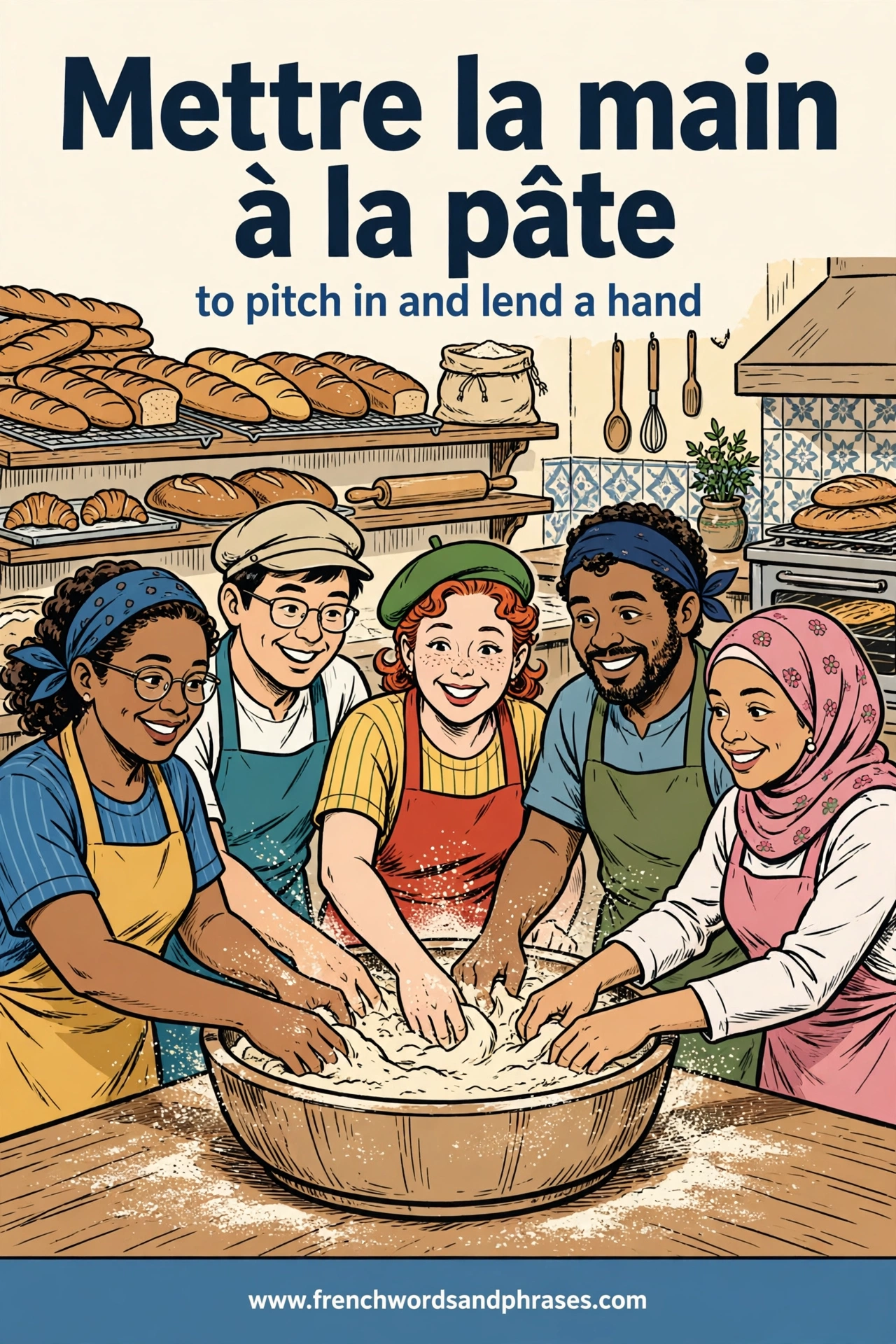
Mettre la main à la pâte means to pitch in and lend a hand — to join in the work yourself instead of watching.
The village hall is chaos an hour before the fête: tables to carry, onions to chop, a hundred crêpes to make. The mayor takes off his jacket, rolls up his sleeves and grabs a bowl. Nobody gives a speech about teamwork — in French, the gesture has its own words: « Il faut mettre la main à la pâte. »
Let’s explore how mettre la main à la pâte works in French, beginning with the whole phrase on one card.
Understanding the French Phrase Mettre la main à la pâte
Mettre la main à la pâte is a French idiomatic expression built from mettre (to put), la main (the hand) and la pâte (dough, pastry). Its home is the bakery and the farmhouse kitchen, where the dough will not knead itself — and where helping means flour on your own hands, not advice from the doorway.
It means to pitch in and lend a hand — to take a real, practical part in the work instead of supervising, commenting or watching. The picture is exact: the hand goes into the dough. French uses it for any shared task — a house move, a harvest, an office deadline — wherever the difference between a spectator and a helper is a pair of hands in the mixture.
Type: Idiomatic expression — work (verb + noun phrase)
Answers the need: Saying you will help with your own hands, not just your opinions
Register: Neutral — warm and approving, safe everywhere
Strength: Warm — praise for the doer, gentle reproach to the watcher
One important usage detail: the phrase can be an invitation, a promise or a reproach — allez, on met la main à la pâte ! (come on, let’s pitch in!), je vais mettre la main à la pâte (I’ll lend a hand), or il ne met jamais la main à la pâte (he never lifts a finger). The dough can be named for real tasks too: mettre la main à la pâte du déménagement is playful but understood.
Experience the Word
Mettre la main à la pâte is the French philosophy of help in five words: if your hands are clean, you are not helping.
Imagine the harvest supper being prepared for thirty people, and the one guest who ‘supervises’ from a chair with a glass in hand. The whole kitchen knows the word for him — the one who never puts his hand in the dough. And it knows the word for the stranger who silently starts peeling potatoes: one of us.
French trusts flour more than speeches. The dough tells the truth about who really helped.
How to Use Mettre la main à la pâte in French: Complete Guide
Let’s explore how mettre la main à la pâte works in French, beginning with the whole phrase on one card.
Mettre la main à la pâte at a Glance
The Whole Phrase on One Card
Real meaning, literal picture, English twin and register — mettre la main à la pâte in five lines.
| Point | Mettre la main à la pâte |
|---|---|
| What it really means | to pitch in and lend a hand — to do your share of the work |
| Word for word | to put your hand in the dough |
| English equivalent | to pitch in / to lend a hand / to muck in |
| Register | neutral and warm — praise for helpers, a nudge for watchers |
| Use it for | shared tasks, teamwork, appeals for help |
Example
Pour la fête du village, tout le monde met la main à la pâte.
For the village fête, everyone pitches in.
Word by Word: Building the Dough
Five small pieces — take them one by one and the sleeves roll up by themselves.
| Word | Literal meaning | Its job in the phrase |
|---|---|---|
| mettre | to put | the act itself — the hand goes in, not just the good intention |
| la main | the hand | your own hand, singular and personal — help is not delegated |
| à | to, in | the little word of contact — hand to dough |
| la pâte | the dough | the work itself, soft, sticky and waiting to be kneaded |
Example
La main dans la pâte, on ne peut plus reculer.
Hand in the dough, there is no backing out.
Quick Quiz 1
What is la pâte, and why does the phrase use it for work?
Reveal the answer
Dough — the baker’s mixture that only moves if a hand goes into it: the perfect picture of real help.
Sans main dans la pâte, pas de pain.
No hand in the dough, no bread.
When You Say It: The Pitching-In Moments
Mettre la main à la pâte fires at moments like these — a shared task, and hands are needed.
| Situation | Example |
|---|---|
| Rallying the team | allez, tout le monde met la main à la pâte ! — come on, everyone pitch in! |
| Promising help | je vais mettre la main à la pâte pour le déménagement — I’ll lend a hand with the move |
| Praising a helper | elle met toujours la main à la pâte — she always pitches in |
| Reproaching a watcher | lui, il ne met jamais la main à la pâte — him, he never lifts a finger |
| At the office | avant la deadline, chacun met la main à la pâte — before the deadline, everyone mucks in |
Example
Il ne met jamais la main à la pâte, mais il mange toujours le premier.
He never pitches in, but he always eats first.
Make It Yours: The Dough for Every Person
Mettre is irregular — je mets, il met, nous mettons — and the hand and the dough never change.
| Form | French | In English |
|---|---|---|
| I pitch in | je mets la main à la pâte | I pitch in |
| He pitches in | il met la main à la pâte | he pitches in |
| We pitch in | nous mettons la main à la pâte | we pitch in |
| Let’s pitch in | mettons la main à la pâte | let’s pitch in |
| He pitched in | il a mis la main à la pâte | he pitched in |
| Never | ne jamais mettre la main à la pâte | to never lift a finger |
Example
Mettons la main à la pâte, le travail sera vite fini.
Let’s pitch in, the work will soon be done.
Quick Quiz 2
Which form is right — il met or il mette la main à la pâte?
Reveal the answer
Il met — mettre drops to a single t in the present for je, tu and il.
Chaque matin, il met la main à la pâte à la boulangerie.
Every morning, he pitches in at the bakery.
Everyday Expressions: Building on the Dough
Mettre la main à la pâte slots into these everyday frames — each one ready to use as it stands.
| Frame | In English |
|---|---|
| mettre la main à la pâte | to pitch in, to lend a hand |
| tout le monde met la main à la pâte | everyone pitches in |
| ne jamais mettre la main à la pâte | to never lift a finger |
| donner un coup de main | to give a hand — the quicker, smaller help |
| retrousser ses manches | to roll up your sleeves — the gesture just before |
Example
Donner un coup de main, c’est bien ; mettre la main à la pâte, c’est mieux.
Giving a hand is good; pitching in properly is better.
Close Cousins: The Other Helping Hands
French has a whole shelf of helping phrases — the dough is the full commitment; its cousins help in smaller or different measures.
| Expression | The difference |
|---|---|
| mettre la main à la pâte | to pitch in fully — your hands in the work, start to finish |
| donner un coup de main | to give a hand — a shorter, lighter bout of help |
| aider | to help — the plain word, no picture at all |
| s’y mettre | to get down to it — starting at last, help or solo |
| ne pas lever le petit doigt | to not lift a finger — the watcher, condemned |
Example
Elle s’y est mise et elle a mis la main à la pâte jusqu’au bout.
She got down to it and pitched in right to the end.
Quick Quiz 3
A neighbour carries one box for you and leaves. Mettre la main à la pâte or donner un coup de main?
Reveal the answer
Donner un coup de main — one box is a quick hand. The pâte is for those who stay and work alongside you.
Merci pour le coup de main avec les cartons.
Thanks for the hand with the boxes.
Mettre la main à la pâte and Its Neighbours
The bakery shelf around the phrase — the dough, the hand, and the bread at the end.
| French | In English |
|---|---|
| la pâte | the dough |
| la farine | flour |
| pétrir | to knead |
| un boulanger | a baker |
| le pain | bread |
| retrousser ses manches | to roll up your sleeves |
Example
Le boulanger pétrit la pâte avant même le lever du soleil.
The baker kneads the dough before the sun is even up.
Watch Out: The Traps Around Mettre la main à la pâte
The traps: pasta that is not dough, a hand that must be yours, and helping that is only talk.
| Trap | The truth |
|---|---|
| the pasta trap | les pâtes (plural) are pasta; la pâte (singular) is dough or pastry — the idiom kneads, it does not boil |
| advice is not pâte | commenting, supervising and encouraging do not count — the phrase demands your own hand in the work |
| the hand is singular | la main, one hand — the phrase is fixed; les mains belongs to other idioms |
| not for solo work | doing your own job alone is just working; the pâte is shared work you join |
Example
Assez de conseils : mets la main à la pâte.
Enough advice: pitch in.
Quick Quiz 4
True or false: giving good advice from a chair counts as mettre la main à la pâte.
Reveal the answer
False — the whole point of the phrase is the hand in the dough: real, practical work.
Il parle beaucoup, mais il ne met jamais la main à la pâte.
He talks a lot, but he never pitches in.
Mettre la main à la pâte in Everyday French: Real-Life Examples
Now that you know the word, let’s see how mettre la main à la pâte appears in everyday French.
Example 1 — The village fête
Pour la fête, tout le village met la main à la pâte.
For the fête, the whole village pitches in.
Example 2 — The house move
Samedi, je mets la main à la pâte pour ton déménagement.
On Saturday, I’ll lend a hand with your move.
Example 3 — The reproach
Lui, il ne met jamais la main à la pâte.
Him, he never lifts a finger.
Example 4 — The rallying cry
Allez, on met la main à la pâte et on finit avant midi.
Come on, let’s pitch in and finish before noon.
Example 5 — At the office
Avant la réunion, chacun a mis la main à la pâte.
Before the meeting, everyone mucked in.
Example 6 — The praise
C’est la première à mettre la main à la pâte, toujours.
She is always the first to pitch in.
Beyond Translation: The Meaning of Mettre la main à la pâte
English helps with hands too — lend a hand, pitch in — but French feeds the hand: it puts it in dough. The picture carries a whole ethic. Dough cannot be helped from a distance; it sticks to whoever touches it, and that is the proof of sincerity.
To mettre la main à la pâte is to accept flour on your sleeves as the receipt for your help.
Villages, kitchens and building sites all run on this sentence — it is less an idiom than a membership card.
How to Remember the French Phrase Mettre la main à la pâte
Remember it this way: Mettre la main à la pâte is help you can see — flour on the hands of everyone who truly joined in.
- You picture the bakery — la pâte is dough, and dough only moves when a hand goes in.
- You keep the hand singular — la main à la pâte, your own hand, personally committed.
- You hear the scale — a coup de main is a moment’s help; the pâte is staying to work.
The key idea is mettre la main à la pâte means to pitch in and lend a hand — your own hand, in the dough of the shared work.
Test Your Knowledge of Mettre la main à la pâte
Let’s see how much you’ve learned. Try answering these questions before revealing the answers.
Question 1
What does mettre la main à la pâte mean?
Reveal the answer
To pitch in and lend a hand — to take a real, practical part in shared work.
Question 2
What is la pâte, word for word?
Reveal the answer
The dough — the baker’s mixture that only moves when a hand goes into it.
Question 3
How do you say ‘he never lifts a finger’ with this phrase?
Reveal the answer
Il ne met jamais la main à la pâte — the negative turns the praise into a reproach.
Question 4
What is the difference between mettre la main à la pâte and donner un coup de main?
Reveal the answer
Un coup de main is a quick, light bout of help. The pâte is full pitching-in, working alongside to the end.
Question 5
Complete the sentence:
Allez, tout le monde met la main à la ______. (Come on, everyone pitch in.)
Reveal the answer
pâte
Allez, tout le monde met la main à la pâte.
Come on, everyone pitch in.
Your Final Challenge
Can You Use It?
How would you say this in French?
“Everyone pitched in to prepare the party.”
Reveal the answer
Tout le monde a mis la main à la pâte pour préparer la fête.
Everyone pitched in to prepare the party.
A little French. A little curiosity. A richer everyday life.
LEARN FRENCH ONE WORD AT A TIME