A French Word to Live By
Translate Lavande to English
/la.vɑ̃d/
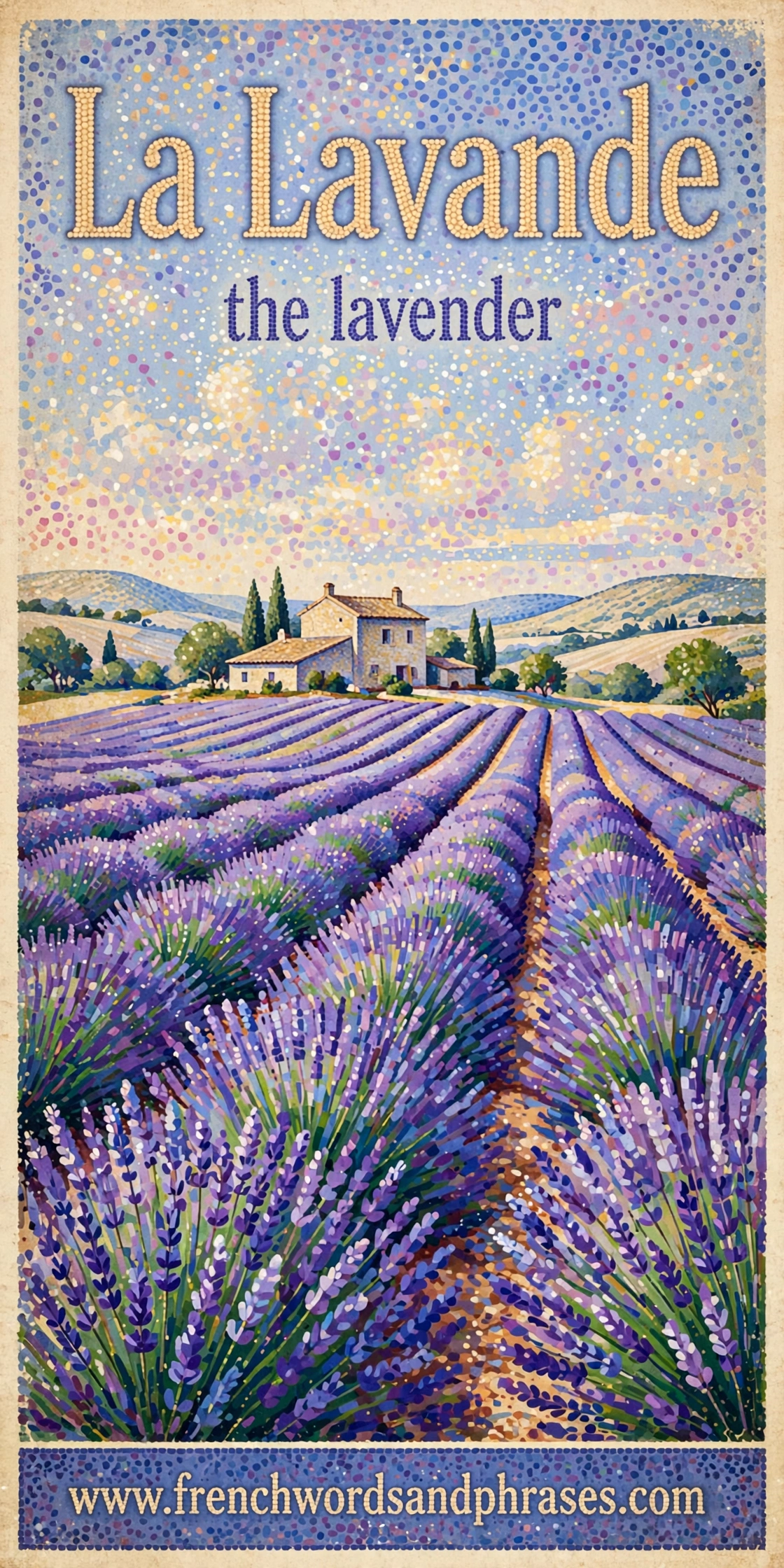
La Lavande means the lavender.
July on the plateau de Valensole: the fields run purple to the horizon, the bees are drunk on perfume, and the whole of Provence smells of one plant — la lavande.
In this guide, you’ll learn what lavande means in English, how to use it with its articles, how to form its plural, and how it appears in everyday French. Explore French examples, English translations, and practice quizzes.
Understanding the French Noun Lavande
Lavande is a feminine French noun. It is learned together with its article: la lavande, and very often without one at all — de la lavande — because lavender behaves like a scent and a substance as much as a plant: you buy some, you smell some, you dry some.
It means the lavender — the grey-green plant with spikes of violet flowers whose perfume is the signature of Provence. Lavender scents the soap of Marseille, the honey of the hills (le miel de lavande), the perfumes of Grasse, and the linen cupboards of France, where a sachet de lavande in every drawer is a grandmother’s law.
Gender: Feminine
Definite article: la — la lavande (the lavender)
Indefinite and partitive: de la lavande — some lavender; un pied de lavande, a lavender plant
Plural: les lavandes — the plants, or the varieties
Heartland: Provence — the plateau de Valensole, the lavender roads
Flowering: June and July, when the fields turn violet
English equivalents: The lavender; some lavender.
One important usage detail: lavender lives a double life in the cupboard. A sachet de lavande — a little bag of dried lavender — perfumes the linen and keeps away les mites, the clothes moths. And a precision for the fields: much of what blazes purple in Provence is technically le lavandin, lavender’s hardier hybrid cousin; the finest perfume lavender is la lavande fine.
Experience the Word
Lavande is more than a plant. It is a whole region distilled into a scent — open a drawer in a French farmhouse in December and July in Provence breathes out at you.
Imagine the harvest: rows of violet under a white-hot sky, the air itself turned purple with perfume, and bundles of lavender drying upside down in the barn.
You have not just smelled a flower. You have breathed Provence — la lavande is its signature.
How to Use Lavande in French: Complete Guide
Let’s explore how lavande works in French, beginning with its articles — and notice how naturally she slips into the partitive: de la lavande.
Lavande with the Definite Article (La, Les)
Used for the lavender everyone means — the lavender of Provence, the lavender in the garden.
| Form | French |
|---|---|
| Feminine singular | la lavande |
| Plural | les lavandes |
Example
La lavande parfume tout le plateau en juillet.
The lavender perfumes the whole plateau in July.
Lavande with the Indefinite Article (Une, Des)
Lavender is counted by the plant: un pied de lavande is one plant; de la lavande is lavender in general.
| Form | French |
|---|---|
| One plant | un pied de lavande |
| Some lavender | de la lavande |
| Plural | des lavandes |
Example
Elle achète de la lavande au marché de Provence.
She is buying lavender at the market in Provence.
Lavande with the Partitive (De la lavande)
Lavender is a scent and a substance, so the partitive is her home ground — some lavender, in all its forms.
| Form | French |
|---|---|
| Some lavender | de la lavande |
| A sprig of lavender | un brin de lavande |
| A bunch of lavender | un bouquet de lavande |
| A field of lavender | un champ de lavande |
| Lavender honey | le miel de lavande |
| A lot of lavender | beaucoup de lavande |
Example
Un brin de lavande suffit pour parfumer le linge.
A sprig of lavender is enough to perfume the linen.
Quick Quiz 1
Complete the sentence:
______ lavande de Provence est célèbre dans le monde entier. (The)
Reveal the answer
La
La lavande de Provence est célèbre dans le monde entier.
The lavender of Provence is famous all over the world.
The Plural of Lavande
Les lavandes names the plants or the varieties — the lavenders of a garden, fine lavender and lavandin side by side.
| Number | French |
|---|---|
| Singular | la lavande / un pied de lavande |
| Plural | les lavandes / des lavandes |
Example
Les lavandes du jardin attirent les abeilles.
The lavenders in the garden attract the bees.
Lavande with Possessive Adjectives (Ma, Ta, Sa…)
Possessives agree with the noun — lavande is feminine, so it takes ma, ta, sa in the singular.
| Owner | French |
|---|---|
| my | ma lavande |
| your (tu) | ta lavande |
| his / her | sa lavande |
| our | notre lavande |
| your (vous) | votre lavande |
| their | leur lavande |
Example
Ma lavande pousse dans un pot sur le balcon.
My lavender grows in a pot on the balcony.
Quick Quiz 2
Complete the sentence:
______ lavande sent très bon. (My)
Reveal the answer
Ma
Ma lavande sent très bon.
My lavender smells wonderful.
Lavande with Demonstrative Adjectives (Cette, Ces)
Used to point at one lavender in particular — cette lavande, this lavender, the violet one.
| Form | French |
|---|---|
| Feminine singular | cette lavande |
| Plural | ces lavandes |
Example
Cette lavande violette vient de Valensole.
This violet lavender comes from Valensole.
Lavande with Adjectives
Adjectives agree with the plant — fraîche, séchée, parfumée, violette.
| Adjective | With Lavande |
|---|---|
| fraîche (fresh) | de la lavande fraîche |
| séchée (dried) | de la lavande séchée |
| parfumée (fragrant) | une lavande parfumée |
| violette (violet) | une lavande violette |
| fine (fine, true) | la lavande fine |
| de Provence (from Provence) | la lavande de Provence |
Example
Elle met de la lavande séchée dans les armoires.
She puts dried lavender in the cupboards.
Quick Quiz 3
Complete the sentence:
La lavande ______ parfume le linge. (dried)
Reveal the answer
séchée
La lavande séchée parfume le linge.
Dried lavender perfumes the linen.
Everyday Expressions with Lavande
Fields, sachets and honey — the lavande phrases of daily life.
| Expression | In English |
|---|---|
| un champ de lavande | a lavender field |
| un sachet de lavande | a lavender sachet |
| l’huile essentielle de lavande | lavender essential oil |
| le miel de lavande | lavender honey |
| la route de la lavande | the lavender road (tourist route) |
| un brin de lavande | a sprig of lavender |
Example
Le sachet de lavande protège le linge des mites.
The lavender sachet protects the linen from moths.
Words from the Same Family as Lavande
Washing, bees and perfume — the words that travel with lavande, starting with the Latin for « to wash ».
| French | In English |
|---|---|
| le lavandin | lavandin, the hybrid lavender of the great fields |
| laver | to wash |
| le parfum | the perfume, the scent |
| le brin | the sprig |
| la ruche | the beehive |
| le miel | the honey |
Example
Le lavandin couvre la plupart des champs de Provence.
Lavandin covers most of the fields of Provence.
Quick Quiz 4
Lavender’s name carries the idea of washing — why?
Reveal the answer
Because it scented the wash — the word goes back to the Latin lavare, to wash: lavender perfumed the bath water and the clean linen of the Romans.
La lavande parfume le linge propre.
Lavender perfumes the clean linen.
Lavande in Everyday French: Real-Life Examples
Now that you know the word, let’s see how lavande appears in everyday French.
Example 1 — In Provence
Les champs de lavande colorent le plateau de violet.
The lavender fields colour the plateau violet.
Example 2 — In the cupboard
Ma grand-mère met un sachet de lavande dans chaque tiroir.
My grandmother puts a lavender sachet in every drawer.
Example 3 — At the market
Il achète du miel de lavande et un savon parfumé.
He is buying lavender honey and a scented soap.
Example 4 — In the garden
La lavande du jardin attire les abeilles et les papillons.
The lavender in the garden attracts the bees and the butterflies.
Example 5 — A gift
Elle offre un bouquet de lavande séchée à son amie.
She is giving a bunch of dried lavender to her friend.
Example 6 — Perfume
Ce parfum contient de la lavande de Grasse.
This perfume contains lavender from Grasse.
Beyond Translation: The Meaning of Lavande
Lavender is old Provence magic with a Roman passport: its name descends from lavare, to wash, because Romans scented their baths and their linen with it, and French grandmothers have kept the faith ever since — a sachet in every drawer. The modern glory is visual: since the twentieth century the plateau de Valensole and the lavender roads have drawn the world to watch the fields turn violet in July, while Grasse turns the finest flowers into perfume.
To say lavande is to smell Provence itself — purple fields, bees, and linen that smells of summer.
It evokes the market stall with its bundles and honey, the soap of Marseille, and the drive south when the first violet field appears and everyone in the car says the same word: enfin.
How to Remember the French Noun Lavande
Remember it this way: Lavande is the lavender — feminine, la lavande, and happiest in the partitive: de la lavande.
- You smell it — la lavande, le parfum de la Provence.
- You dry it — un sachet de lavande dans l’armoire.
- You wash with it — lavare, le latin du linge propre.
The key idea is la lavande — Provence purple, from the Latin for washing.
Test Your Knowledge of Lavande
Let’s see how much you’ve learned. Try answering these questions before revealing the answers.
Question 1
Is lavande masculine or feminine?
Reveal the answer
Feminine — la lavande, de la lavande.
Question 2
Translate: The lavender fields are purple in July.
Reveal the answer
Les champs de lavande sont violets en juillet.
Question 3
What is un sachet de lavande used for?
Reveal the answer
To perfume the linen and keep moths away — a little bag of dried lavender in the cupboard or drawer.
Question 4
Complete the sentence:
______ lavande attire les abeilles. (This)
Reveal the answer
Cette
Cette lavande attire les abeilles.
This lavender attracts the bees.
Question 5
What is le miel de lavande?
Reveal the answer
Lavender honey — honey from hives set among the lavender fields of Provence.
Your Final Challenge
Can You Use It?
How would you say this in French?
“The lavender perfumes the whole garden.”
Reveal the answer
La lavande parfume tout le jardin.
The lavender perfumes the whole garden.
A little French. A little curiosity. A richer everyday life.
LEARN FRENCH ONE WORD AT A TIME