A French Word to Live By
Translate Prendre des airs to English
/pʁɑ̃dʁ de zɛʁ/
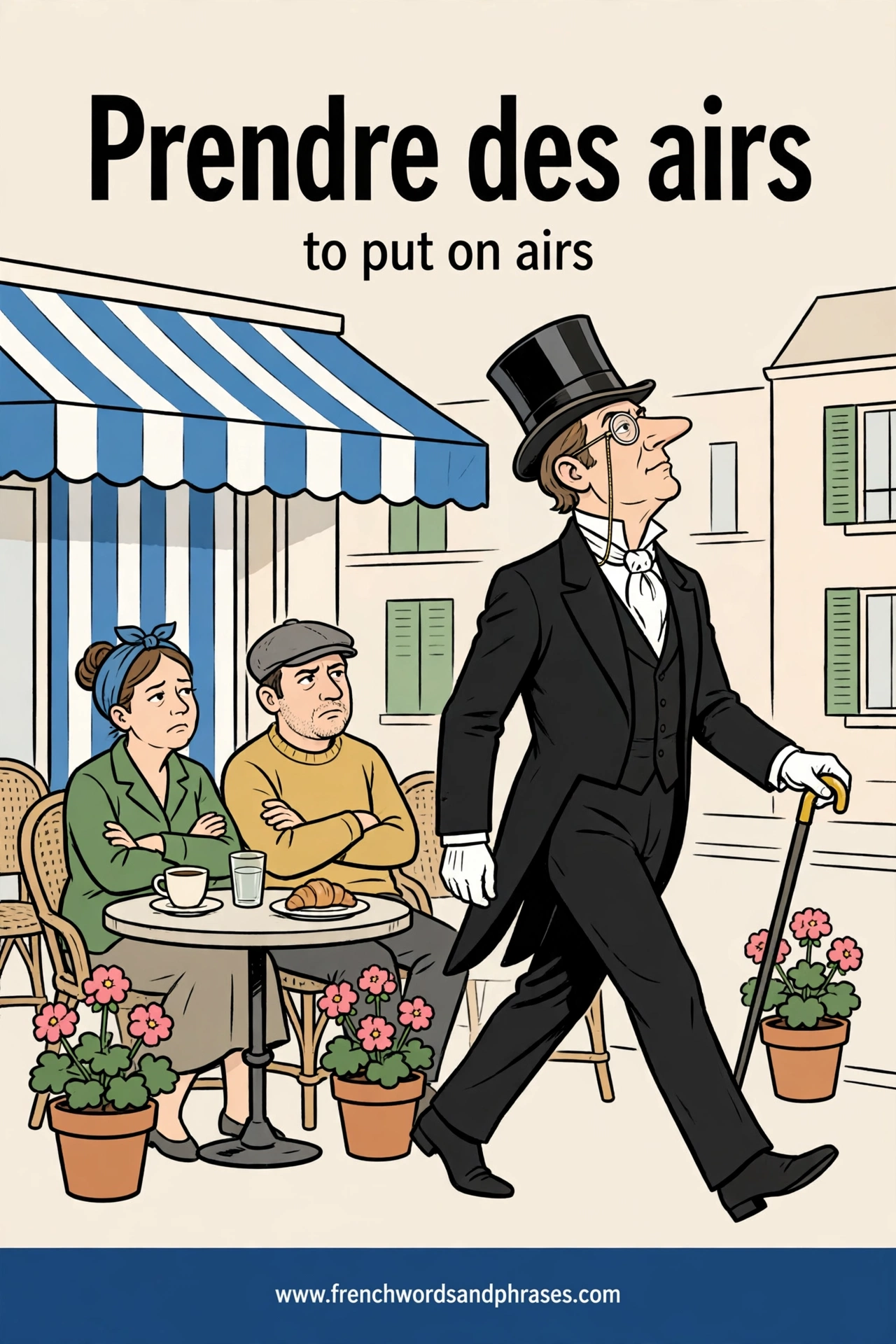
Prendre des airs means to put on airs — to behave as if you were grander and more important than you are.
Since his small promotion, your colleague arrives later, speaks slower and inspects his coffee as if it were a vintage wine. At lunch he corrects the waiter’s French. Your friend watches him sweep out and says it in three words: « Il prend des airs. » He is putting on airs — and everyone at the table can see the strings.
Let’s explore how prendre des airs works in French, beginning with the whole phrase on one card.
Understanding the French Phrase Prendre des airs
Prendre des airs is a French idiomatic expression built from prendre (to take) and des airs (airs, manners — air in its sense of appearance and bearing). It accuses someone of adopting a grand manner they have not earned: the airs are taken, put on like a costume, precisely because they are not natural.
It means to put on airs — to behave with an exaggerated sense of your own importance. Nobody’s lungs are involved: the airs are a performance of superiority, a nose lifted a few degrees too high. French speakers say it with a smile that is not a compliment, of the newly promoted, the suddenly rich, and teenagers practising grandeur in the mirror.
Type: Idiomatic expression — behaviour (prendre + des airs)
Answers the need: Calling out pretentious, self-important behaviour
Register: Neutral to informal — gently mocking, a judgement, not an insult
Strength: Cutting but amused — it deflates rather than attacks
One important usage detail: the phrase often names the kind of airs — prendre des airs de grand seigneur, to act the great lord; prendre des airs supérieurs, to act superior. A close form, se donner des airs, says the same thing with the costume handed to oneself. And the person is usually caught at it: depuis son succès, il prend des airs — ever since his success, he’s been putting on airs.
Experience the Word
Prendre des airs is the phrase French keeps in its pocket for the moment success goes to someone’s head.
Imagine the village boy who leaves for Paris and returns at Christmas with a scarf worn a new way and opinions about the local wine. His grandmother watches him refuse the soup he once begged for, and delivers the family’s verdict before the cheese: il prend des airs. The scarf never recovers.
The mockery is affectionate in French mouths. Prendre des airs punctures the balloon before it floats the person away entirely.
How to Use Prendre des airs in French: Complete Guide
Let’s explore how prendre des airs works in French, beginning with the whole phrase on one card.
Prendre des airs at a Glance
The Whole Phrase on One Card
Real meaning, literal picture, English twin and register — prendre des airs in five lines.
| Point | Prendre des airs |
|---|---|
| What it really means | to put on airs — to act grander and more important than you are |
| Word for word | to take airs — to pick up grand manners and wear them |
| English equivalent | to put on airs / to act superior / to get above oneself |
| Register | neutral to informal — amused mockery, not an insult |
| Use it for | the newly promoted, the suddenly rich, anyone performing importance |
Example
Depuis sa promotion, il prend des airs insupportables.
Since his promotion, he’s been putting on unbearable airs.
Word by Word: Building the Performance
Three small pieces — take them one by one and the costume comes out of the wardrobe.
| Word | Literal meaning | Its job in the phrase |
|---|---|---|
| prendre | to take | the airs are taken, picked up — not born with, which is the whole accusation |
| des | some | a selection of manners, chosen like outfits |
| airs | airs, manners | grand ways of behaving — air in its sense of appearance and bearing |
Example
Elle prend des airs de grande dame.
She puts on the airs of a great lady.
Quick Quiz 1
Why is prendre — to take — the perfect verb for the accusation?
Reveal the answer
Because the airs are borrowed — taken and put on, not natural. What is taken can also be dropped, which is the joke.
Ces airs, il les a pris en arrivant à Paris.
Those airs, he picked them up when he arrived in Paris.
When You Say It: The Puffed-Up Moments
Prendre des airs fires at moments like these — the head swells, and the room notices.
| Situation | Example |
|---|---|
| After a promotion | depuis sa promotion, il prend des airs — since his promotion, he’s putting on airs |
| Acting the lord | il prend des airs de grand seigneur — he’s acting the great lord |
| With you, personally | il prend des airs avec moi — he puts on airs with me, he tries to lord it over me |
| The teenager | à quinze ans, elle prend des airs de star — at fifteen, she’s putting on star airs |
| The verdict of friends | redescends, tu prends des airs — come back down to earth, you’re putting on airs |
Example
Il prend des airs avec moi depuis qu’il a gagné ce prix.
He’s been putting on airs with me since he won that prize.
Make It Yours: The Airs for Every Occasion
Name the costume and the mockery sharpens — des airs de plus a noun dresses the performance.
| Form | French | In English |
|---|---|---|
| The set phrase | prendre des airs | to put on airs |
| Acting superior | prendre des airs supérieurs | to act superior, haughty |
| Acting the great lord | prendre des airs de grand seigneur | to act the great lord |
| The reflexive twin | se donner des airs | to give oneself airs — the same costume, self-handed |
| Important airs | prendre des airs importants | to act self-important |
| Dropping them | laisser tomber les airs | to drop the airs — the hoped-for ending |
Example
Se donner des airs ne trompe personne.
Giving yourself airs fools nobody.
Quick Quiz 2
Which phrase is the reflexive twin — se donner des airs or se prendre un bain?
Reveal the answer
Se donner des airs — to give oneself airs, the same performance. Se prendre un bain would be a very different evening.
Elle se donne des airs depuis son mariage.
She’s been giving herself airs since her wedding.
Everyday Expressions: Building on the Airs
Prendre des airs slots into these everyday frames — each one ready to use as it stands.
| Frame | In English |
|---|---|
| prendre des airs avec quelqu’un | to put on airs with someone, to lord it over them |
| prendre des airs de grand seigneur | to act the great lord |
| depuis quand tu prends des airs ? | since when are you putting on airs? |
| il prend des airs, mais il n’impressionne personne | he puts on airs, but he impresses nobody |
| arrête de prendre des airs | stop putting on airs |
Example
Arrête de prendre des airs, on te connaît.
Stop putting on airs, we know you.
Close Cousins: The Other Grandeurs
French has a shelf of grandeur phrases — prendre des airs is the pretence; its cousins are genuine, or ruder.
| Expression | The difference |
|---|---|
| prendre des airs | to put on airs — pretended grandeur, gently mocked |
| avoir grand air | to look distinguished — the genuine article, a compliment |
| se prendre pour quelqu’un | to think oneself somebody — the same delusion, stated flatly |
| avoir la grosse tête | to be big-headed — informal, the swollen head itself |
| être snob | to be a snob — the borrowed English word, for the social climber |
Example
Il se prend pour quelqu’un depuis qu’il passe à la télévision.
He thinks he’s somebody since he’s been on television.
Quick Quiz 3
Your friend genuinely looks distinguished without trying. Compliment or mockery — grand air or des airs?
Reveal the answer
Grand air — elle a grand air is praise. Prendre des airs is always the pretended version.
Elle a grand air ; lui, il prend des airs.
She looks distinguished; he puts on airs.
Prendre des airs and Its Neighbours
The vanity shelf around the phrase — heads, noses and the mirrors they admire themselves in.
| French | In English |
|---|---|
| la vanité | vanity |
| prétentieux | pretentious |
| se vanter | to boast, to brag |
| mépriser | to look down on, to scorn |
| la modestie | modesty — what the airs replace |
| redescendre sur terre | to come back down to earth |
Example
À force de se vanter, il a fini par prendre des airs.
From boasting so much, he ended up putting on airs.
Watch Out: The Traps Around Prendre des airs
The traps: airs that are tunes, a compliment hiding nearby, and mockery aimed too close.
| Trap | The truth |
|---|---|
| the music trap | un air is also a tune, a melody — jouer un air is to play a tune; only des airs after prendre makes the vanity |
| not a compliment | prendre des airs never praises — for genuine distinction, say avoir grand air |
| avec quelqu’un sharpens it | prendre des airs avec moi means he lords it over me personally — the old gloss ‘he tries to impose upon me’ catches exactly this edge |
| mind the target | the phrase deflates friends charmingly and enemies dangerously — check the room before you fire it |
Example
Il joue un air de piano, sans prendre des airs pour autant.
He plays a piano tune, without putting on airs for all that.
Quick Quiz 4
True or false: prendre des airs is a compliment about someone’s elegant bearing.
Reveal the answer
False — it mocks pretended grandeur. The compliment for real bearing is avoir grand air.
On lui dit qu’elle a grand air ; on murmure qu’il prend des airs.
They tell her she looks distinguished; they whisper that he puts on airs.
Prendre des airs in Everyday French: Real-Life Examples
Now that you know the word, let’s see how prendre des airs appears in everyday French.
Example 1 — The promotion
Depuis sa promotion, il prend des airs.
Since his promotion, he’s been putting on airs.
Example 2 — The great lord
Il prend des airs de grand seigneur au restaurant.
He acts the great lord at the restaurant.
Example 3 — With me
Elle prend des airs avec moi, et je n’aime pas ça.
She puts on airs with me, and I don’t like it.
Example 4 — The teenager
À quinze ans, elle prend déjà des airs de star.
At fifteen, she’s already putting on star airs.
Example 5 — The friendly warning
Arrête de prendre des airs, on se connaît depuis l’école.
Stop putting on airs, we’ve known each other since school.
Example 6 — Nobody fooled
Il prend des airs, mais il n’impressionne personne.
He puts on airs, but he impresses nobody.
Beyond Translation: The Meaning of Prendre des airs
English and French agree completely here, for once — put on airs, prendre des airs, the same costume in both wardrobes. Both languages picture grandeur as something worn, and both keep the verb of dressing for it: what you put on in the morning, you can be asked to take off by lunch.
Real distinction is avoir grand air; prendre des airs is distinction’s fancy-dress party.
The gentleness of the French mockery is worth keeping: it laughs at the costume, and leaves the person underneath a way back.
How to Remember the French Phrase Prendre des airs
Remember it this way: Prendre des airs is grandeur taken out of the wardrobe — a costume of importance that everyone can see being worn.
- You picture the costume — the airs are pris, taken and put on; what is taken is not owned.
- You dress the mockery — des airs de grand seigneur, de star, supérieurs: naming the costume sharpens the joke.
- You keep the compliment separate — avoir grand air praises real bearing; prendre des airs never does.
The key idea is prendre des airs means to put on airs — to act grander and more important than you are.
Test Your Knowledge of Prendre des airs
Let’s see how much you’ve learned. Try answering these questions before revealing the answers.
Question 1
What does prendre des airs mean?
Reveal the answer
To put on airs — to behave as if you were grander and more important than you are.
Question 2
What is the literal, word-for-word meaning?
Reveal the answer
To take airs — the grand manners are picked up and worn, like a costume, which is the whole accusation.
Question 3
How do you say ‘he’s been putting on airs with me since his promotion’?
Reveal the answer
Il prend des airs avec moi depuis sa promotion — avec quelqu’un makes it personal: he lords it over me.
Question 4
What is the difference between prendre des airs and avoir grand air?
Reveal the answer
Prendre des airs is pretence, mocked; avoir grand air is genuine distinction, praised.
Question 5
Complete the sentence:
Depuis son succès, il prend des ______. (Since his success, he’s been putting on airs.)
Reveal the answer
airs
Depuis son succès, il prend des airs.
Since his success, he’s been putting on airs.
Your Final Challenge
Can You Use It?
How would you say this in French?
“Since his promotion, he’s been putting on airs.”
Reveal the answer
Depuis sa promotion, il prend des airs.
Since his promotion, he’s been putting on airs.
A little French. A little curiosity. A richer everyday life.
LEARN FRENCH ONE WORD AT A TIME