A French Word to Live By
Translate Faire son affaire to English
/fɛʁ sɔ̃.na.fɛʁ/
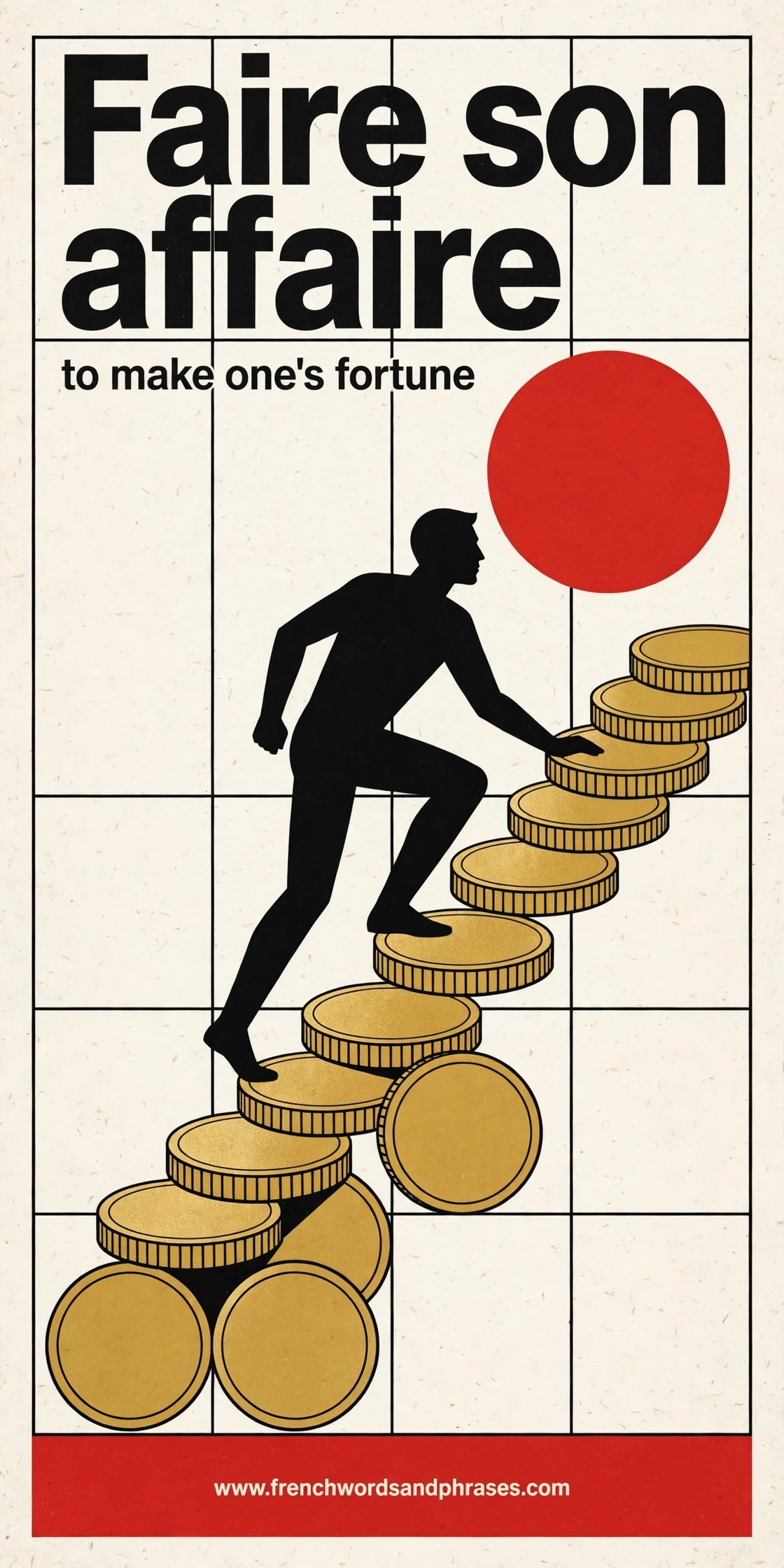
Faire son affaire means to make one’s fortune — and, with en, to make a matter one’s own business.
He arrived in the port with one suitcase and a job washing barrels; thirty years later the shipping line, the warehouses and half the quay carry his name. The old sailors still tell it in one sentence: « Il a fait son affaire. » But the phrase has a second, quieter life — the day the family quarrel landed on his sister’s table and she closed the door with: « J’en fais mon affaire. » Fortune and responsibility, in the same three words.
Let’s explore how faire son affaire works in French, beginning with the whole phrase on one card.
Understanding the French Phrase Faire son affaire
Faire son affaire is a French idiomatic expression built from faire (to make) and son affaire (one’s own business). It carries two senses that this page teaches together. In the past, il a fait son affaire, it celebrates success: he made his fortune, he built his business up from nothing. With en — j’en fais mon affaire — it makes a promise: I make it my business, I will see to it personally.
The first sense is the success story: to make one’s fortune, to do well and build something of one’s own — il a fait son affaire dans le commerce, he made his fortune in trade. The second sense is the pledge: en faire son affaire means to take a matter personally in hand — laisse-moi le contrat, j’en fais mon affaire, leave me the contract, I will see to it myself. Context tells them apart almost every time: the fortune sense looks backwards at a finished rise, usually with il a fait; the pledge sense looks forwards, and nearly always carries the little word en.
Type: Idiomatic expression — success and responsibility (faire + possessive + affaire)
Answers the need: Saying someone made their fortune — or pledging to see to a matter yourself
Register: Neutral — the fortune sense is admiring; the pledge is calm and reliable
Strength: The fortune sense is complete success; the pledge is a personal guarantee
One important usage detail: watch for the en. Faire son affaire without it is the fortune: il a fait son affaire. En faire son affaire — with en replacing the matter already mentioned — is the pledge: ne t’en occupe pas, j’en fais mon affaire. Dropping the en changes a promise into a biography, so French speakers keep it carefully in place. The possessive follows the owner throughout: elle a fait son affaire, ils ont fait leur affaire.
Experience the Word
Faire son affaire is the biography of every self-made merchant in France compressed into three words — arrival, work, and the name over the door.
Imagine the harbour café where the old man’s story is civic property: the suitcase, the barrels, the first borrowed cart. Nobody lists his properties when they honour him. They use the phrase that measures a life by what hands built it: il a fait son affaire. And the same words, spoken by his granddaughter about a disputed contract, turn the family’s pride into a promise — the affair, once made, goes on being made.
French loves the double duty. To faire son affaire is first to build your own house, then to answer for everything that happens inside it.
How to Use Faire son affaire in French: Complete Guide
Let’s explore how faire son affaire works in French, beginning with the whole phrase on one card.
Faire son affaire at a Glance
The Whole Phrase on One Card
Real meaning, literal picture, English twin and register — faire son affaire in five lines.
| Point | Faire son affaire |
|---|---|
| What it really means | to make one’s fortune — and, with en, to make a matter one’s own business |
| Word for word | to make one’s affair, one’s business |
| English equivalent | to make one’s fortune / to make it one’s business to see to it |
| Register | neutral — admiration for the fortune, trust for the pledge |
| Use it for | success stories told backwards, and promises made forwards with en |
Example
Parti de rien, il a fait son affaire dans le commerce.
Starting from nothing, he made his fortune in trade.
Word by Word: Building the Fortune
Three small pieces — take them one by one and a life’s work assembles itself.
| Word | Literal meaning | Its job in the phrase |
|---|---|---|
| faire | to make, to do | the building verb — fortunes and promises are both made |
| son | his, her, one’s own | the ownership — the affair belongs to the person who made it |
| affaire | business, matter | in the fortune sense, the whole enterprise; in the pledge, the matter in hand |
Example
Elle a fait son affaire avec un seul petit magasin.
She made her fortune with a single little shop.
Quick Quiz 1
What single small word turns faire son affaire from a fortune into a pledge?
Reveal the answer
En — j’en fais mon affaire means I make it my business, I will see to it. Without en, il a fait son affaire tells how he made his fortune.
Ne t’inquiète pas, j’en fais mon affaire.
Do not worry, I will see to it personally.
When You Say It: The Fortune and the Pledge
Faire son affaire fires at moments like these — a rise is celebrated, or a matter is taken personally in hand.
| Situation | Example |
|---|---|
| The self-made merchant | il a fait son affaire dans le commerce — he made his fortune in trade |
| The family business grown | ils ont fait leur affaire avec la boulangerie — they made their fortune with the bakery |
| The pledge about a contract | ce contrat, j’en fais mon affaire — this contract, I will see to it myself |
| The pledge about a problem | laisse, j’en fais mon affaire — leave it, I make it my business |
| A quiet ambition | un jour, elle fera son affaire — one day, she will make her fortune |
Example
Ce client difficile, j’en fais mon affaire.
This difficult client, I will see to him personally.
Make It Yours: The Two Senses Side by Side
The fortune looks backwards with the past tense; the pledge looks forwards, carrying its en.
| Form | French | In English |
|---|---|---|
| Fortune — he | il a fait son affaire | he made his fortune |
| Fortune — she | elle a fait son affaire | she made her fortune |
| Fortune — they | ils ont fait leur affaire | they made their fortune |
| Pledge — I | j’en fais mon affaire | I will see to it personally |
| Pledge — she | elle en fait son affaire | she makes it her business |
| Question | tu en fais ton affaire ? | will you see to it yourself? |
Example
Ils ont fait leur affaire, et maintenant elle en fait son affaire.
They made their fortune, and now she makes it her business.
Quick Quiz 2
Your uncle promises to handle the tax letter himself. Which does he say — j’ai fait mon affaire or j’en fais mon affaire?
Reveal the answer
J’en fais mon affaire — the en carries the letter into the sentence, and the phrase becomes a pledge. J’ai fait mon affaire would be a (rather odd) announcement about his fortune.
Cette lettre, j’en fais mon affaire.
This letter, I will see to it myself.
Everyday Expressions: Building on the Fortune
Faire son affaire slots into these everyday frames — each one ready to use as it stands.
| Frame | In English |
|---|---|
| il a fait son affaire | he made his fortune |
| j’en fais mon affaire | I will see to it personally |
| en faire son affaire | to make a matter one’s own business |
| faire son affaire dans le commerce | to make one’s fortune in trade |
| partir de rien et faire son affaire | to start from nothing and make one’s fortune |
Example
Le déménagement ? J’en fais mon affaire.
The move? I will see to it personally.
Close Cousins: The Other Successes and Pledges
French splits the two senses among cousins too — fortunes on one shelf, promises on the other.
| Expression | The difference |
|---|---|
| faire son affaire | to make one’s fortune — the business itself was built by its owner |
| faire fortune | to make a fortune — the money named directly, a shade less personal |
| réussir dans les affaires | to succeed in business — the plain, modern summary |
| je m’en occupe | I am dealing with it — the everyday pledge, without the solemnity of en faire son affaire |
| c’est mon affaire | that is my business — ownership claimed; en faire son affaire is the pledge that follows it into action |
Example
Il a fait fortune jeune, mais c’est elle qui en a fait son affaire ensuite.
He made a fortune young, but it was she who made it her business afterwards.
Quick Quiz 3
Which pair is in the right order — first the fortune, then the pledge?
Reveal the answer
Il a fait son affaire, puis il en a fait son affaire — first he made his fortune, then he made it his business. The en only appears in the pledge.
D’abord le magasin, ensuite la réputation : il en a fait son affaire.
First the shop, then the reputation: he made it his business.
Faire son affaire and Its Neighbours
The success shelf around the phrase — building, succeeding and answering for it.
| French | In English |
|---|---|
| faire fortune | to make a fortune |
| réussir | to succeed |
| un homme d’affaires | a businessman |
| je m’en occupe | I am dealing with it |
| partir de rien | to start from nothing |
| faire son affaire | to make one’s fortune; to make it one’s business |
Example
Parti de rien, cet homme d’affaires a fait son affaire en dix ans.
Starting from nothing, this businessman made his fortune in ten years.
Watch Out: The Traps Around Faire son affaire
The traps: a missing en, a possessive that must travel, and a twin that means mere suitability.
| Trap | The truth |
|---|---|
| the missing en | without en, the sentence is about fortune; the pledge to see to a matter already mentioned needs j’en fais mon affaire |
| the possessive travels | son affaire serves both il and elle; for a group it becomes leur affaire — ils ont fait leur affaire |
| not faire l’affaire | faire l’affaire means to do the trick, said of a thing; faire son affaire is said of a person and their enterprise — the son changes everything |
| not a threat | in older stories, faire son affaire à quelqu’un could mean to settle someone’s hash — today, without à quelqu’un, the phrase is fortune or pledge, never menace |
Example
Ce couteau fera l’affaire, mais le magasin, c’est lui qui a fait son affaire.
This knife will do the trick, but the shop — he is the one who made his fortune with it.
Quick Quiz 4
True or false: elle a fait son affaire and elle en fait son affaire mean the same thing.
Reveal the answer
False — the first says she made her fortune; the second, with en, says she makes the matter in question her own business.
Elle a fait son affaire dans la soie, et du reste, elle en fait son affaire.
She made her fortune in silk, and as for the rest, she makes it her business.
Faire son affaire in Everyday French: Real-Life Examples
Now that you know the word, let’s see how faire son affaire appears in everyday French.
Example 1 — The harbour story
Parti de rien, il a fait son affaire au port.
Starting from nothing, he made his fortune at the port.
Example 2 — The bakery
Ils ont fait leur affaire avec une seule boulangerie.
They made their fortune with a single bakery.
Example 3 — The pledge
Ce contrat, j’en fais mon affaire.
This contract, I will see to it personally.
Example 4 — The difficult client
Laisse-moi ce client, j’en fais mon affaire.
Leave me this client, I will see to him myself.
Example 5 — Her rise
Elle a fait son affaire dans la mode en cinq ans.
She made her fortune in fashion in five years.
Example 6 — The promise repeated
Ne t’en occupe pas, j’en fais mon affaire.
Do not trouble yourself with it, I will see to it.
Beyond Translation: The Meaning of Faire son affaire
English separates what French unites: ‘to make one’s fortune’ looks at money, ‘to make it one’s business’ looks at duty, and never the twain shall meet in one phrase. French, with its single word affaire, refuses the separation. The business you built and the business you answer for are the same affair, and the language insists that a fortune, once made, becomes a responsibility.
Faire son affaire is the whole ethics of the French merchant in three words: build it yourself, then stand behind it yourself.
That is why the little en matters so much. It is the hinge between the two halves of a working life — the fortune behind you, the pledge in front of you.
How to Remember the French Phrase Faire son affaire
Remember it this way: Faire son affaire is the suitcase on the quay and the name over the warehouse door — one life, told in three words.
- You watch for the hinge — no en, a fortune made; with en, a pledge given.
- You read the tense — the fortune looks backwards (il a fait), the pledge forwards (j’en fais).
- You keep the person in it — things font l’affaire; people font leur affaire.
The key idea is faire son affaire means to make one’s fortune — and en faire son affaire, to see to it personally.
Test Your Knowledge of Faire son affaire
Let’s see how much you’ve learned. Try answering these questions before revealing the answers.
Question 1
What are the two senses of faire son affaire?
Reveal the answer
To make one’s fortune — il a fait son affaire — and, with en, to make a matter one’s own business — j’en fais mon affaire, I will see to it.
Question 2
How do you say ‘he made his fortune in trade’?
Reveal the answer
Il a fait son affaire dans le commerce — the fortune sense, in the past, without en.
Question 3
How do you say ‘do not worry, I will see to it personally’?
Reveal the answer
Ne t’inquiète pas, j’en fais mon affaire — the pledge sense, and the en is essential.
Question 4
What is the difference between faire son affaire and faire l’affaire?
Reveal the answer
Person versus thing — faire son affaire is a person’s fortune or pledge; faire l’affaire says a thing does the trick, serves the purpose.
Question 5
Complete the sentence:
Ce contrat, j’______ fais mon affaire. (This contract, I will see to it personally.)
Reveal the answer
en
Ce contrat, j’en fais mon affaire.
This contract, I will see to it personally.
Your Final Challenge
Can You Use It?
How would you say this in French?
“Starting from nothing, he made his fortune in trade.”
Reveal the answer
Parti de rien, il a fait son affaire dans le commerce.
Starting from nothing, he made his fortune in trade.
A little French. A little curiosity. A richer everyday life.
LEARN FRENCH ONE WORD AT A TIME