A French Word to Live By
Translate Abusé to English
/abyze/
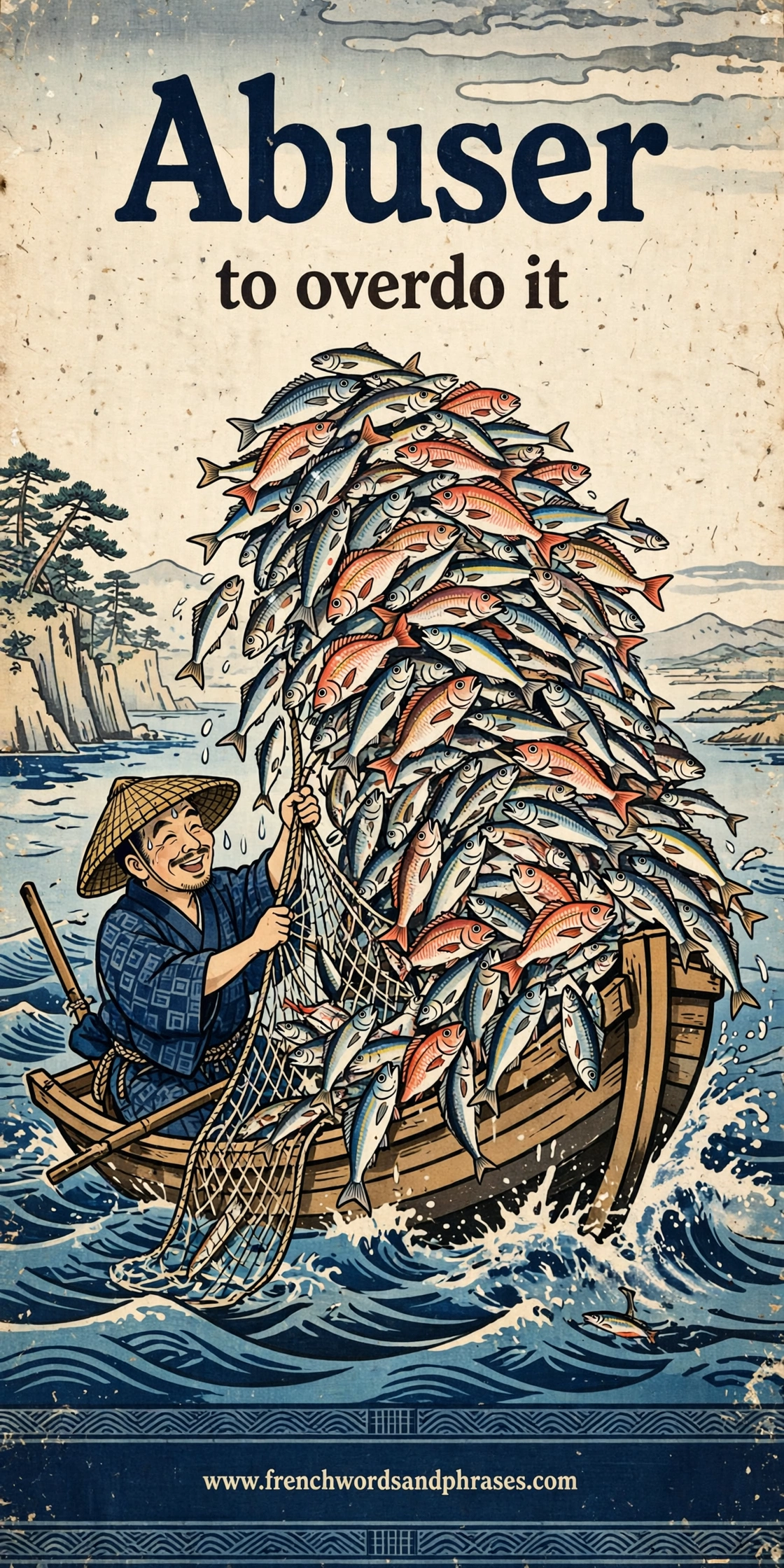
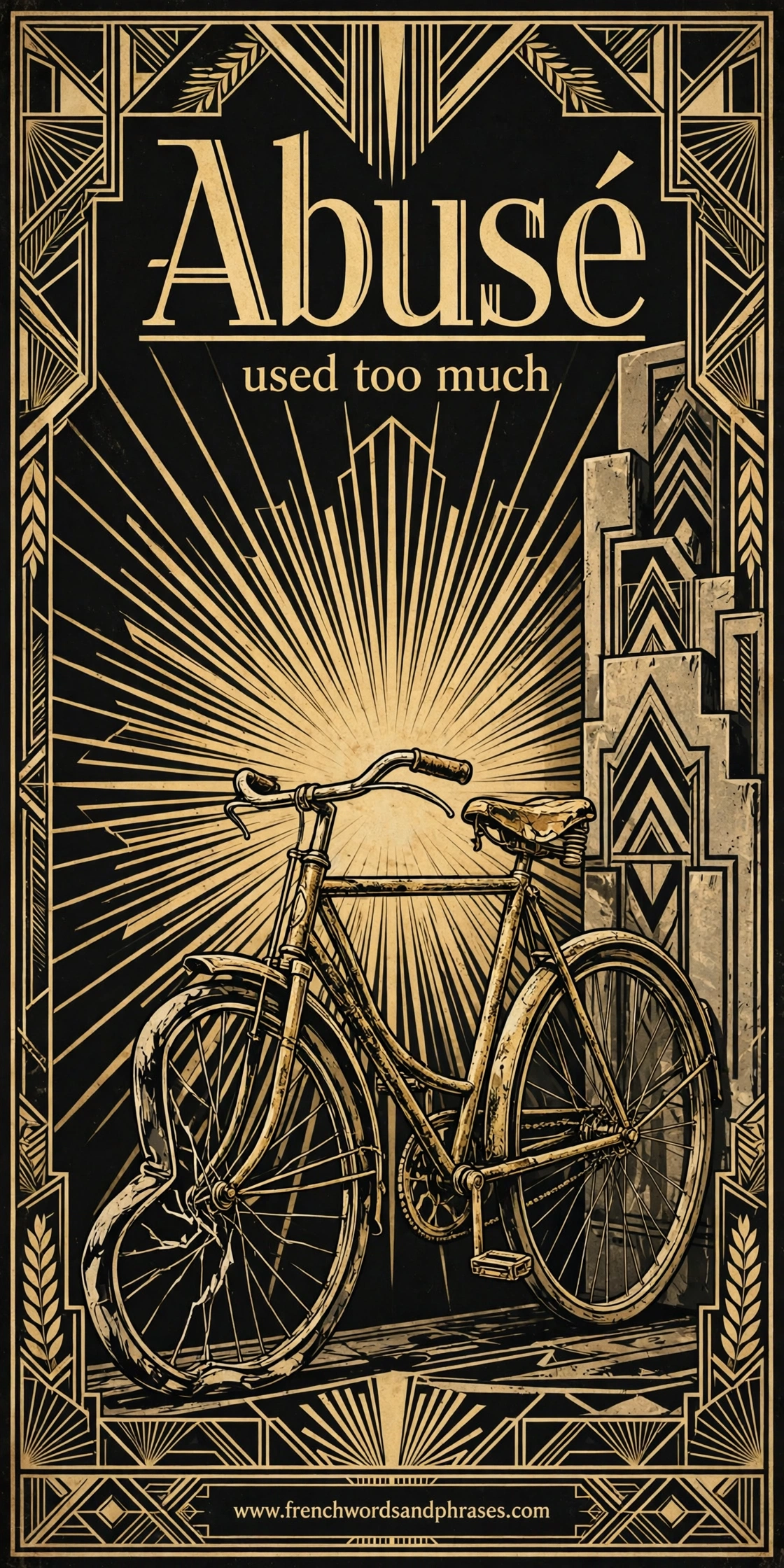
Abusé means used too much.
A copywriter stares at a slogan on her screen — the third this month built on exactly the same pun as every advert since 2010. She deletes it with a sigh: the joke has been used by everyone, everywhere, until it shines no more. French calls a word or a trick worn out like that abusé.
In this guide, you’ll learn what abusé means in English, how it agrees as the past participle of abuser, why it describes words and tricks rather than people, and the famous cousin expression si je ne m’abuse. Explore French examples, English translations, and practice quizzes.
Understanding the French Adjective Abusé
Abusé is a French adjective born from a past participle — the participle of abuser, used as an adjective of wear. It agrees like a regular adjective: abusé, abusée, abusés, abusées. Where the verb abuser means to overdo or misuse, the adjective keeps the result: a thing used so much that its freshness is gone.
It means overused, used too much — worn out by repetition. It describes words and expressions (un mot abusé, an overused word), images, comparisons and tricks of style. It does not describe people: an abusé person is not a French idea — for people, French turns to the family expression si je ne m’abuse, if I am not mistaken, which keeps the old sense of the verb: to be deceived.
Type: Adjective of wear — from the past participle of abuser
Answers the question: What is it like? — overused, worn out by repetition
Changes form: Yes — abusé, abusée, abusés, abusées
English equivalents: Overused; hackneyed; worn-out (of words and devices).
One important usage detail: abusé describes things, not people — une expression abusée, une image abusée. For a person who is mistaken, French uses the living fossil from the same verb: si je ne m’abuse, if I’m not mistaken.
Experience the Word
Abusé is the adjective of the joke told once too often — everything in it still works, except the surprise.
Imagine a village fountain where every tourist has thrown a coin for a hundred years: the ritual is sweet, the gesture sincere, and utterly abusé. French smiles at it with exactly this word — affectionate, not cruel.
You have not just described something old. You have said it has been spent by its own success.
How to Use Abusé in French: Complete Guide
Let’s explore how abusé works in French, beginning with the whole word on one card.
Abusé at a Glance
Before the details, here is the whole word on one card.
The Whole Word on One Card
Meaning, type, position and forms — abusé in four lines.
| Point | Abusé |
|---|---|
| Meaning | used too much, overused |
| Type | adjective of wear — past participle of abuser |
| Usual position | after the noun — une expression abusée |
| Form | abusé / abusée / abusés / abusées |
Example
C’est une image abusée, changeons-la.
It’s an overused image, let’s change it.
The Four Forms of Abusé
Abusé agrees like a past participle: the feminine adds an e, and the plurals add an s.
| Form | Abusé | Example |
|---|---|---|
| Masculine singular | abusé | un mot abusé — an overused word |
| Feminine singular | abusée | une expression abusée — an overused expression |
| Masculine plural | abusés | des mots abusés — overused words |
| Feminine plural | abusées | des expressions abusées — overused expressions |
Example
Ces comparaisons abusées fatiguent le lecteur.
These overused comparisons tire the reader.
Quick Quiz 1
What is the feminine of abusé?
Reveal the answer
abusée
Une métaphore abusée — an overused metaphor.
The feminine adds an e.
The Feminine of Abusé: Add an E
As a past participle, abusé follows the classic rule — the feminine is written with a second e and sounds the same.
| Situation | Example |
|---|---|
| Masculine | un procédé abusé — an overused device |
| Feminine | une formule abusée — an overused formula |
| Why | the participle agrees with the thing worn out |
| The plural | add s — des formules abusées, overused formulas |
Example
Cette formule abusée ouvre encore trop de discours.
This overused formula still opens too many speeches.
Where Abusé Goes: After the Noun
Abusé follows the noun it describes, and it sits comfortably after être in the language of critics and editors.
| Pattern | Example |
|---|---|
| After the noun | une image abusée — an overused image |
| After être | ce mot est abusé — this word is overused |
| With an adverb | un thème un peu abusé — a slightly overused theme |
| Before the noun | une abusée expression — not in everyday French |
Example
Le coucher de soleil sur la pochette : charmant, mais abusé.
The sunset on the cover: charming, but overused.
Quick Quiz 2
How do you say ‘an overused expression’ — une abusée expression or une expression abusée?
Reveal the answer
une expression abusée
Abusé stands after the noun, in the feminine.
An overused expression.
More Overused: Comparing with Abusé
Abusé compares the regular way, with plus, moins and aussi — the scale on which every editor grades a manuscript.
| Degree | Example |
|---|---|
| As overused as | aussi abusé que — as overused as |
| More overused | plus abusé — more overused |
| Less overused | moins abusé — less overused |
| The most overused (masc.) | le plus abusé — le plus abusé des clichés |
| The most overused (fem.) | la plus abusée — la plus abusée des images |
Example
Cette image est plus abusée encore que la précédente.
This image is even more overused than the previous one.
Everyday Expressions with Abusé
Abusé lives in editors’ offices and critics’ columns — and its family keeps one of French’s most polite little phrases.
| Expression | In English |
|---|---|
| un mot abusé | an overused word |
| une expression abusée | an overused expression |
| un thème abusé | an overused theme |
| si je ne m’abuse | if I’m not mistaken — the polite fossil of the same verb |
| abuser | to overdo it, to misuse — the verb (vous abusez !, you’re pushing it!) |
| l’abus | abuse, excess — the noun |
Example
Si je ne m’abuse, ce mot abusé vient d’une vieille chanson.
If I’m not mistaken, this overused word comes from an old song.
Quick Quiz 3
What does si je ne m’abuse mean?
Reveal the answer
If I’m not mistaken
Si je ne m’abuse, nous nous sommes déjà rencontrés.
If I’m not mistaken, we have met before.
Abusé and Its Neighbours
Abusé belongs to the abuser family; its neighbours grade the wear of words from fresh to threadbare.
| French | In English |
|---|---|
| abuser | to overdo, to misuse — the verb |
| un cliché | a cliché — the noun for an overused idea |
| rebattu | hackneyed — des oreilles rebattues, ears tired of hearing it |
| éculé | worn-out, stale — un sujet éculé |
| usé | worn, worn-out — the general word for things |
| original | original, fresh — the opposite every writer wants |
Example
Un sujet éculé, une image abusée : l’article part mal.
A stale subject, an overused image: the article starts badly.
Watch Out: The Traps Around Abusé
The traps here are the people it cannot describe, and an English twin that means something else entirely.
| Trap | The truth |
|---|---|
| Not for people | abusé describes words, images and devices — never a person |
| Not English ‘abused’ | a victim is maltraité or victime d’abus in French; abusé here means overused |
| Agreement | elle est abusée is said of a feminine thing — une formule abusée |
| The polite fossil | si je ne m’abuse keeps the old sense ‘to be deceived’ — learn it as one block |
Example
Une victime n’est pas « abusée » en ce sens : le mot abusé juge les mots, pas les gens.
A victim is not ‘abusée’ in this sense: the word abusé judges words, not people.
Quick Quiz 4
How do you say ‘an overused word’?
Reveal the answer
un mot abusé
Abusé follows the noun and agrees with it.
An overused word.
Abusé in Everyday French: Real-Life Examples
Now that you know the word, let’s see how abusé appears in everyday French.
Example 1 — Editing
Supprime ce mot abusé, il endort le lecteur.
Delete that overused word, it puts the reader to sleep.
Example 2 — Advertising
Encore un cœur rouge : l’image est abusée.
Another red heart: the image is overused.
Example 3 — At school
Le professeur souligne les expressions abusées de ma rédaction.
The teacher underlines the overused expressions in my essay.
Example 4 — Music
Cette mélodie abusée revient dans toutes les publicités.
This overused tune comes back in every advert.
Example 5 — Politeness
Si je ne m’abuse, la réunion est à quinze heures.
If I’m not mistaken, the meeting is at three o’clock.
Example 6 — Writing advice
Un thème abusé peut renaître avec un regard neuf.
An overused theme can be reborn with a fresh eye.
Beyond Translation: The Meaning of Abusé
English speakers meeting abusé expect a victim; French means a cliché. The two senses share a grandfather — Latin abusus, a using-up — and French simply kept the bookkeeping sense: a word abusé has been used up, spent, its shine spent with it.
Abusé is the critic’s word for success that lasted too long.
And the family hides a jewel: si je ne m’abuse, if I am not deceived — French’s most courteous way of saying ‘if I’m not mistaken’, polished by centuries of careful speakers.
How to Remember the French Adjective Abusé
Remember it this way: Abusé is the overused adjective — it agrees like a participle, describes words and devices rather than people, and hides the polite phrase si je ne m’abuse in its family.
- You agree with the thing — un mot abusé, une expression abusée.
- You judge words, not people — une image abusée, jamais un homme abusé en ce sens.
- You keep the jewel — si je ne m’abuse, si je ne me trompe pas.
The key idea is abusé means worn out by use — said of words and images, not of people.
Test Your Knowledge of Abusé
Let’s see how much you’ve learned. Try answering these questions before revealing the answers.
Question 1
What does abusé mean?
Reveal the answer
Used too much, overused — worn out by repetition, of words and devices.
Question 2
What is the feminine of abusé?
Reveal the answer
abusée — une expression abusée.
Question 3
Translate: an overused expression.
Reveal the answer
Une expression abusée.
Question 4
Complete the sentence:
Cette comparaison est ______ .
Reveal the answer
abusée
Cette comparaison est abusée.
This comparison is overused.
Question 5
What does si je ne m’abuse mean?
Reveal the answer
If I’m not mistaken — the polite set phrase from the same verb, abuser.
Your Final Challenge
Can You Use It?
How would you say this in French?
“It is an overused expression.”
Reveal the answer
C’est une expression abusée.
It is an overused expression.
A little French. A little curiosity. A richer everyday life.
LEARN FRENCH ONE WORD AT A TIME