A French Word to Live By
Translate Absence épileptique to English
/ap.sɑ̃s e.pi.lɛp.tik/
Absence épileptique means an absence seizure — a brief epileptic episode in which awareness pauses for a few seconds.
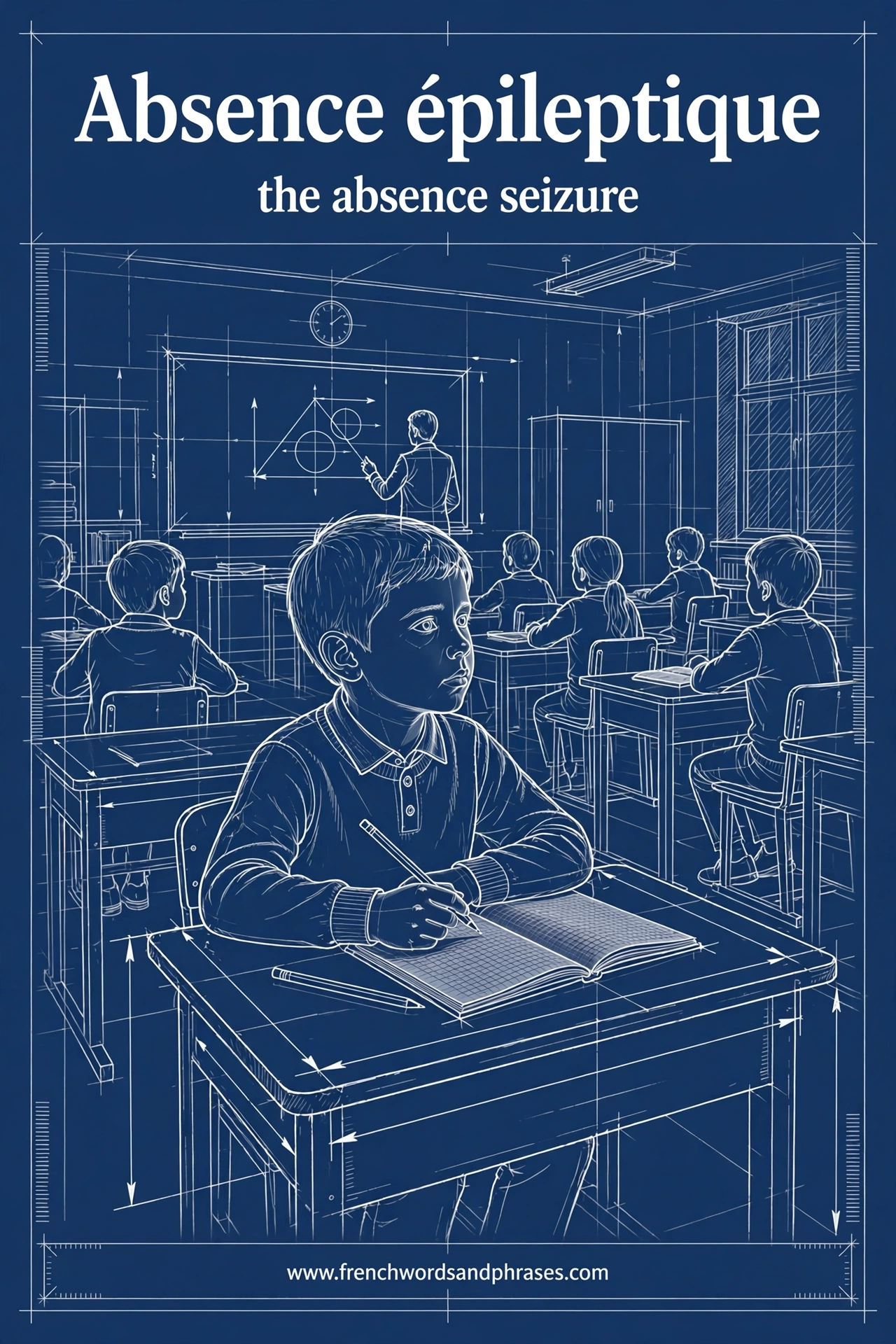
In the middle of dictation, a little girl’s pencil stops. Her eyes stay open, fixed on nothing, for the length of two breaths — then she blinks, looks down at her page, and carries on, unaware that a few seconds are missing. The school nurse has a name for those missing seconds: une absence épileptique.
Let’s explore how absence épileptique works in French, beginning with the whole phrase on one card.
Understanding the French Phrase Absence épileptique
Absence épileptique is a French medical phrase built from une absence (a brief blank, a pause in awareness) and épileptique (epileptic). Doctors also call it une crise d’absence. It names a short seizure, most common in children, in which the person stares, unresponsive, for a few seconds and then returns as if nothing had happened.
It means an absence seizure — a brief episode, usually lasting five to thirty seconds, where awareness switches off and on again. There is no fall and no shaking: the child simply stops mid-sentence or mid-gesture, eyelids sometimes fluttering, and then resumes, remembering nothing of the gap. Older books call it le petit mal; doctors today say une absence or une crise d’absence.
Type: Medical phrase — neurology (noun phrase)
Answers the need: Naming a brief seizure in which awareness pauses
Register: Medical — doctors, nurses, families and schools
Strength: Specific — one seizure type, distinct from convulsions
One important usage detail: in everyday medical French the phrase is often shortened — une absence, des absences — once the context is epilepsy. You will read faire une absence for having one, and the school reports that matter so much: elle fait des absences en classe, she has absence seizures in class.
Experience the Word
Absence épileptique is the gentlest-looking storm in neurology — a pause so quiet that the world can miss it entirely.
Imagine the teacher who learns to see it: not daydreaming, not rudeness, but a small switch turning off and on. Naming it correctly is what turns a ‘dreamy child’ into a child who gets help — that is the weight this quiet phrase carries.
French medicine chose a poetic word for it — absence. For a few seconds, the person is simply, briefly, not there.
How to Use Absence épileptique in French: Complete Guide
Let’s explore how absence épileptique works in French, beginning with the whole phrase on one card.
Absence épileptique at a Glance
The Whole Phrase on One Card
Real meaning, literal picture, English twin and register — absence épileptique in five lines.
| Point | Absence épileptique |
|---|---|
| What it really means | a brief seizure where awareness pauses for a few seconds |
| Word for word | an epileptic absence — a short ‘being away’ of the mind |
| English equivalent | an absence seizure (older term: petit mal) |
| Register | medical — clinics, school reports, family conversations with doctors |
| Use it for | describing the episodes, talking to doctors and teachers |
Example
Une absence épileptique dure souvent moins de trente secondes.
An absence seizure often lasts less than thirty seconds.
Word by Word: Building the Brief Pause
Two pieces — take them one by one and the short blank comes into focus.
| Word | Literal meaning | Its job in the phrase |
|---|---|---|
| absence | absence, a blank | the pause itself — awareness briefly away |
| épileptique | epileptic | ties the pause to epilepsy, not to daydreaming |
Example
Pendant l’absence épileptique, l’enfant ne répond pas.
During the absence seizure, the child does not respond.
Quick Quiz 1
During an absence épileptique, does the person fall and shake?
Reveal the answer
No — that is the point of the phrase. The person stares, unresponsive, for a few seconds, without falling or convulsing.
Elle reste debout, les yeux fixes, puis elle continue sa phrase.
She stays standing, eyes fixed, then she continues her sentence.
When You Say It: The Quiet Episodes
Absence épileptique fires at moments like these — in clinics, classrooms and careful family conversations.
| Situation | Example |
|---|---|
| A doctor explaining | ces absences épileptiques sont fréquentes chez l’enfant — these absence seizures are common in children |
| A teacher reporting | il fait des absences épileptiques pendant les cours — he has absence seizures during lessons |
| A parent describing | elle s’arrête au milieu d’une phrase, c’est une absence — she stops mid-sentence, it is an absence seizure |
| A medical report | absences épileptiques quotidiennes — daily absence seizures |
| After diagnosis | le traitement réduit les absences épileptiques — the treatment reduces the absence seizures |
Example
La maîtresse a signalé des absences épileptiques en classe.
The teacher reported absence seizures in class.
Make It Yours: The Pause in Every Form
Absence is feminine — and in the clinic it often travels without its adjective.
| Form | French | In English |
|---|---|---|
| One episode | une absence épileptique | an absence seizure |
| Several | des absences épileptiques | absence seizures |
| Having one | faire une absence | to have an absence seizure |
| The doctor’s short name | une crise d’absence | an absence seizure (the clinical term) |
| The old name | le petit mal | petit mal (older term) |
| Lasting seconds | une absence de quelques secondes | an absence lasting a few seconds |
Example
Elle fait une absence, puis elle reprend son travail.
She has an absence seizure, then she goes back to her work.
Quick Quiz 2
Which short verb phrase means ‘to have an absence seizure’ — faire une absence or prendre une absence?
Reveal the answer
Faire une absence — French ‘does’ its episodes: elle fait des absences plusieurs fois par jour.
Il fait une absence presque chaque matin.
He has an absence seizure almost every morning.
Everyday Expressions: Building on the Pause
Absence épileptique slots into these frames — each one ready to use as it stands.
| Frame | In English |
|---|---|
| faire des absences | to have absence seizures |
| une crise d’absence | an absence seizure |
| les absences chez l’enfant | absence seizures in children |
| pendant l’absence | during the seizure |
| un traitement contre les absences | a treatment for the seizures |
Example
Le traitement contre les absences commence à marcher.
The treatment for the seizures is starting to work.
Close Cousins: The Other Seizures
Epilepsy has a whole shelf of phrases — the absence is the quiet one; its cousins shake, stiffen or stay local.
| Expression | The difference |
|---|---|
| absence épileptique | awareness pauses for seconds — no fall, no shaking |
| la crise généralisée | the whole brain, the whole body — the person falls and convulses (older name: le grand mal) |
| la crise focale | a partial seizure — one area of the brain, often with awareness kept |
| le petit mal | the old name for the absence seizure — doctors now prefer crise d’absence |
| l’épilepsie | epilepsy itself — the condition behind all of these |
Example
Une absence n’est pas une crise généralisée : le corps reste calme.
An absence seizure is not a generalised seizure: the body stays calm.
Quick Quiz 3
A report uses the old term petit mal. Which modern phrase means the same thing?
Reveal the answer
Une crise d’absence — the absence épileptique. The grand mal, by contrast, is the old name for the big convulsive seizure.
Aujourd’hui, on parle de crise d’absence plutôt que de petit mal.
Today, people say absence seizure rather than petit mal.
Absence épileptique and Its Neighbours
The clinic shelf around the phrase — the people, the tests and the treatment.
| French | In English |
|---|---|
| l’épilepsie | epilepsy |
| un neurologue | a neurologist |
| un électroencéphalogramme | an EEG — the brain-wave recording |
| un traitement antiépileptique | anti-epileptic medication |
| la conscience | awareness, consciousness |
| un enfant rêveur | a ‘dreamy child’ — what an absence can be mistaken for |
Example
Le neurologue demande un électroencéphalogramme.
The neurologist orders an EEG.
Watch Out: The Traps Around Absence épileptique
The traps: a school absence, a daydream, and an old name that can mislead.
| Trap | The truth |
|---|---|
| the school trap | une absence on a school register is an absence from class — the épileptique is what makes the phrase medical |
| not daydreaming | a child having absences is not ‘in the clouds’ on purpose — the pause is a seizure, not a mood |
| the old names | petit mal and grand mal belong to older books; modern French medicine says crise d’absence and crise généralisée |
| no shaking to report | do not describe convulsions with this phrase — absence means stillness and a blank, nothing more |
Example
Ce n’est pas de la rêverie : ses absences épileptiques sont bien réelles.
It is not daydreaming: her absence seizures are quite real.
Quick Quiz 4
True or false: an absence épileptique is the same as being absent from school.
Reveal the answer
False — une absence at school is a day missed. The absence épileptique is a few seconds missed, inside the classroom, in a child’s awareness.
Elle était présente en classe, mais absente quelques secondes.
She was present in class, but absent for a few seconds.
Absence épileptique in Everyday French: Real-Life Examples
Now that you know the word, let’s see how absence épileptique appears in everyday French.
Example 1 — In class
Pendant la dictée, elle fait une absence épileptique de dix secondes.
During dictation, she has a ten-second absence seizure.
Example 2 — At the doctor’s
Le médecin explique ce qu’est une absence épileptique.
The doctor explains what an absence seizure is.
Example 3 — A parent’s worry
Elle fait des absences épileptiques plusieurs fois par jour.
She has absence seizures several times a day.
Example 4 — The teacher’s note
La maîtresse note les absences épileptiques dans le carnet.
The teacher notes the absence seizures in the report book.
Example 5 — The treatment
Grâce au traitement, les absences épileptiques diminuent.
Thanks to the treatment, the absence seizures are becoming rarer.
Example 6 — At home
Après une absence épileptique, il reprend son jeu comme si de rien n’était.
After an absence seizure, he goes back to his game as if nothing had happened.
Beyond Translation: The Meaning of Absence épileptique
Every language struggles to name a few missing seconds. English built a clinical label — absence seizure. French simply took its ordinary word for not being there, absence, and let medicine adopt it: the poetry was already inside the word.
An absence épileptique is a door closing and opening inside a minute — and the phrase teaches you to watch for the door.
That watching matters: most absences are first spotted not by doctors but by teachers and parents who have learned the name.
How to Remember the French Phrase Absence épileptique
Remember it this way: Absence épileptique is a brief switching-off — the lights of awareness dip for a few seconds, then come back.
- You picture the pencil stopping — mid-word, mid-breath, for the length of two breaths.
- You say it with faire — elle fait une absence, des absences, never with prendre.
- You drop the old name — petit mal belongs to old books; today it is une crise d’absence.
The key idea is absence épileptique means an absence seizure — a brief pause of awareness, with no fall and no shaking.
Test Your Knowledge of Absence épileptique
Let’s see how much you’ve learned. Try answering these questions before revealing the answers.
Question 1
What does absence épileptique mean?
Reveal the answer
An absence seizure — a brief epileptic episode in which awareness pauses for a few seconds.
Question 2
How long does an absence seizure usually last?
Reveal the answer
A few seconds — often five to thirty, then the person carries on, remembering nothing of the gap.
Question 3
How do you say ‘she has absence seizures in class’?
Reveal the answer
Elle fait des absences en classe — faire une absence is the living phrase.
Question 4
What is the modern clinical name for the old petit mal?
Reveal the answer
Une crise d’absence — the absence seizure by its current medical name.
Question 5
Complete the sentence:
La petite fille fait des ______ épileptiques qui durent quelques secondes. (The little girl has absence seizures that last a few seconds.)
Reveal the answer
absences
La petite fille fait des absences épileptiques qui durent quelques secondes.
The little girl has absence seizures that last a few seconds.
Your Final Challenge
Can You Use It?
How would you say this in French?
“The little girl has absence seizures that last a few seconds.”
Reveal the answer
La petite fille fait des absences épileptiques qui durent quelques secondes.
The little girl has absence seizures that last a few seconds.
A little French. A little curiosity. A richer everyday life.
LEARN FRENCH ONE WORD AT A TIME