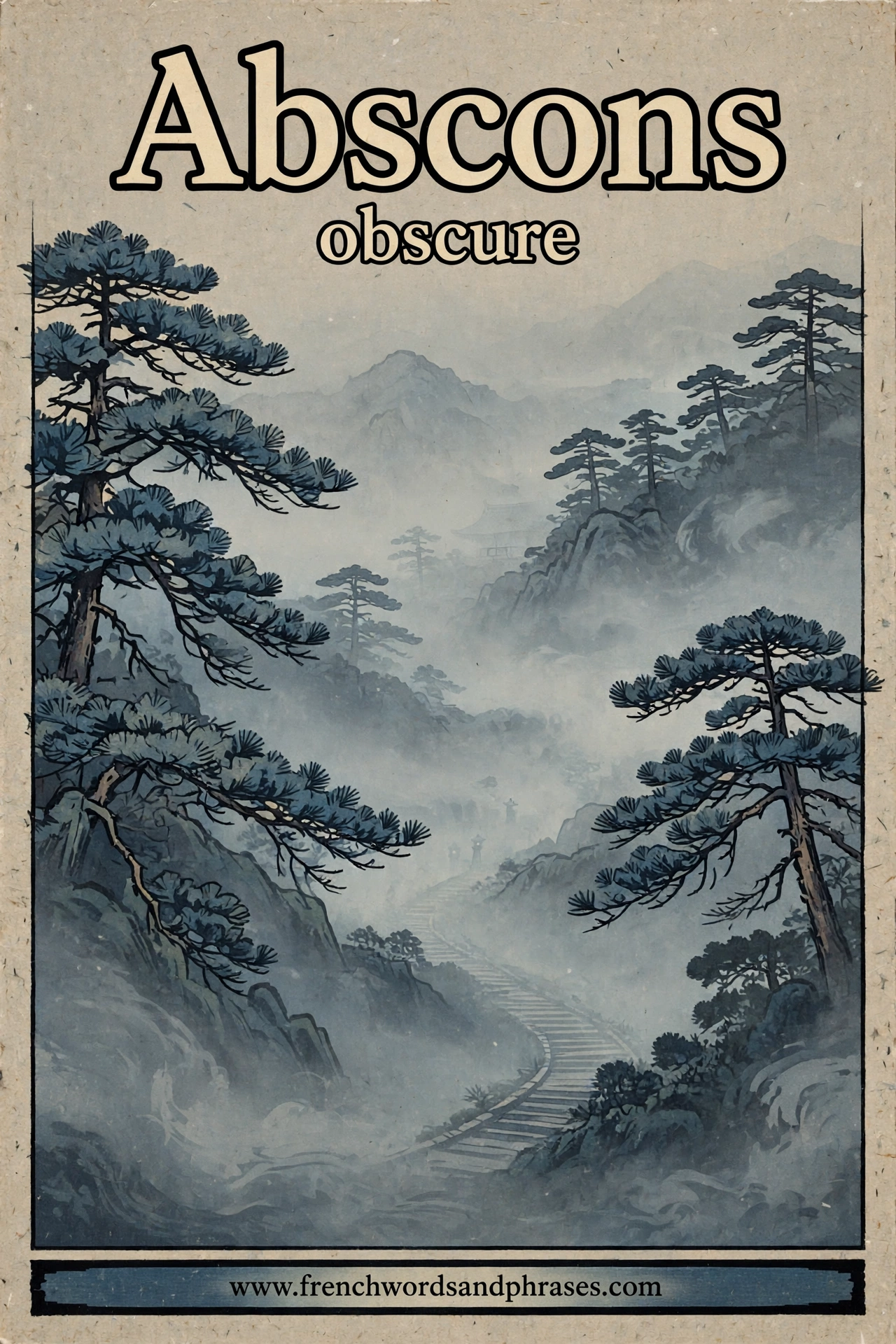
A French Word to Live By
How to Conjugate Abscondre in French
/ap.skɔ̃dʁ/
Abscondre means to abscond — to slip away and hide, a rare and literary verb that modern French has almost forgotten.
A fugitive in a seventeenth-century novel, a treasure walled up in a château, a count lying low in a marsh — abscondre is the verb of hiding as the old books told it: modern French has left it in the library, but the library keeps it safe.
In this guide, you’ll learn how to conjugate abscondre in all the major French tenses and moods. Explore complete conjugation tables, French examples, English translations, and practice quizzes.
Understanding the French Verb Abscondre
Abscondre is a very rare, literary French verb ending in -re, conjugated exactly like répondre — a verb of old books rather than of the street.
It means to abscond, to hide. It survives in old novels, in legal and literary French of past centuries, and in dictionaries — a verb to recognise when reading, not to use when speaking. Its family, though, is alive: the adjective abscons appears in essays and examinations for anything wilfully obscure.
Verb classification: Irregular (-re)
Auxiliary verb: Avoir
Past participle: abscons
Present participle: abscondant
English equivalents: To abscond, to hide, to go into hiding (rare, literary); everyday French says se cacher, s’enfuir, disparaître; its past participle lives on as an adjective: un sens abscons — an obscure, hidden meaning.
One important detail: abscondre follows répondre step for step — je absconds, tu absconds, il abscond (no t in the third person), nous abscondons, vous abscondez, ils abscondent, past participle abscons. Be honest with yourself about this verb: you will probably never say it. Modern French hides with se cacher. But its participle escaped and lives a second life as an adjective — abscons (feminine absconse) means hidden, obscure, hard to penetrate: un langage abscons, impenetrable language.
Experience the Word
Abscondre is itself a hidden verb — even French speakers have to look it up, which is exactly its charm.
Imagine a reader in a country library, deep in a novel from 1650. The hero, betrayed, abscondit dans les marais — and the reader stops, smiles, and reaches for the dictionary, because the verb has hidden itself as well as its hero.
Three centuries have passed. The verb is still in hiding — abscons — waiting in old books for a curious reader.
How to Conjugate Abscondre: Complete French Conjugation Guide
Let’s explore every major conjugation of abscondre, beginning with the indicative mood.
How to Conjugate Abscondre in the Indicative Mood
The indicative mood is used to express facts, observations, actions, and events.
How to Conjugate Abscondre in the Present Tense (Présent)
Used for actions happening now, habitual actions, and general truths.
| Subject | Conjugation |
|---|---|
| je | absconds |
| tu | absconds |
| il / elle | abscond |
| nous | abscondons |
| vous | abscondez |
| ils / elles | abscondent |
Example
Le vieux sage abscond dans sa cabane, loin des hommes.
The old sage hides away in his hut, far from men.
Quick Quiz 1
Complete the sentence:
Nous ______ dans la grange, comme dans les vieux romans.
Reveal the answer
abscondons
Nous abscondons dans la grange, comme dans les vieux romans.
We are hiding in the barn, as in the old novels.
How to Conjugate Abscondre in the Passé Composé
Used for completed actions in the past. Abscondre takes the auxiliary verb avoir.
| Subject | Conjugation |
|---|---|
| j’ | ai abscons |
| tu | as abscons |
| il / elle | a abscons |
| nous | avons abscons |
| vous | avez abscons |
| ils / elles | ont abscons |
Example
Après le vol, le bandit a abscons dans la forêt profonde.
After the robbery, the bandit hid away in the deep forest.
How to Conjugate Abscondre in the Imparfait (Imperfect Tense)
Used for habitual past actions, descriptions, and ongoing situations in the past.
| Subject | Conjugation |
|---|---|
| je | abscondais |
| tu | abscondais |
| il / elle | abscondait |
| nous | abscondions |
| vous | abscondiez |
| ils / elles | abscondaient |
Example
Il abscondait dans la grange chaque fois que la patrouille passait.
He used to hide in the barn whenever the patrol went by.
Quick Quiz 2
Choose the correct form:
The bandit hid away in the forest.
Le bandit ______ dans la forêt. (a abscons / est abscons)
Reveal the answer
a abscons
Le bandit a abscons dans la forêt.
Abscondre takes avoir.
How to Conjugate Abscondre in the Plus-que-parfait
Used to describe an action that had already been completed before another past event.
| Subject | Conjugation |
|---|---|
| j’ | avais abscons |
| tu | avais abscons |
| il / elle | avait abscons |
| nous | avions abscons |
| vous | aviez abscons |
| ils / elles | avaient abscons |
Example
Le fugitif avait abscons dans une grotte avant l’aube.
The fugitive had hidden in a cave before dawn.
How to Conjugate Abscondre in the Passé Simple
Primarily used in formal writing, literature, and historical narratives. It is rarely used in everyday conversation.
| Subject | Conjugation |
|---|---|
| je | abscondis |
| tu | abscondis |
| il / elle | abscondit |
| nous | abscondîmes |
| vous | abscondîtes |
| ils / elles | abscondirent |
Example
Le comte abscondit dans le souterrain du château.
The count hid in the castle’s underground passage.
How to Conjugate Abscondre in the Passé Antérieur
A literary tense used to express an action completed immediately before another past action, generally in the passé simple.
| Subject | Conjugation |
|---|---|
| j’ | eus abscons |
| tu | eus abscons |
| il / elle | eut abscons |
| nous | eûmes abscons |
| vous | eûtes abscons |
| ils / elles | eurent abscons |
Example
Dès qu’il eut abscons derrière le mur, les soldats passèrent sans le voir.
As soon as he had hidden behind the wall, the soldiers passed without seeing him.
How to Conjugate Abscondre in the Future Tense (Futur Simple)
Used to describe actions that will take place in the future.
| Subject | Conjugation |
|---|---|
| je | abscondrai |
| tu | abscondras |
| il / elle | abscondra |
| nous | abscondrons |
| vous | abscondrez |
| ils / elles | abscondront |
Example
Il abscondra dans la montagne si on le poursuit.
He will hide in the mountains if they pursue him.
How to Conjugate Abscondre in the Futur Antérieur (Future Perfect)
Used for an action that will have been completed before a particular point in the future.
| Subject | Conjugation |
|---|---|
| j’ | aurai abscons |
| tu | auras abscons |
| il / elle | aura abscons |
| nous | aurons abscons |
| vous | aurez abscons |
| ils / elles | auront abscons |
Example
À la tombée de la nuit, le fugitif aura abscons dans les bois.
By nightfall, the fugitive will have hidden in the woods.
How to Conjugate Abscondre in the Near Future (Futur Proche)
Used to describe something that is going to happen soon. Formed with aller + infinitive.
| Subject | Conjugation |
|---|---|
| je | vais abscondre |
| tu | vas abscondre |
| il / elle | va abscondre |
| nous | allons abscondre |
| vous | allez abscondre |
| ils / elles | vont abscondre |
Example
Le lièvre va abscondre dans son terrier.
The hare is going to hide in its burrow.
How to Conjugate Abscondre in the Conditional Mood
The conditional mood expresses what would happen under certain circumstances. It is also frequently used to make polite requests or express wishes.
How to Conjugate Abscondre in the Present Conditional
| Subject | Conjugation |
|---|---|
| je | abscondrais |
| tu | abscondrais |
| il / elle | abscondrait |
| nous | abscondrions |
| vous | abscondriez |
| ils / elles | abscondraient |
Example
Sans cette grotte, le fugitif abscondrait en pleine campagne.
Without this cave, the fugitive would hide in the open countryside.
How to Conjugate Abscondre in the Past Conditional
| Subject | Conjugation |
|---|---|
| j’ | aurais abscons |
| tu | aurais abscons |
| il / elle | aurait abscons |
| nous | aurions abscons |
| vous | auriez abscons |
| ils / elles | auraient abscons |
Example
Il aurait abscons dans la grange si la porte avait été ouverte.
He would have hidden in the barn if the door had been open.
Abscondre in the Literary Past Conditional Form
This less common literary form uses the imperfect subjunctive of avoir.
| Subject | Conjugation |
|---|---|
| j’ | eusse abscons |
| tu | eusses abscons |
| il / elle | eût abscons |
| nous | eussions abscons |
| vous | eussiez abscons |
| ils / elles | eussent abscons |
Example
Le proscrit eût abscons dans les marais sans la lune pleine.
The outlaw would have hidden in the marshes but for the full moon.
How to Conjugate Abscondre in the Subjunctive Mood
The subjunctive is used to express wishes, emotions, doubts, necessity, and uncertainty. It frequently follows expressions such as il faut que (it is necessary that) or bien que (although).
How to Conjugate Abscondre in the Present Subjunctive
| Subject | Conjugation |
|---|---|
| que je | absconde |
| que tu | abscondes |
| qu’il / qu’elle | absconde |
| que nous | abscondions |
| que vous | abscondiez |
| qu’ils / qu’elles | abscondent |
Example
Il faut que le trésor absconde où personne ne le cherchera.
The treasure must hide where nobody will look for it.
Quick Quiz 3
Complete the sentence using the subjunctive:
Il faut que tu ______ dans la grange.
Reveal the answer
abscondes
Il faut que tu abscondes dans la grange.
You must hide in the barn.
How to Conjugate Abscondre in the Imperfect Subjunctive
A literary tense, rarely encountered in modern spoken French.
| Subject | Conjugation |
|---|---|
| que je | abscondisse |
| que tu | abscondisses |
| qu’il / qu’elle | abscondît |
| que nous | abscondissions |
| que vous | abscondissiez |
| qu’ils / qu’elles | abscondissent |
Example
On craignait que le fugitif abscondît dans les environs.
People feared the fugitive might be hiding in the neighbourhood.
How to Conjugate Abscondre in the Pluperfect Subjunctive
A literary construction used to express an action completed before another past action.
| Subject | Conjugation |
|---|---|
| que j’ | eusse abscons |
| que tu | eusses abscons |
| qu’il / qu’elle | eût abscons |
| que nous | eussions abscons |
| que vous | eussiez abscons |
| qu’ils / qu’elles | eussent abscons |
Example
On racontait qu’il eût abscons des années dans une île déserte.
People said he had hidden for years on a desert island.
How to Conjugate Abscondre in the Past Subjunctive
| Subject | Conjugation |
|---|---|
| que j’ | aie abscons |
| que tu | aies abscons |
| qu’il / qu’elle | ait abscons |
| que nous | ayons abscons |
| que vous | ayez abscons |
| qu’ils / qu’elles | aient abscons |
Example
Je doute qu’il ait abscons si longtemps sans aide.
I doubt he hid for so long without help.
How to Conjugate Abscondre in the Imperative
The imperative is used to give commands, instructions, invitations, or suggestions. Subject pronouns are omitted.
How to Conjugate Abscondre in the Present Imperative
| Person | Conjugation |
|---|---|
| (tu) | absconds |
| (nous) | abscondons |
| (vous) | abscondez |
Example
Absconds derrière la haie, vite !
Hide behind the hedge, quickly!
Quick Quiz 4
How would you say Hide behind the hedge (tu form)?
Reveal the answer
Absconds derrière la haie !
French Participles of Abscondre
Participles are verb forms that can be used in compound tenses and other grammatical constructions.
Present Participle of Abscondre
abscondant
En abscondant dans les bois, le fugitif a échappé aux chiens.
By hiding in the woods, the fugitive escaped the dogs.
Past Participle of Abscondre
abscons
Abscons dans l’ombre, le trésor attendait son heure.
Hidden in the shadows, the treasure awaited its hour.
Abscondre in Everyday French: Real-Life Examples
Now that you know the conjugations, let’s see how abscondre appears in everyday French.
Example 1 — Present
Le sage abscond dans sa cabane.
The sage hides away in his hut.
Example 2 — Passé composé
Le bandit a abscons dans la forêt.
The bandit hid away in the forest.
Example 3 — Imparfait
Il abscondait dans la grange.
He used to hide in the barn.
Example 4 — Future
Le fugitif abscondra dans la montagne.
The fugitive will hide in the mountains.
Example 5 — Conditional
Il abscondrait en pleine campagne.
He would hide in the open countryside.
Example 6 — Imperative
Absconds derrière la haie !
Hide behind the hedge!
Beyond Translation: The Meaning of Abscondre
English abscond is its twin — both come from the Latin abscondere, to hide away — and both languages have pensioned the verb off into literature and law.
A verb that practises what it preaches.
Abscondre has hidden itself: it lives in old books, in the adjective abscons, and in the pleasure of the reader who finds it, crouching in a sentence from 1650.
How to Remember the French Verb Abscondre
Remember it this way: Abscondre is about the verb in hiding — even French speakers have to look it up.
- A museum verb: you will read it in old books, but modern French says se cacher.
- It follows répondre exactly: je absconds, il abscond, nous abscondons, past participle abscons.
- Its participle escaped into the language: abscons is now an adjective meaning hidden, obscure — un sens abscons.
The key idea is the verb in hiding — even French speakers have to look it up.
Test Your Knowledge of Abscondre
Let’s see how much you’ve learned. Try answering these questions before revealing the answers.
Question 1
Which everyday verb does abscondre conjugate like?
Reveal the answer
Répondre — je absconds, il abscond, nous abscondons, exactly the same pattern.
Question 2
How do you say The bandit hid away in the forest in French?
Reveal the answer
Le bandit a abscons dans la forêt.
Question 3
Translate: The count hid in the castle’s underground passage.
Reveal the answer
Le comte abscondit dans le souterrain du château.
Question 4
What is the past participle of abscondre, and its second life?
Reveal the answer
Abscons — also an adjective meaning hidden, obscure: un sens abscons.
Question 5
Complete the sentence:
Il faut que le trésor ______ où personne ne le cherchera.
Reveal the answer
absconde
Il faut que le trésor absconde où personne ne le cherchera.
The treasure must hide where nobody will look for it.
Your Final Challenge
Can You Use It?
How would you say this in French?
The bandit hid away in the deep forest, and nobody ever found him again.
Reveal the answer
Le bandit a abscons dans la forêt profonde, et nul ne l’a jamais retrouvé.
The bandit hid away in the deep forest, and nobody ever found him again.
A little French. A little curiosity. A richer everyday life.
LEARN FRENCH ONE WORD AT A TIME