A French Word to Live By
How to Conjugate Abreuver in French
/a.bʁœ.ve/
Abreuver means to water — to give animals drink, to drench a field or a sponge, to soak something thoroughly with liquid.
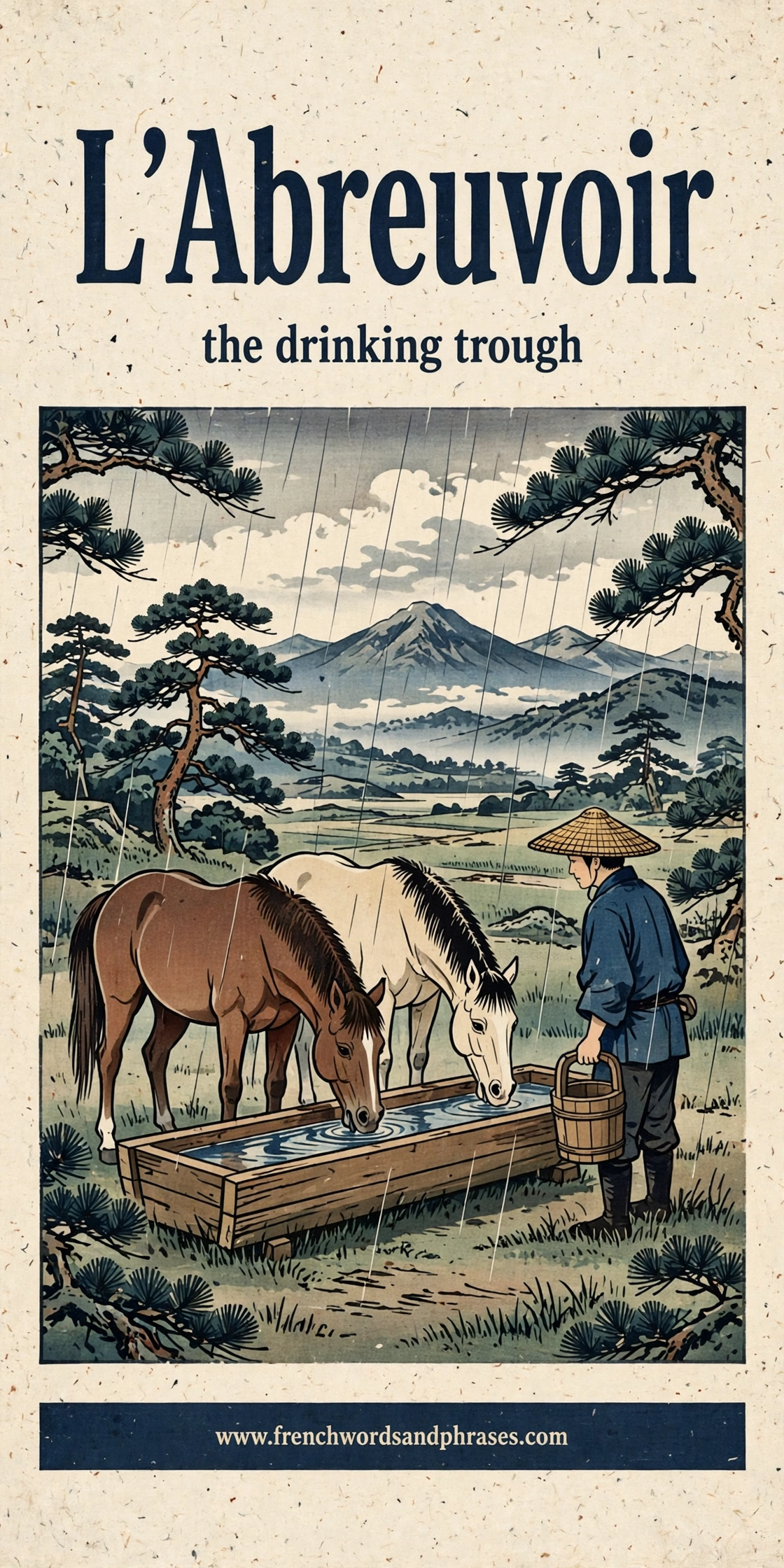
Horses at the trough at dusk, a gardener soaking dry beds, a sponge drinking its fill — abreuver is the verb of giving drink on a grand scale: animals watered, soil drenched, thirsty things saturated.
In this guide, you’ll learn how to conjugate abreuver in all the major French tenses and moods. Explore complete conjugation tables, French examples, English translations, and practice quizzes.
Understanding the French Verb Abreuver
Abreuver is a regular French verb belonging to the first group of verbs, those ending in-er.
It means to drench. It is commonly used on farms and in stables for watering horses and cattle, in gardens for soaking dry soil, and figuratively for anything poured out in quantity — praise, insults, information. The trough itself is un abreuvoir, the place where the whole herd comes to drink.
Verb classification: First group (-er)
Auxiliary verb: Avoir
Past participle: abreuvé
Present participle: abreuvant
English equivalents: To water (animals), to drench, to soak; abreuver les chevaux — to water the horses; s’abreuver — to drink (of animals), to quench one’s thirst; un abreuvoir — a drinking trough; abreuver quelqu’un d’injures — to shower someone with insults.
One important detail: abreuver is a regular -er verb whose natural subject is thirst — of animals first of all: abreuver les chevaux, abreuver le bétail. Its reflexive s’abreuver is how animals drink: les vaches s’abreuvent au ruisseau. And French, loving a metaphor, abreuves people too — abreuver quelqu’un d’injures, to shower someone with insults, as if words were buckets of water.
Experience the Word
Abreuver is drinking organised by someone else — the trough filled, the herd led down, the thirst ended for twenty animals at once.
Imagine a farmyard in a dry August. The farmer hauls bucket after bucket to the long stone trough while the horses wait, stamping — il abreuve ses bêtes, and the water shines black in the evening light.
One bucket would be a drink. He is watering — il abreuve — the whole thirsty farm.
How to Conjugate Abreuver: Complete French Conjugation Guide
Let’s explore every major conjugation of abreuver, beginning with the indicative mood.
How to Conjugate Abreuver in the Indicative Mood
The indicative mood is used to express facts, observations, actions, and events.
How to Conjugate Abreuver in the Present Tense (Présent)
Used for actions happening now, habitual actions, and general truths.
| Subject | Conjugation |
|---|---|
| je | abreuve |
| tu | abreuves |
| il / elle | abreuve |
| nous | abreuvons |
| vous | abreuvez |
| ils / elles | abreuvent |
Example
Le fermier abreuve ses chevaux chaque soir.
The farmer waters his horses every evening.
Quick Quiz 1
Complete the sentence:
Nous ______ le bétail à la rivière.
Reveal the answer
abreuvons
Nous abreuvons le bétail à la rivière.
We water the cattle at the river.
How to Conjugate Abreuver in the Passé Composé
Used for completed actions in the past. Abreuver takes the auxiliary verb avoir.
| Subject | Conjugation |
|---|---|
| j’ | ai abreuvé |
| tu | as abreuvé |
| il / elle | a abreuvé |
| nous | avons abreuvé |
| vous | avez abreuvé |
| ils / elles | ont abreuvé |
Example
Elle a abreuvé les plantes après la sécheresse.
She drenched the plants after the drought.
How to Conjugate Abreuver in the Imparfait (Imperfect Tense)
Used for habitual past actions, descriptions, and ongoing situations in the past.
| Subject | Conjugation |
|---|---|
| je | abreuvais |
| tu | abreuvais |
| il / elle | abreuvait |
| nous | abreuvions |
| vous | abreuviez |
| ils / elles | abreuvaient |
Example
On abreuvait le bétail à la rivière.
People used to water the cattle at the river.
Quick Quiz 2
Choose the correct form:
He watered the horses before dawn.
Il ______ les chevaux avant l’aube. (a abreuvé / est abreuvé)
Reveal the answer
a abreuvé
Il a abreuvé les chevaux avant l’aube.
Abreuver takes avoir.
How to Conjugate Abreuver in the Plus-que-parfait
Used to describe an action that had already been completed before another past event.
| Subject | Conjugation |
|---|---|
| j’ | avais abreuvé |
| tu | avais abreuvé |
| il / elle | avait abreuvé |
| nous | avions abreuvé |
| vous | aviez abreuvé |
| ils / elles | avaient abreuvé |
Example
Il avait abreuvé les chevaux avant l’aube.
He had watered the horses before dawn.
How to Conjugate Abreuver in the Passé Simple
Primarily used in formal writing, literature, and historical narratives. It is rarely used in everyday conversation.
| Subject | Conjugation |
|---|---|
| je | abreuvai |
| tu | abreuvas |
| il / elle | abreuva |
| nous | abreuvâmes |
| vous | abreuvâtes |
| ils / elles | abreuvèrent |
Example
Le berger abreuva son troupeau au puits.
The shepherd watered his flock at the well.
How to Conjugate Abreuver in the Passé Antérieur
A literary tense used to express an action completed immediately before another past action, generally in the passé simple.
| Subject | Conjugation |
|---|---|
| j’ | eus abreuvé |
| tu | eus abreuvé |
| il / elle | eut abreuvé |
| nous | eûmes abreuvé |
| vous | eûtes abreuvé |
| ils / elles | eurent abreuvé |
Example
Quand elle eut abreuvé les bêtes, elle ferma l’étable.
When she had watered the animals, she closed the stable.
How to Conjugate Abreuver in the Future Tense (Futur Simple)
Used to describe actions that will take place in the future.
| Subject | Conjugation |
|---|---|
| je | abreuverai |
| tu | abreuveras |
| il / elle | abreuvera |
| nous | abreuverons |
| vous | abreuverez |
| ils / elles | abreuveront |
Example
Nous abreuverons les chevaux à la prochaine ferme.
We will water the horses at the next farm.
How to Conjugate Abreuver in the Futur Antérieur (Future Perfect)
Used for an action that will have been completed before a particular point in the future.
| Subject | Conjugation |
|---|---|
| j’ | aurai abreuvé |
| tu | auras abreuvé |
| il / elle | aura abreuvé |
| nous | aurons abreuvé |
| vous | aurez abreuvé |
| ils / elles | auront abreuvé |
Example
À midi, il aura abreuvé tout le troupeau.
By noon, he will have watered the whole herd.
How to Conjugate Abreuver in the Near Future (Futur Proche)
Used to describe something that is going to happen soon. Formed with aller + infinitive.
| Subject | Conjugation |
|---|---|
| je | vais abreuver |
| tu | vas abreuver |
| il / elle | va abreuver |
| nous | allons abreuver |
| vous | allez abreuver |
| ils / elles | vont abreuver |
Example
Le jardinier va abreuver les jeunes plants.
The gardener is going to soak the young plants.
How to Conjugate Abreuver in the Conditional Mood
The conditional mood expresses what would happen under certain circumstances. It is also frequently used to make polite requests or express wishes.
How to Conjugate Abreuver in the Present Conditional
| Subject | Conjugation |
|---|---|
| je | abreuverais |
| tu | abreuverais |
| il / elle | abreuverait |
| nous | abreuverions |
| vous | abreuveriez |
| ils / elles | abreuveraient |
Example
On abreuverait les chevaux ici s’il y avait un puits.
We would water the horses here if there were a well.
How to Conjugate Abreuver in the Past Conditional
| Subject | Conjugation |
|---|---|
| j’ | aurais abreuvé |
| tu | aurais abreuvé |
| il / elle | aurait abreuvé |
| nous | aurions abreuvé |
| vous | auriez abreuvé |
| ils / elles | auraient abreuvé |
Example
Elle aurait abreuvé le jardin sans la pluie de la nuit.
She would have watered the garden if not for the rain in the night.
Abreuver in the Literary Past Conditional Form
This less common literary form uses the imperfect subjunctive of avoir.
| Subject | Conjugation |
|---|---|
| j’ | eusse abreuvé |
| tu | eusses abreuvé |
| il / elle | eût abreuvé |
| nous | eussions abreuvé |
| vous | eussiez abreuvé |
| ils / elles | eussent abreuvé |
Example
Le fermier eût abreuvé ses bêtes avant la tempête.
The farmer would have watered his animals before the storm.
How to Conjugate Abreuver in the Subjunctive Mood
The subjunctive is used to express wishes, emotions, doubts, necessity, and uncertainty. It frequently follows expressions such as il faut que (it is necessary that) or bien que (although).
How to Conjugate Abreuver in the Present Subjunctive
| Subject | Conjugation |
|---|---|
| que je | abreuve |
| que tu | abreuves |
| qu’il / qu’elle | abreuve |
| que nous | abreuvions |
| que vous | abreuviez |
| qu’ils / qu’elles | abreuvent |
Example
Il faut qu’on abreuve les chevaux avant le départ.
The horses must be watered before departure.
Quick Quiz 3
Complete the sentence using the subjunctive:
Le maître veut que vous ______ les bêtes à la rivière.
Reveal the answer
abreuviez
Le maître veut que vous abreuviez les bêtes à la rivière.
The master wants you to water the animals at the river.
How to Conjugate Abreuver in the Imperfect Subjunctive
A literary tense, rarely encountered in modern spoken French.
| Subject | Conjugation |
|---|---|
| que je | abreuvasse |
| que tu | abreuvasses |
| qu’il / qu’elle | abreuvât |
| que nous | abreuvassions |
| que vous | abreuvassiez |
| qu’ils / qu’elles | abreuvassent |
Example
Le maître voulait qu’on abreuvât les bêtes à la rivière.
The master wanted the animals watered at the river.
How to Conjugate Abreuver in the Pluperfect Subjunctive
A literary construction used to express an action completed before another past action.
| Subject | Conjugation |
|---|---|
| que j’ | eusse abreuvé |
| que tu | eusses abreuvé |
| qu’il / qu’elle | eût abreuvé |
| que nous | eussions abreuvé |
| que vous | eussiez abreuvé |
| qu’ils / qu’elles | eussent abreuvé |
Example
On vérifia qu’il eût abreuvé tout le troupeau.
They checked that he had watered the whole herd.
How to Conjugate Abreuver in the Past Subjunctive
| Subject | Conjugation |
|---|---|
| que j’ | aie abreuvé |
| que tu | aies abreuvé |
| qu’il / qu’elle | ait abreuvé |
| que nous | ayons abreuvé |
| que vous | ayez abreuvé |
| qu’ils / qu’elles | aient abreuvé |
Example
Je suis content qu’elle ait abreuvé les plantes.
I am glad she watered the plants.
How to Conjugate Abreuver in the Imperative
The imperative is used to give commands, instructions, invitations, or suggestions. Subject pronouns are omitted.
How to Conjugate Abreuver in the Present Imperative
| Person | Conjugation |
|---|---|
| (tu) | abreuve |
| (nous) | abreuvons |
| (vous) | abreuvez |
Example
Abreuve les chevaux avant la nuit !
Water the horses before nightfall!
Quick Quiz 4
How would you say Water the horses (tu form)?
Reveal the answer
Abreuve les chevaux !
French Participles of Abreuver
Participles are verb forms that can be used in compound tenses and other grammatical constructions.
Present Participle of Abreuver
abreuvant
En abreuvant le jardin, il chante doucement.
As he waters the garden, he sings softly.
Past Participle of Abreuver
abreuvé
Abreuvées au ruisseau, les vaches rentrèrent calmement.
Watered at the stream, the cows came home calmly.
Abreuver in Everyday French: Real-Life Examples
Now that you know the conjugations, let’s see how abreuver appears in everyday French.
Example 1 — Present
Le fermier abreuve ses chevaux.
The farmer waters his horses.
Example 2 — Passé composé
Elle a abreuvé les plantes.
She drenched the plants.
Example 3 — Imparfait
On abreuvait le bétail à la rivière.
People used to water the cattle at the river.
Example 4 — Future
Nous abreuverons les chevaux à la ferme.
We will water the horses at the farm.
Example 5 — Conditional
On abreuverait les chevaux s’il y avait un puits.
We would water the horses if there were a well.
Example 6 — Imperative
Abreuve les chevaux avant la nuit !
Water the horses before nightfall!
Beyond Translation: The Meaning of Abreuver
English water the horses is plain and practical; French abreuver carries the trough with it — the stone basin, the queue of animals, the whole ceremony of thirst.
It is the verb of thirst, answered.
And its figurative life is pure French theatre: a politician abreuvé d’injures has been showered with insults, drenched in them — the trough turned into a weapon.
How to Remember the French Verb Abreuver
Remember it this way: Abreuver is about the stone trough at dusk — the whole herd drinking at once.
- The farm verb of giving drink: abreuver les chevaux, abreuver le bétail — and s’abreuver is how the animals drink.
- Regular -er with avoir: j’abreuve, nous abreuvons, past participle abreuvé.
- Figuratively, anything poured in quantity: abreuver quelqu’un d’injures, to shower someone with insults.
The key idea is the stone trough at dusk — the whole herd drinking at once.
Test Your Knowledge of Abreuver
Let’s see how much you’ve learned. Try answering these questions before revealing the answers.
Question 1
What is un abreuvoir?
Reveal the answer
A drinking trough — the long basin where animals come to drink; abreuver is what happens there.
Question 2
How do you say The farmer waters his horses in French?
Reveal the answer
Le fermier abreuve ses chevaux.
Question 3
Translate: The cows drink at the stream.
Reveal the answer
Les vaches s’abreuvent au ruisseau.
Question 4
What is the past participle of abreuver?
Reveal the answer
Abreuvé.
Question 5
Complete the sentence:
Il faut qu’on ______ les chevaux avant le départ.
Reveal the answer
abreuve
Il faut qu’on abreuve les chevaux avant le départ.
The horses must be watered before departure.
Your Final Challenge
Can You Use It?
How would you say this in French?
The farmer waters his horses, then silence returns to the yard.
Reveal the answer
Le fermier abreuve ses chevaux, puis le silence revient sur la cour.
The farmer waters his horses, then silence returns to the yard.
A little French. A little curiosity. A richer everyday life.
LEARN FRENCH ONE WORD AT A TIME