A French Word to Live By
Translate Aborigène to English
/a.bɔ.ʁi.ʒɛn/
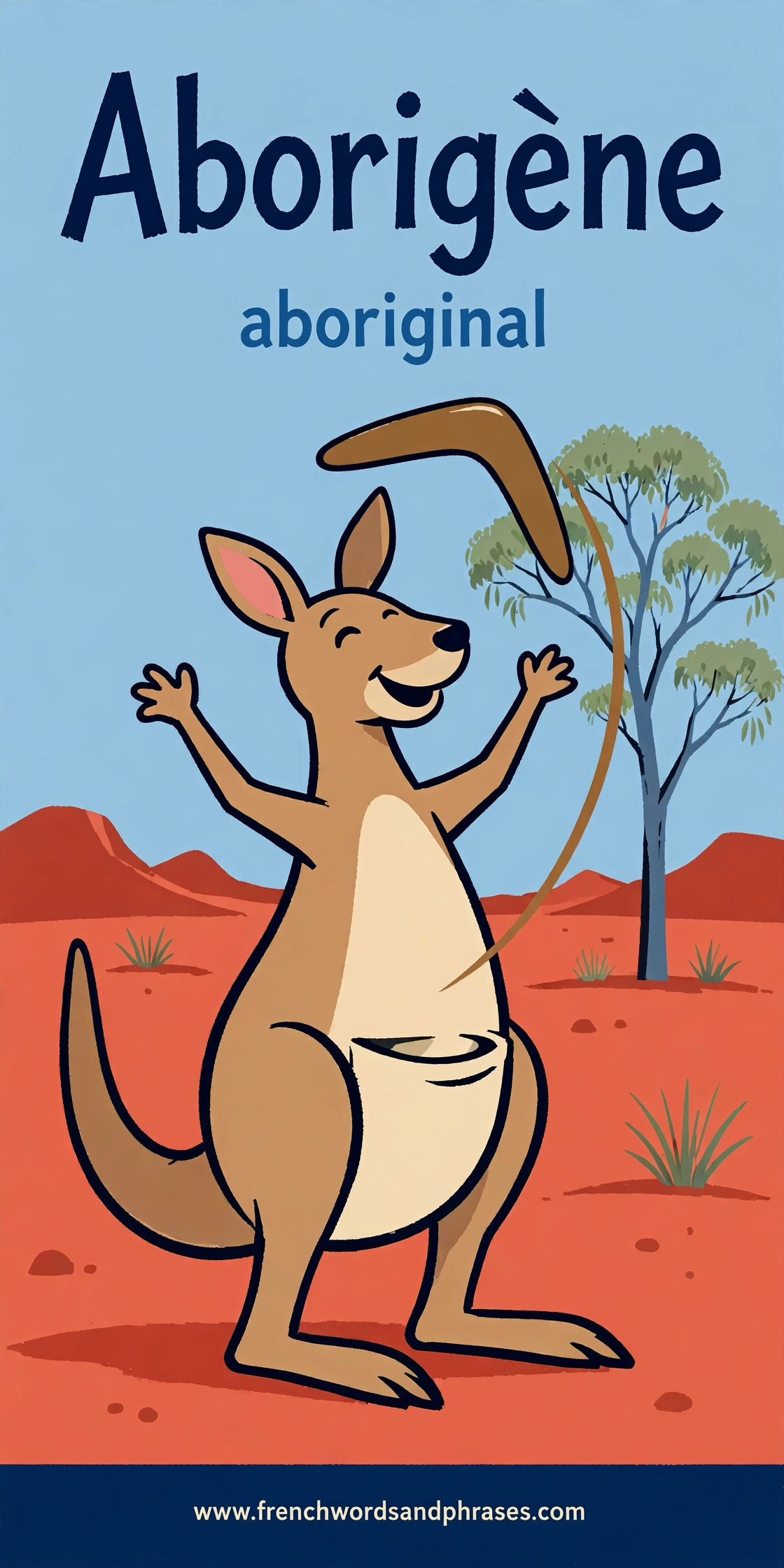
Aborigène means aboriginal.
In a museum in Sydney, a guide stops before a painting of ochre handprints, older than any city on Earth. « Ces artistes, » she says, « sont les premiers habitants de cette terre. » For their cultures, their languages and their art, French uses one respectful word: aborigène.
In this guide, you’ll learn what aborigène means in English, why it never changes between masculine and feminine, where it stands in the sentence, and how it names the Aboriginal peoples of Australia, their art and their languages — with a note on the noun for a person. Explore French examples, English translations, and practice quizzes.
Understanding the French Adjective Aborigène
Aborigène is a French adjective of quality — the adjective for the first peoples of a land, above all the Aboriginal peoples of Australia. It already ends in -e, so masculine and feminine are identical: only the plural adds an s. Un art aborigène, une langue aborigène, les peuples aborigènes — one form does almost all the work. As a noun, un Aborigène (with a capital letter) is an Aboriginal person.
It means aboriginal — belonging to the original inhabitants of a place, especially Australia. It describes peoples (les peuples aborigènes, the Aboriginal peoples), culture (la culture aborigène, Aboriginal culture), art (l’art aborigène, Aboriginal art) and languages (les langues aborigènes, the Aboriginal languages). In Canada, French more often says autochtone for Indigenous peoples; aborigène points first to Australia.
Type: Adjective of quality — first peoples
Answers the question: What is it like? — aboriginal, of the first inhabitants
Changes form: Only in the plural — aborigène / aborigènes, the same for masculine and feminine
English equivalents: Aboriginal; Indigenous (in wider use).
One important usage detail: aborigène stands AFTER the noun — un art aborigène, les peuples aborigènes. Watch the capital letter: the adjective is lower-case, but the noun for a person takes a capital — un Aborigène d’Australie, an Australian Aboriginal man.
Experience the Word
Aborigène is the adjective of deep time — of cultures that were already ancient when the pyramids were new.
Imagine standing before a rock shelter in the Australian outback, where painted hands have watched forty thousand years go by. Every later arrival is a guest in that landscape; aborigène names the hosts.
You have not just said old or native. You have named the first peoples of a land, and their unbroken presence in it.
How to Use Aborigène in French: Complete Guide
Let’s explore how aborigène works in French, beginning with the whole word on one card.
Aborigène at a Glance
Before the details, here is the whole word on one card.
The Whole Word on One Card
Meaning, type, position and forms — aborigène in four lines.
| Point | Aborigène |
|---|---|
| Meaning | aboriginal — of the first inhabitants |
| Type | adjective of quality — peoples and cultures |
| Usual position | after the noun — un art aborigène |
| Form | aborigène for everyone — aborigènes in the plural |
Example
L’art aborigène est très ancien.
Aboriginal art is very ancient.
The Four Forms of Aborigène
Aborigène already ends in -e, so the feminine changes nothing. Only the plural adds an s.
| Form | Aborigène | Example |
|---|---|---|
| Masculine singular | aborigène | un peuple aborigène — an Aboriginal people |
| Feminine singular | aborigène | une langue aborigène — an Aboriginal language |
| Masculine plural | aborigènes | des peuples aborigènes — Aboriginal peoples |
| Feminine plural | aborigènes | des langues aborigènes — Aboriginal languages |
Example
Les langues aborigènes sont nombreuses en Australie.
Aboriginal languages are numerous in Australia.
Quick Quiz 1
Does aborigène change for a feminine noun?
Reveal the answer
No
Un art aborigène, une culture aborigène — the form is identical.
Aboriginal art, Aboriginal culture.
The Feminine of Aborigène: Nothing Changes
Most adjectives build their feminine by adding an e. Aborigène was born with one, so the feminine has nothing to add.
| Situation | Example |
|---|---|
| Masculine | un art aborigène — Aboriginal art |
| Feminine | une tradition aborigène — identical |
| Why | aborigène already ends in -e, so the feminine adds nothing |
| The plural | add s — des traditions aborigènes, Aboriginal traditions |
Example
Cette tradition aborigène a des milliers d’années.
This Aboriginal tradition is thousands of years old.
Where Aborigène Goes: After the Noun
Aborigène follows the noun it describes, like most French adjectives, and it sits comfortably after être.
| Pattern | Example |
|---|---|
| After the noun | un peuple aborigène — an Aboriginal people |
| After être | cette peinture est aborigène — this painting is Aboriginal |
| With an adverb | un art authentiquement aborigène — an authentically Aboriginal art |
| Before the noun | un aborigène peuple — not in everyday French |
Example
Ce site est aborigène et sacré.
This site is Aboriginal and sacred.
Quick Quiz 2
How do you say ‘Aboriginal art’ — aborigène art or art aborigène?
Reveal the answer
art aborigène
Aborigène stands after the noun.
Aboriginal art.
Comparing with Aborigène: A Word Rarely Graded
A culture is aboriginal or it is not, so comparisons are rare — but the machinery exists for emphasis, and plus aborigène appears when traditions are weighed for authenticity.
| Degree | Example |
|---|---|
| As aboriginal as | aussi aborigène que — as aboriginal as |
| More aboriginal | plus aborigène — more aboriginal (rare) |
| Less aboriginal | moins aborigène — less aboriginal (rare) |
| The most aboriginal (masc.) | le plus aborigène — le plus aborigène des peuples |
| The most aboriginal (fem.) | la plus aborigène — la plus aborigène des cultures |
Example
Cette culture est aussi aborigène que l’autre.
This culture is as aboriginal as the other one.
Everyday Expressions with Aborigène
Aborigène appears in museums, geography lessons and documentaries — wherever the first peoples of Australia are named with respect.
| Expression | In English |
|---|---|
| les peuples aborigènes | the Aboriginal peoples |
| l’art aborigène | Aboriginal art |
| les langues aborigènes | the Aboriginal languages |
| la culture aborigène | Aboriginal culture |
| un Aborigène d’Australie | an Australian Aboriginal person (noun, capital A) |
| les Aborigènes australiens | Australian Aboriginal people (noun, plural) |
Example
Les peuples aborigènes vivent en Australie depuis très longtemps.
Aboriginal peoples have lived in Australia for a very long time.
Quick Quiz 3
When does aborigène take a capital letter?
Reveal the answer
As a noun for a person
Un Aborigène d’Australie — but the adjective stays lower-case: un art aborigène.
An Aboriginal person; Aboriginal art.
Aborigène and Its Neighbours
Aborigène shares its field with autochtone — the word Canada prefers for its Indigenous peoples — and with indigène, the older, wider term.
| French | In English |
|---|---|
| autochtone | Indigenous, native — the usual word in Canada |
| indigène | indigenous, native — older and wider |
| ancestral | ancestral — handed down from the ancestors |
| originaire de | originally from, native to — originaire d’Australie |
| traditionnel | traditional — of customs and art |
| colonial | colonial — the later arrivals’ world, the contrast |
Example
Au Canada, on dit plutôt les peuples autochtones.
In Canada, people more often say the Indigenous peoples.
Watch Out: The Traps Around Aborigène
The traps here are the capital letter and the geography: aborigène points first to Australia, autochtone to Canada.
| Trap | The truth |
|---|---|
| The capital | adjective lower-case (un art aborigène), noun capitalised (un Aborigène) |
| Australia first | for Canada’s Indigenous peoples, French prefers autochtone or les Premières Nations |
| Agreement | do not add a second e — une langue aborigène, never ‘aborigénée’ |
| The accent | aborigène keeps its è — not ‘aborigene’ in careful French |
Example
Un Aborigène nous a montré un art aborigène magnifique.
An Aboriginal man showed us magnificent Aboriginal art.
Quick Quiz 4
How do you say ‘the Aboriginal languages’?
Reveal the answer
les langues aborigènes
Aborigène follows the noun and adds s in the plural.
The Aboriginal languages.
Aborigène in Everyday French: Real-Life Examples
Now that you know the word, let’s see how aborigène appears in everyday French.
Example 1 — At the museum
Cette peinture aborigène date de plusieurs siècles.
This Aboriginal painting dates from several centuries ago.
Example 2 — Geography class
Les peuples aborigènes habitent l’Australie depuis très longtemps.
Aboriginal peoples have lived in Australia for a very long time.
Example 3 — A documentary
Le film présente la culture aborigène avec respect.
The film presents Aboriginal culture with respect.
Example 4 — Languages
Certaines langues aborigènes sont en danger.
Some Aboriginal languages are endangered.
Example 5 — Travel
Un guide aborigène nous a fait visiter le site.
An Aboriginal guide showed us around the site.
Example 6 — Art
L’art aborigène utilise souvent des points et des cercles.
Aboriginal art often uses dots and circles.
Beyond Translation: The Meaning of Aborigène
English says aboriginal for the meaning of aborigène — both from Latin ab origine, from the very beginning. French aims the word chiefly at Australia, whose Aboriginal cultures are among the oldest continuous cultures on Earth, while Canada built its own vocabulary of respect around autochtone.
Aborigène names the people who were there from the beginning — and never left.
Used with its capital letter for a person and its lower case for art, languages and peoples, it is a small lesson in how French writes respect.
How to Remember the French Adjective Aborigène
Remember it this way: Aborigène is the first-peoples adjective — one form for him and her, an s for the plural, and a capital only for the person.
- You see one form for everyone — un art aborigène, une langue aborigène.
- You watch the capital — un Aborigène est une personne, l’art aborigène est un adjectif.
- You remember the map — aborigène pour l’Australie, autochtone pour le Canada.
The key idea is aborigène means aboriginal, never changes except in the plural, and takes a capital as a noun.
Test Your Knowledge of Aborigène
Let’s see how much you’ve learned. Try answering these questions before revealing the answers.
Question 1
What does aborigène mean?
Reveal the answer
Aboriginal — of the first inhabitants of a land, especially Australia.
Question 2
What is the feminine of aborigène?
Reveal the answer
aborigène — identical. The word already ends in -e.
Question 3
Translate: Aboriginal art.
Reveal the answer
L’art aborigène.
Question 4
Complete the sentence:
Les langues ______ sont nombreuses en Australie.
Reveal the answer
aborigènes
Les langues aborigènes sont nombreuses en Australie.
Aboriginal languages are numerous in Australia.
Question 5
How do you say ‘an Aboriginal person’ (noun)?
Reveal the answer
un Aborigène — with a capital letter, because it names a person.
Your Final Challenge
Can You Use It?
How would you say this in French?
“Aboriginal art is very ancient.”
Reveal the answer
L’art aborigène est très ancien.
Aboriginal art is very ancient.
A little French. A little curiosity. A richer everyday life.
LEARN FRENCH ONE WORD AT A TIME