A French Word to Live By
Translate Abjectement to English
/ab.ʒɛk.tə.mɑ̃/
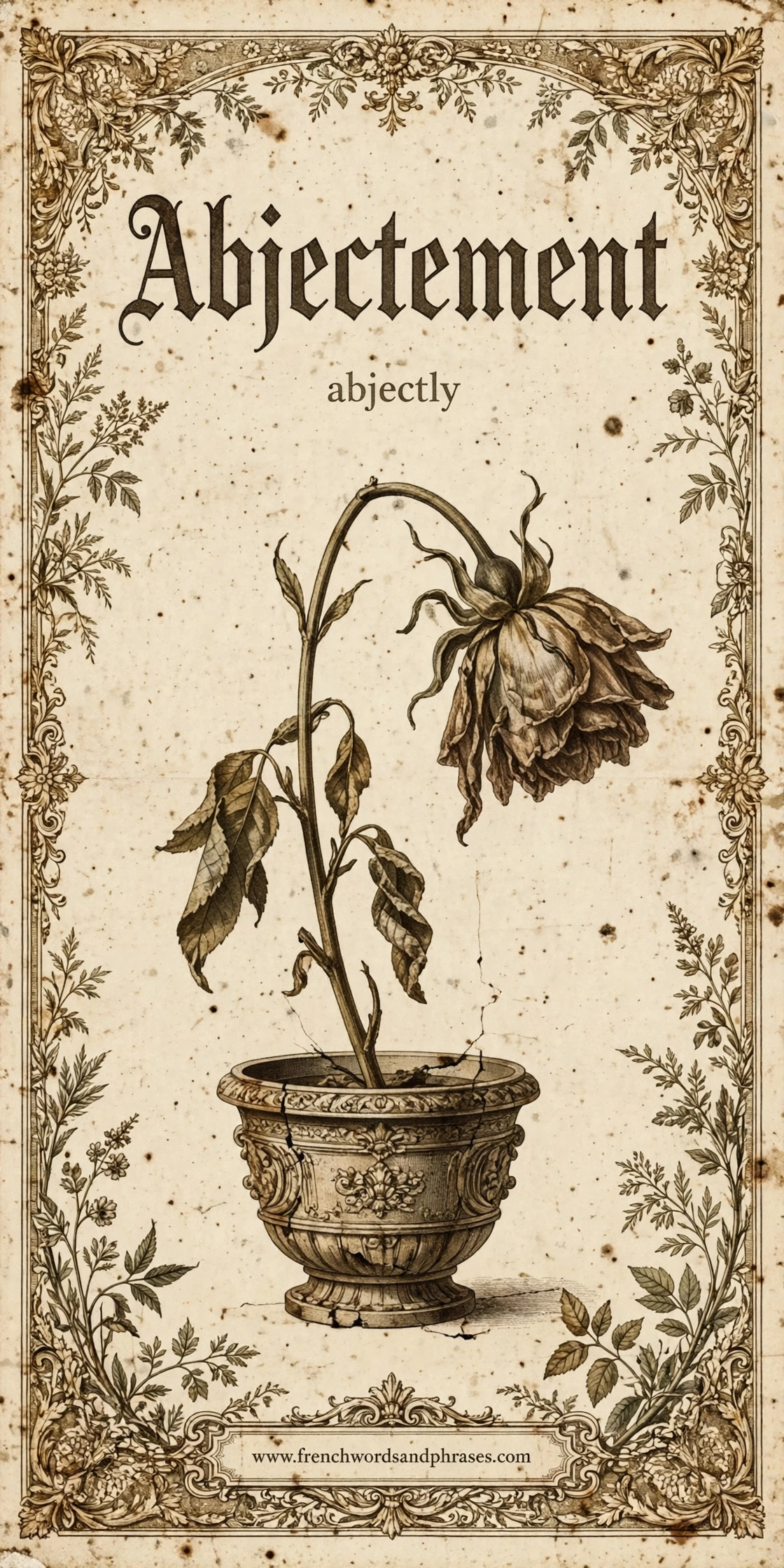
Abjectement means abjectly.
The rain has not stopped for three days in the old novel, and the hero — once rich, once proud — now kneels in the mud outside the inn, begging for a crust of bread. He lives abjectement: utterly low, without dignity, at the very bottom of fortune.
In this guide, you’ll learn what abjectement means in English, how it is built from the adjective abject, where it sits in a French sentence, and why it belongs to novels and formal prose rather than the café. Explore French examples, English translations, and practice quizzes.
Understanding the French Adverb Abjectement
Abjectement is a French adverb of manner. It is built the classic way: the feminine adjective abjecte plus the ending -ment. Like every adverb, it never agrees, never takes a plural, and never changes its shape.
It means abjectly — in an abject way: utterly low, wretched and without dignity. It describes how someone lives, apologises or submits when pride has been stripped away completely. It is a strong, literary word: French reaches for it in novels, history books and solemn speeches, not over coffee.
Type: Adverb of manner — wretchedness and self-abasement
Answers the question: How? — in an utterly low, miserable way
Changes form: Never — abjectement is invariable
English equivalents: Abjectly; in utter wretchedness.
One important usage detail: mind the spelling — abjectement, with a t before -ement, because it is built on the feminine form abjecte. And mind the register: for ordinary bad luck, everyday French prefers misérablement or a plain phrase like dans la misère. Abjectement is the heavy, bookish word.
Experience the Word
Abjectement is the adverb of the gutter in the great French novel — the word for a life lived at the very bottom, with nothing left to lose.
Imagine the scene the novelists loved: the fallen minister, the ruined gambler, the beggar at the church door — « il vivait abjectement, dans une seule pièce, sans feu et sans amis ».
You have not just said miserably. You have pushed the misery all the way down to the floor.
How to Use Abjectement in French: Complete Guide
Let’s explore how abjectement works in French, beginning with the whole word on one card.
Abjectement at a Glance
Before the details, here is the whole word on one card.
The Whole Word on One Card
Meaning, type, position and form — abjectement in four lines.
| Point | Abjectement |
|---|---|
| Meaning | abjectly |
| Type | adverb of manner — utter wretchedness |
| Usual position | after the verb it describes |
| Form | invariable — never changes |
Example
Il vivait abjectement, dans une seule pièce froide.
He lived abjectly, in a single cold room.
Where Abjectement Goes in the Sentence
Abjectement follows the verb it colours, and it can step to the head of the sentence when a writer wants the misery announced first.
| Situation | Pattern |
|---|---|
| After the verb | verb + abjectement — il vivait abjectement |
| With a compound tense | after the past participle — il s’est excusé abjectement |
| Head of the sentence | Abjectement, + sentence — Abjectement, il a tout avoué |
| Before an adjective of state | abjectement + adjective — abjectement pauvre |
Example
Après la défaite, le général s’est excusé abjectement.
After the defeat, the general apologised abjectly.
Quick Quiz 1
What does abjectement add to the verb vivre in « il vivait abjectement »?
Reveal the answer
The depth of the misery — he did not just live poorly, he lived in utter wretchedness, without dignity.
Il vivait abjectement, sans feu et sans amis.
He lived abjectly, without heating and without friends.
Abjectement in Novels and Formal Prose
This is a word of the written page: fallen heroes, grovelling apologies and lives at the bottom of the ladder.
| Situation | Example |
|---|---|
| A ruined life | Il a fini abjectement, seul et oublié. |
| A grovelling apology | Il s’est excusé abjectement devant tout le bureau. |
| Submission | Elle a accepté abjectement toutes les conditions. |
| Poverty | La famille vivait abjectement dans un taudis. |
| A confession | Il a avoué abjectement sa faute. |
Example
Le ministre déchu s’est excusé abjectement à la télévision.
The fallen minister apologised abjectly on television.
Abjectement and Its Neighbours
French has a whole shelf of -ment adverbs for low states. Abjectement is the lowest shelf of all.
| French | In English |
|---|---|
| misérablement | miserably (the everyday word) |
| honteusement | shamefully |
| lamentablement | lamentably, pitifully (often of a failure) |
| pitoyablement | piteously, pathetically |
| abjectement | abjectly (the deepest, most literary) |
Example
Il a échoué lamentablement, puis il s’est excusé abjectement.
He failed lamentably, then he apologised abjectly.
Quick Quiz 2
Complete the sentence:
Le roi déchu vivait ______, dans une cabane près de la mer. (abjectly)
Reveal the answer
abjectement
Le roi déchu vivait abjectement, dans une cabane près de la mer.
The deposed king lived abjectly, in a hut near the sea.
The Family Behind Abjectement: Abject
Abjectement is the adverb of the family abject — the word for everything base, low and despicable.
| French | In English |
|---|---|
| abject / abjecte | abject (adjective) — un comportement abject |
| abjectement | abjectly |
| l’abjection | abjection — the state of being cast down |
| un être abject | a despicable creature |
Example
Un mensonge abject, suivi d’excuses abjectement présentées.
An abject lie, followed by abjectly offered apologies.
Abjectement or Misérablement?
Both mean living low, but they do not weigh the same. Choosing between them is a question of register and force.
| Aspect | The Difference |
|---|---|
| Register | abjectement is literary and solemn; misérablement is everyday |
| Force | abjectement adds disgust and lost dignity, not just poverty |
| You will read it in | abjectement: novels, history, formal speeches — misérablement: speech and ordinary writing |
| A safe rule | In conversation, say misérablement; keep abjectement for writing that wants weight |
Example
Il vivait misérablement, et ses excuses sonnaient abjectement faux.
He lived miserably, and his apologies sounded abjectly false.
Quick Quiz 3
Which word names the state itself: l’abjection or abjectement?
Reveal the answer
l’abjection — it is the noun, the state of being cast down. Abjectement is the adverb, the manner.
Il a sombré dans l’abjection.
He sank into abjection.
The Verbs That Keep Abjectement Company
Abjectement is choosy: it follows a small company of verbs — living, apologising, submitting, confessing — the verbs of a fall.
| Verb | With Abjectement |
|---|---|
| vivre | vivre abjectement — to live in utter wretchedness |
| s’excuser | s’excuser abjectement — to apologise grovellingly |
| accepter | accepter abjectement — to submit without a murmur |
| avouer | avouer abjectement — to confess with one’s head down |
| mourir | mourir abjectement — to die forgotten and destitute |
Example
Il a tout accepté abjectement, même l’injustice.
He accepted everything abjectly, even the injustice.
Watch Out: The Traps Around Abjectement
The traps: a missing t in the spelling, and a heavy word used where a light one belongs.
| Mistake | Correct French |
|---|---|
| Spelling it « abjecement » | abjectement — the t of abjecte stays |
| Using it for a small mishap: « j’ai abjectement raté mon train » | j’ai bêtement raté mon train — abjectement is far too heavy |
| Confusing it with objectivement | objectivement = objectively — a different word entirely |
| Expecting agreement: « elle vivait abjectemente » | adverbs never agree — abjectement for everyone |
Example
Non, pas objectivement : il a agi abjectement.
No, not objectively: he behaved abjectly.
Quick Quiz 4
Translate: He apologised abjectly.
Reveal the answer
Il s’est excusé abjectement.
The adverb follows the past participle — and it never changes its form.
Abjectement in Everyday French: Real-Life Examples
Now that you know the word, let’s see how abjectement appears in everyday French.
Example 1 — In a novel
Le héros finit abjectement, seul dans une chambre de bonne.
The hero ends up abjectly, alone in a maid’s room.
Example 2 — An apology
Le directeur s’est excusé abjectement devant ses employés.
The manager apologised abjectly in front of his employees.
Example 3 — Poverty
Autrefois, des familles entières vivaient abjectement dans ce quartier.
In the past, whole families lived abjectly in this district.
Example 4 — Submission
Il a accepté abjectement les ordres les plus injustes.
He abjectly accepted the most unjust orders.
Example 5 — History
Le roi déchu est mort abjectement, loin de son pays.
The deposed king died abjectly, far from his country.
Example 6 — A confession
Elle a avoué abjectement, les yeux baissés.
She confessed abjectly, her eyes lowered.
Beyond Translation: The Meaning of Abjectement
English speakers meet abjectement and think of the phrase abject poverty — and for once the instinct is right, because French and English borrowed the same Latin root: abjectus, thrown away, cast down.
To do something abjectement is to do it from the very bottom.
It is not an everyday word, and that is its power. A novelist who writes abjectement is not describing a bad week; he is closing the door on dignity itself.
How to Remember the French Adverb Abjectement
Remember it this way: Abjectement means abjectly — living, apologising or submitting from the very bottom, with dignity gone.
- You build it on the feminine — abjecte + ment gives abjectement, with the t kept.
- You feel its weight — plus bas que misérablement : abjectement is the literary word.
- You picture the fallen hero — il vivait abjectement, seul et oublié.
The key idea is abjectement = abjectly, the deepest and most literary of the misery adverbs.
Test Your Knowledge of Abjectement
Let’s see how much you’ve learned. Try answering these questions before revealing the answers.
Question 1
What does abjectement mean?
Reveal the answer
Abjectly — in an utterly low, wretched way.
Question 2
How is abjectement built?
Reveal the answer
From the feminine adjective abjecte + -ment — which is why the t stays in the spelling.
Question 3
Translate: She lived abjectly in a tiny room.
Reveal the answer
Elle vivait abjectement dans une toute petite pièce.
Question 4
Which is the everyday word: abjectement or misérablement?
Reveal the answer
Misérablement — abjectement belongs to novels and formal prose.
Question 5
Complete the sentence:
Il s’est excusé ______. (abjectly)
Reveal the answer
abjectement
Il s’est excusé abjectement.
He apologised abjectly.
Your Final Challenge
Can You Use It?
How would you say this in French?
“He lived abjectly, alone and forgotten.”
Reveal the answer
Il vivait abjectement, seul et oublié.
He lived abjectly, alone and forgotten.
A little French. A little curiosity. A richer everyday life.
LEARN FRENCH ONE WORD AT A TIME