A French Word to Live By
Translate Abigéat to English
/a.bi.ʒe.a/
L’abigéat means the cattle theft.
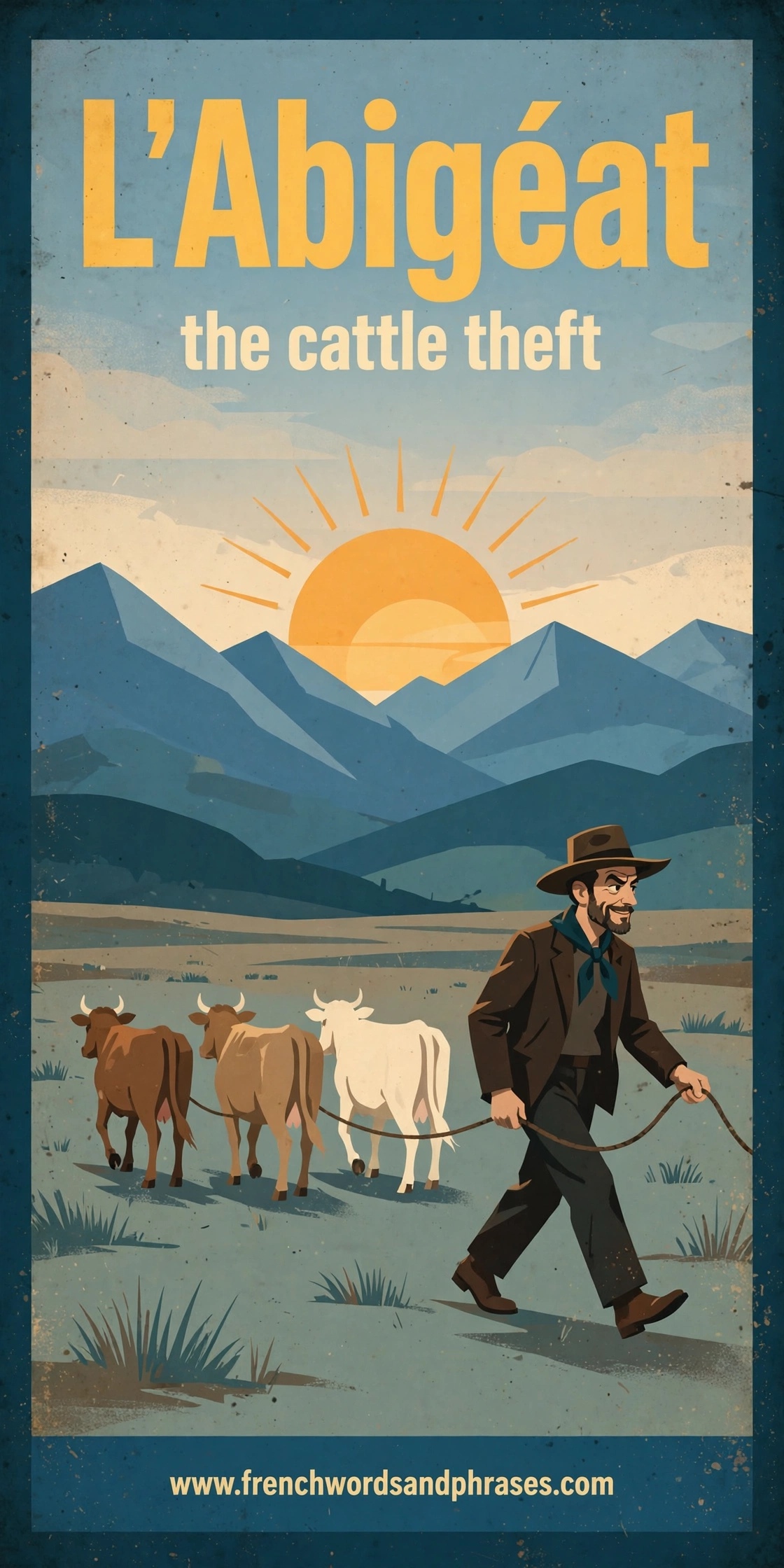
Dawn on a farm, a hundred years ago: the gate stands open, the meadow is empty, and a trail of hoofprints leads away over the hill. The farmer has lost his whole herd in one night — the victim of an old, old crime: l’abigéat.
In this guide, you’ll learn what abigéat means in English, how to use it with its articles, how to form its plural, and how it appears in everyday French. Explore French examples, English translations, and practice quizzes.
Understanding the French Noun Abigéat
Abigéat is a masculine French noun, learned with its article: l’abigéat, un abigéat — because it begins with a vowel, le shrinks to l’. It is an archaic word from the old law books: you will meet it in nineteenth-century novels and legal history, not in a modern newspaper.
It means the theft of cattle or livestock — driving someone else’s herd away to keep it, what English calls cattle rustling. The word carries its crime inside it: it comes from the Latin abigere, to drive away. Old penal codes punished l’abigéat severely, because a stolen herd could ruin a family for a generation.
Gender: Masculine
Definite article: l’ — l’abigéat (the cattle theft)
Indefinite article: un — un abigéat (a cattle theft)
Plural: les abigéats
Register: Archaic, legal — the modern term is le vol de bétail
English equivalents: The cattle theft; livestock rustling.
One important usage detail: abigéat belongs to the language of old courts and old novels. A French farmer today whose cows are stolen reports un vol de bétail — but read Balzac or a history of rural crime and l’abigéat is the word on the page, heavy with hoofbeats and lantern light.
Experience the Word
Abigéat is more than an old legal term. It is a window onto a world where wealth walked on four legs, where a herd was a family’s bank, its milk, its future — and where losing it in one night meant ruin.
Imagine the scene the word paints: torches in the farmyard, neighbours woken, dogs barking at hoofprints in the mud, and the long ride after the thieves before the trail goes cold.
You have not just learned a crime. You have stepped into the rural France of two centuries ago.
How to Use Abigéat in French: Complete Guide
Let’s explore how abigéat works in French, beginning with its articles — and remember, the vowel start means l’ everywhere.
Abigéat with the Definite Article (L’, Les)
Used for a specific, known theft — the one the whole village is talking about.
| Form | French |
|---|---|
| Masculine singular | l’abigéat |
| Plural | les abigéats |
Example
L’abigéat a eu lieu pendant la nuit de la foire.
The cattle theft took place during the night of the fair.
Abigéat with the Indefinite Article (Un, Des)
Used for a cattle theft in general — un abigéat, one more crime in the old assize records.
| Form | French |
|---|---|
| Masculine singular | un abigéat |
| Plural | des abigéats |
Example
Un abigéat a été signalé dans le canton voisin.
A cattle theft has been reported in the neighbouring district.
On the Farm: Words of Herds and Theft
Meadows, herds and thieves — the vocabulary that surrounds l’abigéat in the old stories.
| French | In English |
|---|---|
| le bétail | the livestock, the cattle |
| le troupeau | the herd |
| la vache | the cow |
| le pré | the meadow |
| voler | to steal |
| le voleur | the thief |
Example
Le voleur a conduit le troupeau loin du pré pendant la nuit.
The thief drove the herd far from the meadow during the night.
Quick Quiz 1
Complete the sentence:
Dans les vieux textes de loi, voler du bétail s’appelle commettre un ______.
Reveal the answer
abigéat
Dans les vieux textes de loi, voler du bétail s’appelle commettre un abigéat.
In the old law books, stealing cattle is called committing an abigéat.
The Plural of Abigéat
Abigéat adds an -s in the plural — les abigéats, the rustling cases of a hard decade.
| Number | French |
|---|---|
| Singular | l’abigéat |
| Plural | les abigéats |
Example
Les abigéats se multipliaient pendant les années de famine.
Cattle thefts multiplied during the famine years.
Abigéat with Possessive Adjectives (Mon, Ton, Son…)
Abigéat begins with a vowel, so it takes mon, ton, son — the forms used before a vowel sound.
| Owner | French |
|---|---|
| my | mon abigéat |
| your (tu) | ton abigéat |
| his / her | son abigéat |
| our | notre abigéat |
| your (vous) | votre abigéat |
| their | leur abigéat |
Example
Son abigéat présumé a fait scandale dans tout le canton.
His alleged cattle theft caused a scandal throughout the district.
Quick Quiz 2
Complete the sentence:
______ abigéat, commis en 1843, est resté célèbre dans la région. (Their)
Reveal the answer
Leur
Leur abigéat, commis en 1843, est resté célèbre dans la région.
Their cattle theft, committed in 1843, remained famous in the region.
Abigéat with Demonstrative Adjectives (Cet, Ces)
Used to point: cet abigéat — cet, not ce, because the word begins with a vowel.
| Form | French |
|---|---|
| Masculine singular | cet abigéat |
| Plural | ces abigéats |
Example
Cet abigéat est raconté dans tous les livres d’histoire locale.
This cattle theft is told in every local history book.
Abigéat with Adjectives
Old trials and dark nights — the adjectives that gather around this archaic word.
| Adjective | With Abigéat |
|---|---|
| ancien (old) | un abigéat ancien |
| célèbre (famous) | un abigéat célèbre |
| présumé (alleged) | un abigéat présumé |
| nocturne (night-time) | un abigéat nocturne |
| audacieux (daring) | un abigéat audacieux |
Example
Un abigéat nocturne a vidé l’étable du fermier.
A night-time cattle theft emptied the farmer’s cowshed.
Quick Quiz 3
Complete the sentence:
______ abigéat a eu lieu en 1870. (This)
Reveal the answer
Cet
Cet abigéat a eu lieu en 1870.
This cattle theft took place in 1870 — cet, because abigéat begins with a vowel.
Everyday Expressions with Abigéat
Old courts and village tales — the abigéat phrases you will meet in books.
| Expression | In English |
|---|---|
| commettre un abigéat | to commit a cattle theft |
| être accusé d’abigéat | to be accused of cattle rustling |
| le vol de bétail | livestock theft (the modern term) |
| conduire le troupeau au loin | to drive the herd far away |
| un procès pour abigéat | a trial for cattle theft |
Example
Il a été accusé d’abigéat et jugé aux assises.
He was accused of cattle rustling and tried at the assize court.
Words from the Same Family as Abigéat
Theft, herds and farmyards — the words that travel with abigéat.
| French | In English |
|---|---|
| le vol | the theft |
| voler | to steal |
| le voleur | the thief |
| le bétail | the livestock |
| le troupeau | the herd |
| la prairie | the meadow, the pasture |
Example
Le vol de bétail ruinait les fermiers autrefois.
Livestock theft used to ruin farmers in the old days.
Quick Quiz 4
What is the modern, everyday French term for l’abigéat?
Reveal the answer
Le vol de bétail — livestock theft. Abigéat survives in old law and literature; today’s French simply names the theft and the animals.
La police enquête sur un vol de bétail.
The police are investigating a livestock theft.
Abigéat in Everyday French: Real-Life Examples
Now that you know the word, let’s see how abigéat appears in everyday French.
Example 1 — In an old novel
Le héros du roman est accusé d’abigéat.
The hero of the novel is accused of cattle rustling.
Example 2 — A history lesson
Au XIXe siècle, l’abigéat était sévèrement puni.
In the nineteenth century, cattle theft was severely punished.
Example 3 — A grandfather’s tale
Mon grand-père racontait un abigéat célèbre dans son village.
My grandfather used to tell of a famous cattle theft in his village.
Example 4 — At the museum
Ce vieux document parle d’un procès pour abigéat.
This old document tells of a trial for cattle theft.
Example 5 — On a farm walk
Autrefois, on craignait l’abigéat dans ces prairies isolées.
In the old days, people feared cattle rustling in these isolated pastures.
Example 6 — Reading the archives
Les archives du village mentionnent trois abigéats en dix ans.
The village archives mention three cattle thefts in ten years.
Beyond Translation: The Meaning of Abigéat
Abigéat is a fossil word — and fossils tell stories. It survives from a France where the law spoke Latin’s language and a family’s fortune grazed in a field: steal the herd and you stole the milk, the calves, the ploughing, the dowry, the winter. That is why the old codes treated the cattle thief almost like a murderer, and why the word still smells of mud, straw and lamplight.
To say abigéat is to hear hooves disappearing into the night, two hundred years ago.
Modern French has let the word retire to novels and history books, replacing it with the plain vol de bétail — but meet it once, and every old farmhouse gate left open at dawn looks different.
How to Remember the French Noun Abigéat
Remember it this way: Abigéat is cattle theft, the old legal word — from Latin abigere, to drive away: the thief drives the herd away over the hill.
- You see the herd — l’abigéat, c’est le vol du troupeau.
- You hear the root — abigere en latin : conduire au loin.
- You use today’s words — le vol de bétail, le terme moderne.
The key idea is abigéat — driving the herd away, the old word for cattle rustling.
Test Your Knowledge of Abigéat
Let’s see how much you’ve learned. Try answering these questions before revealing the answers.
Question 1
What does abigéat mean?
Reveal the answer
Cattle theft, livestock rustling — stealing a herd by driving it away.
Question 2
Is abigéat masculine or feminine?
Reveal the answer
Masculine — l’abigéat, un abigéat.
Question 3
Translate: He was accused of cattle rustling.
Reveal the answer
Il a été accusé d’abigéat.
Question 4
What would a French farmer say today instead of abigéat?
Reveal the answer
Un vol de bétail — the modern, everyday term.
Question 5
Complete the sentence:
______ abigéat a eu lieu pendant la foire. (This)
Reveal the answer
Cet
Cet abigéat a eu lieu pendant la foire.
This cattle theft took place during the fair.
Your Final Challenge
Can You Use It?
How would you say this in French?
“The thief committed a cattle theft during the night.”
Reveal the answer
Le voleur a commis un abigéat pendant la nuit.
The thief committed a cattle theft during the night.
A little French. A little curiosity. A richer everyday life.
LEARN FRENCH ONE WORD AT A TIME