A French Word to Live By
How to Conjugate Abâtardir in French
/a.bɑ.taʁ.diʁ/
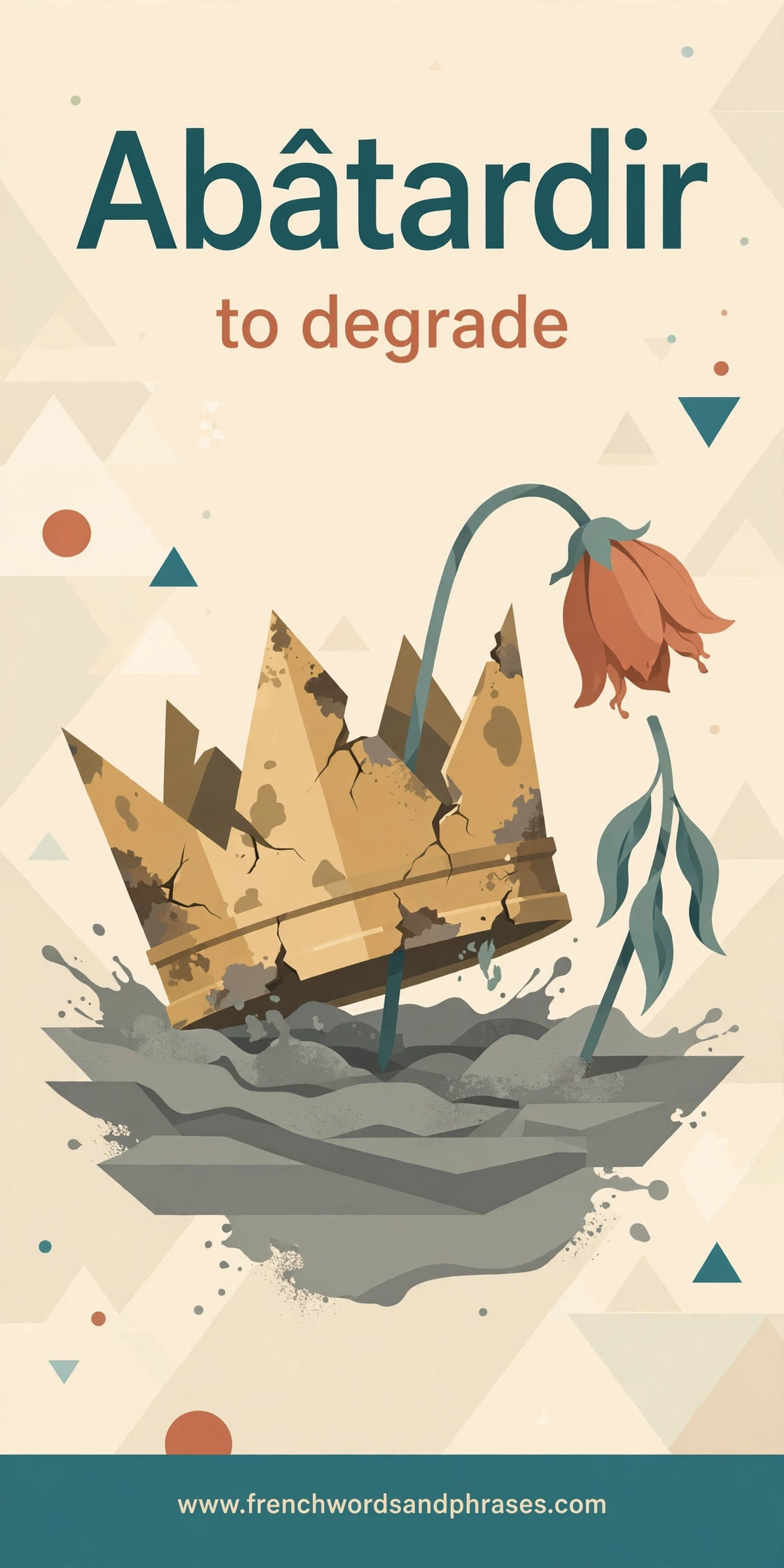
Abâtardir means to degrade — to lower the character, quality or value of something until only a poorer copy of the original remains.
A noble wine cut with water, a fine old language salted with slang until its music thins, a craft cheapened by shortcuts — abâtardir is the verb of decline in quality: whatever was once pure, strong or well-bred, made lesser by mixture and neglect.
In this guide, you’ll learn how to conjugate abâtardir in all the major French tenses and moods. Explore complete conjugation tables, French examples, English translations, and practice quizzes.
Understanding the French Verb Abâtardir
Abâtardir is a regular French verb belonging to the second group of verbs, those ending in -ir.
It means to degrade, to debase. It is commonly used of breeds and bloodlines losing their purity, of languages, styles and crafts cheapened over time, and of wines and products adulterated for profit — a stern, literary verb, more often read than heard, and nearly always a judgement: something precious has been let slip.
Verb classification: Second group (-ir)
Auxiliary verb: Avoir
Past participle: abâtardi
Present participle: abâtardissant
English equivalents: To degrade, to debase, to corrupt, to bastardise; abâtardir une langue — to debase a language; abâtardir un vin — to adulterate a wine; s’abâtardir — to degenerate, to lose one’s quality; l’abâtardissement — degeneration, debasement.
One important detail: abâtardir wears a circumflex on its second a — abâtardir, abâtardi — a little hat inherited from its parent bâtard, a bastard, and it conjugates exactly like finir: j’abâtardis, nous abâtardissons, ils abâtardissent. Used reflexively, s’abâtardir, it describes the thing itself going downhill: la race s’abâtardit, the breed degenerates; le style s’est abâtardi, the style has lost its edge.
Experience the Word
Abâtardir is the verb of the watered wine — nothing is destroyed outright, but everything that made it itself has been thinned away.
Imagine an old vineyard above a Provençal village, its wine famous for three generations. The new owners plant for yield, blend for volume, sweeten for the export market. The label is unchanged, the colour nearly so — but the old men at the café shake their heads: on a abâtardi le vin, the wine has been debased, and no vintage will bring the original back.
The wine still pours and still sells. It has been degraded — abâtardi — and only memory knows what was lost.
How to Conjugate Abâtardir: Complete French Conjugation Guide
Let’s explore every major conjugation of abâtardir, beginning with the indicative mood.
How to Conjugate Abâtardir in the Indicative Mood
The indicative mood is used to express facts, observations, actions, and events.
How to Conjugate Abâtardir in the Present Tense (Présent)
Used for actions happening now, habitual actions, and general truths.
| Subject | Conjugation |
|---|---|
| je | abâtardis |
| tu | abâtardis |
| il / elle | abâtardit |
| nous | abâtardissons |
| vous | abâtardissez |
| ils / elles | abâtardissent |
Example
Le sucre abâtardit ce vin délicat.
Sugar degrades this delicate wine.
Quick Quiz 1
Complete the sentence:
Nous refusons que ces mélanges ______ notre vin.
Reveal the answer
abâtardissent
Nous refusons que ces mélanges abâtardissent notre vin.
We refuse to let these blends degrade our wine.
How to Conjugate Abâtardir in the Passé Composé
Used for completed actions in the past. Abâtardir takes the auxiliary verb avoir.
| Subject | Conjugation |
|---|---|
| j’ | ai abâtardi |
| tu | as abâtardi |
| il / elle | a abâtardi |
| nous | avons abâtardi |
| vous | avez abâtardi |
| ils / elles | ont abâtardi |
Example
Le commerce a abâtardi ce vieux métier d’art.
Commerce has debased this old craft.
How to Conjugate Abâtardir in the Imparfait (Imperfect Tense)
Used for habitual past actions, descriptions, and ongoing situations in the past.
| Subject | Conjugation |
|---|---|
| je | abâtardissais |
| tu | abâtardissais |
| il / elle | abâtardissait |
| nous | abâtardissions |
| vous | abâtardissiez |
| ils / elles | abâtardissaient |
Example
Les croisements abâtardissaient lentement la race des chiens de chasse.
Cross-breeding slowly degraded the breed of hunting dogs.
Quick Quiz 2
Choose the correct form:
Commerce has debased this old trade.
Le commerce ______ ce vieux métier. (a abâtardi / est abâtardi)
Reveal the answer
a abâtardi
Le commerce a abâtardi ce vieux métier.
Abâtardir takes avoir.
How to Conjugate Abâtardir in the Plus-que-parfait
Used to describe an action that had already been completed before another past event.
| Subject | Conjugation |
|---|---|
| j’ | avais abâtardi |
| tu | avais abâtardi |
| il / elle | avait abâtardi |
| nous | avions abâtardi |
| vous | aviez abâtardi |
| ils / elles | avaient abâtardi |
Example
Le temps avait abâtardi la langue des anciens textes.
Time had debased the language of the old texts.
How to Conjugate Abâtardir in the Passé Simple
Primarily used in formal writing, literature, and historical narratives. It is rarely used in everyday conversation.
| Subject | Conjugation |
|---|---|
| je | abâtardis |
| tu | abâtardis |
| il / elle | abâtardit |
| nous | abâtardîmes |
| vous | abâtardîtes |
| ils / elles | abâtardirent |
Example
La mode abâtardit en quelques années ce style autrefois noble.
Fashion degraded this once noble style within a few years.
How to Conjugate Abâtardir in the Passé Antérieur
A literary tense used to express an action completed immediately before another past action, generally in the passé simple.
| Subject | Conjugation |
|---|---|
| j’ | eus abâtardi |
| tu | eus abâtardi |
| il / elle | eut abâtardi |
| nous | eûmes abâtardi |
| vous | eûtes abâtardi |
| ils / elles | eurent abâtardi |
Example
Quand l’usine eut abâtardi le produit, les anciens clients disparurent.
When the factory had debased the product, the old customers vanished.
How to Conjugate Abâtardir in the Future Tense (Futur Simple)
Used to describe actions that will take place in the future.
| Subject | Conjugation |
|---|---|
| je | abâtardirai |
| tu | abâtardiras |
| il / elle | abâtardira |
| nous | abâtardirons |
| vous | abâtardirez |
| ils / elles | abâtardiront |
Example
Ces raccourcis abâtardiront votre écriture.
These shortcuts will degrade your writing.
How to Conjugate Abâtardir in the Futur Antérieur (Future Perfect)
Used for an action that will have been completed before a particular point in the future.
| Subject | Conjugation |
|---|---|
| j’ | aurai abâtardi |
| tu | auras abâtardi |
| il / elle | aura abâtardi |
| nous | aurons abâtardi |
| vous | aurez abâtardi |
| ils / elles | auront abâtardi |
Example
À ce rythme, la mode aura abâtardi le goût de toute une génération.
At this rate, fashion will have debased the taste of a whole generation.
How to Conjugate Abâtardir in the Near Future (Futur Proche)
Used to describe something that is going to happen soon. Formed with aller + infinitive.
| Subject | Conjugation |
|---|---|
| je | vais abâtardir |
| tu | vas abâtardir |
| il / elle | va abâtardir |
| nous | allons abâtardir |
| vous | allez abâtardir |
| ils / elles | vont abâtardir |
Example
Ce mélange va abâtardir la recette originale.
This mixture is going to debase the original recipe.
How to Conjugate Abâtardir in the Conditional Mood
The conditional mood expresses what would happen under certain circumstances. It is also frequently used to make polite requests or express wishes.
How to Conjugate Abâtardir in the Present Conditional
| Subject | Conjugation |
|---|---|
| je | abâtardirais |
| tu | abâtardirais |
| il / elle | abâtardirait |
| nous | abâtardirions |
| vous | abâtardiriez |
| ils / elles | abâtardiraient |
Example
Un tel compromis abâtardirait l’œuvre entière.
Such a compromise would degrade the whole work.
How to Conjugate Abâtardir in the Past Conditional
| Subject | Conjugation |
|---|---|
| j’ | aurais abâtardi |
| tu | aurais abâtardi |
| il / elle | aurait abâtardi |
| nous | aurions abâtardi |
| vous | auriez abâtardi |
| ils / elles | auraient abâtardi |
Example
Sans les puristes, la langue se serait abâtardie plus vite.
Without the purists, the language would have degenerated faster.
Abâtardir in the Literary Past Conditional Form
This less common literary form uses the imperfect subjunctive of avoir.
| Subject | Conjugation |
|---|---|
| j’ | eusse abâtardi |
| tu | eusses abâtardi |
| il / elle | eût abâtardi |
| nous | eussions abâtardi |
| vous | eussiez abâtardi |
| ils / elles | eussent abâtardi |
Example
Le luxe eût abâtardi les mœurs de la cité sans les lois.
Luxury would have debased the morals of the city without the laws.
How to Conjugate Abâtardir in the Subjunctive Mood
The subjunctive is used to express wishes, emotions, doubts, necessity, and uncertainty. It frequently follows expressions such as il faut que (it is necessary that) or bien que (although).
How to Conjugate Abâtardir in the Present Subjunctive
| Subject | Conjugation |
|---|---|
| que je | abâtardisse |
| que tu | abâtardisses |
| qu’il / qu’elle | abâtardisse |
| que nous | abâtardissions |
| que vous | abâtardissiez |
| qu’ils / qu’elles | abâtardissent |
Example
Je crains que l’argent abâtardisse ce bel artisanat.
I fear money may debase this fine craftsmanship.
Quick Quiz 3
Complete the sentence using the subjunctive:
Je crains que l’argent ______ ce bel artisanat.
Reveal the answer
abâtardisse
Je crains que l’argent abâtardisse ce bel artisanat.
I fear money may debase this fine craftsmanship.
How to Conjugate Abâtardir in the Imperfect Subjunctive
A literary tense, rarely encountered in modern spoken French.
| Subject | Conjugation |
|---|---|
| que je | abâtardisse |
| que tu | abâtardisses |
| qu’il / qu’elle | abâtardît |
| que nous | abâtardissions |
| que vous | abâtardissiez |
| qu’ils / qu’elles | abâtardissent |
Example
Il fallait éviter que le mélange abâtardît la race.
It was necessary to prevent the cross-breeding from degrading the breed.
How to Conjugate Abâtardir in the Pluperfect Subjunctive
A literary construction used to express an action completed before another past action.
| Subject | Conjugation |
|---|---|
| que j’ | eusse abâtardi |
| que tu | eusses abâtardi |
| qu’il / qu’elle | eût abâtardi |
| que nous | eussions abâtardi |
| que vous | eussiez abâtardi |
| qu’ils / qu’elles | eussent abâtardi |
Example
Les anciens regrettaient que le siècle eût abâtardi les manières.
The old people regretted that the century had debased manners.
How to Conjugate Abâtardir in the Past Subjunctive
| Subject | Conjugation |
|---|---|
| que j’ | aie abâtardi |
| que tu | aies abâtardi |
| qu’il / qu’elle | ait abâtardi |
| que nous | ayons abâtardi |
| que vous | ayez abâtardi |
| qu’ils / qu’elles | aient abâtardi |
Example
Il est dommage que ce procédé ait abâtardi le vin.
It is a pity that this process has degraded the wine.
How to Conjugate Abâtardir in the Imperative
The imperative is used to give commands, instructions, invitations, or suggestions. Subject pronouns are omitted.
How to Conjugate Abâtardir in the Present Imperative
| Person | Conjugation |
|---|---|
| (tu) | abâtardis |
| (nous) | abâtardissons |
| (vous) | abâtardissez |
Example
N’abâtardis pas ton style pour plaire à tous !
Do not debase your style to please everyone!
Quick Quiz 4
How would you say Do not debase your style (tu form)?
Reveal the answer
N’abâtardis pas ton style !
French Participles of Abâtardir
Participles are verb forms that can be used in compound tenses and other grammatical constructions.
Present Participle of Abâtardir
abâtardissant
En abâtardissant la recette, le cuisinier a perdu ses clients fidèles.
By debasing the recipe, the cook lost his loyal customers.
Past Participle of Abâtardir
abâtardi
Abâtardi par des années de négligence, le jardin avait perdu son dessin.
Degraded by years of neglect, the garden had lost its design.
Abâtardir in Everyday French: Real-Life Examples
Now that you know the conjugations, let’s see how abâtardir appears in everyday French.
Example 1 — Present
Le sucre abâtardit ce vin délicat.
Sugar degrades this delicate wine.
Example 2 — Passé composé
Le commerce a abâtardi ce vieux métier.
Commerce has debased this old trade.
Example 3 — Imparfait
Les croisements abâtardissaient la race.
Cross-breeding used to degrade the breed.
Example 4 — Future
Ces raccourcis abâtardiront ton écriture.
These shortcuts will degrade your writing.
Example 5 — Conditional
Un tel compromis abâtardirait l’œuvre.
Such a compromise would degrade the work.
Example 6 — Imperative
N’abâtardissez pas la recette originale !
Do not debase the original recipe!
Beyond Translation: The Meaning of Abâtardir
English bastardise is its exact cousin — both grow from bâtard, the child born outside the sanctioned line — and French abâtardir keeps that old, snobbish metaphor of purity lost by mixture.
It is a verb of judgement, not of description.
Nobody abâtardit by accident in the eyes of the speaker: the wine, the breed, the language were once whole, and someone let them slip. Modern ears hear the word as literary and severe — which is precisely its power.
How to Remember the French Verb Abâtardir
Remember it this way: Abâtardir is about the watered wine — the label unchanged, the soul thinned away.
- Bâtard is inside it — with its circumflex: abâtardir, abâtardi — to make a lesser copy of the original.
- Finir-type -ir: j’abâtardis, nous abâtardissons, past participle abâtardi.
- Reflexive s’abâtardir = to degenerate, to go downhill all by itself.
The key idea is the watered wine — the label unchanged, the soul thinned away.
Test Your Knowledge of Abâtardir
Let’s see how much you’ve learned. Try answering these questions before revealing the answers.
Question 1
What accent mark does abâtardir carry, and on which letter?
Reveal the answer
A circumflex on the second a — abâtardir, abâtardi — inherited from bâtard.
Question 2
How do you say Commerce has debased this old craft in French?
Reveal the answer
Le commerce a abâtardi ce vieux métier d’art.
Question 3
Translate: Sugar degrades this delicate wine.
Reveal the answer
Le sucre abâtardit ce vin délicat.
Question 4
What is the past participle of abâtardir?
Reveal the answer
Abâtardi.
Question 5
Complete the sentence:
Les croisements ______ lentement la race des chiens de chasse.
Reveal the answer
abâtardissaient
Les croisements abâtardissaient lentement la race des chiens de chasse.
Cross-breeding slowly degraded the breed of hunting dogs.
Your Final Challenge
Can You Use It?
How would you say this in French?
A wine can be debased in a single season, but it takes a century to make it noble again.
Reveal the answer
On peut abâtardir un vin en une saison, mais il faut un siècle pour le refaire noble.
A wine can be debased in a single season, but it takes a century to make it noble again.
A little French. A little curiosity. A richer everyday life.
LEARN FRENCH ONE WORD AT A TIME