A French Word to Live By
Translate À vue de nez to English
/a vy də ne/
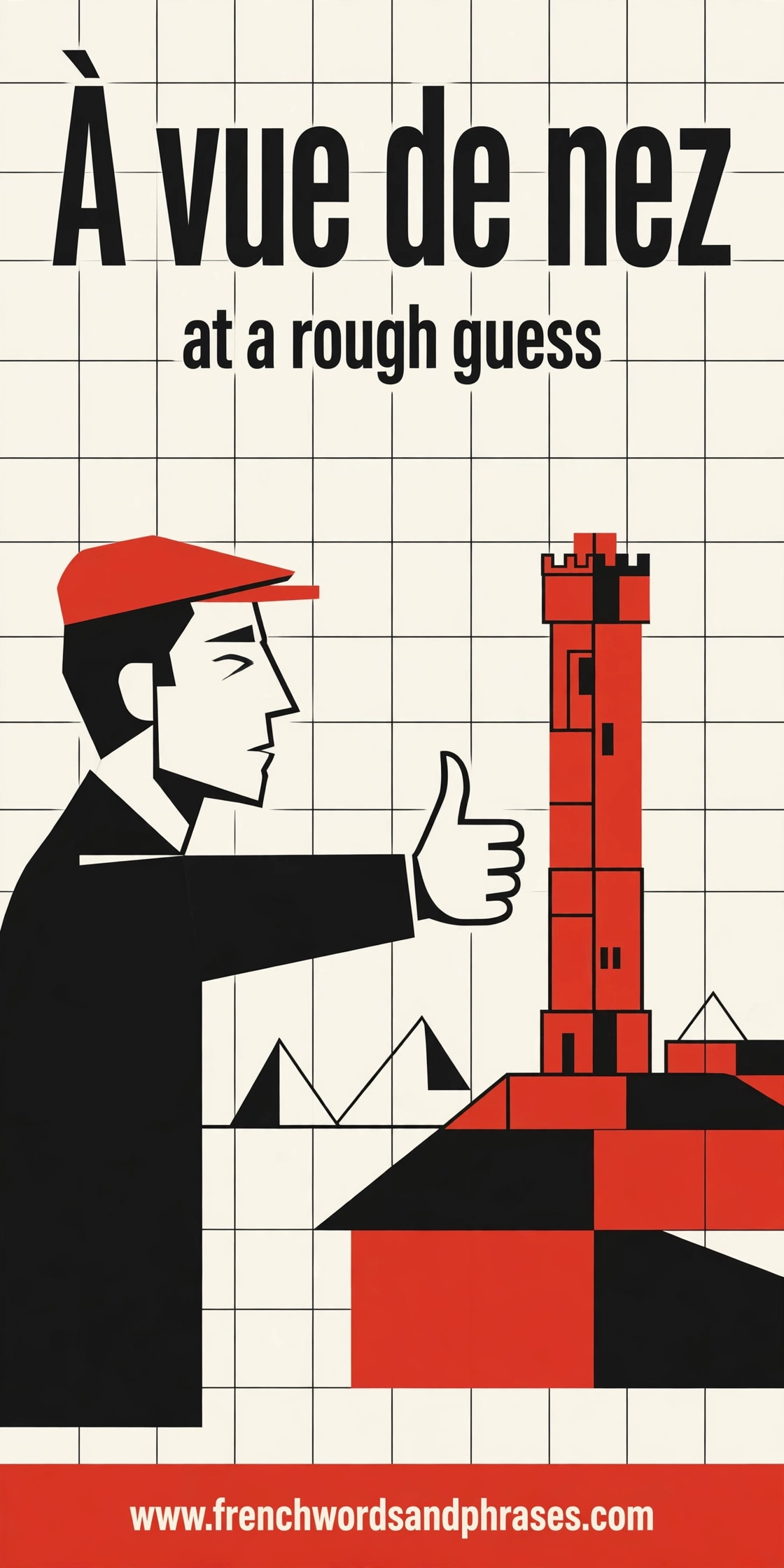
À vue de nez means at a rough guess — judged by eye, at first glance.
The builder walks round the old barn once, squints at the roof, rubs his chin and delivers the estimate that needs no tape measure: « À vue de nez, il y a trois cents mètres de tuiles. » Judged by eye — literally, by sight of nose. À vue de nez is the honest label for every number that comes from looking, not measuring.
Let’s explore how à vue de nez works in French, beginning with the whole phrase on one card.
Understanding the French Phrase À vue de nez
À vue de nez is a French idiomatic phrase built from à (by, at), vue (sight) and nez (nose). It marks a judgement or estimate made by eye, at a glance, without instruments or calculation.
It means at a rough guess, by eye, at first glance — roughly, approximately. A distance, a crowd, a bill: à vue de nez, il y avait deux cents personnes. The nose is the comic instrument of the phrase — the closest measuring device every face carries. The phrase is honest about its own limits: it promises an estimate, and warns you not to build on it.
Type: Idiomatic phrase — estimation (à + noun phrase)
Answers the need: Giving a rough estimate, honestly labelled as one
Register: Informal to neutral — everyday speech, with a smile
Strength: Deliberately approximate — a glance, not a measurement
One important usage detail: à vue de nez usually introduces or follows the estimate itself — à vue de nez, il y a dix kilomètres; il y avait, à vue de nez, deux cents invités. Its sober cousin is approximativement, and the measuring phrase it stands opposite to is au mètre près, to the nearest metre.
Experience the Word
À vue de nez is the estimate with its hands up — a number that confesses it was never measured.
Imagine the fisherman holding his hands apart for the one that got away, the farmer pricing a field from the gate, the cook seasoning a soup for twelve without a scale. All of them are working à vue de nez, with the oldest instruments there are: the eye, the hand, the nose on the face. The phrase respects that craft while smiling at it.
It is the opposite of false precision. À vue de nez says: here is my number, and here is exactly how much it is worth.
How to Use À vue de nez in French: Complete Guide
Let’s explore how à vue de nez works in French, beginning with the whole phrase on one card.
À vue de nez at a Glance
The Whole Phrase on One Card
Real meaning, literal picture, English twin and register — à vue de nez in five lines.
| Point | À vue de nez |
|---|---|
| What it really means | at a rough guess — judged by eye, approximately |
| Word for word | by sight of nose — measured with the face’s own instrument |
| English equivalent | at a rough guess / by eye / off the top of my head |
| Register | informal to neutral — everyday, with a smile |
| Use it for | rough distances, crowds, prices and quantities |
Example
À vue de nez, il y avait trois cents personnes.
At a rough guess, there were three hundred people.
Word by Word: Building the Estimate
Three small pieces — take them one by one and the glance becomes a number.
| Word | Literal meaning | Its job in the phrase |
|---|---|---|
| à | by, at | the preposition of method — judged ‘by’ this instrument |
| vue | sight | the measuring tool — what the eye takes in at a glance |
| nez | nose | the comic gauge on the face — the closest instrument you own |
Example
À vue de nez, le jardin fait cent mètres de long.
At a rough guess, the garden is a hundred metres long.
Quick Quiz 1
What does à vue de nez warn you about the number it introduces?
Reveal the answer
That it is a glance, not a measurement — honest approximation, not to be built upon.
À vue de nez, oui, mais vérifie avec un mètre.
At a rough guess, yes, but check with a tape measure.
When You Say It: The Estimating Moments
À vue de nez fires at moments like these — wherever a number is produced by looking, not counting.
| Situation | Example |
|---|---|
| A crowd | à vue de nez, deux cents personnes — at a rough guess, two hundred people |
| A distance | à vue de nez, dix kilomètres — roughly ten kilometres |
| A bill | ça coûtera, à vue de nez, cinq cents euros — it’ll cost, at a guess, five hundred euros |
| A quantity | à vue de nez, trois kilos de pommes — about three kilos of apples, by eye |
| An age | il a, à vue de nez, une cinquantaine d’années — he’s, at a guess, about fifty |
Example
La réparation coûtera, à vue de nez, deux jours de travail.
The repair will take, at a rough guess, two days’ work.
Make It Yours: The Guess for Every Number
The phrase frames the estimate — before it, after it, or wrapped around it.
| Form | French | In English |
|---|---|---|
| Before the number | à vue de nez, cent personnes | at a rough guess, a hundred people |
| After the number | cent personnes, à vue de nez | a hundred people, at a rough guess |
| In the middle | il y avait, à vue de nez, cent personnes | there were, at a guess, a hundred people |
| A price | à vue de nez, cinquante euros | roughly fifty euros |
| A weight | à vue de nez, cinq kilos | about five kilos, by eye |
| Doubt underlined | à vue de nez, pas plus | at a guess, no more than that |
Example
Il y avait, à vue de nez, mille spectateurs.
There were, at a rough guess, a thousand spectators.
Quick Quiz 2
A surgeon is about to operate. Is à vue de nez the right label for her measurements?
Reveal the answer
Certainly not — the phrase means unmeasured. Surgery works au millimètre près, to the nearest millimetre.
Un chirurgien ne travaille jamais à vue de nez.
A surgeon never works by rough guess.
Everyday Expressions: Building on the Estimate
À vue de nez slots into these everyday frames — each one ready to use as it stands.
| Frame | In English |
|---|---|
| à vue de nez, … | at a rough guess, … |
| juger à vue de nez | to judge by eye |
| à vue d’œil | visibly, by eye — the neighbouring phrase, for changes you can see |
| environ / à peu près | about, roughly — the plain neutral markers |
| au doigt mouillé | by guesswork — the wet-finger twin, even more informal |
Example
On juge la distance à vue de nez, puis on vérifie.
You judge the distance by eye, then you check.
Close Cousins: The Other Rough Numbers
French has a whole shelf of approximation phrases — à vue de nez is the honest glance; its cousins guess, round or wave vaguely.
| Expression | The difference |
|---|---|
| à vue de nez | at a rough guess — by eye, honestly approximate |
| à peu près | roughly, more or less — the neutral everyday marker |
| environ | about, approximately — the written, sober version |
| au doigt mouillé | by pure guesswork — the wet finger in the wind, more slapdash |
| à vue d’œil | visibly — for change seen happening: il grandit à vue d’œil, he’s growing visibly |
Example
Il grandit à vue d’œil, mais son âge, à vue de nez, c’est dix ans.
He’s growing visibly, but his age, at a rough guess, is ten.
Quick Quiz 3
A child is shooting up so fast you can see it week to week. À vue de nez or à vue d’œil?
Reveal the answer
À vue d’œil — visibly, before your eyes. À vue de nez estimates a number; à vue d’œil watches a change.
Ce rosier pousse à vue d’œil.
This rose bush is growing visibly, before your eyes.
À vue de nez and Its Neighbours
The measuring shelf around the phrase — eyes, noses and the instruments that correct them.
| French | In English |
|---|---|
| le nez | the nose |
| la vue | sight, eyesight |
| un œil | an eye |
| un mètre | a metre; a tape measure |
| approximativement | approximately |
| au millimètre près | to the nearest millimetre |
Example
À vue de nez d’abord, au mètre ensuite : voilà la méthode.
By eye first, with the tape measure after: that’s the method.
Watch Out: The Traps Around À vue de nez
The traps: a twin with the eye, and a guess that must never wear a uniform.
| Trap | The truth |
|---|---|
| nez is not œil | à vue de nez estimates a quantity; à vue d’œil means visibly, noticeably — the two phrases are neighbours, not twins |
| keep it out of contracts | the phrase confesses approximation — a quote, a dose or a deadline should never carry it professionally |
| the nose is a joke, not an insult | the phrase smiles at its own method — it never mocks the person estimating |
| no measuring happened | if a tape measure, a scale or a counter was used, the phrase no longer applies — it is the badge of the unmeasured |
Example
Ce devis n’est pas à vue de nez : chaque ligne est mesurée.
This quote is not a rough guess: every line is measured.
Quick Quiz 4
True or false: il grandit à vue de nez is the natural way to say a child is growing visibly.
Reveal the answer
False — visible growth is à vue d’œil. À vue de nez is for estimating numbers by eye.
Il grandit à vue d’œil, et il a, à vue de nez, onze ans.
He is growing visibly, and he is, at a rough guess, eleven.
À vue de nez in Everyday French: Real-Life Examples
Now that you know the word, let’s see how à vue de nez appears in everyday French.
Example 1 — The crowd
À vue de nez, il y avait cinq cents manifestants.
At a rough guess, there were five hundred demonstrators.
Example 2 — The distance
La rivière est, à vue de nez, à deux kilomètres.
The river is, at a rough guess, two kilometres away.
Example 3 — The bill
Les travaux coûteront, à vue de nez, mille euros.
The work will cost, at a rough guess, a thousand euros.
Example 4 — The harvest
À vue de nez, trois cents kilos de pommes cette année.
At a rough guess, three hundred kilos of apples this year.
Example 5 — The age
Il a, à vue de nez, une soixantaine d’années.
He is, at a rough guess, about sixty.
Example 6 — The honest label
C’est un chiffre à vue de nez, rien de plus.
It’s a rough-guess figure, nothing more.
Beyond Translation: The Meaning of À vue de nez
Every language keeps an honest label for guesses, but French gives its guess a nose. The picture is comic and exact at once: the nose is the body part that leads the face, the first instrument to arrive at any scene. English guesses off the top of the head or out of thin air; French measures with the face it has.
À vue de nez is approximation with its papers in order — a number that declares its own margin of error.
In a world of false precision and invented decimals, the phrase is a small ethics: say your number, and say how you got it.
How to Remember the French Phrase À vue de nez
Remember it this way: À vue de nez is the estimate that confesses itself — measured by the oldest instrument on the face.
- You picture the squint and the chin-rub — no tape, no scale, just the eye and the nez leading the face.
- You let it frame the number — before it, after it, or in the middle: il y avait, à vue de nez, cent personnes.
- You keep the eye for changes — à vue d’œil watches things grow; à vue de nez counts them roughly.
The key idea is à vue de nez means at a rough guess — judged by eye, honestly approximate.
Test Your Knowledge of À vue de nez
Let’s see how much you’ve learned. Try answering these questions before revealing the answers.
Question 1
What does à vue de nez mean?
Reveal the answer
At a rough guess — judged by eye, approximately, without measuring.
Question 2
What is the literal, word-for-word meaning?
Reveal the answer
By sight of nose — vue is sight, and the nez is the face’s own comic measuring instrument.
Question 3
How is à vue de nez different from à vue d’œil?
Reveal the answer
À vue de nez estimates a number; à vue d’œil means visibly — for changes you can watch happening.
Question 4
What is the sober, written cousin of the phrase?
Reveal the answer
Approximativement or environ — about, approximately, without the smile.
Question 5
Complete the sentence:
À vue de ______, il y avait deux cents invités. (At a rough guess, there were two hundred guests.)
Reveal the answer
nez
À vue de nez, il y avait deux cents invités.
At a rough guess, there were two hundred guests.
Your Final Challenge
Can You Use It?
How would you say this in French?
“At a rough guess, there were three hundred people.”
Reveal the answer
À vue de nez, il y avait trois cents personnes.
At a rough guess, there were three hundred people.
A little French. A little curiosity. A richer everyday life.
LEARN FRENCH ONE WORD AT A TIME