A French Word to Live By
Translate À voix haute to English
/a vwa ot/
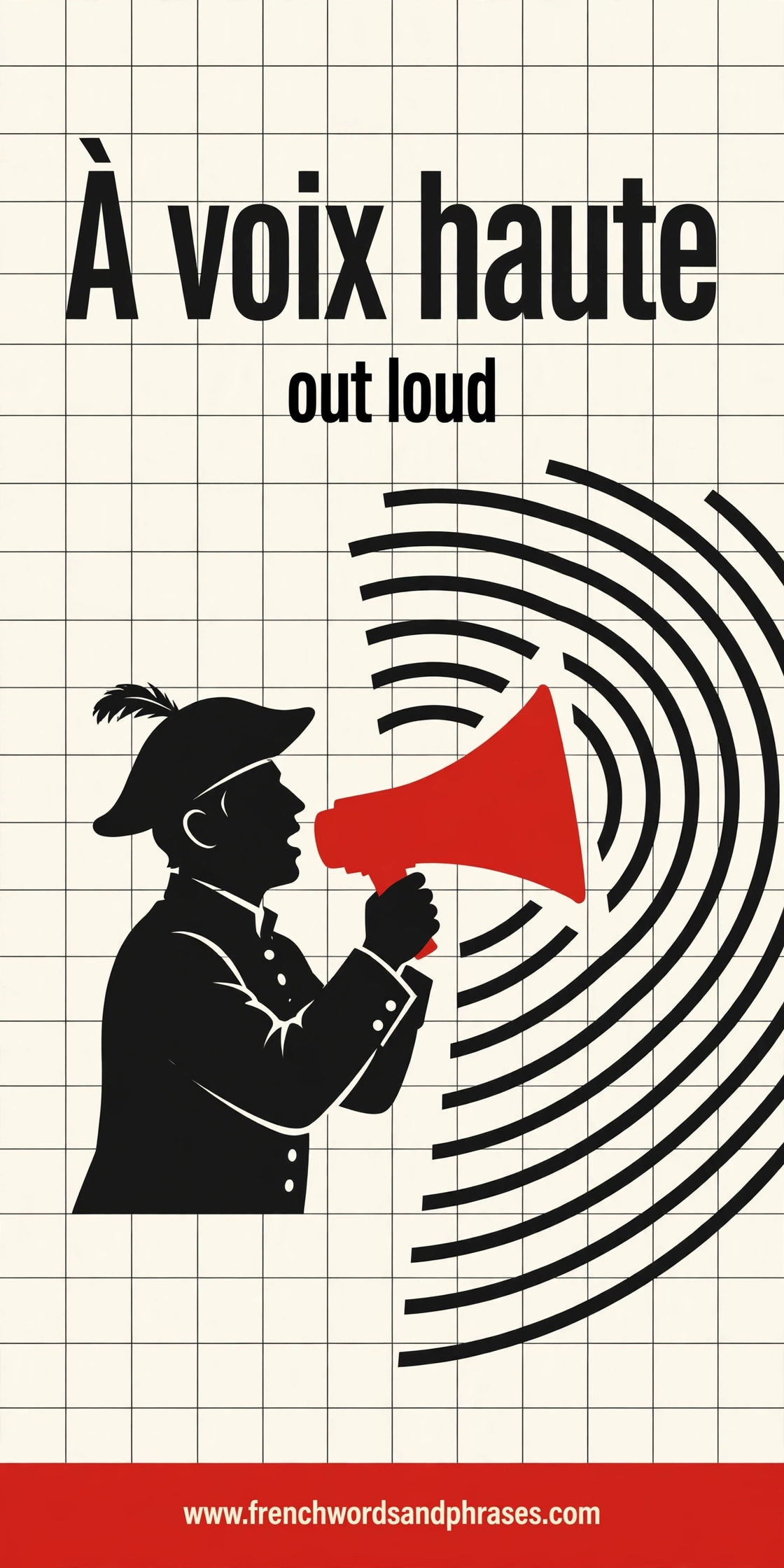
À voix haute means out loud — in a loud, clear voice that others can hear.
The classroom is silent, heads bent over books. Then the teacher points at you: « Lis à voix haute, s’il te plaît. » Suddenly your voice has to fill the room — every classmate, every corner. À voix haute is the moment reading stops being private and becomes performance.
Let’s explore how à voix haute works in French, beginning with the whole phrase on one card.
Understanding the French Phrase À voix haute
À voix haute is a French adverbial phrase built from à (in, with), voix (voice) and haute (high, feminine of haut). It describes speaking or reading at full voice, so that everyone present can hear.
It means out loud, aloud — with the voice raised to its full, clear height. A child who lit à voix haute is reading so others can follow; a thought spoken à voix haute has escaped into the room: je pensais à voix haute, I was thinking out loud. It is the exact opposite of à voix basse, and the two phrases are the two ends of one dial.
Type: Adverbial phrase — manner of speaking (à + noun + adjective)
Answers the need: Saying someone spoke or read aloud, at full voice
Register: Neutral — classrooms, homes and offices alike
Strength: Full — meant to be heard by everyone present
One important usage detail: haute agrees with voix, a feminine noun, so it is always haute in this phrase. The classic classroom pair is lire à voix haute (read aloud) versus lire à voix basse (read quietly to yourself) — and penser à voix haute is the standard way to say thinking out loud.
Experience the Word
À voix haute is the voice standing up straight — nothing hidden, nothing whispered, the words offered to the whole room.
Imagine the grandfather reading the newspaper to his wife whose eyes are tired, his voice carrying across the kitchen; or the small child sounding out her first book, finger under each word, à voix haute because silently is still too hard. The phrase holds both scenes: reading as a gift you give aloud.
French sets the voice by height. À voix haute, the words take their full height — and take responsibility for themselves.
How to Use À voix haute in French: Complete Guide
Let’s explore how à voix haute works in French, beginning with the whole phrase on one card.
À voix haute at a Glance
The Whole Phrase on One Card
Real meaning, literal picture, English twin and register — à voix haute in five lines.
| Point | À voix haute |
|---|---|
| What it really means | out loud — at a full, clear voice that everyone can hear |
| Word for word | at high voice — with the voice turned up |
| English equivalent | out loud / aloud |
| Register | neutral — safe everywhere |
| Use it for | reading aloud, thinking out loud, speaking so all can hear |
Example
Lis le texte à voix haute, s’il te plaît.
Read the text out loud, please.
Word by Word: Building the High Voice
Three small pieces — take them one by one and the volume rises.
| Word | Literal meaning | Its job in the phrase |
|---|---|---|
| à | at, in, with | the preposition that sets the manner — speaking ‘at’ this volume |
| voix | voice | the instrument itself — a feminine noun, la voix |
| haute | high | the volume turned up — feminine haute because voix is feminine |
Example
Elle a lu la lettre à voix haute pour toute la famille.
She read the letter out loud for the whole family.
Quick Quiz 1
Why is it haute and not haut in à voix haute?
Reveal the answer
Because voix is feminine — the adjective takes the feminine form haute to match la voix.
D’une voix haute et claire, elle a annoncé la nouvelle.
In a loud, clear voice, she announced the news.
When You Say It: The Full-Voice Moments
À voix haute fires at moments like these — wherever the words are meant for the whole room.
| Situation | Example |
|---|---|
| In class | lire à voix haute devant la classe — to read out loud in front of the class |
| Thinking | penser à voix haute — to think out loud |
| Reading to a child | lire une histoire à voix haute — to read a story aloud |
| Announcing | annoncer les résultats à voix haute — to announce the results out loud |
| Rehearsing | répéter son discours à voix haute — to rehearse one’s speech aloud |
Example
Je pensais à voix haute, je ne m’en suis même pas rendu compte.
I was thinking out loud, I didn’t even realise.
Make It Yours: The High Voice for Every Verb
The phrase rides on any verb of speaking or reading — the volume stays full.
| Form | French | In English |
|---|---|---|
| To read | lire à voix haute | to read out loud |
| To think | penser à voix haute | to think out loud |
| To say | dire à voix haute | to say out loud |
| To count | compter à voix haute | to count out loud |
| To laugh | rire à voix haute | to laugh out loud |
| To speak | parler à voix haute | to speak out loud |
Example
Les enfants comptent à voix haute jusqu’à cent.
The children count out loud up to a hundred.
Quick Quiz 2
How do you say ‘I was thinking out loud’ with this phrase?
Reveal the answer
Je pensais à voix haute — penser à voix haute is the set expression for thoughts escaping into speech.
Pardon, je pensais à voix haute.
Sorry, I was thinking out loud.
Everyday Expressions: Building on the High Voice
À voix haute slots into these everyday frames — each one ready to use as it stands.
| Frame | In English |
|---|---|
| lire à voix haute | to read out loud |
| penser à voix haute | to think out loud |
| à voix haute, s’il vous plaît | out loud, please |
| rire à voix haute | to laugh out loud |
| se lire à voix haute | to read to oneself out loud |
Example
À voix haute, s’il vous plaît, on n’entend rien au fond.
Out loud, please, we can’t hear anything at the back.
Close Cousins: The Other Volumes
French has a whole shelf of voice phrases — à voix haute is the full setting; its cousins turn the dial down or change the instrument.
| Expression | The difference |
|---|---|
| à voix haute | out loud — full, clear voice for everyone present |
| à voix basse | in a low voice — the exact opposite, quiet and close |
| à mi-voix | in a half-voice — between aloud and a whisper |
| à tue-tête | at the top of one’s voice — shouting, louder than haute |
| d’une voix forte | in a strong voice — describes the voice’s power rather than the act of reading aloud |
Example
Il ne parlait pas à voix haute, il criait à tue-tête.
He wasn’t speaking out loud, he was shouting at the top of his voice.
Quick Quiz 3
A pupil must read so the back row can hear. À voix basse or à voix haute?
Reveal the answer
À voix haute — out loud, at full voice. À voix basse is for the desk beside you, not the back row.
Encore une fois, à voix haute, pour le fond de la classe.
Once more, out loud, for the back of the class.
À voix haute and Its Neighbours
The full-voice shelf around the phrase — reading, announcing and the classroom around them.
| French | In English |
|---|---|
| la lecture | reading |
| à voix basse | in a low voice |
| à mi-voix | in a half-voice |
| à tue-tête | at the top of one’s voice |
| un auditoire | an audience |
| silencieusement | silently |
Example
Devant son auditoire, elle a lu son poème à voix haute.
Before her audience, she read her poem out loud.
Watch Out: The Traps Around À voix haute
The traps: an adjective that must stay feminine, and a loudness that is not shouting.
| Trap | The truth |
|---|---|
| never haut | the phrase is fixed — à voix haute, with haute agreeing with la voix; à voix haut is a classic learner’s slip |
| not shouting | à voix haute is a clear full voice, not a shout — shouting is crier or à tue-tête |
| haute is not ‘tall’ here | haut means high — of the voice’s height on the dial, not of a person’s stature |
| basse is the mirror | the opposite phrase flips one word only: à voix basse — the two phrases share everything but the setting |
Example
Elle parle à voix haute, mais elle ne crie jamais.
She speaks out loud, but she never shouts.
Quick Quiz 4
True or false: lire à voix haut is correct French.
Reveal the answer
False — voix is feminine, so the adjective is haute: lire à voix haute.
Chaque matin, elle lit le journal à voix haute.
Every morning, she reads the newspaper out loud.
À voix haute in Everyday French: Real-Life Examples
Now that you know the word, let’s see how à voix haute appears in everyday French.
Example 1 — In class
Lis la première page à voix haute.
Read the first page out loud.
Example 2 — Thinking
Pardon, je pensais à voix haute.
Sorry, I was thinking out loud.
Example 3 — A story
Grand-père lit une histoire à voix haute aux enfants.
Grandfather reads a story out loud to the children.
Example 4 — The results
Elle a lu les résultats à voix haute.
She read the results out loud.
Example 5 — Counting
Les élèves comptent à voix haute.
The pupils count out loud.
Example 6 — Rehearsing
Il répète sa présentation à voix haute dans le salon.
He rehearses his presentation out loud in the living room.
Beyond Translation: The Meaning of À voix haute
English says out loud — the words come out, into the open air. French says at high voice: the voice itself rises, like water in a lock, until it reaches the whole room. The picture is vertical where English is horizontal, and it explains the pair French keeps so neatly: haute and basse, the high setting and the low, one dial with two ends.
À voix haute is speech at full height — the moment a private thought accepts witnesses.
That is why thinking out loud embarrasses us slightly: the dial was set to haute before the mind had finished deciding.
How to Remember the French Phrase À voix haute
Remember it this way: À voix haute is the voice at full height — reading and thinking with the dial turned all the way up.
- You picture the dial — voix is the voice, and haute raises it to the top of its range.
- You keep haute feminine — la voix is feminine, so it is always haute, never haut.
- You anchor it in the classroom — lire à voix haute, and its escape act, penser à voix haute, thinking out loud.
The key idea is à voix haute means out loud — at a full, clear voice everyone can hear.
Test Your Knowledge of À voix haute
Let’s see how much you’ve learned. Try answering these questions before revealing the answers.
Question 1
What does à voix haute mean?
Reveal the answer
Out loud — at a full, clear voice that everyone present can hear.
Question 2
Why is the adjective haute and not haut?
Reveal the answer
Because voix is feminine — la voix takes the feminine form haute.
Question 3
How do you say ‘to think out loud’?
Reveal the answer
Penser à voix haute — the set expression for thoughts escaping into speech.
Question 4
What is the opposite of à voix haute?
Reveal the answer
À voix basse — in a low voice, the same dial turned down.
Question 5
Complete the sentence:
Lis le poème à voix ______, pour toute la classe. (Read the poem out loud, for the whole class.)
Reveal the answer
haute
Lis le poème à voix haute, pour toute la classe.
Read the poem out loud, for the whole class.
Your Final Challenge
Can You Use It?
How would you say this in French?
“Read the letter out loud, please.”
Reveal the answer
Lis la lettre à voix haute, s’il te plaît.
Read the letter out loud, please.
A little French. A little curiosity. A richer everyday life.
LEARN FRENCH ONE WORD AT A TIME