A French Word to Live By
Translate À un cheveu to English
/a œ̃ ʃə.vø/
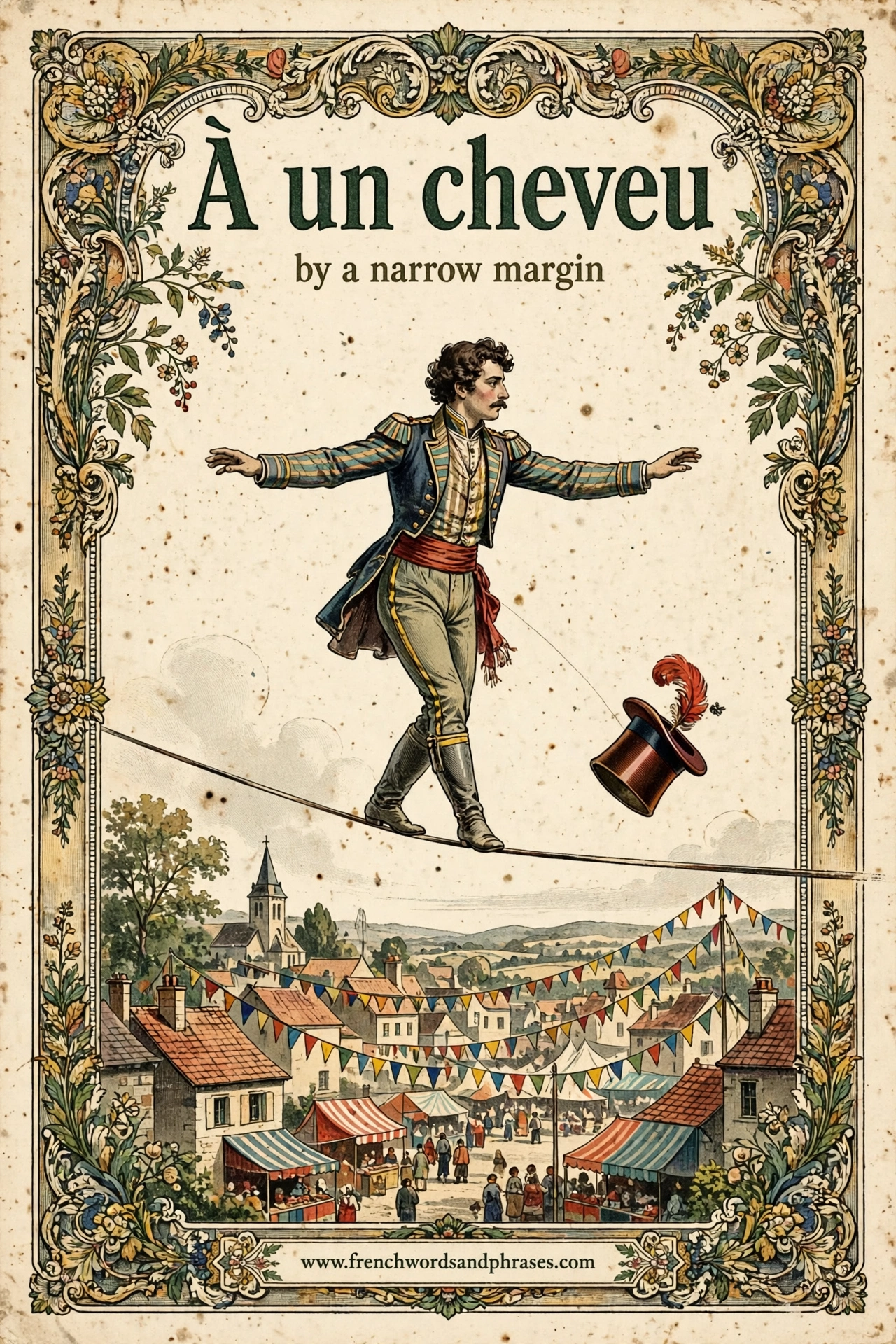
À un cheveu means by a hair — by the narrowest possible margin, a whisker away.
The photo-finish is on the big screen, the crowd is on its feet, and the two horses cross the line as one animal. The judge studies the image for a full minute before the announcement: the winner won « à un cheveu » — by a hair. In French, the smallest measure of victory is not a nose or a neck, but a single hair.
Let’s explore how à un cheveu works in French, beginning with the whole phrase on one card.
Understanding the French Phrase À un cheveu
À un cheveu is a French idiomatic phrase built from à (by, at), un (a, one) and un cheveu (a hair — one single strand). It measures the narrowest margins in French: winning, losing, missing and escaping, all decided by the width of one hair.
It means by a hair — by the smallest imaginable margin. Il a gagné à un cheveu, he won by a hair; elle a évité l’accident à un cheveu, she avoided the accident by a hair’s breadth. It also appears in the pattern à un cheveu de + infinitive: à un cheveu de tomber, a hair away from falling — within one strand of the thing happening.
Type: Idiomatic phrase — margin (à + un + noun)
Answers the need: Saying something was decided by the narrowest possible margin
Register: Neutral — safe everywhere, from sports pages to family stories
Strength: Minimal — the smallest unit French can measure with
One important usage detail: cheveu here is singular and countable — one strand of head hair. The plural cheveux is the mass of hair on a head. The phrase also has a twin pattern, à un cheveu de faire quelque chose, ‘a hair away from doing something’, which looks forward to what nearly happened.
Experience the Word
À un cheveu is the photo-finish of French — the margin too small to see, big enough to change everything.
Imagine the last train of the night: you sprint down the platform, bag swinging, and the doors sigh shut one second after you fall inside. Strangers applaud. You did not catch that train comfortably or even narrowly — you caught it by the exact measure this phrase keeps in its pocket.
French reached for the hair because nothing smaller was at hand. À un cheveu: the distance between the story you tell and the one you almost told.
How to Use À un cheveu in French: Complete Guide
Let’s explore how à un cheveu works in French, beginning with the whole phrase on one card.
À un cheveu at a Glance
The Whole Phrase on One Card
Real meaning, literal picture, English twin and register — à un cheveu in five lines.
| Point | À un cheveu |
|---|---|
| What it really means | by a hair — by the narrowest margin there is |
| Word for word | by one hair — a single strand of hair |
| English equivalent | by a hair / by a whisker / by the skin of one’s teeth |
| Register | neutral — safe everywhere |
| Use it for | photo-finishes, near misses, escapes and elections decided by nothing |
Example
Il a gagné la course à un cheveu.
He won the race by a hair.
Word by Word: Building the Smallest Measure
Three small pieces — the smallest ruler in the language.
| Word | Literal meaning | Its job in the phrase |
|---|---|---|
| à | by, at | the preposition of measure — it names the margin |
| un | one, a | a single one — the count matters: not a lock, one strand |
| cheveu | a hair | one strand of head hair — the thinnest measure nature provides |
Example
Elle a manqué le train à un cheveu.
She missed the train by a hair.
Quick Quiz 1
Is cheveu here the whole head of hair, or one strand?
Reveal the answer
One strand — un cheveu is a single hair. The whole mass on a head is les cheveux, plural.
Il a trouvé un cheveu dans sa soupe.
He found a hair in his soup.
When You Say It: The Photo-Finish Moments
À un cheveu fires at moments like these — wherever the margin shrinks to nothing.
| Situation | Example |
|---|---|
| A race | gagner à un cheveu — to win by a hair |
| A near miss | éviter l’accident à un cheveu — to avoid the accident by a hair |
| An exam | réussir l’examen à un cheveu — to pass the exam by a hair |
| An election | être élu à un cheveu — to be elected by the narrowest margin |
| Nearly doing something | être à un cheveu de tomber — to be a hair away from falling |
Example
Le candidat a été élu à un cheveu.
The candidate was elected by a hair.
Make It Yours: The Smallest Measure for Every Margin
The phrase follows the verb — and the de-pattern opens the door to what nearly happened.
| Form | French | In English |
|---|---|---|
| The phrase | à un cheveu | by a hair |
| A hair away from doing | à un cheveu de faire quelque chose | a hair away from doing something |
| Near-synonym | à un poil | by a hair — the informal twin, with a body hair |
| Just barely | de justesse | narrowly, by a whisker — the neutral version |
| Almost | à deux doigts de | within an ace of — literally ‘two fingers away from’ |
| Not far | pas loin de | not far from, nearly |
Example
Il était à deux doigts de gagner.
He was within an ace of winning.
Quick Quiz 2
Which pattern means ‘a hair away from falling’ — à un cheveu alone, or à un cheveu de tomber?
Reveal the answer
À un cheveu de tomber — add de + infinitive and the phrase points at what nearly happened.
Le vase était à un cheveu de tomber de la table.
The vase was a hair away from falling off the table.
Everyday Expressions: Building on the Smallest Measure
À un cheveu slots into these everyday frames — each one ready to use as it stands.
| Frame | In English |
|---|---|
| à un cheveu | by a hair |
| gagner à un cheveu | to win by a hair |
| à un cheveu de + infinitive | a hair away from doing something |
| échapper à un cheveu | to escape by a hair |
| à un poil | by a hair (informal twin) |
Example
Le chat a échappé au chien à un cheveu.
The cat escaped the dog by a hair.
Close Cousins: The Other Tiny Margins
French has a whole shelf of narrow-margin phrases — the cheveu is the finest; its cousins measure in fingers, beards and justice.
| Expression | The difference |
|---|---|
| à un cheveu | by a hair — one strand, the finest measure |
| à un poil | by a hair — the informal twin; a poil is a body hair or animal hair |
| à deux doigts de | within an ace of — two fingers’ width from the thing happening |
| de justesse | narrowly — the neutral, report-safe version |
| à la barbe de quelqu’un | under someone’s nose — a different beard entirely: daring, not margin |
Example
Il a réussi de justesse, à un cheveu de l’échec.
He passed narrowly, a hair away from failure.
Quick Quiz 3
A formal report needs the margin. À un poil or de justesse?
Reveal the answer
De justesse — à un poil is the informal twin of the cheveu; reports keep the neutral measure.
Le projet a été adopté de justesse.
The project was adopted narrowly.
À un cheveu and Its Neighbours
The hair shelf around the phrase — from the strand to the haircut.
| French | In English |
|---|---|
| un cheveu | a hair, one strand |
| les cheveux | the hair on one’s head |
| un poil | a body hair, an animal hair |
| à deux doigts de | within an ace of |
| de justesse | narrowly, by a whisker |
| se faire couper les cheveux | to have one’s hair cut |
Example
Il se fait couper les cheveux très court.
He has his hair cut very short.
Watch Out: The Traps Around À un cheveu
The traps: a plural that changes the picture, a spelling variant in old books, and a beard that belongs elsewhere.
| Trap | The truth |
|---|---|
| the plural trap | à un cheveux, seen in old texts, is an archaic spelling — modern French writes à un cheveu, one strand |
| the mass trap | les cheveux is the hair on a head; the measure needs the single strand, un cheveu |
| the beard trap | à la barbe de quelqu’un means under someone’s nose — defiance, not a narrow margin |
| margin, not distance | for physical closeness in space, French says à deux pas or tout près — the cheveu measures outcomes, not metres |
Example
Elle habite à deux pas, mais elle a failli manquer la fête à un cheveu.
She lives a stone’s throw away, but she very nearly missed the party.
Quick Quiz 4
True or false: à un cheveu can measure how close your house is to the station.
Reveal the answer
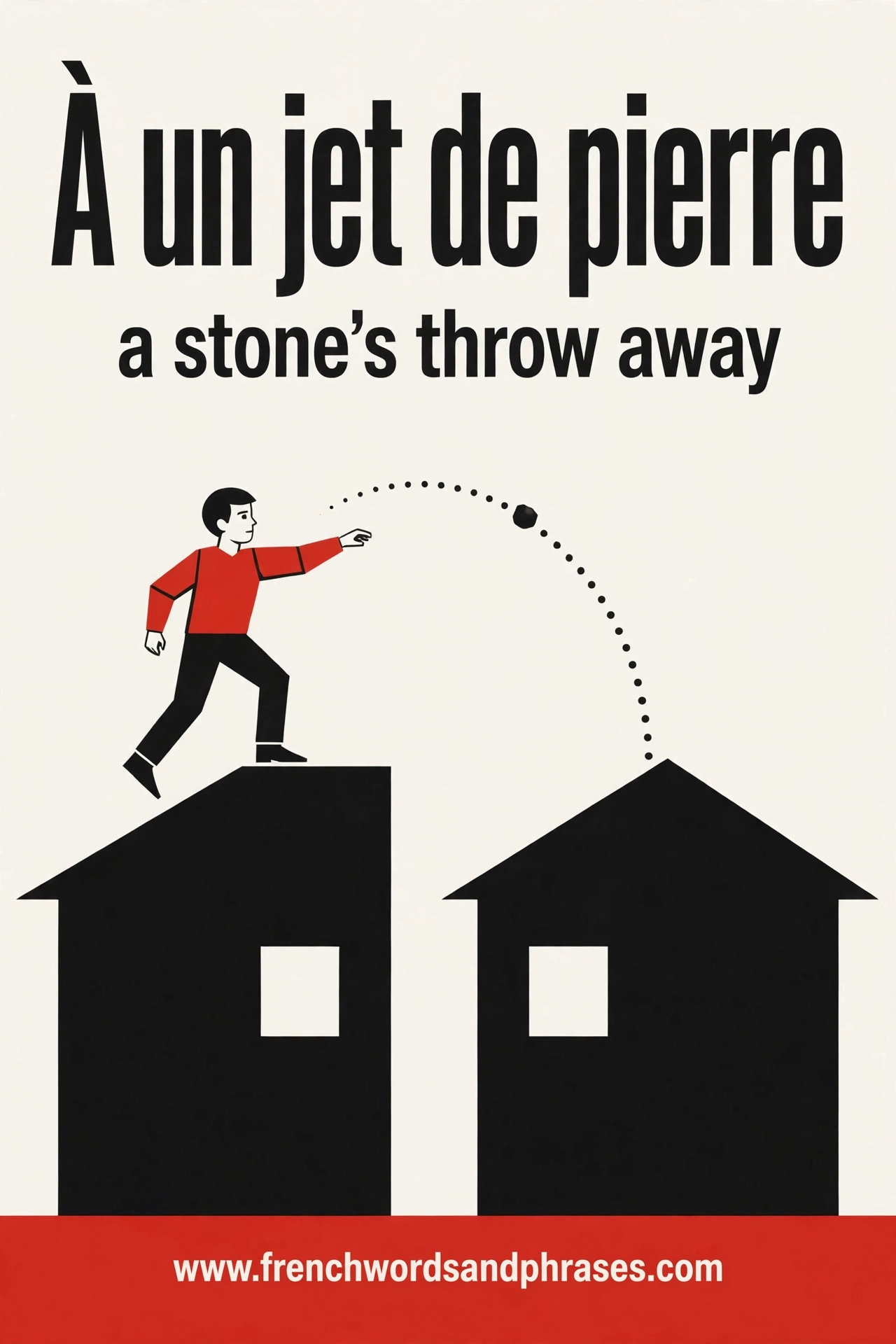
False — the cheveu measures margins of outcome: winning, missing, escaping. Physical closeness is à deux pas or à un jet de pierre.
La gare est à un jet de pierre de chez lui.
The station is a stone’s throw from his house.
À un cheveu in Everyday French: Real-Life Examples
Now that you know the word, let’s see how à un cheveu appears in everyday French.
Example 1 — The race
Notre cheval a gagné à un cheveu.
Our horse won by a hair.
Example 2 — The near miss
Elle a évité la voiture à un cheveu.
She avoided the car by a hair.
Example 3 — The exam
J’ai réussi l’examen à un cheveu.
I passed the exam by a hair.
Example 4 — The vase
Le vase était à un cheveu de tomber.
The vase was a hair away from falling.
Example 5 — The election
Le maire a été réélu à un cheveu.
The mayor was re-elected by a hair.
Example 6 — The escape
Le lapin a échappé au renard à un cheveu.
The rabbit escaped the fox by a hair.
Beyond Translation: The Meaning of À un cheveu
Every language keeps a smallest coin of chance: English pays in whiskers and the skin of teeth, German in hair’s breadths. French chose the cheveu — the one strand, countable, findable in soup. The choice is intimate: the margin that decides a race is the same object you pick off a shoulder.
À un cheveu measures destiny with the smallest thing the body can spare.
No wonder it serves for elections as happily as for trains.
How to Remember the French Phrase À un cheveu
Remember it this way: À un cheveu is the photo-finish ruler — one single strand of hair between winning and the other story.
- You count the strand — un cheveu, one hair only; the whole head of hair, les cheveux, would be a landslide.
- You add de to look forward — à un cheveu de tomber: a hair away from the thing happening.
- You keep space out of it — the cheveu measures outcomes; places sit à un jet de pierre.
The key idea is à un cheveu means by a hair — the narrowest margin, one strand wide.
Test Your Knowledge of À un cheveu
Let’s see how much you’ve learned. Try answering these questions before revealing the answers.
Question 1
What does à un cheveu mean?
Reveal the answer
By a hair — by the narrowest possible margin.
Question 2
What is a cheveu, exactly?
Reveal the answer
One strand of head hair — the plural, les cheveux, is the whole mass of hair on a head.
Question 3
How do you say ‘a hair away from falling’?
Reveal the answer
À un cheveu de tomber — the de + infinitive pattern points at what nearly happened.
Question 4
What is the informal twin of the phrase?
Reveal the answer
À un poil — the same hair’s-breadth margin, measured with a body hair and a smile.
Question 5
Complete the sentence:
Il a gagné la course ______ ______ ______. (He won the race by a hair.)
Reveal the answer
à un cheveu
Il a gagné la course à un cheveu.
He won the race by a hair.
Your Final Challenge
Can You Use It?
How would you say this in French?
“He won the race by a hair.”
Reveal the answer
Il a gagné la course à un cheveu.
He won the race by a hair.
A little French. A little curiosity. A richer everyday life.
LEARN FRENCH ONE WORD AT A TIME