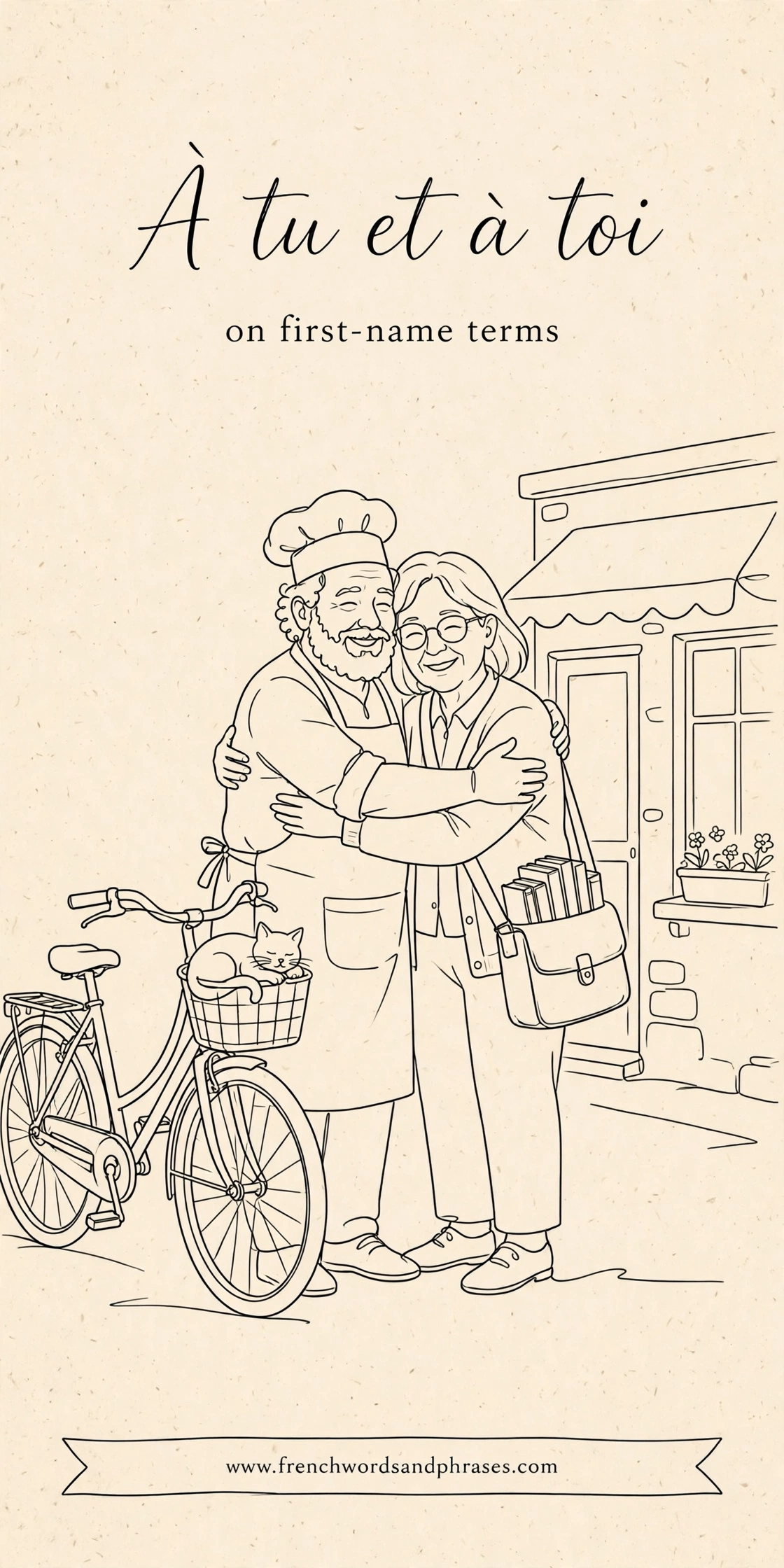
A French Word to Live By
Translate À tu et à toi to English
/a ty e a twa/
À tu et à toi means on first-name terms — familiar enough with someone to say tu to each other.
The new intern has been saying vous to the caretaker for a month, very polite, very stiff. This morning the caretaker laughs, hands him a coffee and says: « Allez, on est à tu et à toi, nous deux. » Come on — we’re on tu terms, you and I. In French, that little sentence is a door swinging open.
Let’s explore how à tu et à toi works in French, beginning with the whole phrase on one card.
Understanding the French Phrase À tu et à toi
À tu et à toi is a French idiomatic phrase built from tu and toi, the familiar forms of ‘you’. The full frame is être à tu et à toi avec quelqu’un: to be on familiar, first-name terms with someone — to have crossed the border from vous to tu.
It means to be on first-name terms — familiar enough that both sides say tu. French guards that border carefully: colleagues, neighbours and even family in-laws may stay at vous for years. To be à tu et à toi is to have been admitted to the inner circle, and the phrase is usually said with pleasure, sometimes with surprise: ils sont à tu et à toi avec le directeur — they’re on tu terms with the director himself.
Type: Idiomatic phrase — familiarity (être à tu et à toi avec quelqu’un)
Answers the need: Saying two people are on familiar, first-name terms
Register: Neutral — safe everywhere; the subject itself is social, not slangy
Strength: Complete — the vous barrier has fully come down
One important usage detail: the phrase almost always travels with être and avec — être à tu et à toi avec quelqu’un. The verb that performs the crossing is tutoyer (to say tu to someone), and the moment itself is le tutoiement. Its opposite is vouvoyer, to say vous.
Experience the Word
À tu et à toi is the sound of a French formality melting — two pronouns shaking hands.
Imagine the village baker you have vou-ed for five years, who one Christmas morning leans over the counter and says: ‘Tu prendras bien un café.’ Five years of politeness, dissolved in one tu. French speakers remember these moments the way others remember engagements.
English lost its thou centuries ago and with it the ceremony. French kept the border, so crossing it still means something — and this phrase is the stamp in the passport.
How to Use À tu et à toi in French: Complete Guide
Let’s explore how à tu et à toi works in French, beginning with the whole phrase on one card.
À tu et à toi at a Glance
The Whole Phrase on One Card
Real meaning, literal picture, English twin and register — à tu et à toi in five lines.
| Point | À tu et à toi |
|---|---|
| What it really means | on first-name terms — both sides say tu to each other |
| Word for word | at tu and at toi — living on the familiar side of ‘you’ |
| English equivalent | on first-name terms / on familiar terms |
| Register | neutral — safe everywhere |
| Use it for | close colleagues, friends of the family, anyone past the vous barrier |
Example
Ils sont à tu et à toi avec le maire.
They are on first-name terms with the mayor.
Word by Word: Building the Open Door
Three small pieces — the two faces of familiar ‘you’, side by side.
| Word | Literal meaning | Its job in the phrase |
|---|---|---|
| à | at, on | the preposition of position — where the relationship stands |
| tu | you (familiar, subject) | the word you say to friends, family and children |
| toi | you (familiar, stressed) | tu’s partner form — together they stand for the whole familiar world |
Example
Avec sa belle-mère, elle est à tu et à toi.
With her mother-in-law, she is on first-name terms.
Quick Quiz 1
What border does à tu et à toi say has been crossed?
Reveal the answer
The border between vous and tu — the two people now use the familiar form with each other, like first names in English.
Depuis l’été, nous sommes à tu et à toi.
Since the summer, we have been on first-name terms.
When You Say It: The Familiarity Moments
À tu et à toi fires at moments like these — wherever the vous barrier has come down.
| Situation | Example |
|---|---|
| New closeness at work | elle est à tu et à toi avec la directrice — she is on tu terms with the director |
| Surprise at others | ils sont déjà à tu et à toi ? — they’re already on first-name terms? |
| Family warmth | avec les voisins, on est à tu et à toi — with the neighbours, we’re on first-name terms |
| An invitation to cross | on peut être à tu et à toi, si tu veux — we can say tu to each other, if you like |
| Not yet | avec lui, on n’est pas encore à tu et à toi — with him, we’re not on tu terms yet |
Example
Après dix ans, ils sont enfin à tu et à toi.
After ten years, they are finally on first-name terms.
Make It Yours: The Border for Every Pair
The phrase lives inside être… avec — and its family holds the verbs of the crossing itself.
| Form | French | In English |
|---|---|---|
| The phrase | être à tu et à toi avec quelqu’un | to be on first-name terms with someone |
| To say tu | tutoyer quelqu’un | to say tu to someone, to be familiar |
| To say vous | vouvoyer quelqu’un | to say vous to someone, to stay formal |
| The crossing | le tutoiement | the use of tu, the familiarity itself |
| The invitation | on se tutoie ? | shall we say tu to each other? |
| Still formal | se vouvoyer | to say vous to each other |
Example
On se tutoie ? — Avec plaisir !
Shall we say tu to each other? — With pleasure!
Quick Quiz 2
Your neighbour of ten years still says vous to you. Are you à tu et à toi?
Reveal the answer
No — the phrase requires tu on both sides. As long as vous stands, the border stands.
Ils se vouvoient encore après dix ans de palier.
They still say vous to each other after ten years on the same landing.
Everyday Expressions: Building on the Open Door
À tu et à toi slots into these everyday frames — each one ready to use as it stands.
| Frame | In English |
|---|---|
| être à tu et à toi avec quelqu’un | to be on first-name terms with someone |
| on se tutoie | we say tu to each other |
| tutoyer quelqu’un | to say tu to someone |
| vouvoyer quelqu’un | to say vous to someone |
| passer au tu | to switch to tu, to cross the border |
Example
Après la fête, tout le bureau est passé au tu.
After the party, the whole office switched to tu.
Close Cousins: The Other Degrees of Closeness
French has a whole shelf of familiarity phrases — à tu et à toi is the pronoun one; its cousins measure warmth in other ways.
| Expression | The difference |
|---|---|
| à tu et à toi | on first-name terms — the tu border has been crossed |
| être copains comme cochons | to be thick as thieves — warm, comic, much closer than tu |
| être en bons termes | to be on good terms — harmony, but possibly still at vous |
| appeler quelqu’un par son prénom | to call someone by their first name — the English-style marker |
| être familier avec quelqu’un | to be familiar with someone — can sound presumptuous if pushed too far |
Example
Ils sont en bons termes, mais ils se vouvoient toujours.
They are on good terms, but they still say vous to each other.
Quick Quiz 3
Which cousin means ‘thick as thieves’ — much closer than mere tu?
Reveal the answer
Copains comme cochons — the comic picture of inseparable friends. À tu et à toi is only the pronoun border.
Ces deux-là sont copains comme cochons depuis l’enfance.
Those two have been thick as thieves since childhood.
À tu et à toi and Its Neighbours
The pronoun shelf around the phrase — both sides of the border.
| French | In English |
|---|---|
| tu | you — familiar, singular |
| vous | you — polite, or plural |
| tutoyer | to say tu to |
| vouvoyer | to say vous to |
| le tutoiement | saying tu, familiarity |
| le vouvoiement | saying vous, formality |
Example
Le vouvoiement reste la règle avec les clients.
Saying vous remains the rule with clients.
Watch Out: The Traps Around À tu et à toi
The traps: a frame it cannot leave, a familiarity that can offend, and an English twin that only half-matches.
| Trap | The truth |
|---|---|
| the frame trap | the phrase needs être and usually avec — à tu et à toi cannot float free as an adverb |
| the presumption trap | crossing to tu uninvited can offend: être trop familier is a fault in French, not a warmth |
| the half-twin trap | English first names come easily; the French tu is a bigger door — do not measure one by the other |
| toi is not a subject | toi is the stressed form — the pair tu/toi stands for the whole familiar system, grammar included |
Example
Il l’a tutoyé trop vite, et le client s’est fermé.
He said tu to him too quickly, and the client shut down.
Quick Quiz 4
True or false: in French, first names and tu always arrive together.
Reveal the answer
False — colleagues can use first names with vous for years. The tu is its own, separate border.
Elle l’appelle par son prénom, mais elle le vouvoie.
She calls him by his first name, but she says vous to him.
À tu et à toi in Everyday French: Real-Life Examples
Now that you know the word, let’s see how à tu et à toi appears in everyday French.
Example 1 — The office
Elle est à tu et à toi avec toute l’équipe.
She is on first-name terms with the whole team.
Example 2 — The surprise
Tu es déjà à tu et à toi avec le directeur ?
You’re already on first-name terms with the director?
Example 3 — The neighbours
Avec nos voisins, on est à tu et à toi depuis l’été.
With our neighbours, we’ve been on tu terms since the summer.
Example 4 — The invitation
On peut être à tu et à toi, je m’appelle Marc.
We can say tu to each other — my name is Marc.
Example 5 — Not yet
Avec mon beau-père, on n’est pas à tu et à toi.
With my father-in-law, we’re not on tu terms.
Example 6 — The family
Chez eux, tout le monde est à tu et à toi.
In their family, everyone is on first-name terms.
Beyond Translation: The Meaning of À tu et à toi
English measures closeness in names: first names, nicknames, the dropped Mr. French measures it in grammar itself — the pronoun you choose is the relationship, worn in every sentence. That is why the crossing has a ceremony and a phrase of its own.
À tu et à toi is the border post of French friendship — small, official, and crossed with a smile.
And like all border posts, it is remembered long after the journey has become ordinary.
How to Remember the French Phrase À tu et à toi
Remember it this way: À tu et à toi is the vous barrier lying flat on the ground — both pronouns of friendship standing in its place.
- You hear both forms — tu the subject and toi the stressed twin stand together for the whole familiar world.
- You keep the frame — être à tu et à toi avec quelqu’un; the phrase cannot travel without them.
- You respect the border — tutoyer too early is a fault; the phrase celebrates a crossing that was offered, not taken.
The key idea is à tu et à toi means on first-name terms — the tu border crossed, both ways.
Test Your Knowledge of À tu et à toi
Let’s see how much you’ve learned. Try answering these questions before revealing the answers.
Question 1
What does à tu et à toi mean?
Reveal the answer
On first-name terms — familiar enough with someone that both sides say tu to each other.
Question 2
What is the full frame of the phrase?
Reveal the answer
Être à tu et à toi avec quelqu’un — the phrase lives inside être… avec and rarely travels without them.
Question 3
What is the verb for saying tu to someone?
Reveal the answer
Tutoyer — and its opposite, saying vous, is vouvoyer.
Question 4
Do first names and tu always arrive together in French?
Reveal the answer
No — first names can live with vous for years. The tu is a separate, bigger border.
Question 5
Complete the sentence:
Ils sont ______ ______ et ______ ______ avec le maire. (They are on first-name terms with the mayor.)
Reveal the answer
à tu et à toi
Ils sont à tu et à toi avec le maire.
They are on first-name terms with the mayor.
Your Final Challenge
Can You Use It?
How would you say this in French?
“They are on first-name terms with the mayor.”
Reveal the answer
Ils sont à tu et à toi avec le maire.
They are on first-name terms with the mayor.
A little French. A little curiosity. A richer everyday life.
LEARN FRENCH ONE WORD AT A TIME