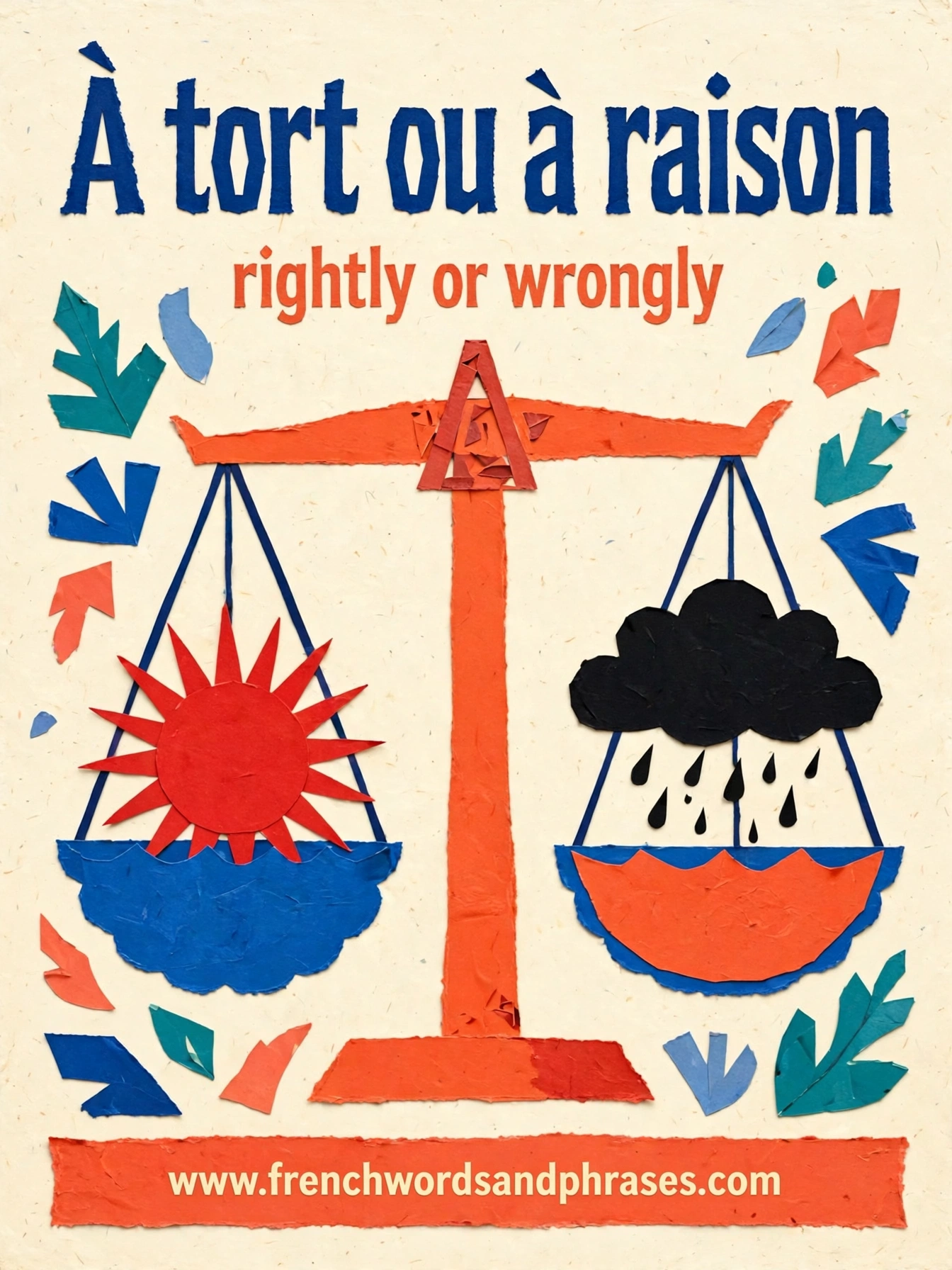
A French Word to Live By
Translate À tort ou à raison to English
/a tɔʁ u a ʁɛ.zɔ̃/
À tort ou à raison means rightly or wrongly — whether the judgement was justified or not.
The committee has argued for two hours about closing the little rural railway line. At last the chairwoman gathers her papers and ends it: « À tort ou à raison, la décision est prise, et nous l’assumerons. » Rightly or wrongly, the decision is made, and we shall stand by it. The room sighs — half relieved, half unconvinced.
Let’s explore how à tort ou à raison works in French, beginning with the whole phrase on one card.
Understanding the French Phrase À tort ou à raison
À tort ou à raison is a French set phrase built from à tort (wrongly) and à raison (rightly — raison is reason, right). The pair holds the two possible verdicts side by side and declines to choose: the thing happened, whichever way the judgement falls.
It means rightly or wrongly: whether justified or not. À tort ou à raison, il a défendu son ami — he stood by his friend, rightly or wrongly. The phrase is the shrug of honest uncertainty: it admits that reasonable people may judge the act either way, and it refuses to pretend the question is settled.
Type: Set phrase — judgement suspended (à tort + ou + à raison)
Answers the need: Saying something was done whether it was justified or not
Register: Neutral to slightly formal — debates, news, considered speech
Strength: Balanced — it concedes both verdicts in a single breath
One important usage detail: à raison alone is rare in modern French — the pair is the living form. The phrase usually stands at the head of the sentence or just before the verb, like a judge’s opening remark: À tort ou à raison, elle a agi vite. Note that raison here means right, correctness — the same raison as in avoir raison, to be right.
Experience the Word
À tort ou à raison is the phrase of the honest bystander — the one who reports the act and leaves the verdict to the room.
Imagine the old teacher watching a former pupil, now famous, defend an unpopular idea on television. Was he brave or stubborn? She pours her tea and gives the judgment of a lifetime of marking essays: à tort ou à raison, il y croit — rightly or wrongly, he believes in it. The phrase does not dodge the question; it honours its difficulty.
French debate loves this balance. À tort ou à raison holds the scales level and lets the listener weigh.
How to Use À tort ou à raison in French: Complete Guide
Let’s explore how à tort ou à raison works in French, beginning with the whole phrase on one card.
À tort ou à raison at a Glance
The Whole Phrase on One Card
Real meaning, literal picture, English twin and register — à tort ou à raison in five lines.
| Point | À tort ou à raison |
|---|---|
| What it really means | rightly or wrongly — whether the act was justified or not |
| Word for word | in wrong or in right — under either verdict |
| English equivalent | rightly or wrongly / right or wrong |
| Register | neutral to slightly formal |
| Use it for | decisions defended, stands taken, judgements left open |
Example
À tort ou à raison, il a dit ce qu’il pensait.
Rightly or wrongly, he said what he thought.
Word by Word: Building the Balance
Four small pieces — take them one by one and the scales appear.
| Word | Literal meaning | Its job in the phrase |
|---|---|---|
| à tort | wrongly | the first pan of the scales: the act may have been unjustified |
| ou | or | the hinge — the phrase refuses to close the question |
| à raison | rightly | the second pan: the act may have been justified after all |
Example
Elle l’a défendu, à tort ou à raison.
She defended him, rightly or wrongly.
Quick Quiz 1
Does à tort ou à raison take a side?
Reveal the answer
No — that is its whole point. It presents both verdicts and leaves the judging to the listener.
À tort ou à raison, l’histoire jugera.
Rightly or wrongly, history will judge.
When You Say It: The Open-Verdict Moments
À tort ou à raison fires at moments like these — wherever a stand was taken and opinion is divided.
| Situation | Example |
|---|---|
| Decisions | à tort ou à raison, la décision est prise — rightly or wrongly, the decision is made |
| Loyalty | il a soutenu son ami à tort ou à raison — he backed his friend, rightly or wrongly |
| Opinions | à tort ou à raison, elle passe pour une originale — rightly or wrongly, she has a reputation as an eccentric |
| Protests | à tort ou à raison, les habitants se sont mobilisés — rightly or wrongly, the residents mobilised |
| History | à tort ou à raison, ce général reste controversé — rightly or wrongly, this general remains controversial |
Example
À tort ou à raison, le village s’est mobilisé contre le projet.
Rightly or wrongly, the village mobilised against the project.
Make It Yours: Balancing Every Verdict
The phrase moves around the sentence — front for ceremony, middle for flow, end for a shrug.
| Form | French | In English |
|---|---|---|
| At the front | à tort ou à raison, … | rightly or wrongly, … (the formal opening) |
| After the verb | il a agi, à tort ou à raison | he acted, rightly or wrongly |
| The reversed twin | à raison ou à tort | rightly or wrongly (rarer, same meaning) |
| With a reputation | passer, à tort ou à raison, pour… | to have a reputation, deserved or not, as… |
| Plain alternative | que ce soit justifié ou non | whether it is justified or not (spelled out) |
| The solo members | à tort / avoir raison | wrongly / to be right |
Example
Il passe, à tort ou à raison, pour un homme difficile.
He has a reputation, deserved or not, as a difficult man.
Quick Quiz 2
Which word in the phrase carries the meaning right — tort or raison?
Reveal the answer
Raison — the same raison as in avoir raison, to be right. Tort is its opposite, the wrong.
La raison d’un côté, le tort de l’autre.
Right on one side, wrong on the other.
Everyday Expressions: Building on the Balance
À tort ou à raison slots into these everyday frames — each one ready to use as it stands.
| Frame | In English |
|---|---|
| à tort ou à raison | rightly or wrongly |
| à tort | wrongly |
| avoir raison | to be right |
| avoir tort | to be wrong |
| donner raison à quelqu’un | to agree with someone, to side with them |
Example
Le temps donnera raison à l’un ou à l’autre.
Time will prove one of them right.
Close Cousins: The Other Suspended Judgements
French suspends judgement in several styles — à tort ou à raison is the classic, courtroom-balanced one.
| Expression | The difference |
|---|---|
| à tort ou à raison | rightly or wrongly — both verdicts held open, evenly |
| à juste titre | rightly, with good reason — this one does take a side: justified |
| à tort | wrongly — the verdict is in, and it is negative |
| quoi qu’on en dise | whatever people may say — the judgement of others is brushed aside |
| selon les points de vue | depending on your point of view — the balance spelled out |
Example
Elle est fière de son fils, à juste titre, quoi qu’on en dise.
She is proud of her son, rightly so, whatever people may say.
Quick Quiz 3
You believe the criticism was fully justified. À tort ou à raison or à juste titre?
Reveal the answer
À juste titre — it takes the side of justified. À tort ou à raison would leave the question open.
Il a été critiqué, mais pas à juste titre selon moi — enfin, à tort ou à raison, l’affaire est close.
He was criticised, though not rightly in my view — anyway, rightly or wrongly, the matter is closed.
À tort ou à raison and Its Neighbours
The judgement shelf around the phrase — verdicts, sides and scales.
| French | In English |
|---|---|
| à tort | wrongly |
| avoir raison | to be right |
| avoir tort | to be wrong |
| à juste titre | rightly, with good reason |
| donner tort à quelqu’un | to rule against someone, to say they are wrong |
| un jugement | a judgement |
Example
Donner tort ou raison, c’est le travail du juge.
To rule wrong or right is the judge’s work.
Watch Out: The Traps Around À tort ou à raison
The traps: a raison that is not a raisin, and a pair that must not be separated.
| Trap | The truth |
|---|---|
| raison is not the fruit | la raison is reason, right; le raisin is the grape — same sound family, different baskets entirely |
| à raison alone is rare | outside the pair, modern French seldom says à raison — learn the couple as one phrase |
| keep the order natural | à tort ou à raison is the standard order; reversing it is possible but marked |
| it judges acts, not facts | the phrase weighs whether something should have been done — for true-or-false questions, use vrai ou faux |
Example
À tort ou à raison, il a vendu ses raisins au marché.
Rightly or wrongly, he sold his grapes at the market.
Quick Quiz 4
True or false: à raison is a common standalone phrase in modern French.
Reveal the answer
False — it lives almost entirely inside the pair à tort ou à raison. On its own, French prefers avec raison or à juste titre.
Elle s’inquiète avec raison, mais à tort ou à raison, le départ est fixé.
She worries with good reason, but rightly or wrongly, the departure is set.
À tort ou à raison in Everyday French: Real-Life Examples
Now that you know the word, let’s see how à tort ou à raison appears in everyday French.
Example 1 — The committee
À tort ou à raison, la décision est prise.
Rightly or wrongly, the decision is made.
Example 2 — Loyalty
Il a défendu son frère à tort ou à raison.
He stood up for his brother, rightly or wrongly.
Example 3 — Reputation
Elle passe, à tort ou à raison, pour quelqu’un de froid.
She has a reputation, deserved or not, as a cold person.
Example 4 — The protest
À tort ou à raison, les pêcheurs ont bloqué le port.
Rightly or wrongly, the fishermen blockaded the port.
Example 5 — The debate
À tort ou à raison, son livre a fait scandale.
Rightly or wrongly, her book caused a scandal.
Example 6 — The verdict of time
À tort ou à raison, l’avenir nous le dira.
Rightly or wrongly, the future will tell us.
Beyond Translation: The Meaning of À tort ou à raison
English rightly or wrongly is already a fine phrase, but French gives the balance a pair of faces: tort, the twisted wrong, against raison, reason itself, the faculty that judges. The act is weighed not by lawyers but by the two powers inside every listener.
À tort ou à raison is democracy in five words: the act is reported, the verdict is yours.
That is why journalists and chairwomen reach for it at the end of long arguments — it closes the debate without rigging it.
How to Remember the French Phrase À tort ou à raison
Remember it this way: À tort ou à raison is a pair of scales held level — tort in one pan, raison in the other, and the phrase refuses to tip them.
- You see the two pans — tort, the wrong, against raison, the right, with ou as the honest hinge.
- You keep the couple together — à raison alone is rare; the pair is the living phrase.
- You leave the verdict open — the moment you take a side, switch to à tort or à juste titre.
The key idea is à tort ou à raison means rightly or wrongly — the act is reported, the verdict left open.
Test Your Knowledge of À tort ou à raison
Let’s see how much you’ve learned. Try answering these questions before revealing the answers.
Question 1
What does à tort ou à raison mean?
Reveal the answer
Rightly or wrongly — whether the act was justified or not.
Question 2
What is the literal, word-for-word meaning?
Reveal the answer
In wrong or in right — tort is wrong, raison is right, reason.
Question 3
How do you say ‘Rightly or wrongly, the decision is made’?
Reveal the answer
À tort ou à raison, la décision est prise — the phrase opens the sentence like a judge’s remark.
Question 4
What is the difference between à tort ou à raison and à juste titre?
Reveal the answer
The open question versus the settled one — à tort ou à raison leaves both verdicts standing; à juste titre declares the thing justified.
Question 5
Complete the sentence:
À tort ou à ______, il a dit ce qu’il pensait. (Rightly or wrongly, he said what he thought.)
Reveal the answer
raison
À tort ou à raison, il a dit ce qu’il pensait.
Rightly or wrongly, he said what he thought.
Your Final Challenge
Can You Use It?
How would you say this in French?
“Rightly or wrongly, she stood by her friend, and she does not regret it.”
Reveal the answer
À tort ou à raison, elle a soutenu son amie, et elle ne le regrette pas.
Rightly or wrongly, she stood by her friend, and she does not regret it.
A little French. A little curiosity. A richer everyday life.
LEARN FRENCH ONE WORD AT A TIME