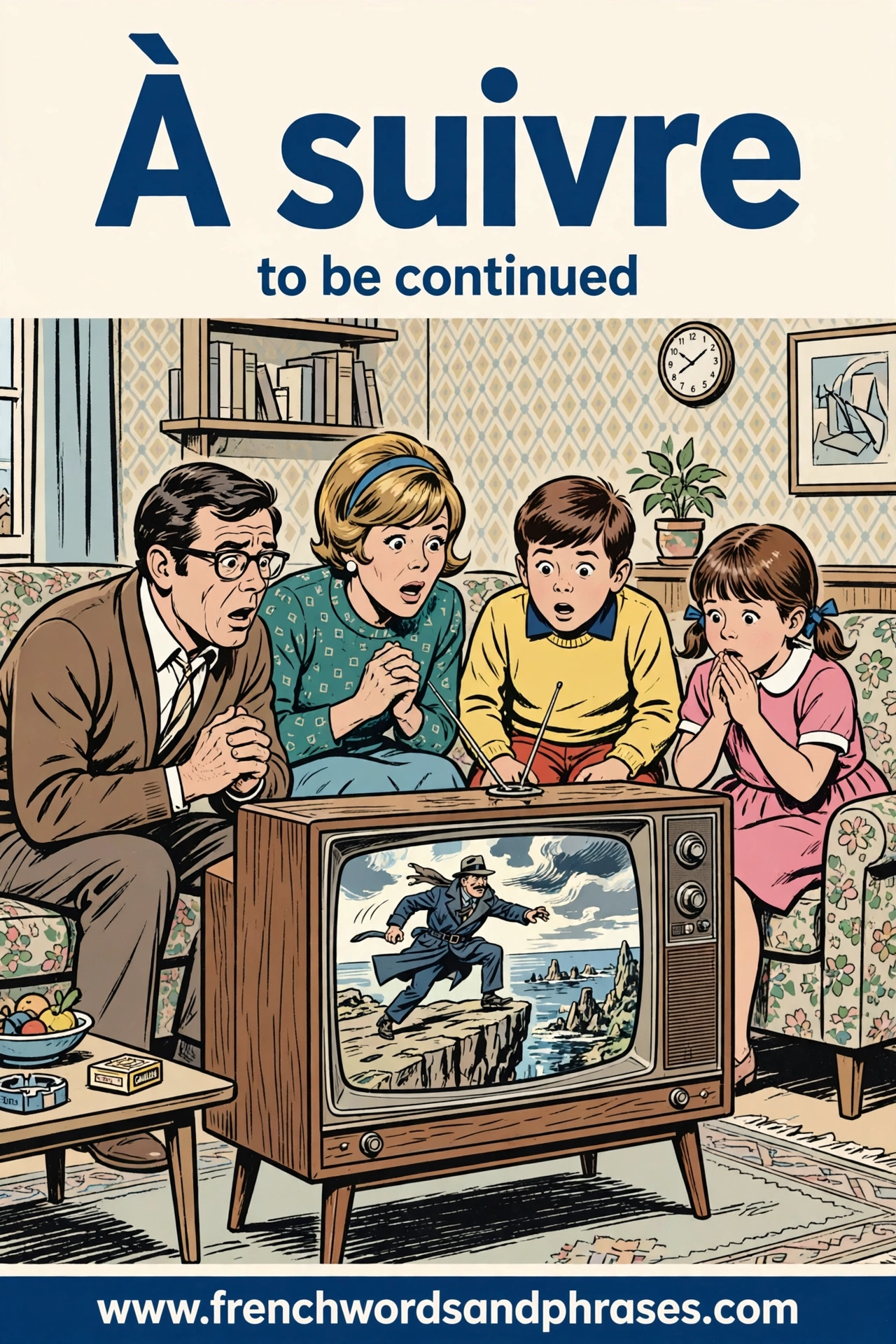
A French Word to Live By
Translate À suivre to English
/a sɥivʁ/
À suivre means to be continued — the story pauses here and resumes in the next episode.
The heroine opens the letter, reads two lines, and her face changes — freeze frame, music, credits. At the bottom of the screen, two small words hold the whole audience hostage until next week: « À suivre… » Half the country will spend seven days wondering what the letter said.
Let’s explore how à suivre works in French, beginning with the whole phrase on one card.
Understanding the French Phrase À suivre
À suivre is a French phrase built from à and suivre (to follow). Printed at the end of a serialised story, a comic, a television episode or a report in parts, it means to be continued: the story stops here, deliberately unfinished, and the rest is promised for the next instalment.
It means to be continued. The phrase began in the age of serial novels, when newspapers published stories in slices and each slice ended mid-breath. Television inherited it, then series, podcasts and long investigations: affaire à suivre, a case to watch, a story that will develop. Wherever à suivre appears, the teller is making a contract — wait, and you shall have the rest.
Type: Closing formula — serials and series (à + infinitive suivre)
Answers the need: Saying a story, episode or case continues in the next instalment
Register: Neutral — print, television, streaming, journalism
Strength: A promise — the pause is deliberate, and the continuation is owed to you
One important usage detail: à suivre stands alone, at the end, often with suspension points — À suivre… In journalism it widens into affaire à suivre, an ongoing story to keep an eye on. Do not confuse it with the verb phrase suivre un cours (to take a course) or with à suivre on instruction leaflets, where it can head the steps that follow.
Experience the Word
À suivre is the smallest cliffhanger in French — two words that turn an ending into a hook.
Imagine the serial novels of the old newspapers: readers queueing at the kiosk, furious and delighted, because yesterday’s chapter stopped at the duel’s first sword-stroke. The two words at the foot of the page were the author’s promise and the editor’s business model in one. Streaming has changed everything except this: the pause still sells the return.
French wears the formula lightly now — a knowing smile at the end of a story. À suivre is the art of stopping exactly where the reader cannot.
How to Use À suivre in French: Complete Guide
Let’s explore how à suivre works in French, beginning with the whole phrase on one card.
À suivre at a Glance
The Whole Phrase on One Card
Real meaning, literal picture, English twin and register — à suivre in five lines.
| Point | À suivre |
|---|---|
| What it really means | to be continued — the story resumes in the next instalment |
| Word for word | to follow — what follows comes next time |
| English equivalent | to be continued / continued in the next episode |
| Register | neutral — print, screen, journalism |
| Use it for | serial stories, episodes, comics, investigations in parts |
Example
Le héros ouvre la porte… À suivre.
The hero opens the door… To be continued.
Word by Word: Building the Cliffhanger
Two small pieces — take them one by one and the story stops mid-breath.
| Word | Literal meaning | Its job in the phrase |
|---|---|---|
| à | to | points forward — the rest is still to come |
| suivre | to follow | the verb of following: the continuation follows, and so must the reader |
Example
Affaire à suivre, annonce le journaliste.
A case to watch, announces the journalist.
Quick Quiz 1
What does à suivre literally say — ‘the end’, or ‘to follow’?
Reveal the answer
To follow — suivre is to follow. The story is not finished; its continuation follows in the next instalment.
La suite au prochain épisode : à suivre.
The rest in the next episode: to be continued.
When You Say It: The Cliffhanger Moments
À suivre fires at moments like these — wherever a teller stops on purpose and promises more.
| Situation | Example |
|---|---|
| End of an episode | l’épisode se termine par un « à suivre » — the episode ends on a ‘to be continued’ |
| In a comic | dernière case : à suivre… — last panel: to be continued… |
| In a newspaper serial | le feuilleton s’arrête, à suivre demain — the serial stops, continued tomorrow |
| In the news | une affaire à suivre de près — a case to follow closely |
| In a letter between friends | je te raconterai le reste… à suivre ! — I’ll tell you the rest… to be continued! |
Example
Cette enquête est une affaire à suivre.
This investigation is a case to keep following.
Make It Yours: The Phrase in Its Frames
The formula stands alone — the frames around it name what continues.
| Form | French | In English |
|---|---|---|
| The classic close | À suivre… | To be continued… |
| The case | une affaire à suivre | a case to watch, an ongoing story |
| The next episode | la suite au prochain épisode | continued in the next episode |
| The continuation | la suite | the rest, the sequel, the continuation |
| Following closely | à suivre de près | to be watched closely |
| The end (opposite) | Fin | The End — no continuation promised |
Example
Pas de « fin » ce soir, seulement un « à suivre ».
No ‘The End’ tonight, only a ‘to be continued’.
Quick Quiz 2
A journalist writes affaire à suivre. Is the story finished, or developing?
Reveal the answer
Developing — affaire à suivre means the case is ongoing and worth watching; more is expected.
C’est une affaire à suivre dans les prochains jours.
It’s a case to follow in the coming days.
Everyday Expressions: Building on the Cliffhanger
À suivre slots into these everyday frames — each one ready to use as it stands.
| Frame | In English |
|---|---|
| À suivre… | To be continued… |
| une affaire à suivre | an ongoing case, a story to watch |
| à suivre de près | to be followed closely |
| la suite au prochain épisode | continued in the next episode |
| un feuilleton | a serial, a soap — the genre à suivre was born in |
Example
Le feuilleton se termine ce soir par un « à suivre » insoutenable.
The serial ends tonight on an unbearable ‘to be continued’.
Close Cousins: The Other Continuation Words
French has a whole shelf of continuation phrases — à suivre is the serial’s promise; its cousins end, resume or follow in other senses.
| Expression | The difference |
|---|---|
| à suivre | to be continued — the serial pauses and promises the rest |
| la suite | the continuation itself — la suite au prochain épisode |
| fin | the end — the story closes, nothing is promised |
| histoire à suivre | a developing story — journalism’s version of the promise |
| à suivre de près | to be watched closely — for cases and situations still moving |
Example
Après la fin du feuilleton, une histoire à suivre a commencé.
After the serial’s end, a developing story began.
Quick Quiz 3
Which word closes a story for good — à suivre or fin?
Reveal the answer
Fin — the end. À suivre is precisely the refusal to write fin: the story is owed a continuation.
Ce soir, pas de fin : à suivre.
Tonight, no ending: to be continued.
À suivre and Its Neighbours
The serial shelf around the phrase — episodes, sequels and waiting a week.
| French | In English |
|---|---|
| un épisode | an episode |
| une série | a series |
| un feuilleton | a serial, a soap opera |
| la suite | the sequel, the continuation |
| le prochain épisode | the next episode |
| un rebondissement | a twist — what the wait is hoping for |
Example
Chaque épisode finit par un rebondissement et un « à suivre ».
Every episode ends with a twist and a ‘to be continued’.
Watch Out: The Traps Around À suivre
The traps: a verb with other jobs, an ending that is really a beginning, and a case that is not a story.
| Trap | The truth |
|---|---|
| suivre has other lives | suivre un cours is to take a course; suivre quelqu’un is to follow someone — the à suivre formula is only the serial’s close |
| it promises, it does not end | à suivre at the foot of a page means the opposite of finished — the rest exists and is coming |
| affaire à suivre is journalism | it labels a developing story in the news, not a television episode — the case is real and still moving |
| the dots are part of the costume | À suivre… with suspension points is the classic printed form; the dots are the held breath |
Example
Elle suit un cours le mardi, puis regarde sa série : à suivre.
She takes a course on Tuesdays, then watches her series: to be continued.
Quick Quiz 4
True or false: à suivre means the story is over.
Reveal the answer
False — it means the opposite: the story is paused, and the continuation is promised for the next instalment.
Le chapitre s’arrête là, mais l’histoire continue : à suivre.
The chapter stops there, but the story goes on: to be continued.
À suivre in Everyday French: Real-Life Examples
Now that you know the word, let’s see how à suivre appears in everyday French.
Example 1 — End of the episode
L’épisode se termine sur un « à suivre » terrible.
The episode ends on a terrible ‘to be continued’.
Example 2 — In the comic
Dernière image : le héros tombe… À suivre.
Last picture: the hero falls… To be continued.
Example 3 — The newspaper serial
Le feuilleton de l’été s’arrête là ; à suivre demain.
The summer serial stops there; continued tomorrow.
Example 4 — The news case
Cette affaire à suivre occupera les journaux toute la semaine.
This developing case will fill the papers all week.
Example 5 — Between friends
Et ensuite ? Je te raconterai… à suivre !
And then? I’ll tell you… to be continued!
Example 6 — The investigation
Une enquête à suivre de près, disent les journalistes.
An investigation to follow closely, say the journalists.
Beyond Translation: The Meaning of À suivre
English borrowed the device and the flat label — ‘to be continued’ — but French à suivre keeps the verb of following inside it, and that changes the contract: the reader is not just promised a continuation, they are enlisted as a follower.
À suivre turns an audience into companions — you do not wait for the story, you follow it.
From newspaper feuilletons to streaming cliffhangers, the two words have survived every technology, because the pleasure they name — the held breath between episodes — never goes out of date.
How to Remember the French Phrase À suivre
Remember it this way: À suivre is the held breath at the bottom of the page — the story stops, and the verb follow pulls you into next week.
- You picture the freeze-frame — the letter half-opened, the music rising, and two small words holding the door.
- You hear the verb — suivre is to follow: the continuation follows, and so do you.
- You borrow it for real life — une affaire à suivre is any story still developing.
The key idea is à suivre means to be continued — the story pauses and promises the rest.
Test Your Knowledge of À suivre
Let’s see how much you’ve learned. Try answering these questions before revealing the answers.
Question 1
What does à suivre mean?
Reveal the answer
To be continued — the story pauses here and resumes in the next instalment.
Question 2
What does suivre mean?
Reveal the answer
To follow — the continuation follows, and the reader follows with it.
Question 3
What does affaire à suivre mean in the news?
Reveal the answer
A developing case to keep watching — the story is real, ongoing and unfinished.
Question 4
What word would close the story instead?
Reveal the answer
Fin — the end. À suivre is exactly the refusal to write it.
Question 5
Complete the sentence:
Le héros ouvre la lettre… À ______. (The hero opens the letter… To be continued.)
Reveal the answer
suivre
Le héros ouvre la lettre… À suivre.
The hero opens the letter… To be continued.
Your Final Challenge
Can You Use It?
How would you say this in French?
“The episode ends here — to be continued.”
Reveal the answer
L’épisode se termine ici — à suivre.
The episode ends here — to be continued.
A little French. A little curiosity. A richer everyday life.
LEARN FRENCH ONE WORD AT A TIME