A French Word to Live By
How to Conjugate Gaspiller in French
/ɡas.pi.je/
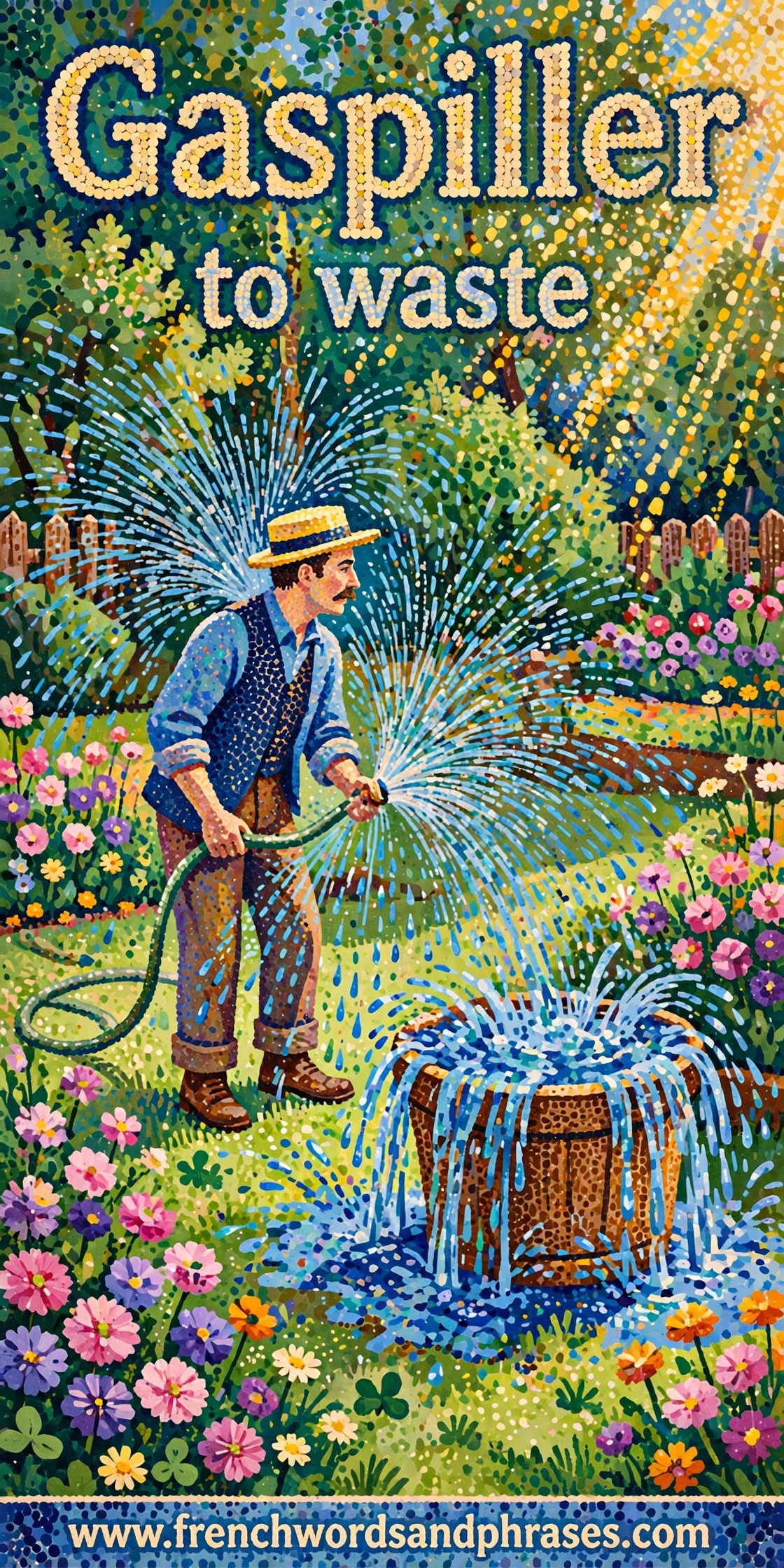
Gaspiller means to waste — to spend water, food, money, time or talent on nothing, and have nothing to show for it.
A tap left running all morning, bread thrown away still fresh, a brilliant student spending his gift on video games — gaspiller is the verb of squandering: whatever precious thing goes down the drain unused, gaspillé, is gone for good.
In this guide, you’ll learn how to conjugate gaspiller in all the major French tenses and moods. Explore complete conjugation tables, French examples, English translations, and practice quizzes.
Understanding the French Verb Gaspiller
Gaspiller is a regular French verb belonging to the first group of verbs, those ending in-er.
It means to waste. It is commonly used for water, energy, food and money thrown away carelessly, for time and opportunities squandered, and for talents and chances wasted by neglect. Wherever a French speaker shakes their head at something precious going to waste, gaspiller is the verb they reach for.
Verb classification: First group (-er)
Auxiliary verb: Avoir
Past participle: gaspillé
Present participle: gaspillant
English equivalents: To waste, to squander; gaspiller l’eau — to waste water; gaspiller de l’argent — to waste money; gaspiller son temps — to waste one’s time; gaspiller un talent — to waste a talent; le gaspillage — waste, wastage; du gaspillage alimentaire — food waste.
One important detail: gaspiller is the strong word for waste — stronger than perdre. Perdre son temps is to lose time, often by accident; gaspiller son temps is to throw it away on purpose, and the blame is built into the verb. Its noun le gaspillage is the word of campaigns and headlines: le gaspillage alimentaire, food waste, is fought by law in French supermarkets. The double l sounds like a y: /ɡas.pi.je/ — gas-pi-YÉ. Otherwise the verb is a perfectly regular -er: je gaspille, nous gaspillons, participle gaspillé.
Experience the Word
Gaspiller is the verb of the open tap and the full bin — value flowing away while nobody watches.
Imagine a market gardener at closing time, looking at crates of perfect peaches, unsold, softening in the sun. Tomorrow they will be rubbish. Around him, shoppers haggle over centimes while tonnes of food are gaspillées every day between the field and the table — and he shakes his head at a world that wastes what it grows.
Grown with care, thrown away without a thought. It has been wasted — on a gaspillé — and waste is a kind of theft from the future.
How to Conjugate Gaspiller: Complete French Conjugation Guide
Let’s explore every major conjugation of gaspiller, beginning with the indicative mood.
How to Conjugate Gaspiller in the Indicative Mood
The indicative mood is used to express facts, observations, actions, and events.
How to Conjugate Gaspiller in the Present Tense (Présent)
Used for actions happening now, habitual actions, and general truths.
| Subject | Conjugation |
|---|---|
| je | gaspille |
| tu | gaspilles |
| il / elle | gaspille |
| nous | gaspillons |
| vous | gaspillez |
| ils / elles | gaspillent |
Example
Tu gaspilles l’eau en laissant le robinet ouvert.
You are wasting water by leaving the tap running.
Quick Quiz 1
Complete the sentence:
Nous ______ trop d’eau dans ce jardin.
Reveal the answer
gaspillons
Nous gaspillons trop d’eau dans ce jardin.
We waste too much water in this garden.
How to Conjugate Gaspiller in the Passé Composé
Used for completed actions in the past. Gaspiller takes the auxiliary verb avoir.
| Subject | Conjugation |
|---|---|
| j’ | ai gaspillé |
| tu | as gaspillé |
| il / elle | a gaspillé |
| nous | avons gaspillé |
| vous | avez gaspillé |
| ils / elles | ont gaspillé |
Example
Nous avons gaspillé une fortune en réparations inutiles.
We wasted a fortune on useless repairs.
How to Conjugate Gaspiller in the Imparfait (Imperfect Tense)
Used for habitual past actions, descriptions, and ongoing situations in the past.
| Subject | Conjugation |
|---|---|
| je | gaspillais |
| tu | gaspillais |
| il / elle | gaspillait |
| nous | gaspillions |
| vous | gaspilliez |
| ils / elles | gaspillaient |
Example
Il gaspillait son argent dès qu’il le recevait.
He used to squander his money as soon as he received it.
Quick Quiz 2
Choose the correct form:
He squandered his inheritance.
Il ______ son héritage. (a gaspillé / est gaspillé)
Reveal the answer
a gaspillé
Il a gaspillé son héritage.
Gaspiller takes avoir.
How to Conjugate Gaspiller in the Plus-que-parfait
Used to describe an action that had already been completed before another past event.
| Subject | Conjugation |
|---|---|
| j’ | avais gaspillé |
| tu | avais gaspillé |
| il / elle | avait gaspillé |
| nous | avions gaspillé |
| vous | aviez gaspillé |
| ils / elles | avaient gaspillé |
Example
Elle avait gaspillé sa chance avant même de s’en rendre compte.
She had wasted her chance before even realising it.
How to Conjugate Gaspiller in the Passé Simple
Primarily used in formal writing, literature, and historical narratives. It is rarely used in everyday conversation.
| Subject | Conjugation |
|---|---|
| je | gaspillai |
| tu | gaspillas |
| il / elle | gaspilla |
| nous | gaspillâmes |
| vous | gaspillâtes |
| ils / elles | gaspillèrent |
Example
Le roi gaspilla le trésor du royaume en fêtes somptueuses.
The king squandered the kingdom’s treasure on lavish feasts.
How to Conjugate Gaspiller in the Passé Antérieur
A literary tense used to express an action completed immediately before another past action, generally in the passé simple.
| Subject | Conjugation |
|---|---|
| j’ | eus gaspillé |
| tu | eus gaspillé |
| il / elle | eut gaspillé |
| nous | eûmes gaspillé |
| vous | eûtes gaspillé |
| ils / elles | eurent gaspillé |
Example
Quand il eut gaspillé son héritage, il se retrouva sans rien.
When he had squandered his inheritance, he found himself with nothing.
How to Conjugate Gaspiller in the Future Tense (Futur Simple)
Used to describe actions that will take place in the future.
| Subject | Conjugation |
|---|---|
| je | gaspillerai |
| tu | gaspilleras |
| il / elle | gaspillera |
| nous | gaspillerons |
| vous | gaspillerez |
| ils / elles | gaspilleront |
Example
Si tu continues ainsi, tu gaspilleras ton talent.
If you go on like this, you will waste your talent.
How to Conjugate Gaspiller in the Futur Antérieur (Future Perfect)
Used for an action that will have been completed before a particular point in the future.
| Subject | Conjugation |
|---|---|
| j’ | aurai gaspillé |
| tu | auras gaspillé |
| il / elle | aura gaspillé |
| nous | aurons gaspillé |
| vous | aurez gaspillé |
| ils / elles | auront gaspillé |
Example
À ce rythme, nous aurons gaspillé la moitié du budget avant Noël.
At this rate, we will have wasted half the budget before Christmas.
How to Conjugate Gaspiller in the Near Future (Futur Proche)
Used to describe something that is going to happen soon. Formed with aller + infinitive.
| Subject | Conjugation |
|---|---|
| je | vais gaspiller |
| tu | vas gaspiller |
| il / elle | va gaspiller |
| nous | allons gaspiller |
| vous | allez gaspiller |
| ils / elles | vont gaspiller |
Example
Ne va pas gaspiller tes économies dans cette voiture !
Do not go and waste your savings on that car!
How to Conjugate Gaspiller in the Conditional Mood
The conditional mood expresses what would happen under certain circumstances. It is also frequently used to make polite requests or express wishes.
How to Conjugate Gaspiller in the Present Conditional
| Subject | Conjugation |
|---|---|
| je | gaspillerais |
| tu | gaspillerais |
| il / elle | gaspillerait |
| nous | gaspillerions |
| vous | gaspilleriez |
| ils / elles | gaspilleraient |
Example
On gaspillerait moins si les portions étaient plus petites.
People would waste less if the portions were smaller.
How to Conjugate Gaspiller in the Past Conditional
| Subject | Conjugation |
|---|---|
| j’ | aurais gaspillé |
| tu | aurais gaspillé |
| il / elle | aurait gaspillé |
| nous | aurions gaspillé |
| vous | auriez gaspillé |
| ils / elles | auraient gaspillé |
Example
Il aurait gaspillé moins d’eau avec un jardin sec.
He would have wasted less water with a dry garden.
Gaspiller in the Literary Past Conditional Form
This less common literary form uses the imperfect subjunctive of avoir.
| Subject | Conjugation |
|---|---|
| j’ | eusse gaspillé |
| tu | eusses gaspillé |
| il / elle | eût gaspillé |
| nous | eussions gaspillé |
| vous | eussiez gaspillé |
| ils / elles | eussent gaspillé |
Example
Le prince eût gaspillé le royaume entier en une saison.
The prince would have squandered the whole kingdom in one season.
How to Conjugate Gaspiller in the Subjunctive Mood
The subjunctive is used to express wishes, emotions, doubts, necessity, and uncertainty. It frequently follows expressions such as il faut que (it is necessary that) or bien que (although).
How to Conjugate Gaspiller in the Present Subjunctive
| Subject | Conjugation |
|---|---|
| que je | gaspille |
| que tu | gaspilles |
| qu’il / qu’elle | gaspille |
| que nous | gaspillions |
| que vous | gaspilliez |
| qu’ils / qu’elles | gaspillent |
Example
Il est dommage que vous gaspilliez tant de nourriture.
It is a shame that you waste so much food.
Quick Quiz 3
Complete the sentence using the subjunctive:
Il est dommage que tu ______ ton talent.
Reveal the answer
gaspilles
Il est dommage que tu gaspilles ton talent.
It is a shame that you are wasting your talent.
How to Conjugate Gaspiller in the Imperfect Subjunctive
A literary tense, rarely encountered in modern spoken French.
| Subject | Conjugation |
|---|---|
| que je | gaspillasse |
| que tu | gaspillasses |
| qu’il / qu’elle | gaspillât |
| que nous | gaspillassions |
| que vous | gaspillassiez |
| qu’ils / qu’elles | gaspillassent |
Example
Je ne voulais pas qu’elle gaspillât ses plus belles années.
I did not want her to waste her best years.
How to Conjugate Gaspiller in the Pluperfect Subjunctive
A literary construction used to express an action completed before another past action.
| Subject | Conjugation |
|---|---|
| que j’ | eusse gaspillé |
| que tu | eusses gaspillé |
| qu’il / qu’elle | eût gaspillé |
| que nous | eussions gaspillé |
| que vous | eussiez gaspillé |
| qu’ils / qu’elles | eussent gaspillé |
Example
On regrettait qu’ils eussent gaspillé une telle occasion.
People regretted that they had wasted such an opportunity.
How to Conjugate Gaspiller in the Past Subjunctive
| Subject | Conjugation |
|---|---|
| que j’ | aie gaspillé |
| que tu | aies gaspillé |
| qu’il / qu’elle | ait gaspillé |
| que nous | ayons gaspillé |
| que vous | ayez gaspillé |
| qu’ils / qu’elles | aient gaspillé |
Example
Je regrette que tu aies gaspillé ton argent ainsi.
I regret that you wasted your money like that.
How to Conjugate Gaspiller in the Imperative
The imperative is used to give commands, instructions, invitations, or suggestions. Subject pronouns are omitted.
How to Conjugate Gaspiller in the Present Imperative
| Person | Conjugation |
|---|---|
| (tu) | gaspille |
| (nous) | gaspillons |
| (vous) | gaspillez |
Example
Ne gaspille pas ton temps avec ces jeux !
Do not waste your time on those games!
Quick Quiz 4
How would you say Do not waste your time (tu form)?
Reveal the answer
Ne gaspille pas ton temps !
French Participles of Gaspiller
Participles are verb forms that can be used in compound tenses and other grammatical constructions.
Present Participle of Gaspiller
gaspillant
En gaspillant l’eau, on prépare les sécheresses de demain.
By wasting water, we are preparing tomorrow’s droughts.
Past Participle of Gaspiller
gaspillé
Gaspillée par négligence, cette chance ne reviendra pas.
Wasted through negligence, this chance will not come back.
Gaspiller in Everyday French: Real-Life Examples
Now that you know the conjugations, let’s see how gaspiller appears in everyday French.
Example 1 — Present
Tu gaspilles l’eau en laissant le robinet ouvert.
You are wasting water by leaving the tap running.
Example 2 — Passé composé
Nous avons gaspillé une fortune en réparations.
We wasted a fortune on repairs.
Example 3 — Imparfait
Il gaspillait son argent dès qu’il le recevait.
He used to squander his money as soon as he got it.
Example 4 — Future
Tu gaspilleras ton talent si tu abandonnes.
You will waste your talent if you give up.
Example 5 — Conditional
On gaspillerait moins avec de plus petites portions.
People would waste less with smaller portions.
Example 6 — Imperative
Ne gaspillez pas la nourriture !
Do not waste food!
Beyond Translation: The Meaning of Gaspiller
English waste covers the ground, but French gaspiller carries the moral weight — it is never neutral.
What is gaspillé was worth something.
That is why the verb leads campaigns: le gaspillage alimentaire shamed France into becoming the first country to ban supermarkets from throwing away unsold food. The gaspilleur is not merely careless; in French ears he is throwing away what others needed — water in a drought, food in a hungry world, a talent in a short life.
How to Remember the French Verb Gaspiller
Remember it this way: Gaspiller is about the open tap and the full bin — value flowing away.
- Stronger than perdre: gaspiller is waste with blame attached — what was gaspillé was precious.
- Its noun leads the campaigns: le gaspillage alimentaire, food waste.
- Regular -er, with ll sounded like y: je gaspille, nous gaspillons, past participle gaspillé.
The key idea is the open tap and the full bin — value flowing away.
Test Your Knowledge of Gaspiller
Let’s see how much you’ve learned. Try answering these questions before revealing the answers.
Question 1
How is gaspiller different from perdre?
Reveal the answer
Gaspiller blames — perdre is losing, often by accident; gaspiller is throwing something precious away on purpose: gaspiller son temps, gaspiller l’eau.
Question 2
How do you say You are wasting water by leaving the tap running in French?
Reveal the answer
Tu gaspilles l’eau en laissant le robinet ouvert.
Question 3
Translate: We wasted a fortune on useless repairs.
Reveal the answer
Nous avons gaspillé une fortune en réparations inutiles.
Question 4
What is the past participle of gaspiller?
Reveal the answer
Gaspillé.
Question 5
Complete the sentence:
Il est dommage que vous ______ tant de nourriture.
Reveal the answer
gaspilliez
Il est dommage que vous gaspilliez tant de nourriture.
It is a shame that you waste so much food.
Your Final Challenge
Can You Use It?
How would you say this in French?
One wastes neither the water of a dry country nor the time of a short life.
Reveal the answer
On ne gaspille ni l’eau d’un pays sec, ni le temps d’une vie courte.
One wastes neither the water of a dry country nor the time of a short life.
A little French. A little curiosity. A richer everyday life.
LEARN FRENCH ONE WORD AT A TIME