A French Word to Live By
Translate Échec to English
/e.ʃɛk/
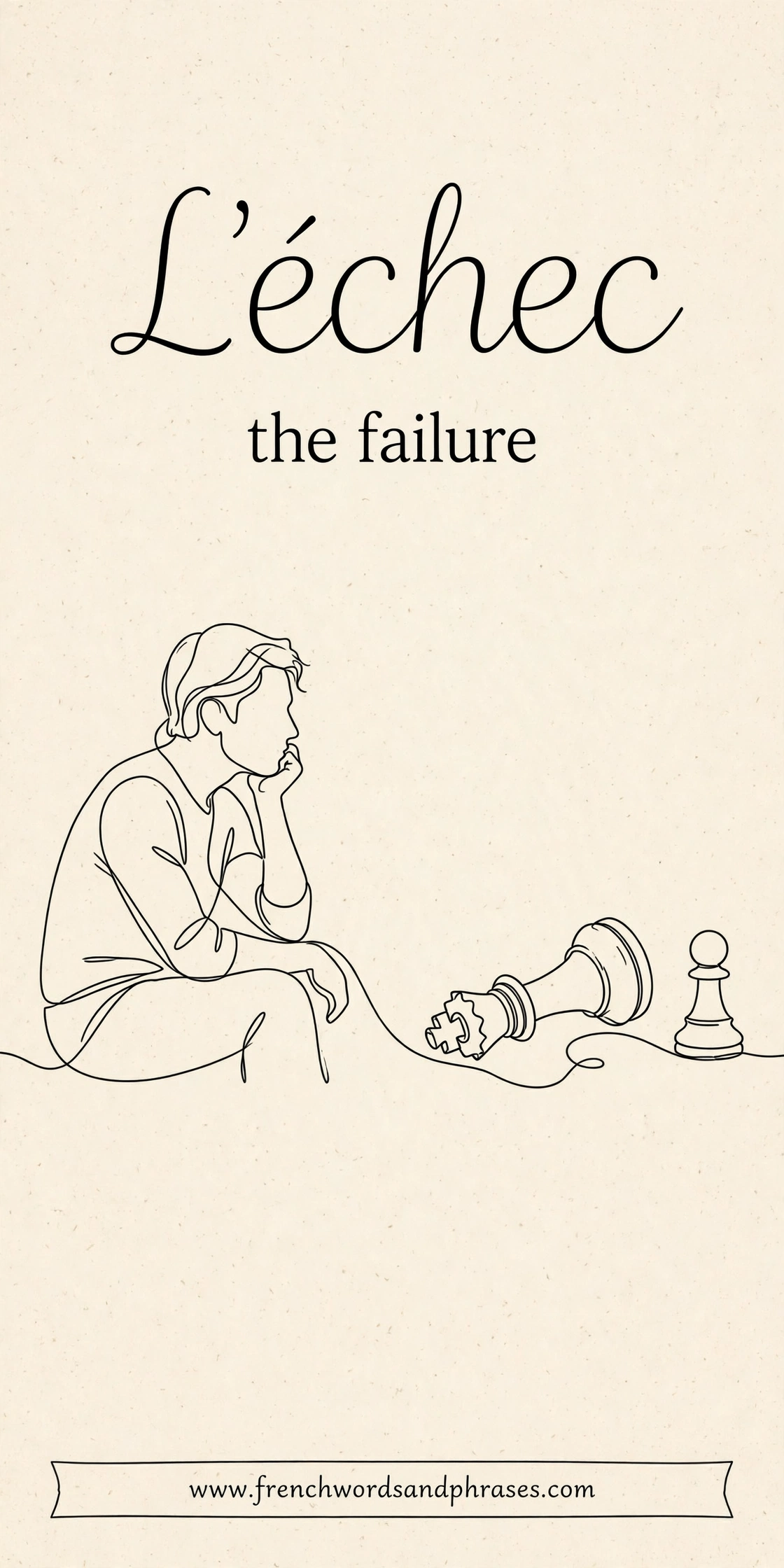
L’échec means the failure.
The hall is silent as the results are read. One candidate closes his eyes and breathes out slowly — for him, this year, it is l’échec. He is already, quietly, planning to try again.
In this guide, you’ll learn what échec means in English, how to use it with its articles, how to form its plural, and how it appears in everyday French. Explore French examples, English translations, and practice quizzes.
Understanding the French Noun Échec
Échec is a masculine French noun. It is learned together with its article: l’échec, un échec — because it begins with a vowel, le shrinks to l’. It is the noun of the verb échouer, to fail — and it hides a second life on the chessboard.
It means the failure — the unsuccessful end of an attempt: un échec à un examen (failing an exam), l’échec d’un projet, un échec amoureux (a heartbreak, a failed love). And in the plural, the word changes game entirely: les échecs is chess — « jouer aux échecs » — and the cry « échec et mat ! » is checkmate.
Gender: Masculine
Definite article: l’ — l’échec (the failure)
Indefinite article: un — un échec (a failure)
Plural: les échecs — also: chess, the game
Word origin: The noun of échouer, to fail — j’échoue, nous échouons
English equivalents: The failure; a setback.
One important usage detail: échec is a strong, clean word — a clear failure, not a small hiccup. French softens it with phrases like « ce n’est pas un échec, c’est une expérience » — it is not a failure, it is experience. And never mix the two lives of the word: « Il joue aux échecs » means he plays chess, while « il subit un échec » means he suffers a failure.
Experience the Word
Échec is more than a bad result. French culture treats it with a particular respect: the failed bac can be retaken, the failed business is a chapter, not the book. L’échec is the tuition fee of la réussite.
Imagine the chess player in the park, studying the board after losing: he replays every move, hunting the exact moment the game turned — failure as a teacher, patiently giving the lesson.
You have not just lost. You have been instructed — à la dure, the hard way, which is the way that lasts.
How to Use Échec in French: Complete Guide
Let’s explore how échec works in French, beginning with its articles — and watch the vowel shrink le into l’.
Échec with the Definite Article (L’, Les)
Échec begins with a vowel, so le becomes l’ — the failure everyone in the conversation knows.
| Form | French |
|---|---|
| Singular | l’échec |
| Plural | les échecs |
Example
L’échec du projet surprend toute l’équipe.
The failure of the project surprises the whole team.
Échec with the Indefinite Article (Un, Des)
Used for a failure in general — un échec, any setback at all.
| Form | French |
|---|---|
| Singular | un échec |
| Plural | des échecs |
Example
Un échec n’est jamais définitif.
A failure is never final.
Failure and Chess: Words Around the Échec
Exams, projects and chessboards — the vocabulary that surrounds the échec.
| French | In English |
|---|---|
| échouer | to fail |
| subir un échec | to suffer a failure, a setback |
| l’échec scolaire | failure at school, academic failure |
| les échecs | chess (the game) |
| échec et mat | checkmate |
| la réussite | success (the opposite) |
Example
Après son échec, il apprend à jouer aux échecs pour se changer les idées.
After his failure, he learns to play chess to take his mind off it.
Quick Quiz 1
Complete the sentence:
______ au permis de conduire le décourage un peu.
Reveal the answer
L’échec
L’échec au permis de conduire le décourage un peu.
Failing his driving test discourages him a little — l’, before the vowel.
The Plural of Échec
Échec adds an -s in the plural — les échecs, the failures of a career… and the name of the game of chess.
| Number | French |
|---|---|
| Singular | l’échec |
| Plural | les échecs |
Example
Ses échecs répétés le poussent à changer de méthode.
His repeated failures push him to change his method.
Échec with Possessive Adjectives (Mon, Ton, Son…)
A vowel-start noun: mon, ton, son flow into the vowel — mon échec, my failure, said without a stumble.
| Owner | French |
|---|---|
| my | mon échec |
| your (tu) | ton échec |
| his / her | son échec |
| our | notre échec |
| your (vous) | votre échec |
| their | leur échec |
Example
Son échec à l’examen le rend plus déterminé.
His failure in the exam makes him more determined.
Quick Quiz 2
Complete the sentence:
Je tire une leçon de ______ échec. (my)
Reveal the answer
mon
Je tire une leçon de mon échec.
I draw a lesson from my failure — mon, the form used before a vowel-start noun.
Échec with Demonstrative Adjectives (Cet, Ces)
Used to point: cet échec — cet, not ce, because the noun begins with a vowel.
| Form | French |
|---|---|
| Singular | cet échec |
| Plural | ces échecs |
Example
Cet échec ne doit pas cacher ses progrès.
This failure must not hide his progress.
Échec with Adjectives
Adjectives agree with échec: masculine forms, cuisant — stinging — is the classic partner.
| Adjective | With Échec |
|---|---|
| cuisant (stinging, bitter) | un échec cuisant |
| scolaire (school) | l’échec scolaire |
| personnel (personal) | un échec personnel |
| total (total) | un échec total |
| premier (first) | un premier échec |
Example
L’équipe subit un échec cuisant en finale.
The team suffers a stinging failure in the final.
Quick Quiz 3
Complete the sentence:
C’est un échec ______, mais il va réessayer. (total)
Reveal the answer
total
C’est un échec total, mais il va réessayer.
It is a total failure, but he is going to try again.
Everyday Expressions with Échec
Exams, chess and second chances — the échec phrases of daily life.
| Expression | In English |
|---|---|
| subir un échec | to suffer a failure |
| l’échec scolaire | academic failure, failure at school |
| aller à l’échec | to be heading for failure |
| jouer aux échecs | to play chess |
| échec et mat | checkmate |
| transformer l’échec en réussite | to turn failure into success |
Example
Le dimanche, ils jouent aux échecs au café.
On Sundays, they play chess at the café.
Words from the Same Family as Échec
Failure, success and trying again — the words that travel with échec.
| French | In English |
|---|---|
| échouer | to fail; to run aground |
| la réussite | success |
| le succès | success |
| réessayer | to try again |
| abandonner | to give up |
| la défaite | the defeat |
Example
Après une défaite, le champion réessaie sans abandonner.
After a defeat, the champion tries again without giving up.
Quick Quiz 4
What does « jouer aux échecs » mean?
Reveal the answer
To play chess — in the plural, les échecs leaves failure behind and names the game.
Échec et mat ! La partie est terminée.
Checkmate! The game is over.
Échec in Everyday French: Real-Life Examples
Now that you know the word, let’s see how échec appears in everyday French.
Example 1 — Exam season
L’échec au bac n’empêche pas de réussir plus tard.
Failing the bac does not prevent succeeding later.
Example 2 — At work
L’échec du produit coûte cher à l’entreprise.
The product’s failure costs the company dearly.
Example 3 — In love
Après un échec amoureux, il prend son temps.
After a heartbreak, he is taking his time.
Example 4 — At school
L’école lutte contre l’échec scolaire.
The school is fighting against academic failure.
Example 5 — Chess club
Le club d’échecs accueille les débutants le samedi.
The chess club welcomes beginners on Saturdays.
Example 6 — Encouragement
Un échec, ce n’est pas la fin du monde.
A failure is not the end of the world.
Beyond Translation: The Meaning of Échec
L’échec has two souls in French: the bitter one — the failed exam, the closed business — and the noble one across the chessboard, where les échecs is the game of kings. The language seems to whisper that failure and strategy are cousins: both demand that you study the board, accept the loss, and play the next game better.
To say échec is to name the defeat that teaches — and the game that consoles.
It evokes the silent hall of results and the clicking pieces in the park — the two classrooms of resilience.
How to Remember the French Noun Échec
Remember it this way: Échec is the failure — and, in the plural, les échecs is also the game of chess.
- You fail the exam — l’échec, puis on réessaie.
- You play the game — les échecs, échec et mat !
- You learn the lesson — transformer l’échec en réussite.
The key idea is l’échec = failure; les échecs = chess.
Test Your Knowledge of Échec
Let’s see how much you’ve learned. Try answering these questions before revealing the answers.
Question 1
What does l’échec mean in English?
Reveal the answer
The failure — of an exam, a project, an attempt.
Question 2
Which verb does échec belong to?
Reveal the answer
Échouer — to fail: j’échoue, nous échouons.
Question 3
Translate: A failure is never final.
Reveal the answer
Un échec n’est jamais définitif.
Question 4
What does « les échecs » mean as a game?
Reveal the answer
Chess — jouer aux échecs, to play chess; échec et mat, checkmate.
Question 5
Complete the sentence:
Il subit un ______ cuisant en finale.
Reveal the answer
échec
Il subit un échec cuisant en finale.
He suffers a stinging failure in the final.
Your Final Challenge
Can You Use It?
How would you say this in French?
“His failure does not discourage him.”
Reveal the answer
Son échec ne le décourage pas.
His failure does not discourage him.
A little French. A little curiosity. A richer everyday life.
LEARN FRENCH ONE WORD AT A TIME