A French Word to Live By
Translate Omelette to English
/ɔm.lɛt/
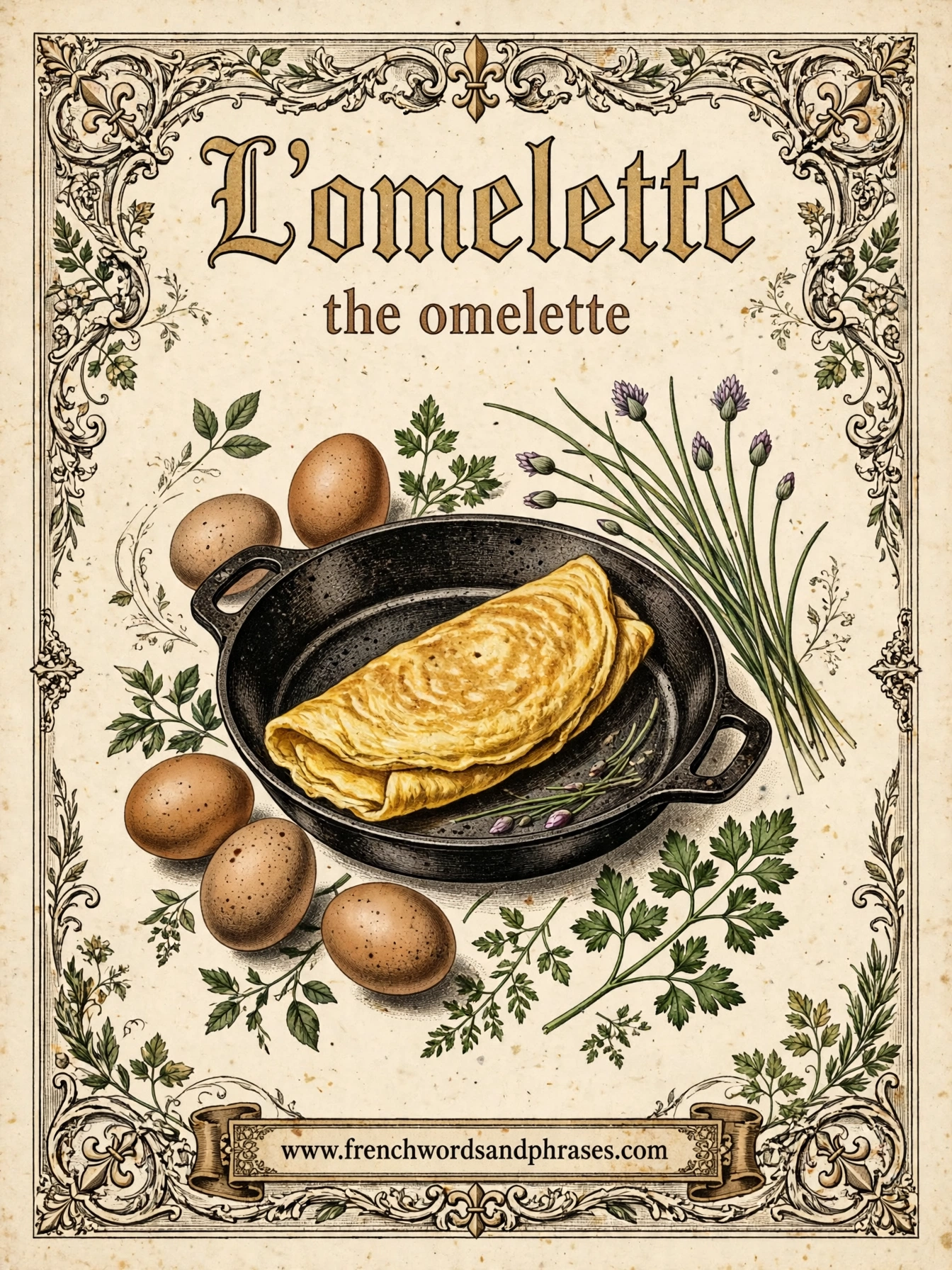
L’omelette means the omelette.
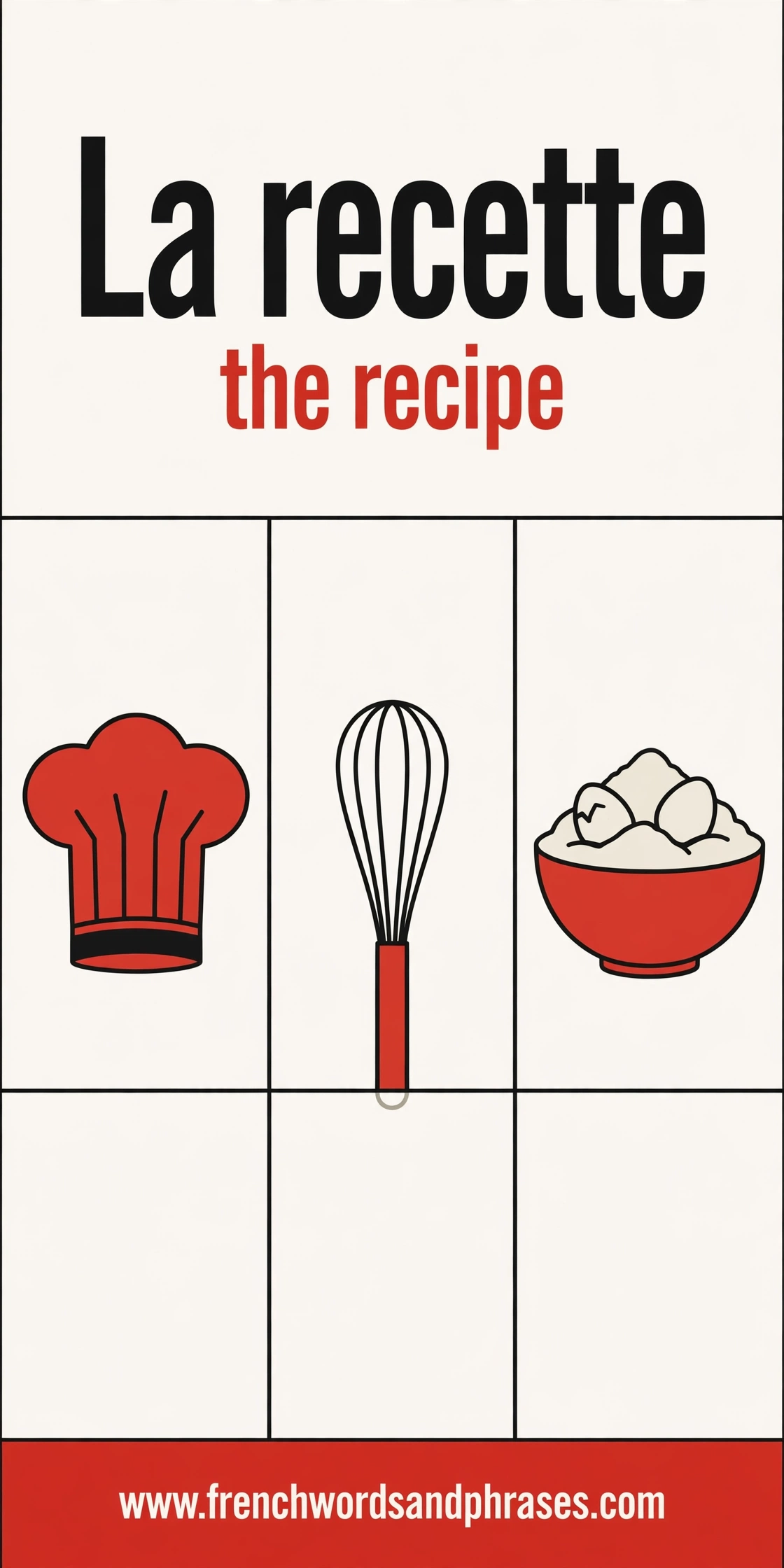
Three eggs crack into the bowl, the whisk flies, the butter foams in the pan — ninety seconds later, golden and trembling: l’omelette.
In this guide, you’ll learn what omelette means in English, how to use it with its articles, how to form its plural, and how it appears in everyday French. Explore French examples, English translations, and practice quizzes.
Understanding the French Noun Omelette
Omelette is a feminine French noun, learned with its article: l’omelette, une omelette. Because it begins with a vowel, le and la shrink to l’ — so listen for the words around it to hear the feminine: une omelette, cette omelette. It ends in -ette, like so many of its sisters on this page.
It means the omelette — beaten eggs, les œufs battus, cooked quickly in a hot pan, folded soft and golden, plain or filled with fromage (cheese), jambon (ham) or champignons (mushrooms). The French like theirs baveuse — still slightly runny in the middle — and argue happily about it.
Gender: Feminine
Definite article: l’ — l’omelette (the omelette)
Indefinite article: une — une omelette (an omelette)
Plural: les omelettes
The French way: baveuse — soft and slightly runny in the middle
English equivalents: The omelette.
One important usage detail: omelette carries France’s most famous cooking proverb — on ne fait pas d’omelette sans casser des œufs, you can’t make an omelette without breaking eggs, said whenever a good result demands a little sacrifice. You will hear it far beyond the kitchen.
Experience the Word
Omelette is more than eggs. It is the fastest honest meal in France — the student’s dinner, the farmer’s lunch, the test by which cooks are judged, because there is nowhere to hide.
Imagine the little bistro at noon: the pan hisses, the omelette slides onto the warm plate still trembling, and the whole table goes quiet for the first forkful.
You have not just cooked eggs. You have performed the classic — l’omelette, three eggs and a hundred years of argument.
How to Use Omelette in French: Complete Guide
Let’s explore how omelette works in French, beginning with its articles — l’omelette, une omelette.
Omelette with the Definite Article (L’, Les)
Omelette begins with a vowel, so la shrinks to l’ — the feminine shows itself in une and cette instead.
| Form | French |
|---|---|
| Feminine singular | l’omelette |
| Plural | les omelettes |
Example
L’omelette est sur la table, encore chaude et dorée.
The omelette is on the table, still warm and golden.
Omelette with the Indefinite Article (Une, Des)
Used for an omelette in general — the one you order without thinking twice.
| Form | French |
|---|---|
| Feminine singular | une omelette |
| Plural | des omelettes |
Example
Pour déjeuner, je prends une omelette au fromage et une salade.
For lunch, I’m having a cheese omelette and a salad.
In the Kitchen: Words of the Omelette
Eggs, pans and butter — the vocabulary of the omelette.
| French | In English |
|---|---|
| l’œuf | the egg |
| la poêle | the frying pan |
| le beurre | butter |
| battre les œufs | to beat the eggs |
| le fromage | cheese |
| plier | to fold |
Example
Elle bat les œufs puis verse tout dans la poêle chaude.
She beats the eggs, then pours everything into the hot pan.
Quick Quiz 1
How do the French like their omelette — baveuse?
Reveal the answer
Soft and slightly runny in the middle.
Je voudrais mon omelette bien baveuse, s’il vous plaît.
I would like my omelette nice and runny, please.
The Plural of Omelette
Omelette adds an -s in the plural — les omelettes, one for everyone at the table.
| Number | French |
|---|---|
| Singular | l’omelette |
| Plural | les omelettes |
Example
Les omelettes arrivent toutes ensemble, dorées et fumantes.
The omelettes all arrive together, golden and steaming.
Omelette with Possessive Adjectives (Mon, Ton, Son…)
A vowel rule: omelette is feminine, but because it begins with a vowel it takes mon, ton, son — mon omelette, never « ma omelette ».
| Owner | French |
|---|---|
| my | mon omelette |
| your (tu) | ton omelette |
| his / her | son omelette |
| our | notre omelette |
| your (vous) | votre omelette |
| their | leur omelette |
Example
Mon omelette est aux champignons, la tienne est au jambon.
My omelette is mushroom; yours is ham.
Quick Quiz 2
Complete the sentence:
______ omelette est prête, à table ! (Your, tu form)
Reveal the answer
Ton
Ton omelette est prête, à table !
Your omelette is ready — dinner! Ton, not ta, because omelette begins with a vowel.
Omelette with Demonstrative Adjectives (Cette, Ces)
Used to point: cette omelette, the perfect one leaving the kitchen.
| Form | French |
|---|---|
| Feminine singular | cette omelette |
| Plural | ces omelettes |
Example
Cette omelette est un modèle du genre, dorée et baveuse.
This omelette is a model of its kind, golden and soft.
Omelette with Adjectives
Adjectives agree with the feminine noun: doré becomes dorée, parfait becomes parfaite.
| Adjective | With Omelette |
|---|---|
| doré (golden) | une omelette dorée |
| baveux (runny, soft) | une omelette baveuse |
| parfait (perfect) | une omelette parfaite |
| légère (light) | une omelette légère |
| raté (failed, spoiled) | une omelette ratée |
Example
Une omelette parfaite doit rester légèrement baveuse.
A perfect omelette should stay slightly runny.
Quick Quiz 3
Complete the sentence:
Cette omelette est vraiment ______. (perfect)
Reveal the answer
parfaite
Cette omelette est vraiment parfaite.
This omelette is really perfect — parfaite, the feminine of parfait.
Everyday Expressions with Omelette
Orders, fillings and the famous proverb — the omelette phrases of daily life.
| Expression | In English |
|---|---|
| une omelette au fromage | a cheese omelette |
| une omelette nature | a plain omelette |
| faire une omelette | to make an omelette |
| battre les œufs | to beat the eggs |
| on ne fait pas d’omelette sans casser des œufs | you can’t make an omelette without breaking eggs |
| l’omelette norvégienne | baked Alaska (the flaming dessert) |
Example
Pour finir le repas en spectacle, ils servent une omelette norvégienne flambée.
To finish the meal with a show, they serve a flaming baked Alaska.
Words from the Same Family as Omelette
Eggs, cooking and pans — the words that travel with omelette.
| French | In English |
|---|---|
| l’œuf | the egg |
| œuf sur le plat | a fried egg |
| œuf à la coque | a soft-boiled egg |
| cuisiner | to cook |
| la cuisson | the cooking |
| le fouet | the whisk |
Example
Avec le fouet, il bat les œufs pour l’omelette du soir.
With the whisk, he beats the eggs for the evening omelette.
Quick Quiz 4
What does the proverb « On ne fait pas d’omelette sans casser des œufs » mean?
Reveal the answer
You can’t get a result without some sacrifice — nothing worthwhile comes entirely free.
Le patron répète le proverbe avant chaque grand changement.
The boss repeats the proverb before every big change.
Omelette in Everyday French: Real-Life Examples
Now that you know the word, let’s see how omelette appears in everyday French.
Example 1 — Ordering
Une omelette au jambon et une salade verte, s’il vous plaît.
A ham omelette and a green salad, please.
Example 2 — Cooking fast
Pas le temps de cuisiner : je fais une omelette.
No time to cook properly: I’ll make an omelette.
Example 3 — A preference
Je préfère mon omelette baveuse, pas trop cuite.
I prefer my omelette runny, not overcooked.
Example 4 — Students
Les étudiants vivent d’omelettes et de pâtes.
Students live on omelettes and pasta.
Example 5 — A compliment
Ton omelette est dorée comme celle des grands chefs.
Your omelette is golden like the great chefs’.
Example 6 — The proverb
On ne fait pas d’omelette sans casser des œufs, dit-elle en riant.
You can’t make an omelette without breaking eggs, she says, laughing.
Beyond Translation: The Meaning of Omelette
France takes the omelette seriously enough to build legends on it: at Mont-Saint-Michel, the omelette de la Mère Poulard — beaten to a foam and cooked over a wood fire — has drawn pilgrims since 1888, and the recipe remains a guarded secret. The word itself wandered through French history, from alemette to omelette, while the dish stayed the same: eggs, butter, fire, ninety seconds. And its proverb escaped the kitchen entirely — politicians and bosses quote the broken eggs whenever change gets expensive.
To say omelette is to name the dish France judges its cooks by.
It evokes the hissing pan and the trembling fold, the bistro at noon, and a proverb that excuses a thousand necessary breakages.
How to Remember the French Noun Omelette
Remember it this way: Omelette is the omelette — feminine behind its l’: l’omelette, une omelette, and mon omelette because of the vowel.
- You see the dish — l’omelette, dorée, baveuse, pliée.
- You mind the vowel — mon omelette, pas ma omelette.
- You quote the proverb — pas d’omelette sans casser des œufs.
The key idea is l’omelette — feminine, hiding behind its l’.
Test Your Knowledge of Omelette
Let’s see how much you’ve learned. Try answering these questions before revealing the answers.
Question 1
Is omelette masculine or feminine?
Reveal the answer
Feminine — une omelette, cette omelette; the l’ hides it in l’omelette.
Question 2
Why do we say mon omelette and not ma omelette?
Reveal the answer
Because omelette begins with a vowel — feminine nouns starting with a vowel take mon, ton, son.
Question 3
Translate: I would like a cheese omelette.
Reveal the answer
Je voudrais une omelette au fromage.
Question 4
What does baveuse mean for an omelette?
Reveal the answer
Soft and slightly runny in the middle — just as the French like it.
Question 5
Complete the sentence:
Elle verse les œufs battus dans ______ poêle chaude.
Reveal the answer
la
Elle verse les œufs battus dans la poêle chaude.
She pours the beaten eggs into the hot pan.
Your Final Challenge
Can You Use It?
How would you say this in French?
“He makes a cheese omelette for lunch.”
Reveal the answer
Il fait une omelette au fromage pour le déjeuner.
He makes a cheese omelette for lunch.
A little French. A little curiosity. A richer everyday life.
LEARN FRENCH ONE WORD AT A TIME