A French Word to Live By
Translate Assiette to English
/a.sjɛt/
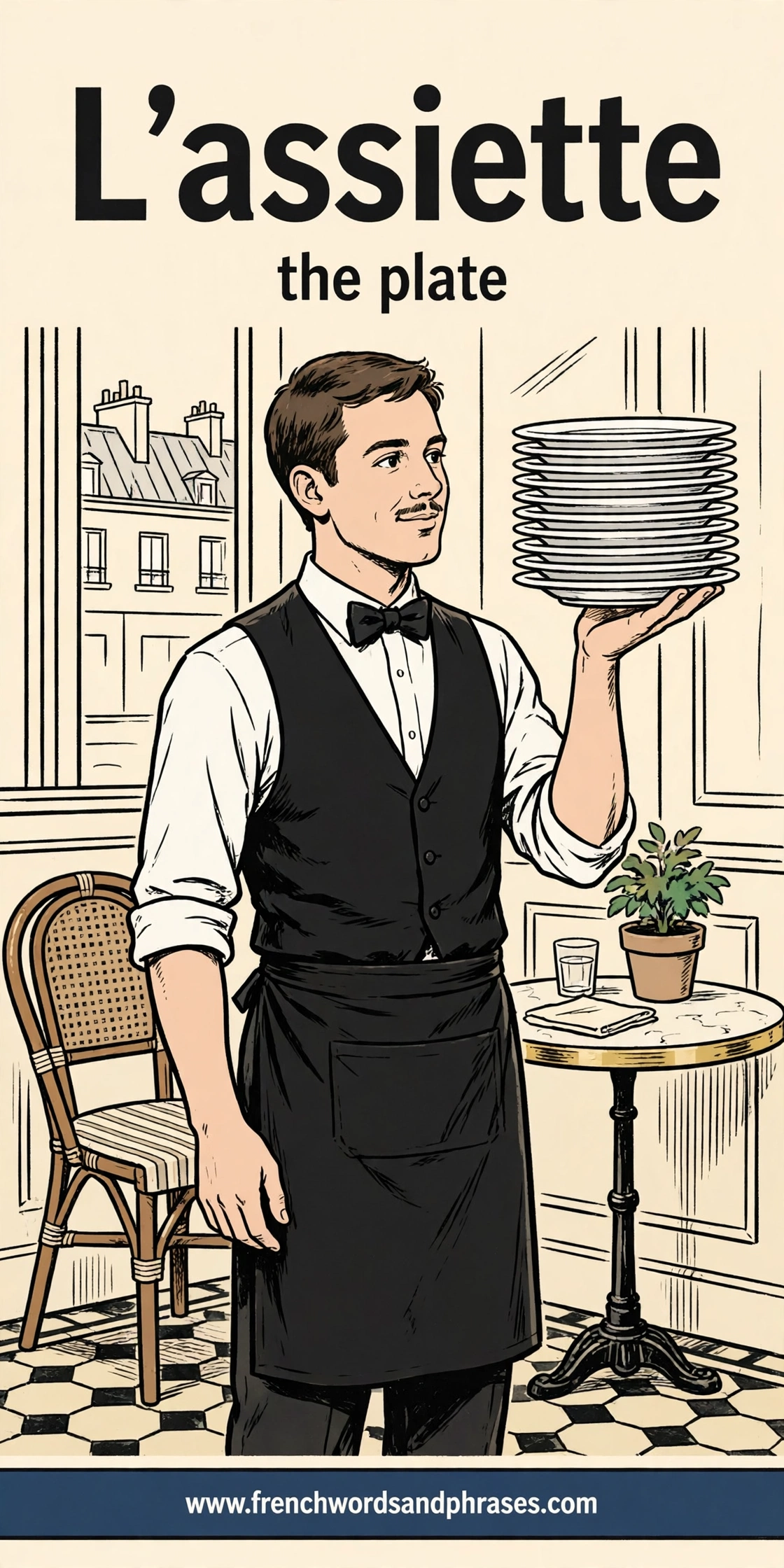
L’assiette means the plate.
Sunday lunch, the table is dressed like a small ceremony — glasses catching the light, bread in its basket — and at every place, waiting for the roast, a clean white assiette.
In this guide, you’ll learn what assiette means in English, how to use it with its articles, how to form its plural, and how it appears in everyday French. Explore French examples, English translations, and practice quizzes.
Understanding the French Noun Assiette
Assiette is a feminine French noun. It begins with a vowel, so the article shrinks: l’assiette — but one plate is une assiette, and the plural is les assiettes. Like allumette, it belongs to the feminine -ette family.
It means the plate — the dish your food arrives on. French tables distinguish their assiettes carefully: l’assiette plate is the flat dinner plate, l’assiette creuse the deep soup plate, and l’assiette à dessert the small one that ends the meal. By extension, l’assiette is also what is on it: a generous assiette of charcuterie is a plateful. And in the famous expression ne pas être dans son assiette, it has nothing to do with food at all — it means to feel out of sorts, not quite yourself.
Gender: Feminine
Definite article: l’ — l’assiette (the plate)
Indefinite article: une — une assiette (a plate)
Partitive article: de l’ — une assiette de soupe, a plate of soup
Plural: les assiettes
English equivalents: The plate; a plateful.
One important usage detail: the assiette is what you eat from; the cooked food served on it is le plat — which is also, confusingly, a large serving dish. And remember the expression: je ne suis pas dans mon assiette means « I feel off colour, not myself » — every French learner should keep it ready for a grey morning.
Experience the Word
Assiette is more than a piece of porcelain. In France the plate is a small stage: the food is arranged, the sauce is placed just so, and the empty white circle is treated with the respect of a blank page.
Imagine the great French lunch working through its assiettes: the assiette creuse for the soup, the assiette plate for the roast, the little assiette à fromage, the assiette à dessert — four plates, four acts, one long happy afternoon.
You have not just eaten a meal. You have turned four pages — assiette après assiette, the chapters of a French lunch.
How to Use Assiette in French: Complete Guide
Let’s explore how assiette works in French, beginning with its articles — and remember the hidden feminine: l’assiette, une assiette.
Assiette with the Definite Article (L’, Les)
Assiette begins with a vowel, so la shrinks to l’ — l’assiette, the plate in question.
| Form | French |
|---|---|
| Singular | l’assiette |
| Plural | les assiettes |
Example
L’assiette est chaude, attention aux doigts.
The plate is hot, mind your fingers.
Assiette with the Indefinite Article (Une, Des)
Used for a plate in general — and une reveals that assiette is feminine.
| Form | French |
|---|---|
| Singular | une assiette |
| Plural | des assiettes |
Example
Elle pose une assiette devant chaque invité.
She puts a plate in front of each guest.
Setting the Table: Words around Assiette
Glasses, cutlery and tablecloths — the vocabulary of the assiette’s table.
| French | In English |
|---|---|
| le verre | the glass |
| la fourchette | the fork |
| le couteau | the knife |
| la cuillère | the spoon |
| la nappe | the tablecloth |
| le plat | the dish; the course |
Example
La fourchette est à gauche de l’assiette.
The fork is to the left of the plate.
Quick Quiz 1
Complete the sentence:
Il met ______ assiette sur la table. (a)
Reveal the answer
une
Il met une assiette sur la table.
He puts a plate on the table — une, because assiette is feminine.
The Plural of Assiette
Assiette adds an -s in the plural — les assiettes, a whole dresser of them.
| Number | French |
|---|---|
| Singular | l’assiette |
| Plural | les assiettes |
Example
Les assiettes propres sont dans le buffet.
The clean plates are in the sideboard.
Assiette with Possessive Adjectives (Mon, Ton, Son…)
Assiette is feminine but begins with a vowel, so it takes mon, ton, son — son assiette, his or her plate.
| Owner | French |
|---|---|
| my | mon assiette |
| your (tu) | ton assiette |
| his / her | son assiette |
| our | notre assiette |
| your (vous) | votre assiette |
| their | leur assiette |
Example
L’enfant finit son assiette sans discuter.
The child finishes his plate without arguing.
Quick Quiz 2
Complete the sentence:
______ assiette de soupe est délicieuse. (This)
Reveal the answer
Cette
Cette assiette de soupe est délicieuse.
This plate of soup is delicious — cette, the feminine demonstrative.
Assiette with Demonstrative Adjectives (Cette, Ces)
Used to point: cette assiette, this plate; ces assiettes, these plates.
| Form | French |
|---|---|
| Singular | cette assiette |
| Plural | ces assiettes |
Example
Ces assiettes en porcelaine viennent de Limoges.
These porcelain plates come from Limoges.
Assiette with Adjectives
Adjectives agree with assiette: pleine, creuse and propre take their feminine forms.
| Adjective | With Assiette |
|---|---|
| pleine (full) | une assiette pleine |
| creuse (deep) | une assiette creuse |
| plate (flat) | une assiette plate |
| propre (clean) | une assiette propre |
| vide (empty) | une assiette vide |
Example
Une assiette creuse pour la soupe, une assiette plate pour le rôti.
A deep plate for the soup, a flat plate for the roast.
Quick Quiz 3
What does je ne suis pas dans mon assiette mean?
Reveal the answer
I feel out of sorts, not quite myself — nothing to do with food.
Aujourd’hui, je ne suis pas dans mon assiette.
Today, I don’t feel quite myself.
Everyday Expressions with Assiette
Sunday lunches, soup plates and grey mornings — the assiette phrases of daily life.
| Expression | In English |
|---|---|
| une assiette de soupe | a plate (bowl) of soup |
| une assiette pleine | a full plate |
| vider son assiette | to empty one’s plate, to eat everything |
| mettre les assiettes sur la table | to put the plates on the table |
| une assiette à dessert | a dessert plate |
| ne pas être dans son assiette | to feel out of sorts |
Example
L’enfant vide son assiette et demande du dessert.
The child empties his plate and asks for dessert.
Words from the Same Family as Assiette
Meals, dishes and washing up — the words that travel with assiette.
| French | In English |
|---|---|
| le plat | the dish; the course |
| la vaisselle | the washing-up; the dishes |
| servir | to serve |
| le repas | the meal |
| manger | to eat |
| la fourchette | the fork |
Example
Après le repas, les enfants font la vaisselle.
After the meal, the children do the washing-up.
Quick Quiz 4
Which assiette do you use for soup — plate or creuse?
Reveal the answer
Creuse — the deep one. L’assiette plate is the flat dinner plate.
Une assiette creuse pour la soupe, toujours.
A deep plate for soup, always.
Assiette in Everyday French: Real-Life Examples
Now that you know the word, let’s see how assiette appears in everyday French.
Example 1 — Setting the table
Pose les assiettes sur la nappe blanche.
Put the plates on the white tablecloth.
Example 2 — Serving lunch
Elle sert une assiette pleine au grand-père.
She serves a full plate to grandfather.
Example 3 — A good appetite
Le petit vide son assiette en dix minutes.
The little one empties his plate in ten minutes.
Example 4 — Feeling unwell
Excuse-moi, je ne suis pas dans mon assiette.
Sorry, I don’t feel quite myself.
Example 5 — Soup first
Pour la soupe, prends une assiette creuse.
For the soup, take a deep plate.
Example 6 — Washing up
Les assiettes sales attendent dans l’évier.
The dirty plates are waiting in the sink.
Beyond Translation: The Meaning of Assiette
The assiette is where French civilisation meets the appetite: porcelain from Limoges has covered the world’s great tables for two centuries, and the ritual order of plates — creuse, plate, à dessert — is taught at French family tables like a small liturgy. The word even serves the tax office: l’assiette fiscale is the base on which a tax is calculated, the « plate » the state helps itself from.
To say assiette is to set a place for someone at the table of France.
It evokes Sunday roasts and porcelain dressers, children finishing their assiette to earn dessert, and the honest confession of a grey day: « Je ne suis pas dans mon assiette. »
How to Remember the French Noun Assiette
Remember it this way: Assiette is the plate — feminine, une assiette, hidden behind l’ — flat for the roast, creuse for the soup.
- You set the table — une assiette devant chaque invité.
- You serve the soup — une assiette creuse, the deep one.
- You feel off colour — je ne suis pas dans mon assiette.
The key idea is l’assiette, une assiette — plate for the soup, creuse; flat, plate.
Test Your Knowledge of Assiette
Let’s see how much you’ve learned. Try answering these questions before revealing the answers.
Question 1
Is assiette masculine or feminine?
Reveal the answer
Feminine — une assiette, cette assiette, behind the l’ of the definite article.
Question 2
Translate: She puts a plate on the table.
Reveal the answer
Elle met une assiette sur la table.
Question 3
What is une assiette creuse?
Reveal the answer
A deep plate — the soup plate, as opposed to the flat assiette plate.
Question 4
Why do we say son assiette and not sa assiette?
Reveal the answer
Because assiette begins with a vowel — feminine nouns starting with a vowel take mon, ton, son.
Question 5
Complete the sentence:
Les ______ sont dans le buffet, propres et rangées.
Reveal the answer
assiettes
Les assiettes sont dans le buffet, propres et rangées.
The plates are in the sideboard, clean and put away.
Your Final Challenge
Can You Use It?
How would you say this in French?
“She puts a clean plate in front of each guest.”
Reveal the answer
Elle pose une assiette propre devant chaque invité.
She puts a clean plate in front of each guest.
A little French. A little curiosity. A richer everyday life.
LEARN FRENCH ONE WORD AT A TIME