A French Word to Live By
Translate Poignet to English
/pwa.ɲɛ/
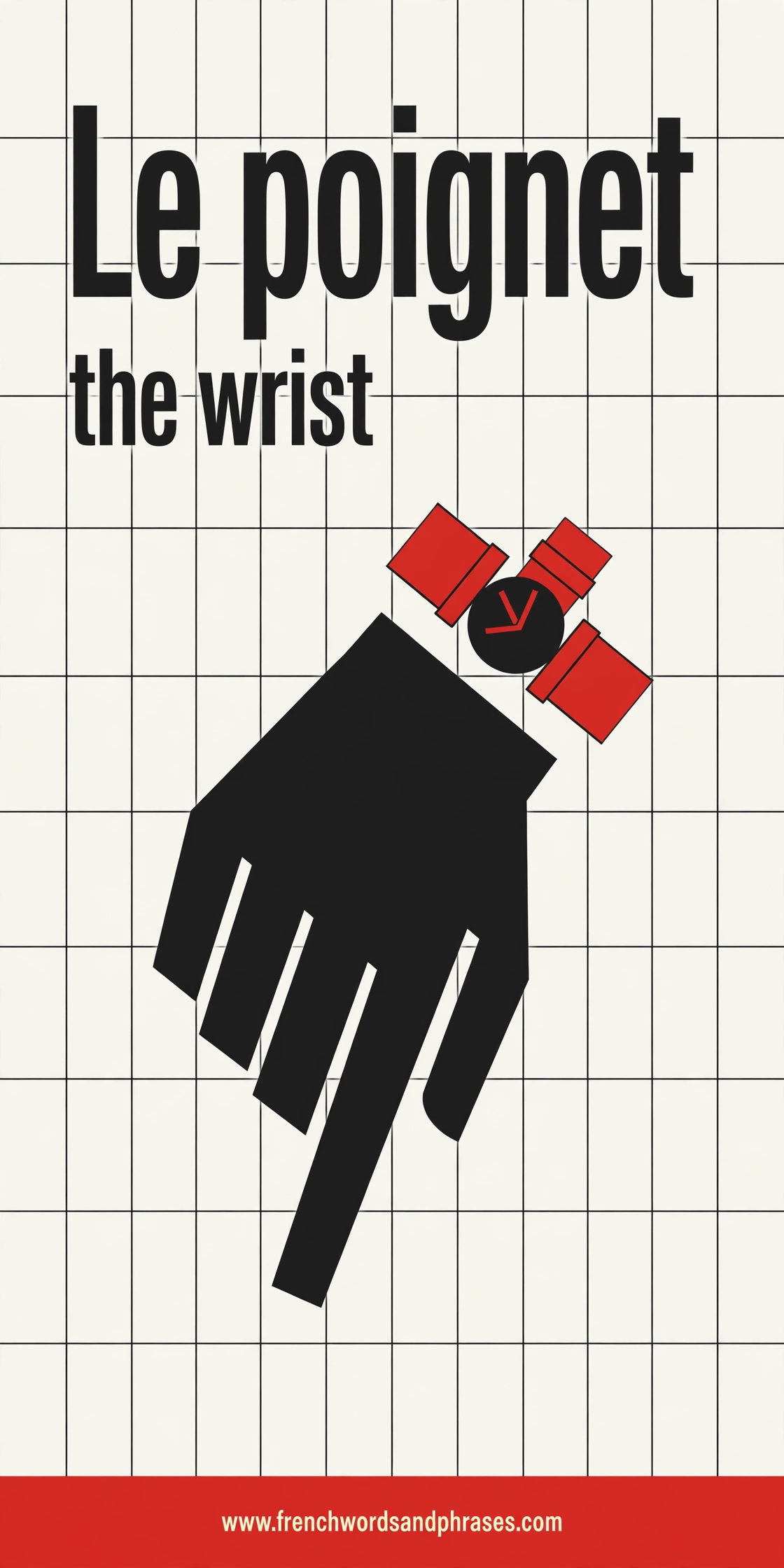
Le poignet means the wrist.
The tennis coach takes the boy’s arm, turns it gently and taps the narrow joint between hand and forearm: « Tout est dans le poignet — everything is in the wrist. »
In this guide, you’ll learn what poignet means in English, how to use it with its articles, how to form its plural, and how it appears in everyday French. Explore French examples, English translations, and practice quizzes.
Understanding the French Noun Poignet
Poignet is a masculine French noun. It is learned together with its article: le poignet, un poignet. It comes from le poing, the fist — the poignet is the joint just behind the fist, and the family resemblance is worth remembering.
It means the wrist — the flexible joint between la main (the hand) and l’avant-bras (the forearm). The poignet wears the watch and the bracelet, bends for tennis, writing and waving, and is famously easy to hurt: se fouler le poignet is to sprain your wrist. On a shirt, the same word names the cuff — le poignet de la chemise — the band of cloth that circles exactly there.
Gender: Masculine
Definite article: le — le poignet (the wrist)
Indefinite article: un — un poignet (a wrist)
Partitive article: du — du poignet is not used; wrists are counted: un poignet, les deux poignets
Plural: les poignets
English equivalents: The wrist; (of a shirt) the cuff.
One important warning: le poignet (masculine) is the wrist, but la poignée (feminine, with an extra syllable) is a handle or a handful — la poignée de la porte, the door handle. One letter changes the body part into hardware, so listen for that final -ée.
Experience the Word
Poignet is more than a joint. It is the hinge of every gesture — the wave, the signature, the serve, the hand offered and the hand shaken all turn on this small, elegant axle.
Imagine the violinist, the watchmaker, the fencer: three trades, one secret, and it lives in the poignet — strength and delicacy balanced in two inches of bone and tendon.
You have not just named a joint. You have named the hinge of the hand — le poignet, where every gesture begins.
How to Use Poignet in French: Complete Guide
Let’s explore how poignet works in French, beginning with its articles — le poignet, un poignet, des poignets.
Poignet with the Definite Article (Le, Les)
Used for the wrist everyone is talking about — the sprained one, the one with the watch.
| Form | French |
|---|---|
| Singular | le poignet |
| Plural | les poignets |
Example
Le poignet relie la main à l’avant-bras.
The wrist connects the hand to the forearm.
Poignet with the Indefinite Article (Un, Des)
Used for a wrist in general — a thin wrist, a sprained wrist.
| Form | French |
|---|---|
| Singular | un poignet |
| Plural | des poignets |
Example
Elle a un poignet fin et délicat.
She has a slim, delicate wrist.
Around the Hand: Words that Travel with Poignet
Hands, fingers and watches — the vocabulary of the poignet’s neighbourhood.
| French | In English |
|---|---|
| la main | the hand |
| le doigt | the finger |
| l’avant-bras | the forearm |
| le coude | the elbow |
| la montre | the watch |
| le bracelet | the bracelet |
Example
Elle porte sa montre au poignet gauche.
She wears her watch on her left wrist.
Quick Quiz 1
Complete the sentence:
Il porte un bracelet ______ poignet droit. (on his)
Reveal the answer
au
Il porte un bracelet au poignet droit.
He wears a bracelet on his right wrist — au poignet, on the wrist.
The Plural of Poignet
Poignet adds an -s in the plural — les poignets, the pair that carries your watch and your bracelet.
| Number | French |
|---|---|
| Singular | le poignet |
| Plural | les poignets |
Example
Ses poignets sont fins comme ceux d’une enfant.
Her wrists are as slim as a child’s.
Poignet with Possessive Adjectives (Mon, Ton, Son…)
Possessives agree with the noun: poignet is masculine, so it takes mon, ton, son.
| Owner | French |
|---|---|
| my | mon poignet |
| your (tu) | ton poignet |
| his / her | son poignet |
| our | notre poignet |
| your (vous) | votre poignet |
| their | leur poignet |
Example
Mon poignet me fait mal après le match.
My wrist hurts after the match.
Quick Quiz 2
Le poignet or la poignée — which one is the door handle?
Reveal the answer
La poignée — feminine, with the extra syllable. Le poignet is your wrist.
Tourne la poignée de la porte.
Turn the door handle.
Poignet with Demonstrative Adjectives (Ce, Ces)
Used to point: ce poignet, this wrist; ces poignets, these wrists.
| Form | French |
|---|---|
| Singular | ce poignet |
| Plural | ces poignets |
Example
Ce poignet foulé doit rester au repos.
This sprained wrist must rest.
Poignet with Adjectives
Adjectives agree with poignet: fin, foulé and fragile take their masculine forms.
| Adjective | With Poignet |
|---|---|
| fin (slim, fine) | un poignet fin |
| foulé (sprained) | un poignet foulé |
| fragile (fragile) | un poignet fragile |
| fort (strong) | un poignet fort |
| douloureux (painful) | un poignet douloureux |
Example
Un poignet foulé fait mal pendant des semaines.
A sprained wrist hurts for weeks.
Quick Quiz 3
Complete the sentence:
Elle s’est foulé ______ en tombant. (the wrist)
Reveal the answer
le poignet
Elle s’est foulé le poignet en tombant.
She sprained her wrist when she fell — se fouler le poignet.
Everyday Expressions with Poignet
Watches, tennis and sprains — the poignet phrases of daily life.
| Expression | In English |
|---|---|
| porter une montre au poignet | to wear a watch on one’s wrist |
| se fouler le poignet | to sprain one’s wrist |
| se casser le poignet | to break one’s wrist |
| un bracelet au poignet | a bracelet on the wrist |
| le poignet de la chemise | the shirt cuff |
| tout est dans le poignet | it’s all in the wrist |
Example
Au tennis, tout est dans le poignet.
In tennis, it’s all in the wrist.
Words from the Same Family as Poignet
Fists, handles and hands — the words that travel with poignet.
| French | In English |
|---|---|
| le poing | the fist |
| la poignée | the handle; a handful |
| empoigner | to grab, to seize by the handle |
| la main | the hand |
| serrer | to grip, to squeeze |
| la manche | the sleeve |
Example
Il serre le poing, puis ouvre la main.
He clenches his fist, then opens his hand.
Quick Quiz 4
What is le poing, the word poignet comes from?
Reveal the answer
The fist — the closed hand, just beyond the wrist.
L’enfant ferme le poing sur la pièce.
The child closes his fist around the coin.
Poignet in Everyday French: Real-Life Examples
Now that you know the word, let’s see how poignet appears in everyday French.
Example 1 — At the tennis club
Tout est dans le poignet, regarde bien.
It’s all in the wrist, watch carefully.
Example 2 — At the doctor’s
Je me suis foulé le poignet en skiant.
I sprained my wrist while skiing.
Example 3 — Getting dressed
Elle porte une montre en or au poignet.
She wears a gold watch on her wrist.
Example 4 — A compliment
Quels poignets fins et élégants !
What slim, elegant wrists!
Example 5 — An accident
Il s’est cassé le poignet en tombant.
He broke his wrist when he fell.
Example 6 — At the tailor’s
Le poignet de la chemise est un peu large.
The shirt cuff is a little loose.
Beyond Translation: The Meaning of Poignet
The French have a saying for every trade where skill hides in a small movement: c’est un coup de poignet — a flick of the wrist. Cooks flip crêpes with it, fencers score with it, and grandmothers judge a handshake by it. The word also dresses you: the poignet of a well-made shirt, closed by a bouton de manchette, was once a whole language of elegance in Paris.
To say poignet is to name the small hinge on which every grand gesture turns.
It evokes tennis courts and violin lessons, watches inherited from grandfathers, and the sprain that every skier’s family knows by heart.
How to Remember the French Noun Poignet
Remember it this way: Poignet is the wrist — masculine, le poignet — and it comes from le poing, the fist just beyond it.
- You wear your watch there — la montre au poignet.
- You hurt it skiing — se fouler le poignet, a sprained wrist.
- You open a door — c’est la poignée, the handle, not the wrist.
The key idea is le poignet — the wrist; la poignée — the handle.
Test Your Knowledge of Poignet
Let’s see how much you’ve learned. Try answering these questions before revealing the answers.
Question 1
Is poignet masculine or feminine?
Reveal the answer
Masculine — le poignet, un poignet.
Question 2
Translate: She wears her watch on her left wrist.
Reveal the answer
Elle porte sa montre au poignet gauche.
Question 3
What does se fouler le poignet mean?
Reveal the answer
To sprain your wrist — the classic skiing and skating accident.
Question 4
What is le poignet de la chemise?
Reveal the answer
The shirt cuff — the band of cloth around the wrist.
Question 5
Complete the sentence:
Mon ______ me fait mal après le match de tennis.
Reveal the answer
poignet
Mon poignet me fait mal après le match de tennis.
My wrist hurts after the tennis match.
Your Final Challenge
Can You Use It?
How would you say this in French?
“He sprained his wrist while skiing.”
Reveal the answer
Il s’est foulé le poignet en skiant.
He sprained his wrist while skiing.
A little French. A little curiosity. A richer everyday life.
LEARN FRENCH ONE WORD AT A TIME