A French Word to Live By
Translate Hoquet to English
/ɔ.kɛ/
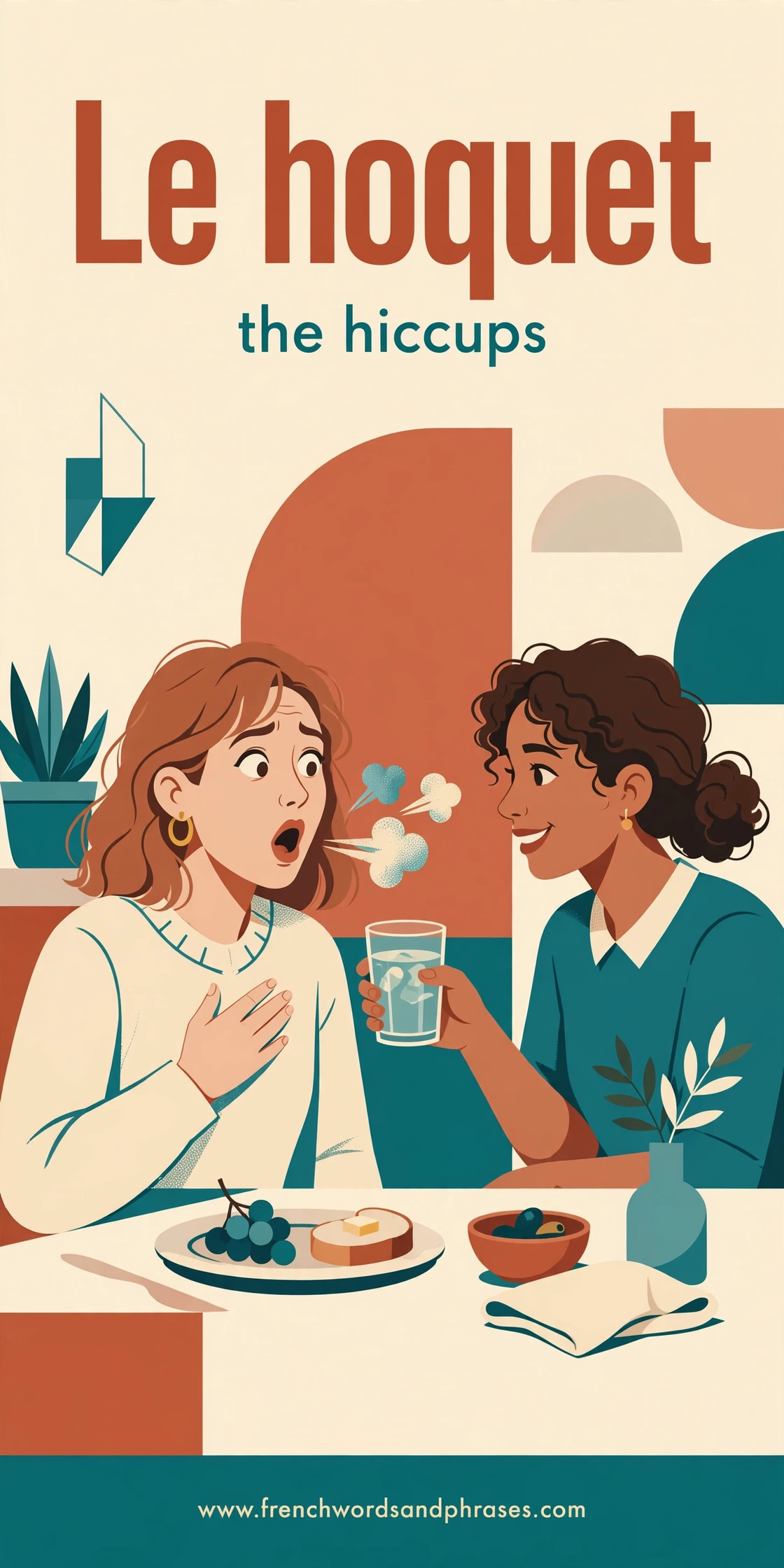
Le hoquet means the hiccups.
The class is silent, the dictation has begun, and from the third row comes a sound nobody can ignore — hic ! All heads turn, the shoulders shake with laughter. Someone has le hoquet.
In this guide, you’ll learn what hoquet means in English, how to use it with its articles, how to form its plural, and how it appears in everyday French. Explore French examples, English translations, and practice quizzes.
Understanding the French Noun Hoquet
Hoquet is a masculine French noun, learned with its article: le hoquet. It is almost always used in the singular, even though English insists on the plural ‘hiccups’: French treats the whole attack as one thing — avoir le hoquet, to have the hiccups. The h is silent, and the word imitates the sound it names.
It means the hiccups — the sudden, repeated little jumps of the diaphragm that follow eating too fast, laughing too hard or drinking something fizzy: une crise de hoquet is a fit of hiccups. French remedies are as inventive as everyone’s: boire un verre d’eau, retenir sa respiration (hold your breath), or the classic — faire peur à quelqu’un, give them a fright.
Gender: Masculine
Definite article: le — le hoquet (the hiccups)
Indefinite article: un — un hoquet (a hiccup, one single jump)
Plural: les hoquets — rare; the attack is usually singular
The phrase: avoir le hoquet — to have the hiccups
English equivalents: The hiccups; une crise de hoquet = a fit of hiccups.
One important usage detail: where English says ‘I have the hiccups’, French says j’ai le hoquet — singular, with le. A single hiccup, counted one by one, is un hoquet: « Tu as entendu ce hoquet ? » And the sound itself is written the way it sounds: hic !
Experience the Word
Hoquet is the body’s smallest comedian: it arrives uninvited, usually at the worst moment — a speech, an exam, a solemn silence — and turns its owner into a metronome of hic ! while the whole room tries not to laugh.
Imagine the wedding toast: the best man rises, glass in hand, opens his mouth — hic ! — and the entire room dissolves, the speech forgotten, the hiccup immortal.
You have not just had the hiccups. You have been interrupted — coupé en plein élan, by your own diaphragm.
How to Use Hoquet in French: Complete Guide
Let’s explore how hoquet works in French, beginning with its articles — le hoquet, singular where English is plural.
Hoquet with the Definite Article (Le, Les)
Used for the attack itself — le hoquet, the hiccups as one single event.
| Form | French |
|---|---|
| Masculine singular | le hoquet |
| Plural | les hoquets (rare) |
Example
Le hoquet l’empêche de finir sa phrase.
The hiccups stop him finishing his sentence.
Hoquet with the Indefinite Article (Un, Des)
Un hoquet counts a single jump — one hiccup on its own.
| Form | French |
|---|---|
| Masculine singular | un hoquet |
| Plural | des hoquets |
Example
Un petit hoquet lui échappe pendant le discours.
A little hiccup escapes him during the speech.
Hiccup Territory: Causes and Cures
Fizzy drinks, laughter and grandmothers’ remedies — the hoquet’s world.
| French | In English |
|---|---|
| avoir le hoquet | to have the hiccups |
| une crise de hoquet | a fit of hiccups |
| retenir sa respiration | to hold your breath |
| boire un verre d’eau | to drink a glass of water |
| faire peur à quelqu’un | to give someone a fright |
| le hoquet s’arrête | the hiccups stop |
Example
Pour arrêter le hoquet, retiens ta respiration et compte jusqu’à dix.
To stop the hiccups, hold your breath and count to ten.
Quick Quiz 1
Complete the sentence:
Depuis le déjeuner, elle a ______ hoquet.
Reveal the answer
le
Depuis le déjeuner, elle a le hoquet.
Since lunch, she has had the hiccups — avoir le hoquet, singular in French where English is plural.
The Plural of Hoquet
The plural exists — les hoquets — but French prefers to keep the whole attack singular: le hoquet.
| Number | French |
|---|---|
| Singular | le hoquet |
| Plural | les hoquets |
Example
Ses hoquets résonnent dans la salle silencieuse.
His hiccups echo in the silent room.
Hoquet with Possessive Adjectives (Mon, Ton, Son…)
Possessives agree with the noun: hoquet is masculine, so it takes mon, ton, son.
| Owner | French |
|---|---|
| my | mon hoquet |
| your (tu) | ton hoquet |
| his / her | son hoquet |
| our | notre hoquet |
| your (vous) | votre hoquet |
| their | leur hoquet |
Example
Mon hoquet a duré dix minutes après le repas.
My hiccups lasted ten minutes after the meal.
Quick Quiz 2
Complete the sentence:
______ hoquet ne passe pas, bois un verre d’eau. (Your)
Reveal the answer
Ton
Ton hoquet ne passe pas, bois un verre d’eau.
Your hiccups won’t stop, drink a glass of water.
Hoquet with Demonstrative Adjectives (Ce, Ces)
Used to point at the attack in progress: ce hoquet, this endless fit.
| Form | French |
|---|---|
| Masculine singular | ce hoquet |
| Plural | ces hoquets |
Example
Ce hoquet commence vraiment à m’énerver.
These hiccups are really starting to annoy me.
Hoquet with Adjectives
Adjectives agree with hoquet: un hoquet interminable, the one that outstays its welcome.
| Adjective | With Hoquet |
|---|---|
| petit (little) | un petit hoquet |
| interminable (endless) | un hoquet interminable |
| premier (first) | le premier hoquet |
| nouveau (new) | un nouveau hoquet |
| gros (big) | un gros hoquet |
Example
Un gros hoquet lui échappe en plein silence.
A big hiccup escapes him in the middle of the silence.
Quick Quiz 3
Complete the sentence:
Elle a un hoquet vraiment ______. (endless)
Reveal the answer
interminable
Elle a un hoquet vraiment interminable.
She has truly endless hiccups — interminable keeps the same form for both genders.
Everyday Expressions with Hoquet
Breath-holding and frights — the hoquet phrases of daily life.
| Expression | In English |
|---|---|
| avoir le hoquet | to have the hiccups |
| le hoquet passe | the hiccups go away |
| donner le hoquet | to give (someone) the hiccups |
| une crise de hoquet | a fit of hiccups |
| arrêter le hoquet | to stop the hiccups |
| hic ! | hic! (the sound itself) |
Example
Boire trop vite lui donne toujours le hoquet.
Drinking too fast always gives him the hiccups.
Words from the Same Family as Hoquet
Breaths and jumps — the hoquet’s small, noisy family.
| French | In English |
|---|---|
| le diaphragme | the diaphragm |
| respirer | to breathe |
| la respiration | breathing, breath |
| sursauter | to jump, to start (with surprise) |
| avaler | to swallow |
| rire | to laugh |
Example
Le hoquet vient du diaphragme, qui se contracte d’un coup.
Hiccups come from the diaphragm, which contracts suddenly.
Quick Quiz 4
What is une crise de hoquet?
Reveal the answer
A fit of hiccups — the whole attack, hiccup after hiccup.
Elle a eu une crise de hoquet pendant le film.
She had a fit of hiccups during the film.
Hoquet in Everyday French: Real-Life Examples
Now that you know the word, let’s see how hoquet appears in everyday French.
Example 1 — At the table
Mange plus lentement, sinon tu vas avoir le hoquet.
Eat more slowly, or you’ll get the hiccups.
Example 2 — In class
Son hoquet fait rire toute la classe pendant la dictée.
His hiccups make the whole class laugh during the dictation.
Example 3 — A remedy
Bois un verre d’eau à l’envers, ça arrête le hoquet.
Drink a glass of water upside down, it stops the hiccups.
Example 4 — A fright
Bouh ! Je t’ai fait peur, ton hoquet est parti ?
Boo! I gave you a fright, have your hiccups gone?
Example 5 — At the doctor’s
Un hoquet qui dure plus de deux jours doit être examiné.
Hiccups lasting more than two days should be examined.
Example 6 — Relief
Enfin, le hoquet s’est arrêté tout seul.
At last, the hiccups stopped on their own.
Beyond Translation: The Meaning of Hoquet
Every language gives the hiccup a name that sounds like the thing itself, and French is no exception: hoquet is a little imitation, a written hiccup. The word has inspired centuries of remedies, from the glass of water drunk upside down to the sudden fright administered by a helpful friend — and one piece of folklore says that when you have the hoquet, someone, somewhere, is thinking of you. The longest recorded attack lasted decades; most of ours last the length of a laugh.
To say hoquet is to hear the hiccup itself — hic ! — dressed as a word.
It evokes school dictations and wedding toasts, held breaths and glasses of water, and the helpless laughter of everyone who is not, for once, the one hiccuping.
How to Remember the French Noun Hoquet
Remember it this way: Hoquet is the hiccups — masculine and singular in French, so you say avoir le hoquet where English counts them in the plural.
- You have them — j’ai le hoquet, au singulier.
- You cure them — retenir sa respiration, boire un verre d’eau.
- You hear them — hic !, le mot imite le son.
The key idea is le hoquet — avoir le hoquet, to have the hiccups.
Test Your Knowledge of Hoquet
Let’s see how much you’ve learned. Try answering these questions before revealing the answers.
Question 1
Is hoquet masculine or feminine?
Reveal the answer
Masculine — le hoquet, un hoquet.
Question 2
How do you say I have the hiccups in French?
Reveal the answer
J’ai le hoquet — singular in French, where English uses the plural.
Question 3
Translate: Her hiccups lasted ten minutes.
Reveal the answer
Son hoquet a duré dix minutes.
Question 4
What is retenir sa respiration, the classic remedy?
Reveal the answer
To hold your breath — one of the grandmothers’ cures for le hoquet.
Question 5
Complete the sentence:
Il boit trop vite et attrape ______ hoquet.
Reveal the answer
le
Il boit trop vite et attrape le hoquet.
He drinks too fast and gets the hiccups.
Your Final Challenge
Can You Use It?
How would you say this in French?
“The child has the hiccups after lunch.”
Reveal the answer
L’enfant a le hoquet après le déjeuner.
The child has the hiccups after lunch.
A little French. A little curiosity. A richer everyday life.
LEARN FRENCH ONE WORD AT A TIME