A French Word to Live By
Translate Pâtes to English
/pɑt/
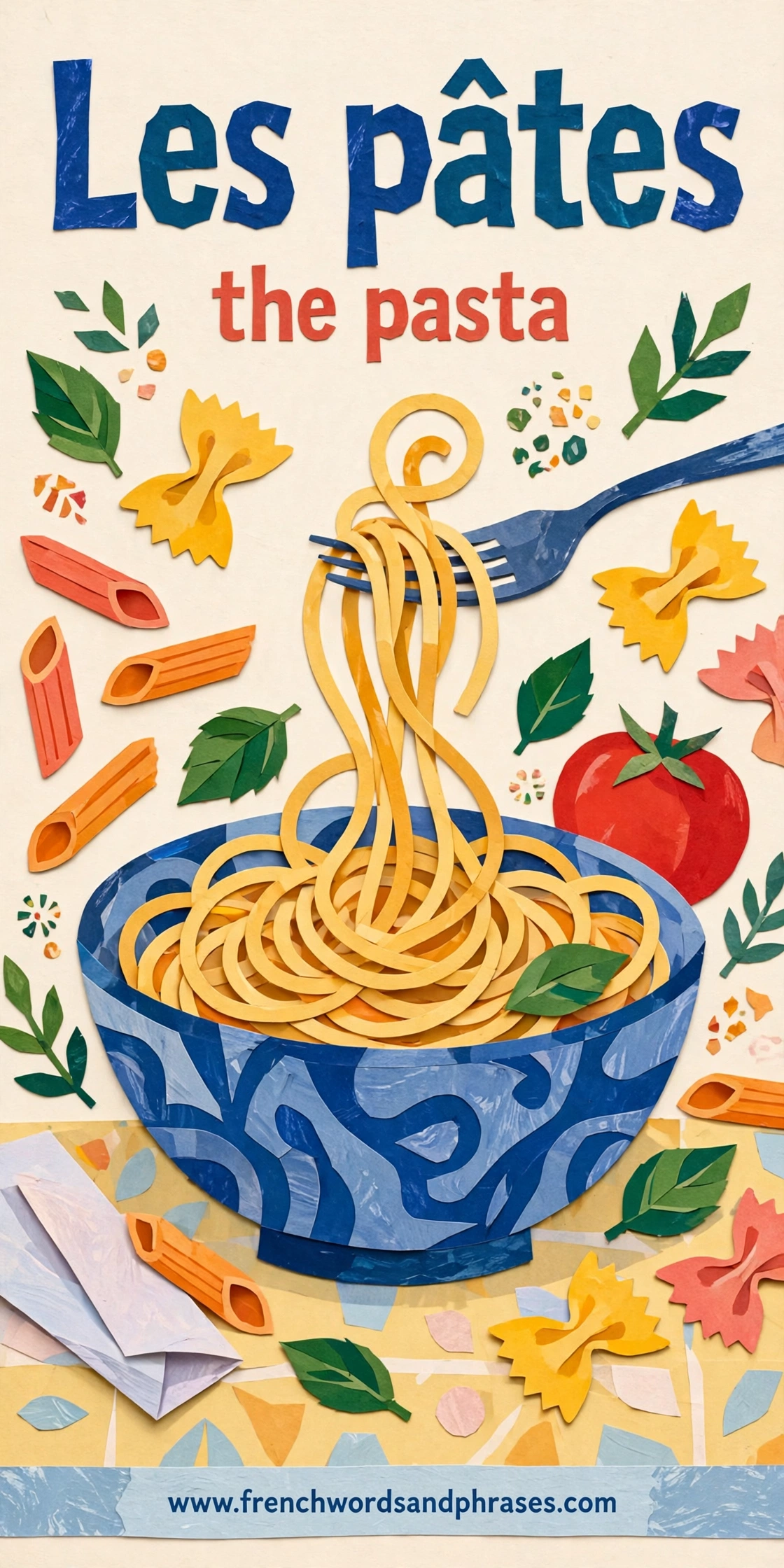
Les pâtes means the pasta.
The big pot is boiling, the whole kitchen smells of garlic and tomatoes, and the children are already at the table with their forks ready. Tonight it is the dish nobody ever refuses — les pâtes.
In this guide, you’ll learn what pâtes means in English, how to use it with its articles, how to form its plural, and how it appears in everyday French. Explore French examples, English translations, and practice quizzes.
Understanding the French Noun Pâtes
Pâtes is a feminine French noun that lives in the plural: les pâtes, des pâtes. In the singular, une pâte exists but means something else — a dough or a paste, the raw mixture before cooking. For the pasta on your plate, French always uses the plural.
It means the pasta — spaghetti, penne, coquillettes and all their cousins, the weeknight hero of French family cooking just as much as Italian. France eats pâtes with everything: les pâtes au beurre (butter pasta, the children’s classic), les pâtes à la sauce tomate, les pâtes au fromage, and the student legend, les pâtes au ketchup.
Gender: Feminine — and used in the plural for this meaning
Definite article: les — les pâtes (the pasta)
Indefinite article: des — des pâtes (some pasta, pasta)
Singular: une pâte — a dough, a paste (a different meaning)
Plural: les pâtes — always plural for the dish
English equivalents: The pasta.
One important usage detail: for pasta the dish, stay in the plural — les pâtes sont prêtes, with a plural verb and a feminine plural adjective. The singular une pâte is the baker’s dough or a spreadable paste: la pâte à tarte (pastry), la pâte à tartiner (chocolate spread). Same word, two worlds — number tells them apart.
Experience the Word
Pâtes is more than a dish. It is the rescue dinner of every French family — the plate that ends arguments, feeds unexpected friends, and tastes of childhood: les coquillettes au beurre of a thousand school-night suppers.
Imagine the steaming bowl in the middle of the table: everyone serving themselves, the grated cheese going round, and the sauce argued over like a matter of state.
You have not just cooked pasta. You have made everyone happy — les pâtes, the great peace treaty of the kitchen.
How to Use Pâtes in French: Complete Guide
Let’s explore how pâtes works in French, beginning with its articles — always plural: les pâtes, des pâtes.
Pâtes with the Definite Article (Les)
Pasta the dish is always plural, so the definite article is always les.
| Form | French |
|---|---|
| Feminine plural | les pâtes |
| Singular (a different meaning) | la pâte — the dough, the paste |
Example
Les pâtes sont prêtes, à table !
The pasta is ready — dinner’s served!
Pâtes with the Indefinite Article (Des)
Des pâtes covers both « some pasta » and pasta in general — the everyday way to order it.
| Form | French |
|---|---|
| Feminine plural | des pâtes |
| Singular (a different meaning) | une pâte — a dough, a paste |
Example
Ce soir, nous mangeons des pâtes à la tomate.
This evening, we are eating pasta with tomato sauce.
Pâtes with Quantities (De)
After quantities, des becomes de — un paquet de pâtes, a packet of pasta.
| Form | French |
|---|---|
| A packet of pasta | un paquet de pâtes |
| A plate of pasta | une assiette de pâtes |
| A lot of pasta | beaucoup de pâtes |
Example
Il achète deux paquets de pâtes au supermarché.
He is buying two packets of pasta at the supermarket.
Quick Quiz 1
Complete the sentence:
______ pâtes sont sur la table. (The)
Reveal the answer
Les
Les pâtes sont sur la table.
The pasta is on the table — les, because pâtes is plural.
The Plural of Pâtes
There is no journey to make: pâtes is born plural for this meaning, and its singular means dough.
| Number | French |
|---|---|
| Plural (the dish) | les pâtes |
| Singular (the raw mixture) | la pâte — dough, paste |
Example
Elle prépare la pâte le matin et fait des pâtes le soir.
She prepares the dough in the morning and makes pasta in the evening.
Pâtes with Possessive Adjectives (Mes, Tes, Ses…)
Possessives agree with the noun: pâtes is feminine plural, so it takes mes, tes, ses.
| Owner | French |
|---|---|
| my | mes pâtes |
| your (tu) | tes pâtes |
| his / her | ses pâtes |
| our | nos pâtes |
| your (vous) | vos pâtes |
| their | leurs pâtes |
Example
Mes pâtes préférées sont les coquillettes au beurre.
My favourite pasta is little shells with butter.
Quick Quiz 2
Complete the sentence:
Il finit ______ pâtes en cinq minutes. (his)
Reveal the answer
ses
Il finit ses pâtes en cinq minutes.
He finishes his pasta in five minutes.
Pâtes with Demonstrative Adjectives (Ces)
Used to point: ces pâtes, this pasta — the bowl in front of you.
| Form | French |
|---|---|
| Feminine plural | ces pâtes |
| Singular (a different meaning) | cette pâte — this dough, this paste |
Example
Ces pâtes sont délicieuses, quelle est la sauce ?
This pasta is delicious; what is the sauce?
Pâtes with Adjectives
Adjectives agree with pâtes — feminine plural, so they end in -es: fraîches, chaudes, excellentes.
| Adjective | With Pâtes |
|---|---|
| frais (fresh) | des pâtes fraîches |
| chaud (hot) | des pâtes chaudes |
| excellent (excellent) | des pâtes excellentes |
| complet (wholewheat) | des pâtes complètes |
| fait maison (home-made) | des pâtes faites maison |
Example
Les pâtes fraîches de ce restaurant sont excellentes.
The fresh pasta at this restaurant is excellent.
Quick Quiz 3
Complete the sentence:
Les pâtes sont ______ et délicieuses. (hot, feminine plural)
Reveal the answer
chaudes
Les pâtes sont chaudes et délicieuses.
The pasta is hot and delicious — chaudes, feminine plural.
Everyday Expressions with Pâtes
Butter, tomato and cheese — the pâtes phrases of daily life.
| Expression | In English |
|---|---|
| les pâtes au beurre | pasta with butter |
| les pâtes à la sauce tomate | pasta with tomato sauce |
| des pâtes fraîches | fresh pasta |
| faire cuire les pâtes | to cook the pasta |
| les pâtes sont prêtes | the pasta is ready |
| un plat de pâtes | a pasta dish, a bowl of pasta |
Example
Les enfants demandent des pâtes au beurre tous les mercredis.
The children ask for butter pasta every Wednesday.
Words from the Same Family as Pâtes
Doughs, pastries and spreads — the words that travel with pâtes.
| French | In English |
|---|---|
| la pâte | the dough, the paste |
| la pâte feuilletée | puff pastry |
| la pâte à tartiner | chocolate spread |
| les nouilles | noodles |
| le spaghetti | spaghetti (one strand or the dish, masculine) |
| la farine | the flour |
Example
La pâte feuilletée sert à faire des croissants.
Puff pastry is used to make croissants.
Quick Quiz 4
What does la pâte mean in the singular?
Reveal the answer
Dough, or a paste — the raw mixture, not the cooked dish.
La pâte à tarte est prête pour la quiche.
The pastry dough is ready for the quiche.
Pâtes in Everyday French: Real-Life Examples
Now that you know the word, let’s see how pâtes appears in everyday French.
Example 1 — At the table
Les pâtes sont prêtes, tout le monde à table !
The pasta is ready — everyone to the table!
Example 2 — Cooking
Elle fait cuire les pâtes dans une grande casserole.
She is cooking the pasta in a big pot.
Example 3 — Talking about tastes
Mes pâtes préférées sont les pâtes au fromage.
My favourite pasta is pasta with cheese.
Example 4 — At the shop
Nous n’avons plus de pâtes, j’en achète ce soir.
We have no pasta left; I’ll buy some this evening.
Example 5 — A children’s dinner
Les coquillettes au beurre, c’est le plat des enfants.
Little shells with butter — that’s the children’s dish.
Example 6 — Leftovers
Il reste des pâtes d’hier dans le réfrigérateur.
There is some of yesterday’s pasta left in the fridge.
Beyond Translation: The Meaning of Pâtes
Pasta may be Italy’s glory, but France adopted it so completely that les pâtes are now the country’s most-cooked home dish — the coquillette is practically a French citizen. Every family has its rules: butter first or cheese first, sauce mixed in the pot or on the plate, and the eternal debate about whether to break the spaghetti. Students live on them, children grow up on them, and grandparents secretly love them.
To say pâtes is to name the dish that never lets a French family down.
It evokes the steaming shared bowl and the grated cheese going round — simple, generous, and always plural, like the people around the table.
How to Remember the French Noun Pâtes
Remember it this way: Pâtes is the pasta — feminine and always plural for the dish; the singular, une pâte, is dough or paste.
- You serve the dish — les pâtes sont prêtes, des pâtes au beurre.
- You agree in the plural — des pâtes chaudes, mes pâtes préférées.
- You keep the singular apart — la pâte is the dough, not dinner.
The key idea is les pâtes — always plural for pasta.
Test Your Knowledge of Pâtes
Let’s see how much you’ve learned. Try answering these questions before revealing the answers.
Question 1
Why do we say les pâtes and not la pâte for pasta?
Reveal the answer
Because the dish is always plural in French — la pâte in the singular means dough or paste.
Question 2
Complete: Les pâtes ______ prêtes.
Reveal the answer
sont
Les pâtes sont prêtes.
The pasta is ready — plural verb, feminine plural adjective.
Question 3
Translate: We are eating pasta this evening.
Reveal the answer
Nous mangeons des pâtes ce soir.
Question 4
What is la pâte à tartiner?
Reveal the answer
Chocolate spread — literally, the paste for spreading.
Question 5
Complete the sentence:
Je voudrais ______ avec de la sauce tomate. (some pasta)
Reveal the answer
des pâtes
Je voudrais des pâtes avec de la sauce tomate.
I would like some pasta with tomato sauce.
Your Final Challenge
Can You Use It?
How would you say this in French?
“The pasta is ready, everyone to the table.”
Reveal the answer
Les pâtes sont prêtes, tout le monde à table.
The pasta is ready, everyone to the table.
A little French. A little curiosity. A richer everyday life.
LEARN FRENCH ONE WORD AT A TIME