A French Word to Live By
Translate Poulet to English
/pu.lɛ/
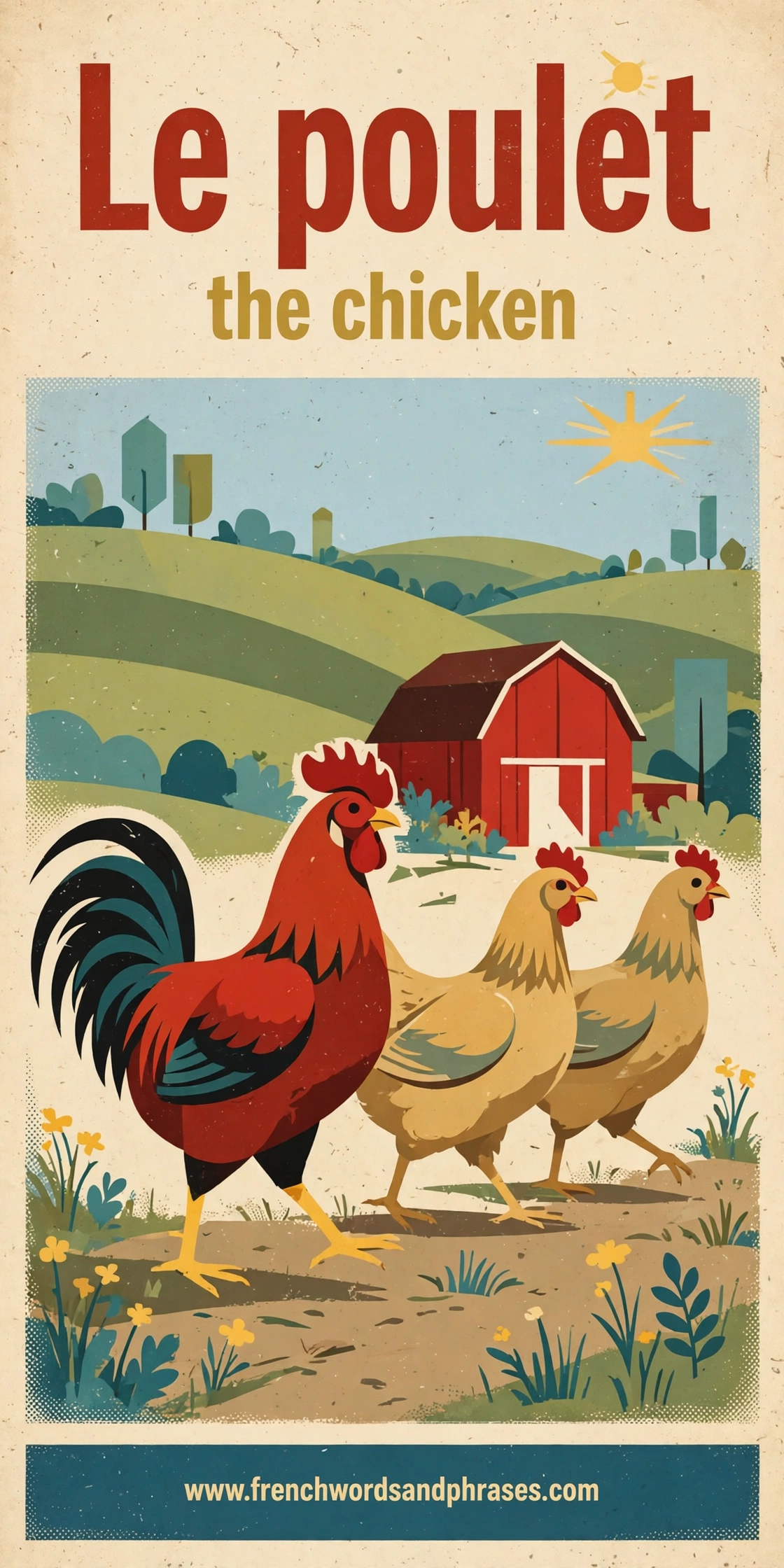
Le poulet means the chicken.
Sunday at the market, and the longest queue is at the rôtisserie, where golden birds turn slowly behind the glass and the smell of roasting herbs fills the street. Everyone is waiting for the same thing — le poulet du dimanche.
In this guide, you’ll learn what poulet means in English, how to use it with its articles, how to form its plural, and how it appears in everyday French. Explore French examples, English translations, and practice quizzes.
Understanding the French Noun Poulet
Poulet is a masculine French noun, learned with its article: le poulet, un poulet. One word covers the living bird and the meat on your plate: English separates « chicken » the animal from « chicken » the food far less than it separates hen and rooster — in French, la poule is the hen and le coq is the rooster, while le poulet is the young chicken, and the dish.
It means the chicken — the bird raised on every farm, and its meat, the most everyday of French dishes: le poulet rôti (roast chicken), le poulet fermier (free-range chicken), un blanc de poulet (a chicken breast). The Sunday poulet rôti, bought hot from the market rôtisserie with its little bag of potatoes cooked in the juices, is a French institution.
Gender: Masculine
Definite article: le — le poulet (the chicken)
Indefinite article: un — un poulet (a chicken)
Partitive: du poulet — some chicken (the meat)
Plural: les poulets
English equivalents: The chicken.
One important usage detail: the farmyard family splits by age and sex — le coq is the rooster, la poule is the hen, and le poulet is the young bird and the meat. At the table, ask for du poulet (some chicken); at the market, buy un poulet entier (a whole chicken).
Experience the Word
Poulet is more than a dish. It is Sunday itself — the family around the table, the crispy golden skin fought over politely, the potatoes roasted underneath in the juices.
Imagine the market rôtisserie: the birds turning in rows, the queue chatting, and your poulet wrapped in paper, still steaming as you carry it home for lunch.
You have not just bought lunch. You have kept the Sunday ritual — le poulet rôti, the roast of the family.
How to Use Poulet in French: Complete Guide
Let’s explore how poulet works in French, beginning with its articles — un poulet at the market, du poulet at the table.
Poulet with the Definite Article (Le, Les)
Used for the chicken everyone means — the one roasting, the one in the yard.
| Form | French |
|---|---|
| Masculine singular | le poulet |
| Plural | les poulets |
Example
Le poulet rôti est prêt pour dimanche midi.
The roast chicken is ready for Sunday lunch.
Poulet with the Indefinite Article (Un, Des)
Un poulet is one whole bird — the unit of the market stall.
| Form | French |
|---|---|
| Masculine singular | un poulet |
| Plural | des poulets |
Example
Elle achète un poulet fermier au marché.
She is buying a free-range chicken at the market.
Poulet with the Partitive Article (Du)
For chicken as meat on the plate — some chicken — French uses du poulet.
| Form | French |
|---|---|
| Some chicken | du poulet |
| No chicken (after a negative) | pas de poulet |
| A little chicken | un peu de poulet |
Example
Les enfants mangent du poulet avec des frites.
The children are eating chicken with chips.
Quick Quiz 1
At the table, you want some chicken. Complete the sentence:
Je prends ______, merci.
Reveal the answer
du poulet
Je prends du poulet, merci.
I’ll have some chicken, thanks — du, the partitive, for the meat.
The Plural of Poulet
Poulet adds an -s in the plural — les poulets, the birds of the farmyard.
| Number | French |
|---|---|
| Singular | le poulet / un poulet |
| Plural | les poulets / des poulets |
Example
Les poulets courent dans la cour de la ferme.
The chickens are running around the farmyard.
Poulet with Possessive Adjectives (Mon, Ton, Son…)
Possessives agree with the noun: poulet is masculine, so it takes mon, ton, son.
| Owner | French |
|---|---|
| my | mon poulet |
| your (tu) | ton poulet |
| his / her | son poulet |
| our | notre poulet |
| your (vous) | votre poulet |
| their | leur poulet |
Example
Mon poulet rôti est célèbre dans la famille.
My roast chicken is famous in the family.
Quick Quiz 2
Complete the sentence:
Il met ______ poulet au four à midi. (his)
Reveal the answer
son
Il met son poulet au four à midi.
He puts his chicken in the oven at midday.
Poulet with Demonstrative Adjectives (Ce, Ces)
Used to point: ce poulet, this chicken — the one you choose at the stall.
| Form | French |
|---|---|
| Masculine singular | ce poulet |
| Plural | ces poulets |
Example
Ce poulet a l’air délicieux, je le prends.
This chicken looks delicious; I’ll take it.
Poulet with Adjectives
Adjectives agree with poulet: rôti, fermier, doré — chicken talk at the market.
| Adjective | With Poulet |
|---|---|
| rôti (roast) | un poulet rôti |
| fermier (free-range) | un poulet fermier |
| doré (golden) | un poulet doré |
| tendre (tender) | un poulet tendre |
| entier (whole) | un poulet entier |
Example
Un poulet doré et tendre sort du four.
A golden, tender chicken comes out of the oven.
Quick Quiz 3
Complete the sentence:
Nous mangeons un poulet ______ le dimanche. (roast)
Reveal the answer
rôti
Nous mangeons un poulet rôti le dimanche.
We eat a roast chicken on Sundays.
Everyday Expressions with Poulet
Sunday roasts and farmyards — the poulet phrases of daily life.
| Expression | In English |
|---|---|
| le poulet rôti | roast chicken |
| un blanc de poulet | a chicken breast |
| le poulet fermier | free-range chicken |
| une cuisse de poulet | a chicken leg, a drumstick |
| le poulet du dimanche | the Sunday chicken |
| avoir la chair de poule | to have goosebumps (literally, hen’s flesh) |
Example
Le poulet du dimanche rassemble toute la famille.
The Sunday chicken brings the whole family together.
Words from the Same Family as Poulet
Hens, roosters and eggs — the words that travel with poulet.
| French | In English |
|---|---|
| la poule | the hen |
| le coq | the rooster, the cockerel |
| le poussin | the chick |
| l’œuf | the egg |
| la volaille | poultry |
| rôtir | to roast |
Example
La poule pond un œuf tous les matins.
The hen lays an egg every morning.
Quick Quiz 4
What is la chair de poule?
Reveal the answer
Goosebumps — literally « hen’s flesh », the skin that prickles with cold or fear.
Ce film me donne la chair de poule.
This film gives me goosebumps.
Poulet in Everyday French: Real-Life Examples
Now that you know the word, let’s see how poulet appears in everyday French.
Example 1 — At the market
Je voudrais un poulet fermier, s’il vous plaît.
I would like a free-range chicken, please.
Example 2 — Sunday lunch
Le poulet rôti est prêt, à table !
The roast chicken is ready — dinner’s served!
Example 3 — At the table
Tu veux du poulet ou du poisson ?
Do you want chicken or fish?
Example 4 — Cooking
Le poulet cuit au four pendant une heure.
The chicken cooks in the oven for an hour.
Example 5 — On the farm
Les poulets picorent dans la cour.
The chickens are pecking in the yard.
Example 6 — Ordering food
Pour moi, un blanc de poulet avec du riz.
For me, a chicken breast with rice.
Beyond Translation: The Meaning of Poulet
If one dish rules the French Sunday, it is the poulet rôti. King Henri IV wished every labourer a poule au pot — a chicken in the pot — every Sunday, and the wish became a national promise: chicken as the people’s celebration. Four centuries on, the market rôtisserie queue is its living proof, and the argument over who gets the crispy skin is a family tradition of its own.
To say poulet is to name the dish France eats when it is happy together.
It evokes the golden bird turning at the market, the potatoes in their juices, and the full table of a Sunday noon.
How to Remember the French Noun Poulet
Remember it this way: Poulet is the chicken — masculine, one bird at the market (un poulet) and « some chicken » at the table (du poulet).
- You buy the bird — un poulet fermier, un poulet entier.
- You eat the meat — du poulet rôti avec des frites.
- You know the family — le coq, la poule, le poulet, le poussin.
The key idea is le poulet, du poulet — the chicken, some chicken.
Test Your Knowledge of Poulet
Let’s see how much you’ve learned. Try answering these questions before revealing the answers.
Question 1
How do you ask for some chicken at the table?
Reveal the answer
Du poulet — the partitive: « Je prends du poulet, merci. »
Question 2
What is the difference between la poule and le poulet?
Reveal the answer
La poule is the hen — the adult female bird; le poulet is the young chicken, and the meat.
Question 3
Translate: We eat roast chicken on Sundays.
Reveal the answer
Nous mangeons du poulet rôti le dimanche.
Question 4
Is poulet masculine or feminine?
Reveal the answer
Masculine — le poulet, un poulet.
Question 5
Complete the sentence:
Elle achète ______ au marché pour dimanche. (a chicken)
Reveal the answer
un poulet
Elle achète un poulet au marché pour dimanche.
She is buying a chicken at the market for Sunday.
Your Final Challenge
Can You Use It?
How would you say this in French?
“The roast chicken is ready for lunch.”
Reveal the answer
Le poulet rôti est prêt pour le déjeuner.
The roast chicken is ready for lunch.
A little French. A little curiosity. A richer everyday life.
LEARN FRENCH ONE WORD AT A TIME