A French Word to Live By
Translate Il fait beau to English
/il fɛ bo/
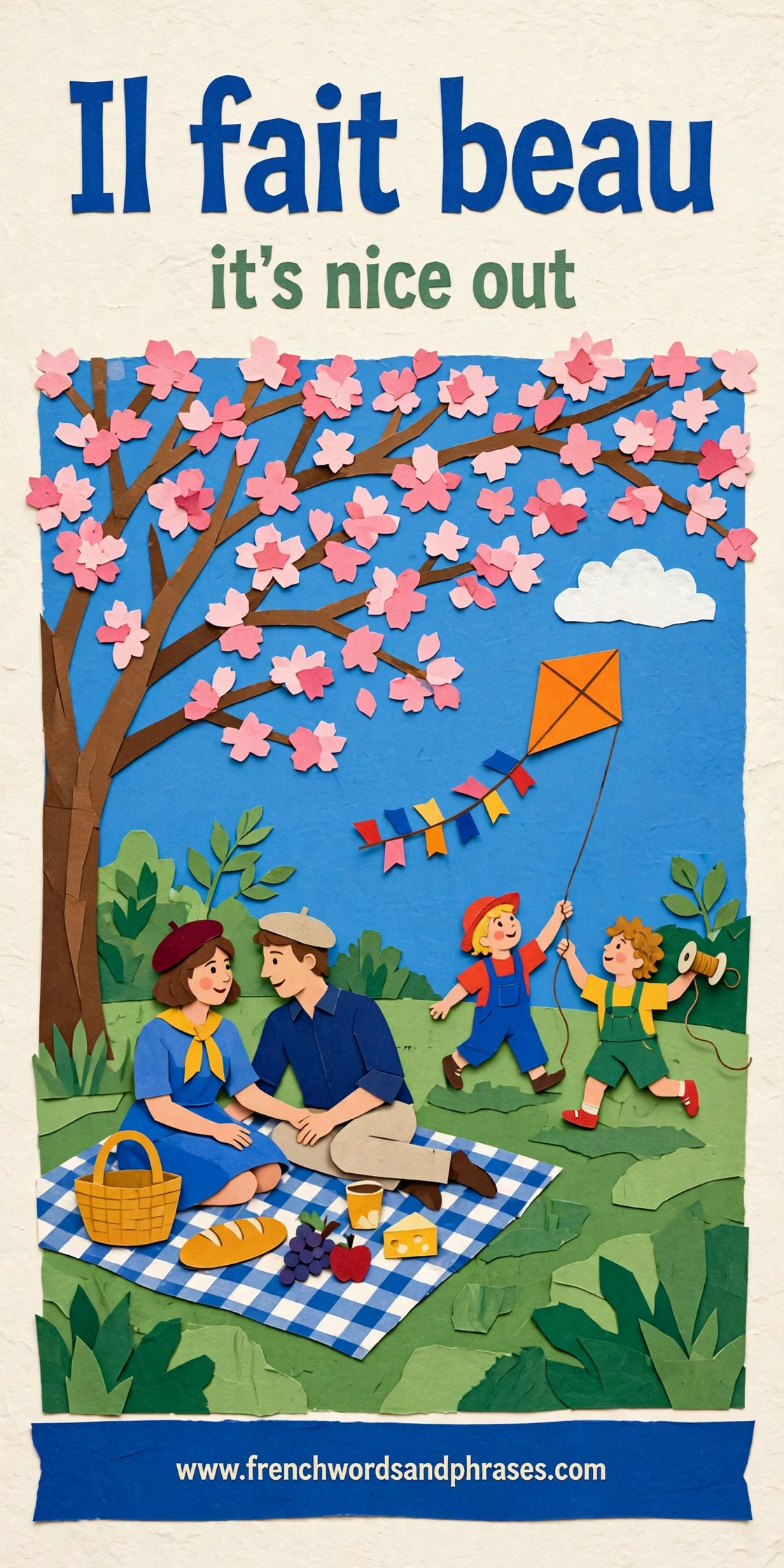
Il fait beau means it’s nice out — the weather is fine and pleasant.
Saturday morning. You draw the curtains on a sky washed clean — blue from one end to the other, a light breeze moving the washing on the line, the café terraces already filling. No thermometer needed, no numbers at all: the whole street is saying the same sentence: « Il fait beau ! »
Let’s explore how il fait beau works in French, beginning with the whole phrase on one card.
Understanding the French Phrase Il fait beau
Il fait beau is a French weather phrase built from il (the impersonal weather ‘it’), fait (makes — from faire, the weather verb) and beau (beautiful, fine). Beau here judges the whole day, not a face or a view: il fait beau means the weather itself is fine — dry, bright and pleasant, whatever the temperature.
It means it’s nice out — good weather, the kind that pulls you outdoors. The picture inside it is a day with its face washed: beau is beauty applied to the sky. Unlike chaud and froid, beau says nothing about temperature — a crisp January morning and a warm June evening can both earn an il fait beau.
Type: Weather phrase — impersonal (il fait + beau)
Answers the need: Saying the weather is fine and pleasant — good-weather verdicts
Register: Neutral — safe everywhere, in speech and writing
Strength: Cheerful and approving — the small-talk champion of French weather
One important usage detail: il fait beau judges the weather as a whole — it is not il fait beau temps in everyday speech, though you will meet il fait un temps magnifique for a glorious day. Its true opposite is il fait mauvais, the weather is bad. And note: beau changes form elsewhere (un beau jour, une belle journée) but inside il fait beau it never moves.
Experience the Word
Il fait beau is the most hopeful sentence in French small talk — the one that rearranges picnics, weddings and market days around itself.
Imagine the weather forecast’s magic words on Friday evening: il fera beau ce week-end. Balconies bloom, bicycles come out of cellars, and the whole country makes the same plan at the same time.
French weather talk is a daily referendum on the sky. Il fait beau is the sky winning the vote.
How to Use Il fait beau in French: Complete Guide
Let’s explore how il fait beau works in French, beginning with the whole phrase on one card.
Il fait beau at a Glance
The Whole Phrase on One Card
Real meaning, inner picture, English twin and register — il fait beau in five lines.
| Point | Il fait beau |
|---|---|
| What it really means | it’s nice out — the weather is fine and pleasant |
| Word for word | it makes beautiful |
| English equivalent | it’s nice out / the weather is fine / it’s a lovely day |
| Register | neutral — safe everywhere |
| Use it for | fine days, picnic verdicts, forecasts and cheerful small talk |
Example
Il fait beau, allons nous promener.
It is nice out, let’s go for a walk.
Word by Word: Building the Fine Day
Three small pieces — take them one by one and the sky clears.
| Word | Literal meaning | Its job in the phrase |
|---|---|---|
| il | it | the weather’s il — the sky’s placeholder, naming nobody |
| fait | makes, does | from faire — the weather is made, and today it is made beautifully |
| beau | beautiful, fine | beauty applied to the whole day — dry, bright, pleasant |
| temps | weather, time | the word behind the question: quel temps fait-il ? |
Example
Il fait beau et le temps est doux : profitons-en.
It is nice out and the weather is mild: let’s make the most of it.
Quick Quiz 1
Does il fait beau tell you the temperature?
Reveal the answer
No — beau judges the whole day: fine and pleasant. It can be cold and beau, or hot and beau.
Il fait froid mais il fait beau : une belle journée d’hiver.
It is cold but it is fine out: a beautiful winter’s day.
When You Say It: The Fine-Day Moments
Il fait beau fires at moments like these — wherever the sky earns its compliment.
| Situation | Example |
|---|---|
| Opening the curtains | il fait beau ce matin — it is nice out this morning |
| Planning the day | il fait beau, on déjeune dehors — it is fine, we’re lunching outside |
| The forecast | il fera beau ce week-end — it will be fine this weekend |
| Asking the question | quel temps fait-il ? il fait beau — what is the weather like? it is fine |
| Making the most of it | il fait beau, profitons-en — it is nice out, let’s enjoy it |
Example
Il fait beau aujourd’hui, le marché sera plein.
It is nice out today, the market will be full.
Make It Yours: The Fine Day at Every Strength
The phrase dresses up for glorious days and down for merely decent ones.
| Form | French | In English |
|---|---|---|
| The classic | il fait beau | it is nice out |
| Stronger | il fait très beau | it is really fine |
| Glorious | il fait un temps magnifique | the weather is glorious |
| With sun | il fait beau et il y a du soleil | it is fine and sunny |
| In the past | il faisait beau | it was fine, the weather was nice |
| Tomorrow | il fera beau | it will be fine |
Example
Il faisait beau hier, et il fera beau demain.
It was fine yesterday, and it will be fine tomorrow.
Quick Quiz 2
What is the opposite of il fait beau: il fait mauvais or il fait doux?
Reveal the answer
Il fait mauvais — the weather is bad. Il fait doux means it is mild, which is pleasant, not opposite.
Hier il faisait mauvais, aujourd’hui il fait beau.
Yesterday the weather was bad, today it is fine.
Everyday Expressions: Building on the Fine Day
Il fait beau slots into these everyday frames — each one ready to use as it stands.
| Frame | In English |
|---|---|
| il fait beau | it is nice out |
| il fait mauvais | the weather is bad |
| il fait un temps magnifique | the weather is glorious |
| le beau temps | the fine weather |
| quel temps fait-il ? | what is the weather like? |
Example
Le beau temps revient enfin après la pluie.
The fine weather is finally back after the rain.
Close Cousins: The Rest of the Sky
French runs its weather from one shelf — il fait beau is the verdict shelf; its cousins add temperature and detail.
| Expression | The difference |
|---|---|
| il fait beau | it is nice out — the whole day is fine |
| il fait chaud | it is hot — temperature only, fine or not |
| il fait froid | it is cold — the winter shelf |
| il fait doux | it is mild — gentle temperatures, softly pleasant |
| il fait mauvais | the weather is bad — the exact opposite verdict |
| il y a du soleil | it is sunny — the sun itself is out |
Example
Il fait beau, il fait doux, il y a du soleil : parfait.
It is fine, it is mild, it is sunny: perfect.
Quick Quiz 3
Which cousin names the sun itself — il y a du soleil or il fait doux?
Reveal the answer
Il y a du soleil — it is sunny, built on il y a, there is. Il fait doux is about mild air.
Il y a du soleil toute la journée.
It is sunny all day long.
Il fait beau and Its Neighbours
The weather shelf around the phrase — the words a fine day brings with it.
| French | In English |
|---|---|
| le beau temps | fine weather |
| le ciel | the sky |
| un nuage | a cloud |
| le soleil | the sun |
| une promenade | a walk |
| un pique-nique | a picnic |
Example
Un ciel sans nuage, et c’est le pique-nique assuré.
A cloudless sky, and the picnic is guaranteed.
Watch Out: The Traps Around Il fait beau
The traps: a beau that changes shape elsewhere, a temperature it never mentions, and a missing ‘temps’.
| Trap | The truth |
|---|---|
| beau never changes here | inside il fait beau the word is fixed — but outside it agrees: un beau ciel, une belle journée |
| no temperature promised | il fait beau can be freezing and bright — add il fait chaud or froid if temperature matters |
| don’t add temps | everyday French says il fait beau, full stop — il fait beau temps belongs to older, literary French |
| mauvais is the opposite | for bad weather the pair is il fait mauvais — not il fait mal |
Example
Une belle journée commence toujours par un il fait beau.
A beautiful day always begins with an ‘it’s nice out’.
Quick Quiz 4
True or false: il fait beau and il fait chaud mean the same thing.
Reveal the answer
False — beau judges the whole day, chaud only the heat. A hot, stormy day is chaud but not beau.
Il fait chaud mais le ciel est noir : il ne fait pas beau.
It is hot but the sky is black: it is not fine out.
Il fait beau in Everyday French: Real-Life Examples
Now that you know the word, let’s see how il fait beau appears in everyday French.
Example 1 — The morning
Il fait beau, ouvrons les fenêtres.
It is nice out, let’s open the windows.
Example 2 — The picnic
Il fait beau : parfait pour un pique-nique.
It is nice out: perfect for a picnic.
Example 3 — The forecast
Il fera beau dimanche, dit la météo.
It will be fine on Sunday, says the forecast.
Example 4 — The past
Il faisait beau le jour de la fête.
The weather was nice on the day of the festival.
Example 5 — The contrast
Hier il faisait mauvais, aujourd’hui il fait beau.
Yesterday the weather was bad, today it is fine.
Example 6 — The invitation
Il fait beau, tu viens te promener ?
It is nice out, are you coming for a walk?
Beyond Translation: The Meaning of Il fait beau
English it’s nice out is a shrug of approval. French goes further and calls the day beautiful — beau, the word for a face, a painting, a cathedral, handed to the sky.
Il fait beau treats good weather as a work of art.
No wonder the phrase rearranges the country’s plans: when the day itself is beautiful, staying indoors feels like leaving an exhibition early.
How to Remember the French Phrase Il fait beau
Remember it this way: Il fait beau is the sky with its face washed — beau judges the whole day, and temperature is none of its business.
- You judge the whole day — beau means fine overall: dry, bright, pleasant, hot or cold.
- You learn its shadow — il fait mauvais is the exact opposite: the weather is bad.
- You keep beau frozen — inside the phrase it never changes; outside it becomes bel or belle.
The key idea is il fait beau means it’s nice out — beau judges the whole day, not the temperature.
Test Your Knowledge of Il fait beau
Let’s see how much you’ve learned. Try answering these questions before revealing the answers.
Question 1
What does il fait beau mean?
Reveal the answer
It is nice out — the weather is fine and pleasant.
Question 2
What is the opposite of il fait beau?
Reveal the answer
Il fait mauvais — the weather is bad.
Question 3
Does il fait beau mean it is hot?
Reveal the answer
No — beau judges the whole day; a cold, bright morning is beau too. Hot is il fait chaud.
Question 4
How do you say ‘the weather is glorious’?
Reveal the answer
Il fait un temps magnifique — the dressed-up form of il fait beau.
Question 5
Complete the sentence:
Il fait ______ : allons au parc. (It is nice out: let’s go to the park.)
Reveal the answer
beau
Il fait beau : allons au parc.
It is nice out: let’s go to the park.
Your Final Challenge
Can You Use It?
How would you say this in French?
“It is nice out today.”
Reveal the answer
Il fait beau aujourd’hui.
It is nice out today.
A little French. A little curiosity. A richer everyday life.
LEARN FRENCH ONE WORD AT A TIME