A French Word to Live By
How to Conjugate Ressembler in French
/ʁə.sɑ̃.ble/
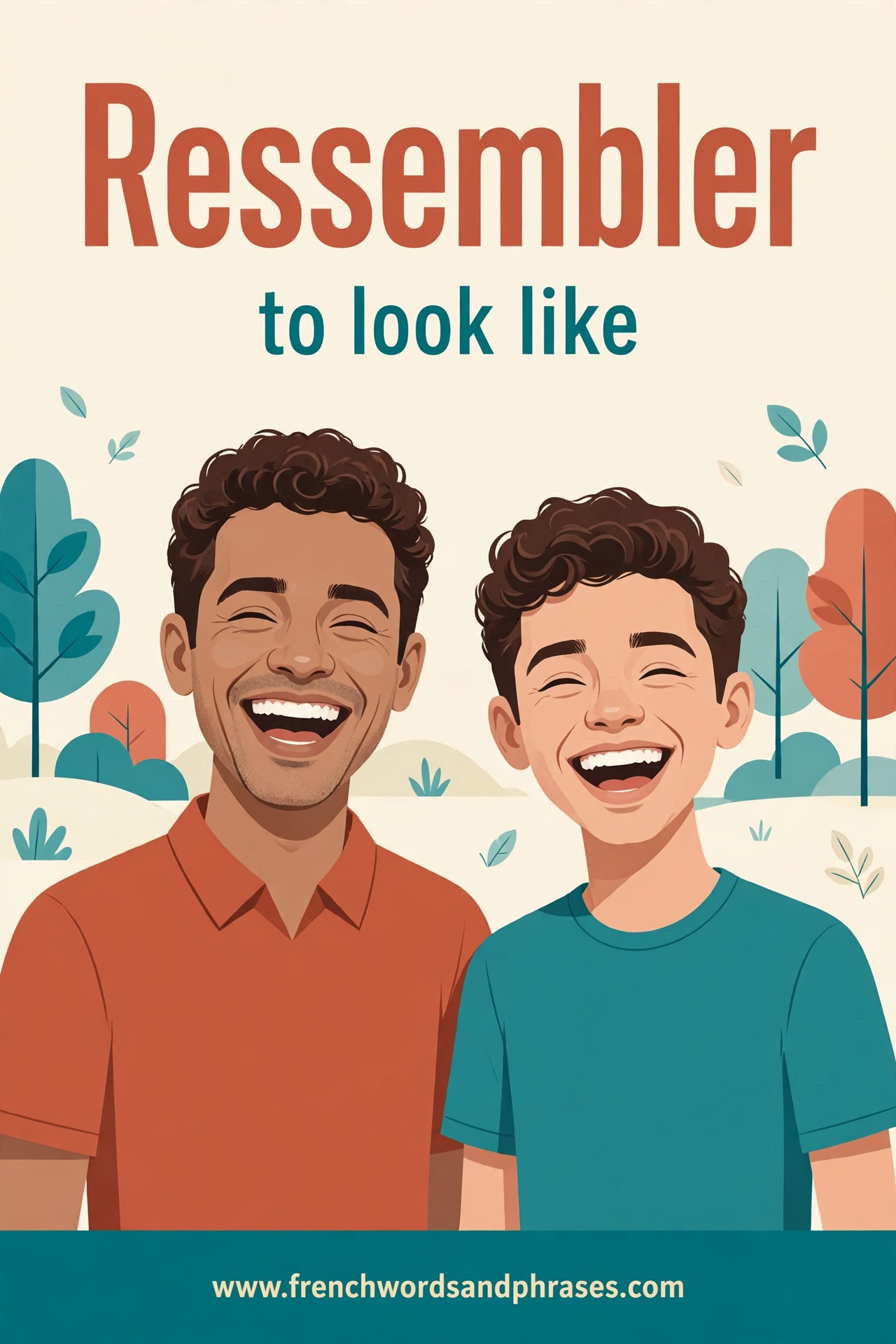
Ressembler means to look like — to share the face, the manner or the character of someone or something else.
A daughter with her mother’s eyes, a son with his father’s laugh, a small town that looks like a postcard — ressembler is the verb of resemblance: the moment one face, one voice or one place calls another to mind.
In this guide, you’ll learn how to conjugate ressembler in all the major French tenses and moods. Explore complete conjugation tables, French examples, English translations, and practice quizzes.
Understanding the French Verb Ressembler
Ressembler is a regular French verb belonging to the first group of verbs, those ending in-er.
It means to look like. It is commonly used for family likeness above all — children resembling parents, siblings resembling each other — but it stretches easily to places, voices and behaviour: a town can ressembler à un décor de cinéma, a voice can ressembler à celle d’un acteur, and an act of kindness can ressembler à quelqu’un, be just like them.
Verb classification: First group (-er)
Auxiliary verb: Avoir
Past participle: ressemblé
Present participle: ressemblant
English equivalents: To look like, to resemble; ressembler à quelqu’un — to look like someone; ressembler à sa mère — to look like one’s mother; ça te ressemble ! — that’s just like you!; se ressembler — to look alike, to resemble each other.
One important detail: ressembler never stands alone — it is always followed by à: elle ressemble à sa mère, ce village ressemble à une carte postale. Forgetting the à is the classic learner’s mistake. The verb itself is perfectly regular: je ressemble, nous ressemblons, past participle ressemblé. Note too the handy everyday exclamation ça te ressemble bien ! — “that’s just like you!” — said with a smile when someone does something completely in character. And when two people look like each other, French switches to the reflexive: les deux sœurs se ressemblent, they look alike.
Experience the Word
Ressembler is the verb of the double take — the second glance that says: I have seen this face before, in another generation.
Imagine a family lunch on a Sunday. The grandmother opens an old photo album: a girl of ten in a garden, squinting at the sun. Across the table, her granddaughter makes exactly the same face at exactly the same age — elle ressemble à sa grand-mère trait pour trait, and the whole table goes quiet, then laughs.
Two faces, sixty years apart. One resembles — ressemble à — the other, line for line.
How to Conjugate Ressembler: Complete French Conjugation Guide
Let’s explore every major conjugation of ressembler, beginning with the indicative mood.
How to Conjugate Ressembler in the Indicative Mood
The indicative mood is used to express facts, observations, actions, and events.
How to Conjugate Ressembler in the Present Tense (Présent)
Used for actions happening now, habitual actions, and general truths.
| Subject | Conjugation |
|---|---|
| je | ressemble |
| tu | ressembles |
| il / elle | ressemble |
| nous | ressemblons |
| vous | ressemblez |
| ils / elles | ressemblent |
Example
Elle ressemble à sa mère comme deux gouttes d’eau.
She looks like her mother like two peas in a pod.
Quick Quiz 1
Complete the sentence:
Nous ______ à nos parents sur les vieilles photos.
Reveal the answer
ressemblons
Nous ressemblons à nos parents sur les vieilles photos.
We look like our parents in the old photos.
How to Conjugate Ressembler in the Passé Composé
Used for completed actions in the past. Ressembler takes the auxiliary verb avoir.
| Subject | Conjugation |
|---|---|
| j’ | ai ressemblé |
| tu | as ressemblé |
| il / elle | a ressemblé |
| nous | avons ressemblé |
| vous | avez ressemblé |
| ils / elles | ont ressemblé |
Example
Sur cette photo, tu as ressemblé à ton grand-père à s’y méprendre.
In this photo, you looked so much like your grandfather it was uncanny.
How to Conjugate Ressembler in the Imparfait (Imperfect Tense)
Used for habitual past actions, descriptions, and ongoing situations in the past.
| Subject | Conjugation |
|---|---|
| je | ressemblais |
| tu | ressemblais |
| il / elle | ressemblait |
| nous | ressemblions |
| vous | ressembliez |
| ils / elles | ressemblaient |
Example
Enfant, il ressemblait à son père, avec les mêmes yeux bleus.
As a child, he looked like his father, with the same blue eyes.
Quick Quiz 2
Choose the correct form:
She looked like her sister.
Elle ______ sa sœur. (a ressemblé à / est ressemblé)
Reveal the answer
a ressemblé à
Elle a ressemblé à sa sœur.
Ressembler takes avoir, and it always keeps its à.
How to Conjugate Ressembler in the Plus-que-parfait
Used to describe an action that had already been completed before another past event.
| Subject | Conjugation |
|---|---|
| j’ | avais ressemblé |
| tu | avais ressemblé |
| il / elle | avait ressemblé |
| nous | avions ressemblé |
| vous | aviez ressemblé |
| ils / elles | avaient ressemblé |
Example
Avant ses cheveux gris, elle avait ressemblé à sa sœur jumelle.
Before her grey hair, she had looked like her twin sister.
How to Conjugate Ressembler in the Passé Simple
Primarily used in formal writing, literature, and historical narratives. It is rarely used in everyday conversation.
| Subject | Conjugation |
|---|---|
| je | ressemblai |
| tu | ressemblas |
| il / elle | ressembla |
| nous | ressemblâmes |
| vous | ressemblâtes |
| ils / elles | ressemblèrent |
Example
Le portrait ressembla au roi si fidèlement que la cour murmura.
The portrait resembled the king so faithfully that the court murmured.
How to Conjugate Ressembler in the Passé Antérieur
A literary tense used to express an action completed immediately before another past action, generally in the passé simple.
| Subject | Conjugation |
|---|---|
| j’ | eus ressemblé |
| tu | eus ressemblé |
| il / elle | eut ressemblé |
| nous | eûmes ressemblé |
| vous | eûtes ressemblé |
| ils / elles | eurent ressemblé |
Example
Dès qu’il eut ressemblé à son frère sur la photo, tout le monde comprit la méprise.
As soon as he had looked like his brother in the photo, everyone understood the mix-up.
How to Conjugate Ressembler in the Future Tense (Futur Simple)
Used to describe actions that will take place in the future.
| Subject | Conjugation |
|---|---|
| je | ressemblerai |
| tu | ressembleras |
| il / elle | ressemblera |
| nous | ressemblerons |
| vous | ressemblerez |
| ils / elles | ressembleront |
Example
Avec cette barbe, tu ressembleras à ton oncle Paul.
With that beard, you will look like your uncle Paul.
How to Conjugate Ressembler in the Futur Antérieur (Future Perfect)
Used for an action that will have been completed before a particular point in the future.
| Subject | Conjugation |
|---|---|
| j’ | aurai ressemblé |
| tu | auras ressemblé |
| il / elle | aura ressemblé |
| nous | aurons ressemblé |
| vous | aurez ressemblé |
| ils / elles | auront ressemblé |
Example
À vingt ans, elle aura ressemblé à trois générations de femmes de sa famille.
By twenty, she will have resembled three generations of women in her family.
How to Conjugate Ressembler in the Near Future (Futur Proche)
Used to describe something that is going to happen soon. Formed with aller + infinitive.
| Subject | Conjugation |
|---|---|
| je | vais ressembler |
| tu | vas ressembler |
| il / elle | va ressembler |
| nous | allons ressembler |
| vous | allez ressembler |
| ils / elles | vont ressembler |
Example
Attention, avec cette coiffure, tu vas ressembler à ton frère !
Careful, with that hairstyle, you are going to look like your brother!
How to Conjugate Ressembler in the Conditional Mood
The conditional mood expresses what would happen under certain circumstances. It is also frequently used to make polite requests or express wishes.
How to Conjugate Ressembler in the Present Conditional
| Subject | Conjugation |
|---|---|
| je | ressemblerais |
| tu | ressemblerais |
| il / elle | ressemblerait |
| nous | ressemblerions |
| vous | ressembleriez |
| ils / elles | ressembleraient |
Example
Sans ses lunettes, il ressemblerait encore plus à son père.
Without his glasses, he would look even more like his father.
How to Conjugate Ressembler in the Past Conditional
| Subject | Conjugation |
|---|---|
| j’ | aurais ressemblé |
| tu | aurais ressemblé |
| il / elle | aurait ressemblé |
| nous | aurions ressemblé |
| vous | auriez ressemblé |
| ils / elles | auraient ressemblé |
Example
Elle aurait ressemblé à une star avec cette robe.
She would have looked like a star in that dress.
Ressembler in the Literary Past Conditional Form
This less common literary form uses the imperfect subjunctive of avoir.
| Subject | Conjugation |
|---|---|
| j’ | eusse ressemblé |
| tu | eusses ressemblé |
| il / elle | eût ressemblé |
| nous | eussions ressemblé |
| vous | eussiez ressemblé |
| ils / elles | eussent ressemblé |
Example
Il eût ressemblé à son aïeul, n’eût été son sourire.
He would have resembled his ancestor, had it not been for his smile.
How to Conjugate Ressembler in the Subjunctive Mood
The subjunctive is used to express wishes, emotions, doubts, necessity, and uncertainty. It frequently follows expressions such as il faut que (it is necessary that) or bien que (although).
How to Conjugate Ressembler in the Present Subjunctive
| Subject | Conjugation |
|---|---|
| que je | ressemble |
| que tu | ressembles |
| qu’il / qu’elle | ressemble |
| que nous | ressemblions |
| que vous | ressembliez |
| qu’ils / qu’elles | ressemblent |
Example
Il est étonnant que le fils ressemble autant à son père.
It is astonishing that the son looks so much like his father.
Quick Quiz 3
Complete the sentence using the subjunctive:
Il est étonnant que vous ______ à votre père.
Reveal the answer
ressembliez
Il est étonnant que vous ressembliez à votre père.
It is astonishing that you look like your father.
How to Conjugate Ressembler in the Imperfect Subjunctive
A literary tense, rarely encountered in modern spoken French.
| Subject | Conjugation |
|---|---|
| que je | ressemblasse |
| que tu | ressemblasses |
| qu’il / qu’elle | ressemblât |
| que nous | ressemblassions |
| que vous | ressemblassiez |
| qu’ils / qu’elles | ressemblassent |
Example
On doutait que le tableau ressemblât vraiment au modèle.
People doubted that the painting really resembled the model.
How to Conjugate Ressembler in the Pluperfect Subjunctive
A literary construction used to express an action completed before another past action.
| Subject | Conjugation |
|---|---|
| que j’ | eusse ressemblé |
| que tu | eusses ressemblé |
| qu’il / qu’elle | eût ressemblé |
| que nous | eussions ressemblé |
| que vous | eussiez ressemblé |
| qu’ils / qu’elles | eussent ressemblé |
Example
Elle s’étonnait qu’il eût ressemblé à ce point à son frère dans sa jeunesse.
She was amazed that he had resembled his brother so much in his youth.
How to Conjugate Ressembler in the Past Subjunctive
| Subject | Conjugation |
|---|---|
| que j’ | aie ressemblé |
| que tu | aies ressemblé |
| qu’il / qu’elle | ait ressemblé |
| que nous | ayons ressemblé |
| que vous | ayez ressemblé |
| qu’ils / qu’elles | aient ressemblé |
Example
Je suis ravi que le bébé ait ressemblé à sa mère dès la naissance.
I am delighted that the baby looked like her mother from birth.
How to Conjugate Ressembler in the Imperative
The imperative is used to give commands, instructions, invitations, or suggestions. Subject pronouns are omitted.
How to Conjugate Ressembler in the Present Imperative
| Person | Conjugation |
|---|---|
| (tu) | ressemble |
| (nous) | ressemblons |
| (vous) | ressemblez |
Example
Ressemble à ton grand-père sur la photo, tiens-toi droit !
Look like your grandfather in the photo, stand up straight!
Quick Quiz 4
How would you say Look like your sister for the photo (tu form)?
Reveal the answer
Ressemble à ta sœur pour la photo !
French Participles of Ressembler
Participles are verb forms that can be used in compound tenses and other grammatical constructions.
Present Participle of Ressembler
ressemblant
En ressemblant à sa mère, elle a hérité de son élégance naturelle.
By resembling her mother, she inherited her natural elegance.
Past Participle of Ressembler
ressemblé
Ressemblé par aucun de ses enfants, le vieil homme gardait un visage unique.
Resembled by none of his children, the old man kept a face all his own.
Ressembler in Everyday French: Real-Life Examples
Now that you know the conjugations, let’s see how ressembler appears in everyday French.
Example 1 — Present
Elle ressemble à sa mère.
She looks like her mother.
Example 2 — Passé composé
Tu as ressemblé à ton père sur cette photo.
You looked like your father in this photo.
Example 3 — Imparfait
Enfant, il ressemblait à son grand-père.
As a child, he looked like his grandfather.
Example 4 — Future
Avec une barbe, tu ressembleras à ton oncle.
With a beard, you will look like your uncle.
Example 5 — Conditional
Sans lunettes, elle ressemblerait à sa sœur.
Without glasses, she would look like her sister.
Example 6 — Imperative
Ressemble à ta sœur pour la photo, souris !
Look like your sister for the photo, smile!
Beyond Translation: The Meaning of Ressembler
English resemble is the same word wearing an English coat — both come from the Latin similis, like.
In French, resemblance is always a meeting.
One never simply “resembles” in French; one resembles à someone — the likeness reaches out towards the other person, the way a child’s face reaches back across the years towards a grandparent’s. Its family is warm and familiar: la ressemblance is the likeness itself, and semblable means similar.
How to Remember the French Verb Ressembler
Remember it this way: Ressembler is about the granddaughter making her grandmother’s face across sixty years.
- Never alone: ressembler always takes à — elle ressemble à sa mère, never without it.
- Two people who look like each other switch to the reflexive: les sœurs se ressemblent.
- Regular -er: je ressemble, nous ressemblons, past participle ressemblé, auxiliary avoir.
The key idea is the granddaughter making her grandmother’s face across sixty years.
Test Your Knowledge of Ressembler
Let’s see how much you’ve learned. Try answering these questions before revealing the answers.
Question 1
Which little word must always follow ressembler, and which auxiliary does it take?
Reveal the answer
À, and avoir — elle ressemble à sa mère; elle a ressemblé à sa mère.
Question 2
How do you say She looks like her mother in French?
Reveal the answer
Elle ressemble à sa mère.
Question 3
Translate: The two sisters look alike.
Reveal the answer
Les deux sœurs se ressemblent.
Question 4
What is the past participle of ressembler?
Reveal the answer
Ressemblé.
Question 5
Complete the sentence:
Il est étonnant que le fils ______ autant à son père.
Reveal the answer
ressemble
Il est étonnant que le fils ressemble autant à son père.
It is astonishing that the son looks so much like his father.
Your Final Challenge
Can You Use It?
How would you say this in French?
She resembles her grandmother line for line, and the past smiles at the table.
Reveal the answer
Elle ressemble à sa grand-mère trait pour trait, et le passé sourit à table.
She resembles her grandmother line for line, and the past smiles at the table.
A little French. A little curiosity. A richer everyday life.
LEARN FRENCH ONE WORD AT A TIME